August 14, 2026
Common Signs of Oral Cancer You Should Never Ignore – Causes, Symptoms, Care & Treatment
Abstract
Oral cancer is the second most common cancer affecting the head and neck region. It can develop in any part of the oral cavity, including the tongue, lips, cheeks, floor of the mouth, and palate. It may also spread to the pharynx, throat, and tonsils. Oral cancer presents with a variety of signs and symptoms and can cause significant discomfort while talking, eating, or swallowing. The disease progresses through different stages, and many people remain undiagnosed until it reaches an advanced stage. A healthcare provider confirms the diagnosis through an oral examination and diagnostic tests such as a biopsy. Treatment options include surgery, radiotherapy, or chemotherapy, depending on the stage and type of cancer, as well as the patient’s overall health.
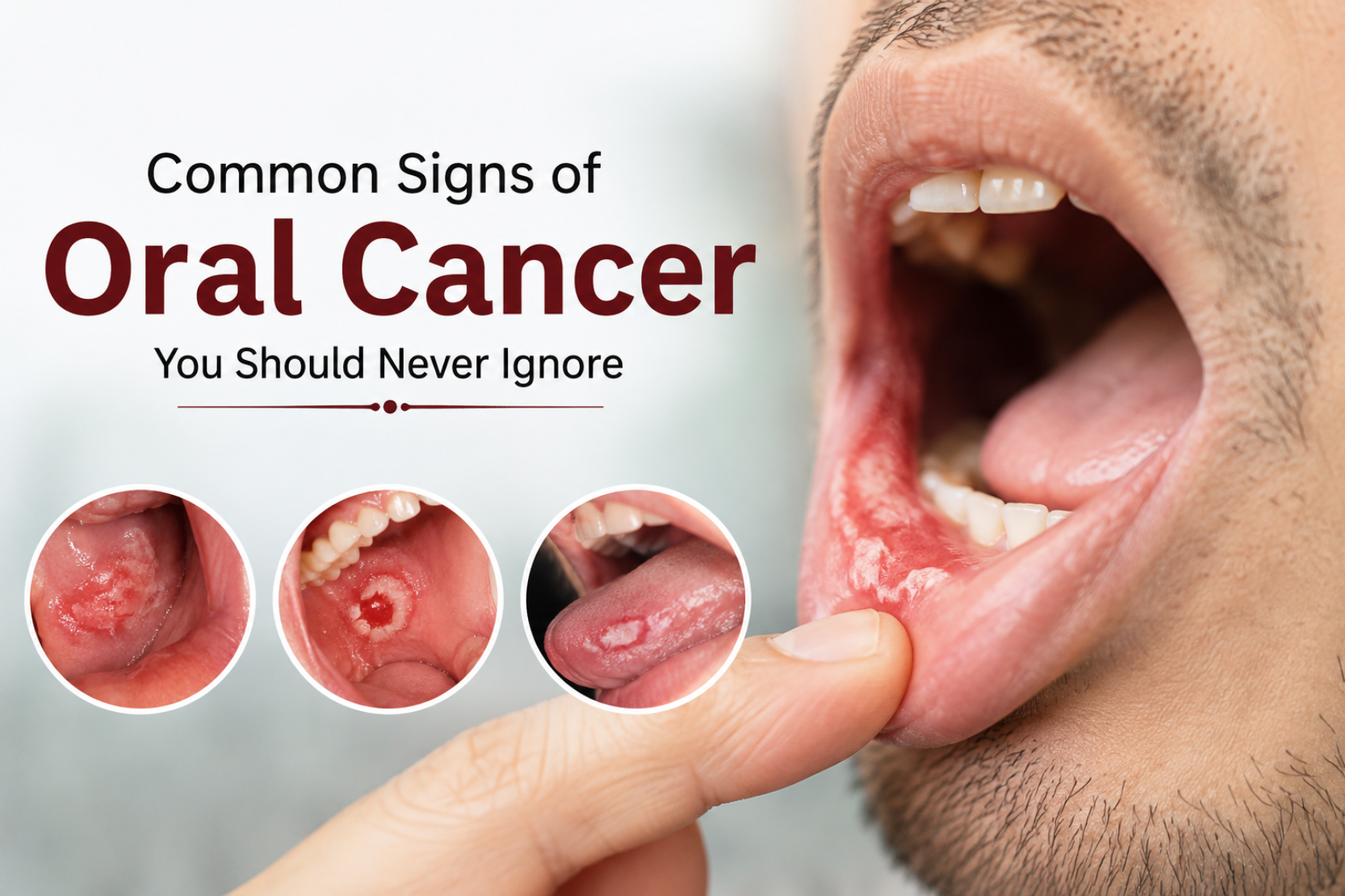
Statistics for Oral Cancer
- In India, there are around 70000-77000 new cases of oral cancers each year.
- The death rate with oral cancer is most common in India with 52000 cancer patients dying annually.
- The average age of oral cancer prevalence is 64 years and 20% of the cases are under 55 years of age.
- Oral cancer accounts for about 5% of all cancers worldwide.
- Every hour, about five people die from oral cancer, reflecting its high mortality rate.
Introduction
Oral cancer is a broad term used to describe cancers that affect different parts of the oral cavity. Early signs may resemble common conditions such as white patches, mouth ulcers, or bleeding gums, making them easy to overlook. Oral cancer has the potential to spread to nearby structures in the head and neck region. It is more common in men than in women. The disease may also affect the oropharynx, including the palate, the posterior part of the tongue, and the middle part of the throat.
Different anatomical sites of Oral Cancer
- Gums
- Lips
- Floor of mouth
- Anterior part of tongue
- Cheeks
- Area behind the third molar tooth.
Types of Oral Cancer
There are several types of oral cancer based upon their location in the mouth. These are:
- Squamous cell carcinoma – It affects some parts of the tongue, buccal mucosa, gingiva and lower lip.
- Lymphoma – It affects the posterior area of the oral cavity, tonsillar region and base of the tongue.
- Verrucous carcinoma – It affects the inner lining of cheeks, gingiva or the tongue.
- Mucoepidermoid carcinoma – It is a tumor of the parotid salivary gland.
- Adenoid cystic carcinoma – It is a salivary gland tumor
- Melanoma – It affects the hard palate and upper gingiva.
- Sarcoma – It affects the jaw bone and the buccal soft tissues.
Pathophysiology and risk factors of Oral Cancer
Grow and multiply uncontrollably. Most oral cancers arise from squamous cells, which are thin, flat cells that line the lips and the inside of the oral cavity. Changes or mutations in the DNA of these cells disrupt the normal regulation of cell growth and programmed cell death. As a result, abnormal cells continue to multiply while healthy cells die. Over time, these abnormal cells accumulate to form a mass known as a tumor. The tumor can invade nearby healthy tissues, and some cancer cells may eventually spread to distant parts of the body through a process known as metastasis.
Since there is no single cause of oral cancer, several risk factors contribute to its development. These include:
- Alcohol: Excessive and frequent alcohol consumption increases the risk of oral cancer.
- Smoking and tobacco use: Tobacco products such as cigarettes, cigars, pipes, chewing tobacco, betel nut, and snuff significantly increase the risk.
- Ultraviolet (UV) radiation: Prolonged exposure to sunlight or tanning lamps increases the risk of lip cancer.
- Human papillomavirus (HPV): HPV is transmitted through sexual contact. Although it often causes no symptoms, certain strains can alter cellular DNA and contribute to oral cancer.
- Weak immunity and chronic stress: A weakened immune system due to medications, organ transplantation, HIV infection, or chronic stress may increase susceptibility to oral cancer.
- Age: People aged 65–69 years are at a higher risk of developing oral cancer.
- Family history: Individuals with a family history of cancer may have an increased risk because of shared genetic, environmental, and lifestyle factors.
Seven Common Signs of Oral Cancer that Should Not be Ignored
Recognizing the early signs of oral cancer can improve the chances of successful treatment. Early-stage oral cancer is often highly treatable. Therefore, it is important to seek medical evaluation if any of the following symptoms persist:
- Persistent mouth sores: Mouth sores caused by accidental cheek biting, tongue biting, braces, or minor infections usually heal within one to two weeks. However, sores that persist for more than 14 days should be evaluated, as they may indicate a precancerous or cancerous condition. Initially, these sores may be painless but can later become painful or bleed.
- Lumps in the mouth and neck: Any unexplained lump or thickened tissue in the mouth or neck that persists without an obvious cause should not be ignored. These lumps may be noticed while brushing, speaking, or chewing.
- Red or white patches: White patches (leukoplakia) and red patches (erythroplakia) result from abnormal cell growth and are considered precancerous lesions. Red patches are particularly concerning because they have a higher likelihood of becoming cancerous. Mixed red-and-white patches may also occur.
- Difficulty in jaw movements and swallowing: Progressive difficulty in opening the mouth or swallowing may indicate oral cancer. Pain while swallowing food or liquids and unintentional weight loss due to reduced food intake are common associated symptoms. Jaw stiffness may also contribute to temporomandibular joint (TMJ) disorders.
- Persistent pain in ear: Long-lasting ear pain without an obvious ear infection may be referred to as pain from a tumor in the oral cavity or throat and should be medically evaluated.
- Changes in voice or hoarseness: Persistent hoarseness, a strained or raspy voice, or difficulty speaking should not be ignored, particularly if accompanied by mouth sores, difficulty swallowing, or unexplained weight loss.
- Bleeding in the mouth: Unexplained bleeding from the mouth, especially while brushing the teeth or blood in the saliva without an obvious cause, requires prompt medical evaluation.
Diagnosis and staging of Oral Cancer
Anyone experiencing symptoms suggestive of oral cancer should consult a healthcare provider for evaluation. Early diagnosis can prevent disease progression and improve treatment outcomes. Several diagnostic tests are used to confirm the diagnosis:
- Incisional biopsy: The doctor removes a small sample of tissue for examination. If the suspicious area appears concerning, they may also remove the entire lesion along with a small margin of surrounding healthy tissue.
- Oral brush biopsy: Cells are collected by gently brushing the affected area with a specialized brush.
- Fine-needle aspiration (FNA): A thin, hollow needle attached to a special syringe is used to collect a sample of cells from a lump in the neck or an enlarged lymph node for laboratory examination.
- Endoscopy: The doctor examines the throat using a flexible tube fitted with a tiny camera. If any abnormal or suspicious areas are identified, tissue samples may be collected for further analysis.
- HPV testing: In cancers involving the throat or the back of the tongue, tumor cells may be tested for HPV, as the presence of the virus influences cancer staging.
- Imaging tests (CT, MRI, and PET/CT): CT and MRI scans help determine the size and location of the tumor and assess whether the cancer has spread to nearby lymph nodes or other parts of the body.
Staging of Oral Cancer
Oral cancers are classified on the basis of size of tumor, lymph node involvement and its spread. TNM staging is done for this purpose. T denotes tumor size, N denotes nodal involvement and M denotes metastasis.
T = Primary tumor
- Tx – Tumor cannot be detected
- Tis – Carcinoma in-situ
- T1 – Size of tumor is less than or equal to 2cm
- T2 – Size of tumor is more than 2cm
- T3 – Size of tumor is greater than 2cm or equal to 4cm
- T4 -Size of tumor is greater than 4cm
N = Regional lymph node
- NX– Nodes cannot be detected
- N0– No spread to lymph nodes.
- N1– Spread to one lymph node on the same side, with size 3 cm or less
- N2– Spread to one large or several lymph nodes on the same or opposite side
- N3– Spread to a node larger than 6 cm, or there is multi-node involvement
M = Distant metastasis
- M0 – No spread
- M1 – Spread to other parts of body
There are different stages of oral cancer which are as follows:
- Stage 0 – Carcinoma in-situ : Tis, N0, M0
- Stage 1 – T1, N0, M0
- Stage 2 – T2, N0, M0
- Stage 3 – T3, N0, M0 or T1/T2/T3, N1, M0
- Stage 4a – T4a, (N0, N1), M0 or (T1, T2, T3, T4a), N2, M0
- Stage 4b – (Any T), N3, M0 or T4b, (Any N), M0
- Stage 4c – (Any T), (Any N), M1
Conclusion
Oral cancer is a serious but largely preventable disease that requires early recognition and timely treatment. The main causes include tobacco, alcohol, HPV infection, and long-term sun exposure. Diagnosis is confirmed through clinical examination, biopsy, and imaging, while staging helps determine the extent of the disease and guides treatment planning. Early diagnosis greatly improves prognosis and survival. Raising awareness, reducing risk factors, and encouraging regular oral examinations are essential for improving survival and quality of life.

Dr. Vikram Chauhan
https://www.planetayurveda.comDr. Vikram Chauhan (MD - Ayurveda) is a Globally Renowned Ayurveda Physician with Expertise of more than 25 Years. He is the CEO & Founder of http://www.PlanetAyurveda.com, a leading Ayurveda Brand, Manufacturing, and Export Company with a Chain of Clinics and Branches in the US, Europe, Africa, Southeast Asia, India, and other parts of the World. He is also an Ayurveda Author who has written Books on Ayurveda, translated into Many European Languages. One of his Books is "Ayurveda – God’s Manual for Healing". He is on a Mission to Spread Ayurveda All Over the Planet through all the Possible Mediums. With his Vast Experience in Herbs and their Applied Uses, he is successfully treating Numerous Patients suffering from Various Ailments with the help of the Purest Herbal Supplements, Diet, and Lifestyle, according to the Principles of Ayurveda. For More Details, visit - www.planetayurveda.com, www.alwaysayurveda.com
View more posts from this author