Category: Low Immunity

Raktapittakulkuthar Ras – Ayurvedic Remedy for Bleeding Disorders
bleeding disorders

ABSTRACT

Processed spicy-salty foods, pollution-induced heat, winter dryness, chronic stress, and vitamin K-deficient diets fuel the surge in Raktapitta cases nowadays, triggering sudden, profuse bleeding from body openings such as the nose (epistaxis), mouth (hematemesis), urine (hematuria), and rectum without any injury. People consume too many pungent, sour, and hot items, push their bodies with overwork and heat exposure, and endure constant emotional pressure, all of which stir up Pitta dosha fiercely. This aggravated Pitta then poisons the Rakta dhatu (blood tissue) right at its source in the spleen and liver (Pliha-Yakrit), sparking a rapid, burning hemorrhage that ancient sages labeled a Mahagada—a major killer. Ayurveda offers many medications along with lifestyle modifications for these disorders. Raktpittakulkuthar ras is one of the best Ayurvedic herbomineral formulations for bleeding disorders. Let’s know about this formulation in detail.
bleeding disorders

INTRODUCTION

Raktapittakulkuthar Ras stands as a potent herbo-mineral formulation renowned for halting Raktapitta bleeding and its complications like epistaxis along with hemorrhagic crises. The name “Kulkuthar” (root-destroyer) reflects its fierce assault on Pitta-Rakta roots, combining the ingredients in Vasa (Adhatoda vasica), triturated for profound Pitta pacification and Rakta stabilization. Moreover, there are two phrases given in the text for this formulation which signifies its importance in Raktapitta (bleeding disorders).

रक्तपित्तकुलकण्डनाभिधो जायते रसवरोअस्त्रपित्तिनाम् ।
(योगरत्नाकरः/ रक्तपित्तरोगाधिकारः/ १०/१२२)

This preparation is known as Rakatpittakulkandan ras, which is the supreme medicine for rakatpitta

नास्त्यनेन सममत्र भूतले भेषजं किंमपि रक्तपित्तनाम्।।१२३।।
(योगरत्नाकरः/ रक्तपित्तरोगाधिकारः/ १०/ १२३ )

This shloka glorifies Raktapittakulkuthar Ras as earth’s unparalleled supreme remedy for conquering Raktapitta.

CLASSICAL INDICATION

Rakatpitta (bleeding disorders)

INGREDIENTS

शुद्धपारदबलिप्रवालकं हेममाक्षिकभुजङ्गरङ्गकम्।
मारितं सकलमेतदुत्तमम् भावयेदथ पृथक्पृथक्द्रवैस्त्रिशः ।।१२०।।
चन्दनस्य कमलस्य मालतीकोरकस्य वृषपल्लवस्य च।
धान्यवारणकणाशतावरीशाल्मलीवटजटामृतस्य च।।१२१।।
  1. Purified Mercury (Shuddha Parad)
  2. Purified Sulphur (Shuddha Gandhak)
  3. Coral Calx (Praval Bhasma)
  4. Chalcopyrite calx (Swarna Makshik Bhasma)
  5. Naga Bhasma (Lead Calx)
  6. Vanga Bhasma (Tin Calx)

Bhavna (levigating medium)- These ingredients are triturated (Bhavana) with the juices or decoctions of

  1. Sandalwood (Chandana)
  2. Lotus (Kamala)
  3. Flower buds of Malati (Jasmine)
  4. Tender leaves of Vrisha (Adhatoda vasica)
  5. Dhanyaka (Coriander)
  6. Varana (Crataeva nurvala)
  7. Kusha Grass (Desmostachya bipinnata)
  8. Shatavari (Asparagus racemosus)
  9. Shalmali (Silk cotton tree)
  10. Vata Jata (aerial roots of Banyan tree)
  11. Guduchi (Tinospora cordifolia).

INGREDIENT DESCRIPTION

  1. Purified Mercury (Shuddha Parad) – Mercury, after proper purification, helps control excessive bleeding and has a deep tissue penetration effect, supporting hemostasis in mucosal and internal bleeding. Its special effect helps stabilize vascular integrity.
  2. Purified Sulphur (Shuddha Gandhak) possesses Shodhana (detoxifying) and Raktashodhaka (blood purifying) properties. Sulphur’s mild astringent and antimicrobial actions help control bleeding and prevent infection in sites of blood loss.
  3. Coral Calx (Praval Bhasma) is  rich in calcium carbonate, which helps in strengthening vascular walls, helping to reduce capillary fragility and control bleeding tendencies. Its cooling potency also pacifies Pitta, the chief dosha responsible for bleeding.
  4. Chalcopyrite Calx (Swarna Makshik Bhasma) contains copper and iron compounds, which promote blood nourishment and aid in vascular stabilization, indirectly helping to manage bleeding.
  5. Naga Bhasma (Lead Calx) particularly pacifies Pitta, helping to control mucosal and gastrointestinal bleeding. Its trace mineral content also supports vascular integrity.
  6. Vanga Bhasma (Tin Calx) exhibits mild hemostatic action, enhancing tissue resilience and reducing excessive hemorrhage. Its special effect also supports blood quality.
  7. Chandana (Sandalwood) is cool in potency and it rapidly cools aggravated Pitta and stabilizes overheated Rakta Dhatu (blood tissue). Also, Santalol (active constituent) exhibits haemostatic, helping arrest bleeding.
  8. Kamala (Lotus) has flavonoids & tannins that strengthen capillary walls and prevent spontaneous bleeding.
  9. Malati (Jasmine Bud) has Essential oils (benzyl acetate) which is a mild vasoconstrictive and anti-inflammatory action supporting haemostasis.
  10. Vrisha (Adhatoda vasica) also known as Vasa is mentioned as the agray dravya (supreme herb) for Raktpitta (bleeding disorders). Its bitter and astringent taste reduces internal bleeding. Moreover the Vasicine alkaloid present in this is known for haemostatic and capillary-protective effects.
  11. Dhanyaka (Coriandrum sativum) with its cool potency and Linalool which reduces vascular irritation and supports blood stability.
  12. Varana (Crataeva nurvala) checks bleeding by constricting blood channels. Its Triterpenoids aid in healing damaged Rakta-srotas (blood vessels).
  13. Kusha Grass (Desmostachya bipinnata) has Siliceous compounds that support vascular integrity and reduce seepage of blood. It is very useful in spontaneous bleeding due to the haemostatic effect.
  14. Shatavari (Asparagus racemosus) is very much beneficial in nourishing, promoting tissue repair and preventing recurrent bleeding, due to the presence of the Steroidal saponins (Shatavarins).
  15. Shalmali (Bombax ceiba) has wound-healing action.Its Tannins & mucilage seal bleeding surfaces and promote clot formation.
  16. Vata Jata (Banyan aerial roots) has a potent astringent taste that can reduce excessive blood discharge. Its Polyphenols aid in strengthening blood vessels and control capillary bleeding.
  17. Amrita (Tinospora cordifolia) has Tinosporin & diterpenoids that enhance haemostasis and immunity, preventing recurrence.

METHOD OF PREPARATION

  • Take a clean stone slab and grind purified mercury and sulphur together to form a fine homogenous paste (Kajjali)
  • Mix this Kajjali with the remaining ingredients in powdered form.
  • Grind thoroughly with the paste to obtain a homogeneous mixture.
  • Take 10 dravyas (substances) and triturate 30 times (3 times with each levigating medium).
  • Prepare 2–2 Ratti (250 mg) of tablets and dry them in shade.

MEDICINAL PROPERTIES

  • Raktapittakulkuthar Ras pairs best with honey (Madhu) and Vasa patra swarasa (Adhatoda vasica leaf juice) as anupana for optimal Pitta-Rakta shamaka effects, arresting hemorrhage, strengthening Raktavaha srotas (blood channels), and restoring hemostatic balance through stambhana (astringent) and rakta shodhana (blood purifying) actions.
  • For Urdhvajanya Raktapitta (Epistaxis/Nosebleeds), administer Raktapittakulkuthar Ras (62.5-125 mg twice daily) with Pravala pishti (500 mg), curbing nasal bleeding and Pitta aggravation via enhanced coagulation promotion and cooling nasal mucosa synergy.
  • In cases of Adhoga Raktapitta (Hematuria/GI Bleeds), Raktapittakulkuthar Ras combines with Kamadudha Ras (125 mg), a potent Pitta pacifier for Raktasraava (blood loss) and Daha (burning), boosting dhatu sanghata (tissue cohesion) and plihan-yakrit saharana (spleen-liver support).
  • In hemorrhagic complications with Mandagni (Weak Digestion) & Dourbalya (Debility), Raktapittakulkuthar Ras works best with Aarogya vardhini Vati (250 mg), aiding agni deepana (digestive fire ignition) and bala vardhana (strength promotion) by balancing tridosha and countering raktapitta prakopa (disease flare-ups).

IMPACT ON DOSHA

Raktapittakulkuthar Ras primarily pacifies Pitta at Pliha-Yakrit (spleen-liver), neutralizing hot-sharp qualities driving Rakta vitiation. Balances Vata against foamy bleeds and Kapha against slimy outflows.

INDICATIONS

Raktapittakulkuthar Ras treats hemorrhagic disorders effectively.

  1. Urdhvaj Raktapitta: Epistaxis, hematemesis, hemoptysis from upper channels.
  2. Adhoga Raktapitta: Hematuria, rectal bleeding, menorrhagia from lower tracts.
  3. Associated Conditions: Burning sensation (daha), weakness (dourbalya), spleen-liver dysfunction.

Dosage

1-2 tablets (250 mg to 500 mg) once or twice daily.

Anupana (Adjuvant)

प्राणदो मधुवृषद्रवैरयम् सेवितस्तु वसुकृष्णाम्लेर्मितः।।१२२।।
(योगरत्नाकरः/ रक्तपित्तरोगाधिकारः/ १०/ १२२)

CONTRAINDICATION

  1. Avoid with Anticoagulant such as warfarin/aspirin
  2. Pregnancy and lactation

CONCLUSION

Raktapittakulkuthar Ras stands as a time-tested herbo-mineral powerhouse against Raktapitta’s hemorrhagic crisis, masterfully pacifying vitiated Pitta-Rakta through purified rasa dravyas and Vasa (Adhatoda vasica) synergy. As modern diets and stress fuel Mahagada’s rise, this supreme remedy—lauded in shlokas as earth’s unmatched healer—delivers rapid hemostasis and vitality when guided by expert vaidyas with proper anupana (adjuvant). Pair with Pitta-pacifying lifestyle shifts for lasting blood harmony.
Atibala in Ayurveda: Benefits, Uses, Dosage & Healing Properties

Abstract

Atibala, scientifically known as Abutilon indicum, is a treasured herb in Ayurveda celebrated for its broad spectrum of healing qualities. This shrub, belonging to the Malvaceae family, is traditionally used for its ability to strengthen the body, boost immunity, and act as a natural aphrodisiac. Atibala’s distinctive combination of anti-inflammatory, pain-relieving, liver-protective, and wound-healing properties makes it an essential herb for healing. Its capacity to balance bodily energies, support detoxification, and vitality in the body are amazing. Let’s discuss it briefly.
Atibala

Description

Atibala (Abutilon indicum) is a highly esteemed Ayurvedic herb known for its potent strengthening, rejuvenating, and versatile healing qualities. It holds an important place in classical Ayurveda for enhancing muscle strengthening, boosting immunity, and providing relief for joint problems. This makes Atibala a vital natural herb for managing both chronic and acute health conditions effectively. It is also a part of Balatrayam and Balapanchak in ayurveda.

Scientific classification

  • Kingdom: Plantae
  • Subkingdom: Tracheobionta (vascular plants)
  • Superdivision: Spermatophyta (seed plants)
  • Division: Magnoliophyta (flowering plants)
  • Class: Magnoliopsida (dicotyledons)
  • Subclass: Dilleniidae
  • Order: Malvales
  • Family: Malvaceae (mallow family)
  • Genus: Abutilon
  • Species: Abutilon indicum (L.) Sweet
  • Botanical name : Abutilon indicum

Synonyms

  • Rishyaprokta
  • Balika
  • Rishagadha
  • Bhuribala

Other vernacular names

  • In Sanskrit : Rishyaprokta, Kankatika, Balika, Rishagadha, Bhuribala, and Vatyapushpy.
  • In Hindi : Kanghi and Kakahi.
  • In English :Country Mallow or Indian Mallow.
  • In Bengali : Petari and Jhapi.
  • In Gujarati : Khapat and Kansaki.
  • In Kannada : Shrimudrigida and Mudragida.
  • In Tamil : Tutti and Thuthi.
  • In Telugu : Tutturu Benda.
  • In Malayalam :Vellula.
  • In Punjabi : Kangi and Kangibooti.

Habitat

Atibala (Abutilon indicum), is commonly found across tropical and subtropical regions, especially in India and Sri Lanka. This plant usually grows wild along roadsides, in waste areas, scrublands, and farms where the soil is often dry and disturbed. It can thrive from sea level up to heights of about 1,200 to 1,400 meters, including in the foothills of the Himalayas and warmer parts of India. Known for its resilience, Atibala tolerates different soil types such as dry, rocky, and even salty soils. Its widespread presence in diverse habitats has made it readily available and a valued herb in traditional Ayurvedic and folk medicine.

Morphology

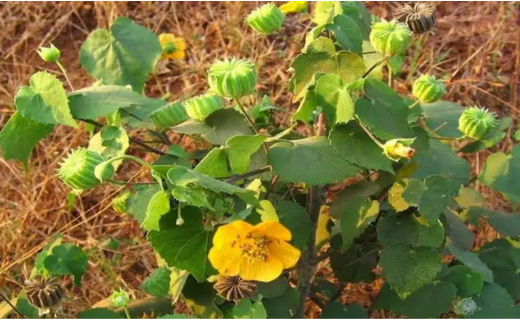
Atibala (Abutilon indicum) is a perennial shrub that typically reaches heights between 1 and 3 meters. Its stems and branches are adorned with soft, star-shaped hairs, giving the plant a smooth, velvety texture. The leaves are simple and alternately spaced, usually ovate with a cordate (heart-shaped) base and slightly toothed edges, ranging from 4 to 12 centimeters long. The herb produces bisexual flowers, which may appear alone or in small clusters; each flower has five yellow, obovate petals with fine hairs along the margins. The calyx is shaped like a small bell with five lobes, and the flowers are attractive to pollinators. The fruit is a capsule known as a schizocarp, generally rounded or oval, segmented into hairy parts called mericarps that open up when mature. Its seeds are kidney-shaped, dark brown or black, and covered with tiny rough hairs. These distinct features—including the velvety stems, heart-shaped serrated leaves, and bright yellow, hairy-edged flowers—define Atibala as a robust and medicinally valuable plant widely used in traditional healing practices.

Classical categorisation

  • Acharya Charaka classified Atibala under Madhura Skanda, indicating it possesses a sweet taste (madhura rasa).
  • It is included in the Balya Mahakashaya group, used primarily to enhance patient strength.
  • Atibala is often mentioned alongside Bala, and together they are known as Baladwaya.
  • Bala, Atibala, and Nagbala collectively form the group called Balatraya.
  • When Mahabala is added to these three, the combined group is called Bala Chatushka.
  • The Kaiyadeva Nighantu places Atibala in the Aushadhi Varga category.
  • The Raj Nighantu categorizes it in the Satahvadi Varga.
  • Both Dhanwantri Nighantu and Bhavprakash Nighantu include detailed descriptions of Atibala, recognizing its significant therapeutic value in classical Ayurveda.

Shloka’s

वातपित्तापहं ग्राही बल्यं वृष्यं बलात्रयम् ।

(Dhanwantri Nighantu / Guduchyadi Varga)

Interpretation of shloka:This means that Atibala is an herb that pacifies the aggravated Vata and Pitta doshas, possesses styptic (wound-healing) properties, strengthens the body, and acts as a natural aphrodisiac. It is considered one among the famous “Balatraya”—a trio of herbs known for their power to enhance strength and vitality.

तिक्ता कटुश्चातिबला वातघ्नी कृमिनाशनी ।

     दाहतॄष्णाविषच्छर्दि क्लेदोपशमनी परा ।।

  (Raj Nighantu / Satahvadi Varga)

Interpretation of shloka: Atibala (Abutilon indicum) is known for its multifaceted healing properties. It possesses a combination of Tikta (bitter) and (katu) pungent tastes and is highly regarded for its ability to pacify aggravated Vata dosha. Atibala also has strong anthelmintic (kriminashini) effects, making it effective in eliminating intestinal worms. Its cooling potency helps relieve burning sensations, excessive thirst, poisoning , vomiting, and excessive moisture-related conditions in the body.These qualities make Atibala a superior medicinal herb in Ayurveda, widely used for balancing doshas, detoxification, and alleviation of digestive and metabolic disorders.

बलचतुष्टयम् शीतं मधुरं बलकांतिकृत ।

    स्निगधम् ग्राही समीरास्रपित्तास्रक्षतनाशनम् ।।

 (Reference – Bhavprakash Nighantu / Guduchyadi Varga)

Interpretation of shloka: Atibala is known for its therapeutic properties. It is primarily categorized as a Balya (strength-giving) herb that helps in enhancing physical strength and vitality. Atibala has a madhura (sweet) taste, snigdha (unctuous) quality, sheeta (cooling) potency, and madhura vipaka, which contribute to its ability to balance Vata and Pitta doshas effectively. The herb acts as a grahi (astringent), vatahara (pacifies Vata), balya (strengthener), varishya (aphrodisiac), kantivardhaka (improves skin complexion), and ojjovardhaka (enhances immunity and vigor).

Ayurvedic properties

  • Rasa (taste): Madhura (sweet)
  • Guna (qualities): Laghu (light), Snigdha (unctuous)
  • Virya (potency): Sheeta (cooling)
  • Vipaka (post-digestive effect): Madhura (sweet)
  • Karma : Balances the vata and pitta doshas.

Therapeutic indication

  • Pacifies aggravated vata and pitta doshas, treating disorders related to their imbalance.
  • Acts as a potent balay (strengthens), enhancing physical strength, endurance, and vitality.
  • Reduces inflammation and alleviates pain, especially effective in conditions like arthritis, joint pain, and muscle spasms.
  • Supports respiratory health by easing cough, bronchitis, and removing excess phlegm.
  • It functions as a strong kriminashini (anthelmintic), expelling intestinal worms and parasites.
  • Relieves burning sensations, excessive thirst, poisoning, vomiting, and excess moisture in the body.
  • Promotes wound healing and is beneficial in skin conditions such as ulcers, eczema, and boils.
  • Aids in urinary tract and liver disorders, facilitating detoxification and managing jaundice.
  • Enhances male reproductive health by improving sexual vigor, sperm quality, and addressing fertility issues.
  • Helps regulate digestive disorders such as diarrhea, ulcers, and abnormal intestinal motility.
  • Boosts immunity and detoxifies the body, supporting overall health and longevity.

Systemic actions

  • Nervous system : Strengthens and nourishes the nervous system, helping to balance aggravated Vata and alleviating disorders such as paralysis, tremors, and nerve pain by supporting the Majja dhatu (nervous tissue).
  • Musculoskeletal system : Acts as a potent anti-inflammatory and analgesic for the musculoskeletal system, easing joint inflammation, muscle cramps, and stiffness, thus improving mobility and relieving Vata-induced discomfort.
  • Respiratory system: Supports respiratory health by functioning as an expectorant and bronchodilator, facilitating the removal of mucus, and reducing cough, asthma, and bronchial congestion.
  • Digestive system: Enhances digestive fire (Agni), promotes efficient digestion and assimilation, and treats conditions like diarrhea, gastric ulcers, and toxin (Ama) accumulation.
  • Reproductive system : Functions as a Vrishya (aphrodisiac), improving reproductive health by increasing sperm production, sexual vigor, and treating infertility.
  • Excretory system : Supports the excretory system through diuretic and detoxifying properties, aiding in kidney function and urinary tract health.
  • Immune system: Boosts the immune system by acting as an immunomodulator, enhancing resistance and overall vitality.

Chemical composition & their Properties

  • Contains mucilaginous substances rich in pentoses, methyl pentoses, hexoses, and uronic acids, which contribute to its soothing and demulcent properties.
  • Comprises proteins, carbohydrates, and free amino acids essential for tissue nourishment.
  • Enriched with saponins and various glycosides, providing medicinal potency.
  • Possesses phytosterols like β-sitosterol, α-sitosterol, and cholest-5-en-3-ol, contributing to anti-inflammatory effects.
  • Contains several fatty acids including linoleic, stearic, palmitic, lauric, myristic, caprylic, and capric acids, beneficial for skin and metabolic health.
  • Rich in bioactive alkaloids, tannins, flavonoids (notably quercetin and rutin), phenolic compounds, and steroids which exhibit antioxidant and healing activity.
  • Includes lupeol, a compound known for wound healing and anti-inflammatory properties.
  • Has a variety of essential oils such as α-pinene, caryophyllene, and caryophyllene oxide, supporting respiratory and antimicrobial functions.
  • Contains several amino acids including aspartic acid, histidine, threonine, serine, leucine, alanine, cysteine, tyrosine, phenylalanine, valine, and arginine, supporting metabolic processes.
  • Contains organic acids like fumaric, p-coumaric, vanillic, and caffeic acid which contribute to its antioxidant properties.

Practical use and benefits

  • Acts as a powerful tonic to boost physical strength, endurance, and overall vitality.
  • Helps balance aggravated Vata and Pitta doshas, beneficial for neurological ailments like paralysis, tremors, and nerve pain.
  • Provides relief from inflammation and pain, especially useful in arthritis, joint stiffness, and muscle cramps.
  • Supports lung health by reducing cough, clearing excessive mucus, and alleviating bronchitis and asthma symptoms.
  • Possesses vermifuge properties that help expel intestinal parasites and support digestive health.
  • Promotes healing of wounds, skin ulcers, boils, and various dermatological conditions thanks to its anti-inflammatory and antimicrobial effects.
  • Enhances urinary and liver function; supports detoxification and treatment of jaundice and urinary tract infections.
  • Improves reproductive health in men by enhancing semen quality, sexual vigour, and fertility.
  • Helps manage digestive issues such as diarrhea, acidic ulcers, and gut inflammation.
  • Acts as an immune booster, enhancing resistance against infections and improving overall health.
  • Treats a range of conditions including fever, blood disorders, leprosy, piles, gonorrhea, and urinary system complaints.
  • Used externally and internally for oral health issues like toothache and gum inflammation; also beneficial for bladder inflammations.
  • Leaf juice combined with herbs used for liver protection and jaundice management.
  • Flower pastes and root infusions applied for healing skin lesions and reducing fevers.

Part used

  • Roots
  • Leaves
  • Seeds
  • Flowers
  • Bark
  • Whole plant

Dosage

  • Decoction & juice of leaves – 10-20 ml.
  • Powder – 3-6 gm.

Ayurvedic Medicines

  • Mahanarayan Tail
  • Bala Taila
  • Ksheerbala Tail
  • Gandha Tailam
  • Punarnavadyarishta
  • Balarishta
  • Chyawanprash

Planet ayurveda products

Conclusion

Atibala (Abutilon indicum) is a potent and genuine Ayurvedic herb that harmoniously combines ancient medicinal wisdom with modern therapeutic applications. Its remarkable ability to support the nervous system, musculoskeletal health, immune function, and reproductive vitality makes it an excellent choice for comprehensive wellness. This herb honors its timeless tradition as a natural source of strength, healing, and balance for the body and mind.