Category: Skin Health

Phytophotodermatitis: Symptoms, Causes, And Treatment By Ayurveda

ABSTRACT

Phytophotodermatitis is a type of contact dermatitis. Dermatitis is a common skin irritation including atopic dermatitis (eczema), and seborrheic dermatitis (dandruff). It can be described as a number of skin irritations and rashes that are caused by genetics, an overactive immune system, and allergies. The range of rashes varies from mild to a severe form, In teens and adults, it is typically found on the hands, neck, and knees. Seborrheic dermatitis and cradle dermatitis are typically found on the scalp, and ears whereas periorificial dermatitis is found around the eyes and on the genitals. It is caused due to a combination of activation of the immune system, due to genetics, and environmental triggers which cause moisture and leads to dermatitis. There may be small blisters that cause the skin to thicken, and a small covering of the entire body can be due to a combination of allergy and poor venous return. It mainly involves symptoms such as swelling, itching, and sometimes skin lesion that causes oozing and scarring mainly seen on the neck, wrist, and ankle. It can be treated on its own or within a few weeks, treatment includes- steroids, creams, and lotions to treat dry skin. In this article, we are going to study in detail this disease’s causes and its ayurvedic management.

Phytophotodermatitis

INTRODUCTION

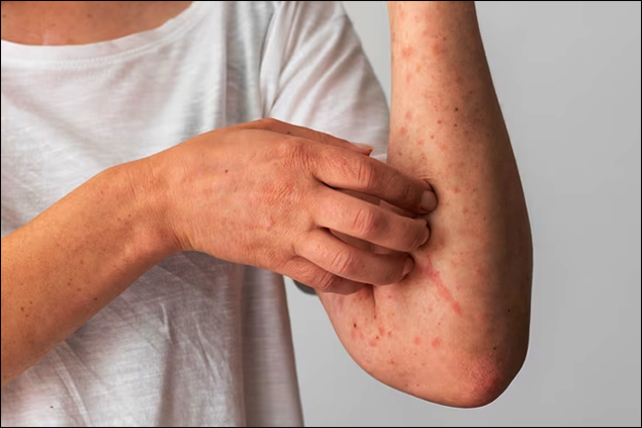
Phytophotodermatitis (PDD) is a cutaneous inflammatory eruption that results from light-sensitizing botanical plants known as Furanocoumarins and long-wave ultraviolet A. Psoralen is the particle that is present in Furanocoumarins (found in parsley, carrot, limes) when reacting with psoralen and UV radiations from the eruptions on the skin. Phytophotodermatitis is a type of contact dermatitis that is broken down into three parts- Phyto means plant, Photo means sunlight, and Dermatitis means inflammation in the skin. It happens when a certain planet’s chemical causes the skin to become inflamed after being exposed to sunlight. It is also known as lime disease, the patches of blisters are in irregular shape, typically manifest burning erythema, and cause blisters and are acutely red, when the acute inflammatory reactions subside there is post-inflammatory hyperpigmentation which lasts for years. The eruption lasts for 24 hours and peaks at 48-72 hours. It is known as baroque dermatitis or margarita photodermatitis, heat and moisture tend to exacerbate the reaction. Bergapten and xanthotoxin (methoxsalen) are derived from psoralen. Pain is also associated with the blister which results from necrosis of the affected epidermis. Aside from round blisters, the patches are also in the form of drips and streaks. A certain form of plant and sun dermatitis called baroque dermatitis is caused by exposure to perfumes. The rashes look darker and fully fade. It is not an allergic or immune reaction, it is the reaction between plant substance and skin cells. The lining of the skin cells is damaged and cells die and flake off (like a sunburn)

 FACTS

  • Thousands of substances can cause irritation and further allergic contact dermatitis
  • Contact dermatitis can start at any time in the life
  • The best way to treat contact dermatitis is to avoid
  • Contact dermatitis can take up to 3 weeks to go away
  • Touching the rash won’t spread it to another person

CAUSES

  • The plants containing furanocoumarins are responsible for the acute phototoxic reactions, which interfering with Ultraviolet A produce cell membrane damage and inflammation through the process of photosynthesis.
  • It affects the epidermis only and the epidermis is the outer layer of the skin.
  • Some common plants which contain psoralen include- Parsley, carrot, celery, breadnut, and citrus fruit.
  • On exposure to UVA light, it causes photochemical reactions in the skin
  • This damage the skin cells and causes cell death which leads to many symptoms.
  • Furocoumarins are responsible for producing excess melanin in the skin cells, which causes subsequent discoloration of the skin.

SYMPTOMS

1. It is based on the cycle of reactions, which first appear in blister-like patches across the skin, which are itchy and irregular-shaped. These patches are seen where the skin is exposed to the plant substance. The most common affected areas are

  • Legs
  • Arms
  • Hands

1. Drip-shaped lesions on arms (lime juice exposure)

2. Round lesions on the lips from using a plant pea shooter

3. Redness from the use of herbal cosmetics on the exposed skin

4. Streaks on the face and torso from using a string trimmer

5. Redness and swelling on exposed sites of hands, and arms after eating a large amount of furocoumarin-containing foods.

6. Pain

7. Tenderness

8. Crusted patches of skin once the blister the burst

9. Burning sensation

10. Wet skin, sweat, and heat are the initial symptoms while the sun darkens the skin pigmentation

11. Blisters (bullae) are formed within 48 hours and may leave black, brown, and purplish scars which last for several years.

RISK FACTORS

It can affect anyone, but several factors may increase the risk-

  • Exposure to certain plants and plant-based products
  • Sunny weather
  • Using perfumes or oils which contain plant chemicals
  • Canning fruits and vegetables
  • Fishing, gardening, and outdoor recreational activities expose the person to both plants and sunlight.
  • Farmers, forest rangers, and kitchen staff are at higher risk.
  • It is more prevalent in the spring and summer.

 DIAGNOSIS

  • Physical examination

 It can be confused with other skin conditions such as 

  • Sun allergies
  • Poison ivy
  • Hives
  • Sunburn
  • Poison oak

DIFFERENTIAL DIAGNOSIS

  • Allergic contact dermatitis
  • Burns
  • Dermatitis artefacta
  • Non-accidental injury
  • Photosensitivity due to drugs
  • Cellulitis
  • Fungal skin infections

TREATMENT

General Measures 

  • Cool compresses
  • Topical antiseptics to prevent infections
  • Topical steroids
  • Analgesia

COMPLICATIONS

  • Blisters
  • Ulcerations
  • Infections
  • Scars
  • Post-inflammatory hyperpigmentation  

AYURVEDIC MANAGEMENT

In Ayurveda, it is correlated with Niryas which can be from different parts of the plants and these niryas include different types of secretory products such as gum, resins, and sometimes latex. These niryas can cause rakta and pitta dushti, Niryas are the semi-solid exudate such as oleo gums, which are secreted as a result of the increased temperature of the plant. It causes rakta pitta dushti, pitta, and blood to be connected directly, the blood vitiation is due to the usage of hot and spicy food, food intake in large quantities, and usage of excessive salty, acidic, and pungent foods. The blood which is vitiated by pitta dosha is yellow and black and takes a long time to thicken because of the inherent heat.

LINE OF TREATMENT

  • Raktamokshana (bloodletting therapy)
  • Purgation (virechana panchkarma treatment)
  • Langhana (fasting)

RAKTASHODHANA (PURIFICATION OF BLOOD)

Two methods purify it

  • Local purification (where the blood-borne disease is present in localized areas such as hands, legs, and feet)
  • Systemic purification (it is present in the whole part of the body, which involves vital organs such as the liver, heart, and spleen)

HERBS USEFUL IN PHYTOPHOTODERMATITIS

  • Ghrit Kumari- Ghrit Kumari (Aloe vera) is promoting prebiotics that is good for the skin and intestines. Aloe vera has blood thinning action which is useful for treating atherosclerosis, improving ovulation, and helping to induce menstruation. It is good for the stomach and acts as an antimicrobial and helps to detoxify the blood. It helps to balance tridoshas and relieves worm infestation. 
  • Manjishtha- Manjishtha (Rubia cordifolia) is a famous herb used for the detoxification of blood, so it is helpful in various skin disorders, helps to regulate blood pressure, and prevents the clotting of blood. It is helpful in treating irregular menstruation. It helps remove freckles, pimples, and discoloration which promotes the healing of skin tissues due to skin tissue damage.    
  • Aaragwadha- Aaragwadha (Cassia fistula) is widely used in various skin disorders and to relieve constipation. It helps to balance Kapha and pitta doshas and acts as a mild purgation. It has antipyretic properties, acts as an analgesic, and has blood purification properties. Aragvadha helps to relive the ama and relieve abdominal colic pain. Help to detoxify the digestive tract.
  • Gandhak-  Gandhak (Sulfur) is used in various skin disorders, and urinary tract disorders and to relieve itching. It has an anti-aging property which helps to improve digestion, skin complexion, and balance of the tridosha. Gandhak improves the fertility of both men and women which further improves digestion strength. Helpful in intestine-related disorders such as IBS, and ulcerative colitis.  
  • Bakuchi- Bakuchi (Psoralea corylifolia) is a very well-known herb that is used in various skin disorders including leucoderma. It helps to balance the vata dosha, useful in various diseases such as urinary tract disorder, and chronic respiratory disease. Helps to relieve inflammation, acts as an anti-aging, and is useful in anemia.   

HERBAL REMEDIES BY PLANET AYURVEDA FOR PHYTOPHOTODERMATITIS 

Planet Ayurveda is an ayurvedic manufacturing company that makes all formulations from natural resources. Planet Ayurveda has many branches overseas. It is a GMP-certified company that makes all the products according to ancient ayurvedic texts. The products made are free from any preservatives, colors, and resins. The ingredients are free from any adulterations. The products made are free of any side effects but provide health benefits to the patients.

Product List

1. Gleaming Skin, Hair, and Nails Formula

2. Gandhak Rasayan

3.  Kustha Rakshas Tel

4. Royal Honey Shower Gel

5. Dermo Plan Syrup

Herbal Remedies For Phytophotodermatitis

Herbal Remedies For Phytophotodermatitis

Products Description

1. Gleaming Skin, Hair, and Nails Formula

Gleaming Skin, Hair, Nails formula are polyherbal capsules formulated by Planet Ayurveda using various ingredients such as Manjistha (Rubia cordifolia), Ghrit Kumari (Aloe barbadensis), Sariva (Hemidesmus indices). It helps to maintain the elasticity of the skin, providing smoothness and firmness to the skin. These capsules provide strength to the hair and nails. Improve the texture and appearance of the skin.

Dosage  1-2 capsules twice daily with plain water after meals.

2. Gandhak Rasayan

Gandhak Rasayan is an herbal tablet prepared by Planet Ayurveda using a single extract of Gandhak (Sulfur). These tablets are useful in various skin conditions such as Eczema which reduces the rashes and will provide relief. Helps to purify the blood which reduces acne and pimple and improves skin complexion. Gandhak Rasayan enhances the immunity of the body to fight against infections.

Dosage  1-2 tablets twice daily with lukewarm water.

3. Kustha Rakshas Tel

Kustha Rakshas Tel is a classical ayurvedic formulation prepared by planet ayurveda using ingredients such as Kushta (Saussurea lappa), Aragwadha (Cassia fistula), Tamra bhasma (Calcined copper), Sarson ka tail (Mustard oil) and many more. This oil is useful in various skin disorders such as Psoriasis, Eczema, and many more. It helps to apply over the external piles. Helpful in patients who are suffering from itching in the private parts, and fistula.

Dosage applied externally over the affected area twice daily.

4. Royal Honey Shower Gel

Royal Honey Shower Gel is an Ayurvedic cosmetics product prepared by planet Ayurveda using ingredients such as Honey, Vitamin E, Aloe Vera extract (Aloe barbadensis), DM water, and many more. It helps to maintain healthy skin, which nourishes dry skin, and dull skin, and provides soothing and moisturizing effects so keeps hydrated for a long period of time.

Dosage  Squeeze a small amount of wet body sponge to convert it into a rich creamy lather and then rinse it.

5. Dermo Plan Syrup

Dermoplan Syrup is an herbal syrup formulation which is formulated by planet ayurveda using ingredients such as Chopchini (Smilax china), Sariva (Hemidesmus indicus), Shobhanjan (Moringa oleifera), and many more. This syrup is useful in skin disorders and helps to strengthen and balance the overall functions of the body. It also works as an anti-inflammatory and has antioxidant properties.

Dosage 1-2 teaspoons twice daily

CONTACT PLANET AYURVEDA TO PROVIDE YOU THE COSTING / ORDERING AND DELIVERY INFORMATION AT – COSTING.PLANETAYURVEDA@GMAIL.COM OR CALL AT +91-172-5214040

CONCLUSION

Phytophotodermatitis is a type of contact dermatitis. Dermatitis is a common skin irritation including atopic dermatitis (eczema), and seborrheic dermatitis (dandruff). Phytophotodermatitis (PDD) is a cutaneous inflammatory eruption that results from light-sensitizing botanical plants known as Furanocoumarins and long-wave ultraviolet A. Psoralen is the particle that is present in Furanocoumarins (found in parsley, carrot, limes) when reacting with psoralen and UV radiations from the eruptions on the skin. In Ayurveda it is correlated with Niryas which can be from different parts of the plants and these niryas include the different types of secretory products such as gum, resins, and sometimes latex. Therefore, planet Ayurveda provides many herbal remedies which provide great relief to patients without causing any side effects. 

Metastatic Crohn’s Disease Treatment by Herbal Remedies

ABSTRACT 

Nowadays due to changing dietary and lifestyle habits people are more prone to any of the health conditions. There are a lot of diseases when not treated carefully at times may lead to severe and life-threatening complications. If diabetes is not treated with time it may lead to complications like retinopathy, nephropathy, neuropathy, etc. Jaundice may also lead to severe complications such as bleeding, anemia, infections, kidney failure, liver failure, etc. Same with some of these complications we are here with a very serious complication of Crohn’s disease which is Metastatic Crohn’s disease. Also with a complete view of this complication, we are going to discuss its Ayurvedic management.     

Metastatic Crohn’s


INTRODUCTION

Metastatic Crohn’s disease refers to the existence of non-caseating granuloma of skin located at sites segregated from the GI tract (gastrointestinal tract) by the normal tissue, basically a cutaneous manifestation. This condition is considered one of the least common manifestations of Crohn’s disease. In adults, this condition usually appears following the initial diagnosis of Crohn’s disease which is in 70% of cases. In children, this condition occurs at the same time as the manifestation of Crohn’s disease in 50% of cases. So now let’s discuss the pathophysiology and clinical presentation of this severe complication.   

PATHOPHYSIOLOGY

As like Crohn’s disease the exact etiology of Metastatic Crohn’s disease is unknown. There are two most vulnerable theories that are considered the main pathology of this condition. One theory believes that the lesions occurring in metastatic Crohn’s disease are due to granulomatous response which involves the perivascular fixation of monocytes to unknown antigens from the GI tract that is carried via circulation and after that deposits into the skin. Another theory mentions that a granulomatous vasculitis occurrence secondary to the hypersensitivity type iv reaction which is associated with the lymphocytes that react to with circulatory antigens that release activating monocytes and lymphokines which further results in granulomatous injury and inflammation of the vessel wall. 

CLINICAL PRESENTATION

There are cutaneous lesions presented as plaques, papules, ulcerations, and nodules that may involve legs, arms, face, and genitalia. Other sites included are the breast, nipple, and ear. The most affected areas include the skin folds that remain in moist environments like abdominal creases, submammary creases, and inguinal and perineal regions. The genitalia is considered the most commonly affected part and the sites of genitalia involved are the penile, labia, scrotal swelling without erythema, and scrotal swelling with the erythema. The lesions occurring on the skin are generally painless and feel tender on palpation.     

DIAGNOSIS

Metastatic Crohn’s disease is considered one of the great mimickers and mostly remains misdiagnosed. With a proper and detailed history along with a clear physical examination, the differential diagnosis may be narrow. To confirm the diagnosis, a lesion biopsy is most important. Other investigations like acid and alcohol fast bacilli, periodic acid Schiff staining, tuberculin skin test, and tissue cultures may also be done for excluding the mimickers of Metastatic Crohn’s disease.    

AYURVEDIC VIEW

As per Ayurveda, Crohn’s disease results from vitiated Pitta dosha which causes inflammation in the intestines. When the intestines are inflamed, it leads to symptoms that are the same as when Pitta is vitiated. After the disease is in existence or the condition is resolved but the one who is suffering from it is taking the pittaj Sahara and vihara with low immunity leads to its serious complication that is metastatic Crohn’s disease. In this condition, the vitiated pitta dosha gets situated in twak dhatu (skin) which leads to the formation of skin lesions and ulcerations. So as per ayurveda, the management is basically done by the management of pitta dosha, detoxifying the body and boosting the immunity levels. For this line of treatment, Planet Ayurveda provides a list of herbal remedies that we are going to discuss in further study.

HERBAL REMEDIES BY PLANET AYURVEDA FOR METASTATIC CROHN’S DISEASE

Planet Ayurveda is one of the GMP-certified clinics that work in accordance with holistic science- Ayurveda. They formulate their own remedies under the strict observance of M.D. Ayurveda practitioners. All the formulations are free from any kind of added preservatives, colors, fillers, resins, gums, fibers, etc. These formulations are 100% pure so don’t produce any side effects feel free to consume any of the remedies by Planet Ayurveda that are suited for your associated health concern. Planet Ayurveda provided with remedies for all health concerns and for managing metastatic Crohn’s disease they provide the following list of medications.

Products List

1. PITTA BALANCE

2. SANJIVANI VATI 

3. GANDHAK RASAYAN

4. SWARN VASANT MALTI RAS

5. BELGIRI POWDER

6. NEEM CAPSULES

7. MAHAMANJISHTHADI KWATH 


Metastatic Crohns Disease Care Pack

Metastatic Crohns Disease Care Pack

1. PITTA BALANCE

Pitta balance is one of the best pitta balancing formulations by Planet ayurveda in capsule form. It consists of a standardized extract of johar mohra pishti (an ayurvedic compound), kahawai pishti (an ayurvedic compound), akik pishti (an ayurvedic mineral formulation), and some other ingredients. The ingredients of pitta balance include the best cooling and astringent effects which are very effective in pacifying pitta dosha. This formulation helps in providing relief from skin lesions by providing a soothing effect.

 Dosage 1 capsule twice daily with plain water after meals.  

2. SANJIVANI VATI 

Sanjivani vati is one of the classical ayurvedic formulations that is formulated by Planet Ayurveda under the strict observance of M.D. Ayurveda practitioners. It includes various ingredients such as vanga (Embelia ribes), ginger (Zingiber officinale), pippali (Piper longum), Amalaki (Emblica Officinalis), Vacha (Acorus calamus) and some others. This ayurvedic remedy is best for eliminating ama dosha (endotoxins) from the body and is beneficial for ama pachanga (detoxification). So by detoxifying the body sanjivani vati assists in the management of metastatic Crohn’s disease. 

Dosage: 1 tablet twice daily to be chewed. 

3. GANDHAK RASAYAN

Gandhak rasayan is a formulation in tablet form produced by Planet Ayurveda basically for boosting immunity and maintaining skin health. It is formed with the main ingredient shuddha gandhak (Purified sulfur). The properties of gandhak (sulfur) include properties such as Antibacterial, antimicrobial, antiviral, anti-inflammatory, blood purifying, and detoxifying properties. It aids in relieving skin conditions and thus alleviates the cutaneous manifestations in Metastatic Crohn’s disease. 

Dosage: 1 tablet twice daily with plain water after meals.  

4. SWARN VASANT MALTI RAS

Swarn vasant malti ras is a classical ayurvedic formulation prepared by Planet Ayurveda. The formulation is available in tablet form and consists of various ingredients like Swarna bhasma (calyx of gold), mukta bhasma (calyx of pearl), Kali marina (Piper nigrum), and various others. This formulation has been used since ancient times for boosting immunity and is one of the balsa rasayana (strength rejuvenators). Improving immunity it assists in promoting the management of Metastatic Crohn’s disease.   

Dosage: 1 tablet once daily to be chewed.  

 5. BELGIRI POWDER

Belgiri powder is prepared by Planet ayurveda with the main ingredient bilva seed (Aegle marmelos). Aegle marmelos consists of pitta pacifying, astringent, and cooling effects. These effects, it provides smoothness and calmness to the cutaneous lesions. The pitta pacifying effect of belgiri powder assists in alleviating pitta dosha from the body which is the main cause behind the condition thus alleviating the cutaneous manifestation of Crohn’s disease.   

Dosage  ½ tsp twice daily with plain water after meals.

6. NEEM CAPSULES

Neem capsules are one of the blood-purifying formulations produced by Planet Ayurveda with the standardized extract of herb neem (Azadirachta indica). This formulation consists of blood-purifying properties which assist in removing toxins from the body. By detoxifying, the body’s neem capsules relieve various skin conditions. So these capsules are effective in relieving skin lesions and assist in managing Metastatic Crohn’s disease with positive results. 

Dosage 1 capsule twice daily with plain water after meals.  

7. MAHAMANJISHTHADI KWATH

Mahamanjishthadi kwath is a classical ayurvedic formulation that has been used since ancient times for various skin conditions. It is prepared by Planet Ayurveda under the strict guidance of an M.D. Ayurveda practitioners. It consists of various ingredients such as manjishtha (Rubia cordifolia), nagarmotha (Cyperus rotundus), kutaj Holarrhena antidysenterica, sonth (Zingiber officinale) and various others. These ingredients collectively promote blood purification, pacify pitta dosha and promote detoxification in the body. The mentioned benefits effectively manage the condition of Metastatic Crohn’s disease, so you can use mahamanjishthadi kwath for relief. 

Dosage  2 tsp twice daily with plain water after meals.      

CONTACT PLANET AYURVEDA TO PROVIDE YOU THE COSTING / ORDERING AND DELIVERY INFORMATION AT – COSTING.PLANETAYURVEDA@GMAIL.COM OR CALL AT +91-172-5214040

CONCLUSION  

Metastatic Crohn’s disease refers to the existence of non-caseating granuloma of skin located at sites segregated from the GI tract (gastrointestinal tract) by the normal tissue, basically a cutaneous manifestation. As like Crohn’s disease the exact etiology of Metastatic Crohn’s disease is unknown. There are cutaneous lesions presented as plaques, papules, ulcerations, and nodules that may involve legs, arms, face, and genitalia. For diagnosis a proper and detailed history along with a clear physical examination is to be done and to confirm the diagnosis, a lesion biopsy is most important. As per Ayurveda Crohn’s disease is associated with aggravated pitta dosha and if a person with Crohn’s disease practices a diet and regimen that aggravates pitta dosha then the pitta dosha gets situated into the twak dhatu (skin) and leads to skin lesions. So for the management of this condition in a natural way, the management of pitta dosha detoxifies the body and boosts immunity levels. For this purpose, you can use herbal formulations by planet ayurveda which provide all the benefits that help in the management of Metastatic Crohn’s disease. While consuming medications if you have any queries you can mail us at herbalremedies123@yahoo.com.