Category: Skin Health

Adult Still’s Disease Treatment with Herbal Remedies

ABSTRACT

What is a joint, a junction where two or more bones meet together. These can be rigid such as joints between skull bones, and movable like knee or shoulder joints. Many joints consist of cartilages at the part of the bone where the joint formed. If the cartilages are healthy it assists in gliding the bones smoothly over each other. They also prevent the bones from friction while movement which is the main reason of degradation of the bones. So if the joints are healthy you will be able to freely walk, run, jump and do all other daily activities without any difficulty. For some reasons if your bones are affected then it may restrict your day to day activities too. Also there are a lot of joint diseases which affect the quality of life of the person, among which one is Adults Still’s Syndrome. About this condition we will study in this article along with its Ayurvedic perspective and management.

Adult Still’s Disease

INTRODUCTION

Autoimmune conditions are the conditions in which a person’s immune system kills or attacks its own body tissues. The role of the immune system is to guard the whole body but what if instead of guardian it starts killing the body cells. There are a lot of such conditions and all those conditions affect the quality of life of the person to a great extent. One such condition is Adults Still’s Disease which is a rare autoimmune condition of the joints. This condition includes characteristic features such as rashes, fever and joint pain. This condition persists in episodes, some may have one or some have more than one episode. This condition associates with the inflammatory changes which if persisted longer may damage the affected joints and most commonly the wrist joints. This is a brief introductory part about the disease and now we are going to discuss some more about this condition in the further article.

SOME QUICK FACTS ABOUT ADULT STILL’S DISEASE

Following are some facts to know about Adult Still’s Disease before reading further article:

  • It is an autoimmune condition of the joints which is the inflammatory type of arthritis.
  • The condition is hard to diagnose.
  • It affects the internal organs.
  • If not treated the complications may be life threatening.
  • It affects 0.4 cases among 100,000 adults
  • This condition occurs in children also which is known as systemic onset juvenile inflammatory arthritis.
  • Its episodes affect more between the ages from 15 to 25 and between 36 to 46.
  • Both the sex are equally at the risk of occuring this condition.

CAUSES OF ADULT STILL’S DISEASE

This condition has no such relevant cause, it is considered as an idiopathic condition which means the condition without any known cause. This condition may be triggered by infections which majorly involve microbes like fungi, bacteria, or yeast. Some researchers mentioned that the condition is autoimmune and till now no theory is considered relevant for the cause of Adult Still’s Disease.

SYMPTOMS OF ADULT STILL’S DISEASE

Adult Still’s Disease produce systemic symptoms which may cause in both adults and children, among which following are the most common symptoms

  • Fever: In this condition fever occurs daily upto 102 degrees which may last upto a week or more than a week. Hikes of fever most of the times occur in early evening and afternoon and for 1 or 2 times a day and in between the temperature comes down to normal.
  • Rashes: After fever a rash may occur which appears to be of salmon colour. These rashes appear on the arms, trunk or legs.
  • Sore throat: In adults this symptom seems to be the earliest sign. Along with sore throat a person may experience swollen and tender lymph nodes in the region of the neck.
  • Inflamed joints: Inflammation starts occurring in the joints and the person may experience pain and stiffness too. Most commonly joints involved are wrist joint and knee joint.
  • Muscle pain: This may affect the daily activities and reduce the quality of life of the person.

DIAGNOSIS OF ADULT STILL’S DISEASE

There is no single test which can diagnose the same condition, the physician may suggest multiple tests for confirming the diagnosis. Both types of diagnostic techniques have to be done like blood tests assist to rule out other similar conditions and imaging tests help in revealing damage due to the disease. Certain diagnostic tests to confirm its diagnosis includes the following.

  • Antinuclear antibody test
  • CT Scan
  • C-reactive protein test
  • Ferritin test
  • Echocardiogram
  • ESR
  • X-Ray
  • Ultrasound

AYURVEDIC VIEW OF ADULT STILL’S DISEASE

As this condition is an autoimmune condition so as per Ayurveda we can correlate the same with aam dosha janya vikara. Now let us know what is ama dosha? Main role of producing ama dosha is mandagni which means a low digestive fire. Mandagni leads to the formation of undigested food which gets logged into various channels of the body that is known as Ama dosha.

Causes of Ama dosha

Dietary causes

  • Starvation, intake of food even over indigestion, excessive eating, etc.

Lifestyle causes

  • suppression of natural urges, sleeping in the day time, laziness.

Symptoms of Ama dosha

Stasis of fecal matter, fatigue, stiffness, fainting, vertigo, indigestion, anorexia, thirst, tenesmus, nausea, vomiting, fever and various other depending upon the lodgement of ama dosha in particular channels of the body.

Specification of Ama Dosha in Adults Still’s Syndrome

As we studied ama dosha in general and its symptoms appearing all over the body. But we can give a specific name to this condition that is saam asthija pradoshaj vikara. In this condition there is the accumulation of ama dosha in the channels nourishing the asthi dhatu (bones and joints).

Symptoms of saam asthija pradoshaj vikara are

  • Increase in size of asthi, pain  in bones and joints, piercing in the bones, etc.

Common management protocol for Ama dosha in the body

It includes three steps that are langhan (fasting), langhan-pachan (fasting and digestive management) and the last one is dosha avsechan (elimination of dosha from the body). Now let’s see what will be the management option for this condition by Planet Ayurveda.

HERBAL REMEDIES BY PLANET AYURVEDA ADULT STILL’S DISEASE

Ayurveda is a holistic science which has been working with preventive and promotive purposes for more than 3000 years. Planet Ayurveda is a Company which formulates their own products as per the same aim of Ayurveda. The formulations prepared by Planet Ayurveda are GMP and ISO certified. All these formulations are devoid of any kind of added synthetic materials and preservatives so it has no side effects. Every person from child to old age can consume these remedies under the guidance of Ayurvedic practitioners. For managing the symptoms of Adults Still’s Disease and improving the quality of life of the patient Planet Ayurveda provides the following remedies. So let’s have a look at how these remedies are effective in managing the symptoms of Adult Still’s Disease.

  1. YOGRAJ GUGGUL
  2. BOSWELLIA CURCUMIN
  3. PANCHTIKTAGHRIT GUGGUL
  4. AMAR SUNDARI VATI
  5. AAMVATANTAK CHURNA
  6. MAHA RASNADI KWATH
    Herbal Remedies Adult Still’s Disease Buy Now

PRODUCT DESCRIPTION

1. YOGRAJ GUGGUL

Yograj Guggul is a classical Ayurvedic formulation used for bone and joint disorders since ancient times. The remedy is available in tablet form and consists of ingredients such as guggul (Commiphora mukul), mustak (Cyperus rotundus), pippali (Piper longum) and some others. This formulation assists in alleviating ama dosha from the body. It nourishes the bones and cartilages of the joints to maintain the daily activities. This formulation has very good analgesic properties which relieves the pain in the joints.

Dosage: 2 tablets twice daily with plain water after meals.

2. BOSWELLIA CURCUMIN

Boswellia Curcumin is a formulation prepared by Planet Ayurveda in capsule form. This formulation is made up of standardized extract of herbs such as shallaki (Boswellia serrata) and curcumin (Curcuma longa). This remedy consists of antioxidant and analgesic properties. The antioxidant properties assist in eliminating lodgement of ama dosha from the body. The best analgesic protein assists in reducing the pain as well as it has hor potency which helps in reducing stiffness in the joints.

Dosage: 1 capsule twice daily with plain water after meals.

3. PANCHTIKTAGHRIT GUGGUL

Panchtiktaghrit Guggul is a classical ayurvedic formulation prepared by Planet Ayurveda as mentioned in the texts. This is well known for its anti-inflammatory properties since ancient times. As inflammatory changes are the main characteristic feature of this condition so use of this formulation is very best for alleviating the same. Also rashes occur in this condition which also get alleviated by panchtiktaghrit guggul by its antihistaminic properties.

Dosage: 2 tablets twice daily with plain water after meals.

4. AMAR SUNDARI VATI

Amar Sundri Vati is formulated by Planet Ayurveda as mentioned in classical Ayurvedic texts. This remedy consists of ingredients such as ginger (Zingiber officinale), Amalaki (Emblica officinalis), loha bhasma (calyx of iron) and various others. The formulation consists of hot potency that improves the digestive fire and helps in eliminating ama dosha from the body. It also has kapha and vata pacifying properties which are very beneficial for reducing inflammation, stiffness and pain in the joints.

Dosage: 2 tablets twice daily with plain water after meals.

5. AAMVATANTAK CHURNA

Aamvatantak Churna is a polyherbal powder formulated by Planet Ayurveda. This herbal powder consists of ingredients such as ashwagandha (Withania somnifera), methi (Trigonella foenum graecum), haridra (Curcuma longa). As the name suggests aamvatantak which means it assists in eliminating ama dosha from the body and pacifying vata dosha. By reducing ama and vata dosha this formulation is effective in reducing the symptoms of Adults Still’s Syndrome such as pain, inflammation, stiffness, fever, etc.

Dosage: ½ tsp twice daily with plain water after meals.

6. MAHA RASNADI KWATH

Maha Rasnadi Kwath is a classical Ayurvedic formulation prepared by Planet Ayurveda as per the texts. The formulation is in syrup form which consists of the ingredients such as bala (Sida cordifolia), errand (Ricinus communis) and some others. It is well known for its vata pacifying properties. As vata dosha is responsible for mandagni (low digestive fire) which is responsible for improper digestion and accumulation of ama dosha. So by pacifying vata dosha and improving the digestive fire this syrup assists in eliminating ama dsha from the body and reduces pain and stiffness very effectively.

Dosage: 2 tsp twice daily with plain water after meals.

Contact Planet Ayurveda Support Team to provide you the costing/ordering and delivery information at – costing.planetayurveda@gmail.com or Call at 0172-521-4040 (India), +91-172-521-4040 (Outside India) or Whatsapp at (+91) 842-749-4030.

CONCLUSION

Adults Still’s Disease which is a rare autoimmune condition of the joints. This condition includes characteristic features such as rashes, fever and joint pain. The cause of this condition is unknown so it is considered as an idiopathic disease. There is no one diagnostic technique which may assist in diagnosing the same condition and doctors may suggest the blood tests and various imaging tests too. As per Ayurveda this condition can be correlated to ama dosha as it is an autoimmune condition. Specifically it is considered as saam asthi pradoshaj vikara which means accumulation of ama dosha in the bone nourishing channels. So to manage this condition it is important to eliminate the ama dosha by promoting the digestive fire. For this Planet Ayurveda provides various remedies and you can consume these remedies without thinking of its side effects, as they are free from any kind of added preservatives and synthetic materials.

Phytophotodermatitis: Symptoms, Causes, And Treatment By Ayurveda

ABSTRACT

Phytophotodermatitis is a type of contact dermatitis. Dermatitis is a common skin irritation including atopic dermatitis (eczema), and seborrheic dermatitis (dandruff). It can be described as a number of skin irritations and rashes that are caused by genetics, an overactive immune system, and allergies. The range of rashes varies from mild to a severe form, In teens and adults, it is typically found on the hands, neck, and knees. Seborrheic dermatitis and cradle dermatitis are typically found on the scalp, and ears whereas periorificial dermatitis is found around the eyes and on the genitals. It is caused due to a combination of activation of the immune system, due to genetics, and environmental triggers which cause moisture and leads to dermatitis. There may be small blisters that cause the skin to thicken, and a small covering of the entire body can be due to a combination of allergy and poor venous return. It mainly involves symptoms such as swelling, itching, and sometimes skin lesion that causes oozing and scarring mainly seen on the neck, wrist, and ankle. It can be treated on its own or within a few weeks, treatment includes- steroids, creams, and lotions to treat dry skin. In this article, we are going to study in detail this disease’s causes and its ayurvedic management.

Phytophotodermatitis

INTRODUCTION

Phytophotodermatitis (PDD) is a cutaneous inflammatory eruption that results from light-sensitizing botanical plants known as Furanocoumarins and long-wave ultraviolet A. Psoralen is the particle that is present in Furanocoumarins (found in parsley, carrot, limes) when reacting with psoralen and UV radiations from the eruptions on the skin. Phytophotodermatitis is a type of contact dermatitis that is broken down into three parts- Phyto means plant, Photo means sunlight, and Dermatitis means inflammation in the skin. It happens when a certain planet’s chemical causes the skin to become inflamed after being exposed to sunlight. It is also known as lime disease, the patches of blisters are in irregular shape, typically manifest burning erythema, and cause blisters and are acutely red, when the acute inflammatory reactions subside there is post-inflammatory hyperpigmentation which lasts for years. The eruption lasts for 24 hours and peaks at 48-72 hours. It is known as baroque dermatitis or margarita photodermatitis, heat and moisture tend to exacerbate the reaction. Bergapten and xanthotoxin (methoxsalen) are derived from psoralen. Pain is also associated with the blister which results from necrosis of the affected epidermis. Aside from round blisters, the patches are also in the form of drips and streaks. A certain form of plant and sun dermatitis called baroque dermatitis is caused by exposure to perfumes. The rashes look darker and fully fade. It is not an allergic or immune reaction, it is the reaction between plant substance and skin cells. The lining of the skin cells is damaged and cells die and flake off (like a sunburn)

 FACTS

  • Thousands of substances can cause irritation and further allergic contact dermatitis
  • Contact dermatitis can start at any time in the life
  • The best way to treat contact dermatitis is to avoid
  • Contact dermatitis can take up to 3 weeks to go away
  • Touching the rash won’t spread it to another person

CAUSES

  • The plants containing furanocoumarins are responsible for the acute phototoxic reactions, which interfering with Ultraviolet A produce cell membrane damage and inflammation through the process of photosynthesis.
  • It affects the epidermis only and the epidermis is the outer layer of the skin.
  • Some common plants which contain psoralen include- Parsley, carrot, celery, breadnut, and citrus fruit.
  • On exposure to UVA light, it causes photochemical reactions in the skin
  • This damage the skin cells and causes cell death which leads to many symptoms.
  • Furocoumarins are responsible for producing excess melanin in the skin cells, which causes subsequent discoloration of the skin.

SYMPTOMS

1. It is based on the cycle of reactions, which first appear in blister-like patches across the skin, which are itchy and irregular-shaped. These patches are seen where the skin is exposed to the plant substance. The most common affected areas are

  • Legs
  • Arms
  • Hands

1. Drip-shaped lesions on arms (lime juice exposure)

2. Round lesions on the lips from using a plant pea shooter

3. Redness from the use of herbal cosmetics on the exposed skin

4. Streaks on the face and torso from using a string trimmer

5. Redness and swelling on exposed sites of hands, and arms after eating a large amount of furocoumarin-containing foods.

6. Pain

7. Tenderness

8. Crusted patches of skin once the blister the burst

9. Burning sensation

10. Wet skin, sweat, and heat are the initial symptoms while the sun darkens the skin pigmentation

11. Blisters (bullae) are formed within 48 hours and may leave black, brown, and purplish scars which last for several years.

RISK FACTORS

It can affect anyone, but several factors may increase the risk-

  • Exposure to certain plants and plant-based products
  • Sunny weather
  • Using perfumes or oils which contain plant chemicals
  • Canning fruits and vegetables
  • Fishing, gardening, and outdoor recreational activities expose the person to both plants and sunlight.
  • Farmers, forest rangers, and kitchen staff are at higher risk.
  • It is more prevalent in the spring and summer.

 DIAGNOSIS

  • Physical examination

 It can be confused with other skin conditions such as 

  • Sun allergies
  • Poison ivy
  • Hives
  • Sunburn
  • Poison oak

DIFFERENTIAL DIAGNOSIS

  • Allergic contact dermatitis
  • Burns
  • Dermatitis artefacta
  • Non-accidental injury
  • Photosensitivity due to drugs
  • Cellulitis
  • Fungal skin infections

TREATMENT

General Measures 

  • Cool compresses
  • Topical antiseptics to prevent infections
  • Topical steroids
  • Analgesia

COMPLICATIONS

  • Blisters
  • Ulcerations
  • Infections
  • Scars
  • Post-inflammatory hyperpigmentation  

AYURVEDIC MANAGEMENT

In Ayurveda, it is correlated with Niryas which can be from different parts of the plants and these niryas include different types of secretory products such as gum, resins, and sometimes latex. These niryas can cause rakta and pitta dushti, Niryas are the semi-solid exudate such as oleo gums, which are secreted as a result of the increased temperature of the plant. It causes rakta pitta dushti, pitta, and blood to be connected directly, the blood vitiation is due to the usage of hot and spicy food, food intake in large quantities, and usage of excessive salty, acidic, and pungent foods. The blood which is vitiated by pitta dosha is yellow and black and takes a long time to thicken because of the inherent heat.

LINE OF TREATMENT

  • Raktamokshana (bloodletting therapy)
  • Purgation (virechana panchkarma treatment)
  • Langhana (fasting)

RAKTASHODHANA (PURIFICATION OF BLOOD)

Two methods purify it

  • Local purification (where the blood-borne disease is present in localized areas such as hands, legs, and feet)
  • Systemic purification (it is present in the whole part of the body, which involves vital organs such as the liver, heart, and spleen)

HERBS USEFUL IN PHYTOPHOTODERMATITIS

  • Ghrit Kumari- Ghrit Kumari (Aloe vera) is promoting prebiotics that is good for the skin and intestines. Aloe vera has blood thinning action which is useful for treating atherosclerosis, improving ovulation, and helping to induce menstruation. It is good for the stomach and acts as an antimicrobial and helps to detoxify the blood. It helps to balance tridoshas and relieves worm infestation. 
  • Manjishtha- Manjishtha (Rubia cordifolia) is a famous herb used for the detoxification of blood, so it is helpful in various skin disorders, helps to regulate blood pressure, and prevents the clotting of blood. It is helpful in treating irregular menstruation. It helps remove freckles, pimples, and discoloration which promotes the healing of skin tissues due to skin tissue damage.    
  • Aaragwadha- Aaragwadha (Cassia fistula) is widely used in various skin disorders and to relieve constipation. It helps to balance Kapha and pitta doshas and acts as a mild purgation. It has antipyretic properties, acts as an analgesic, and has blood purification properties. Aragvadha helps to relive the ama and relieve abdominal colic pain. Help to detoxify the digestive tract.
  • Gandhak-  Gandhak (Sulfur) is used in various skin disorders, and urinary tract disorders and to relieve itching. It has an anti-aging property which helps to improve digestion, skin complexion, and balance of the tridosha. Gandhak improves the fertility of both men and women which further improves digestion strength. Helpful in intestine-related disorders such as IBS, and ulcerative colitis.  
  • Bakuchi- Bakuchi (Psoralea corylifolia) is a very well-known herb that is used in various skin disorders including leucoderma. It helps to balance the vata dosha, useful in various diseases such as urinary tract disorder, and chronic respiratory disease. Helps to relieve inflammation, acts as an anti-aging, and is useful in anemia.   

HERBAL REMEDIES BY PLANET AYURVEDA FOR PHYTOPHOTODERMATITIS 

Planet Ayurveda is an ayurvedic manufacturing company that makes all formulations from natural resources. Planet Ayurveda has many branches overseas. It is a GMP-certified company that makes all the products according to ancient ayurvedic texts. The products made are free from any preservatives, colors, and resins. The ingredients are free from any adulterations. The products made are free of any side effects but provide health benefits to the patients.

Product List

1. Gleaming Skin, Hair, and Nails Formula

2. Gandhak Rasayan

3.  Kustha Rakshas Tel

4. Royal Honey Shower Gel

5. Dermo Plan Syrup

Herbal Remedies For Phytophotodermatitis

Herbal Remedies For Phytophotodermatitis

Products Description

1. Gleaming Skin, Hair, and Nails Formula

Gleaming Skin, Hair, Nails formula are polyherbal capsules formulated by Planet Ayurveda using various ingredients such as Manjistha (Rubia cordifolia), Ghrit Kumari (Aloe barbadensis), Sariva (Hemidesmus indices). It helps to maintain the elasticity of the skin, providing smoothness and firmness to the skin. These capsules provide strength to the hair and nails. Improve the texture and appearance of the skin.

Dosage  1-2 capsules twice daily with plain water after meals.

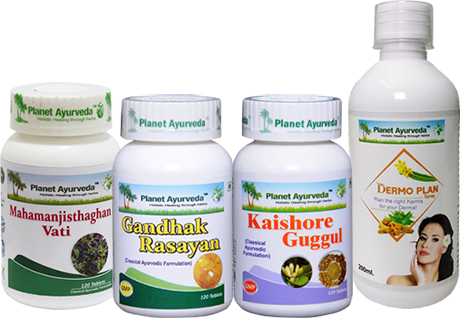
2. Gandhak Rasayan

Gandhak Rasayan is an herbal tablet prepared by Planet Ayurveda using a single extract of Gandhak (Sulfur). These tablets are useful in various skin conditions such as Eczema which reduces the rashes and will provide relief. Helps to purify the blood which reduces acne and pimple and improves skin complexion. Gandhak Rasayan enhances the immunity of the body to fight against infections.

Dosage  1-2 tablets twice daily with lukewarm water.

3. Kustha Rakshas Tel

Kustha Rakshas Tel is a classical ayurvedic formulation prepared by planet ayurveda using ingredients such as Kushta (Saussurea lappa), Aragwadha (Cassia fistula), Tamra bhasma (Calcined copper), Sarson ka tail (Mustard oil) and many more. This oil is useful in various skin disorders such as Psoriasis, Eczema, and many more. It helps to apply over the external piles. Helpful in patients who are suffering from itching in the private parts, and fistula.

Dosage applied externally over the affected area twice daily.

4. Royal Honey Shower Gel

Royal Honey Shower Gel is an Ayurvedic cosmetics product prepared by planet Ayurveda using ingredients such as Honey, Vitamin E, Aloe Vera extract (Aloe barbadensis), DM water, and many more. It helps to maintain healthy skin, which nourishes dry skin, and dull skin, and provides soothing and moisturizing effects so keeps hydrated for a long period of time.

Dosage  Squeeze a small amount of wet body sponge to convert it into a rich creamy lather and then rinse it.

5. Dermo Plan Syrup

Dermoplan Syrup is an herbal syrup formulation which is formulated by planet ayurveda using ingredients such as Chopchini (Smilax china), Sariva (Hemidesmus indicus), Shobhanjan (Moringa oleifera), and many more. This syrup is useful in skin disorders and helps to strengthen and balance the overall functions of the body. It also works as an anti-inflammatory and has antioxidant properties.

Dosage 1-2 teaspoons twice daily

CONTACT PLANET AYURVEDA TO PROVIDE YOU THE COSTING / ORDERING AND DELIVERY INFORMATION AT – COSTING.PLANETAYURVEDA@GMAIL.COM OR CALL AT +91-172-5214040

CONCLUSION

Phytophotodermatitis is a type of contact dermatitis. Dermatitis is a common skin irritation including atopic dermatitis (eczema), and seborrheic dermatitis (dandruff). Phytophotodermatitis (PDD) is a cutaneous inflammatory eruption that results from light-sensitizing botanical plants known as Furanocoumarins and long-wave ultraviolet A. Psoralen is the particle that is present in Furanocoumarins (found in parsley, carrot, limes) when reacting with psoralen and UV radiations from the eruptions on the skin. In Ayurveda it is correlated with Niryas which can be from different parts of the plants and these niryas include the different types of secretory products such as gum, resins, and sometimes latex. Therefore, planet Ayurveda provides many herbal remedies which provide great relief to patients without causing any side effects.