What Is ISAACS Syndrome & Its Ayurvedic Treatment
ABSTRACT
Autoimmune diseases are the conditions which include the depletion of the body’s own tissues by its own immune system. The immune system protects our body against viruses and bacteria and when it sights these foriegn bodies it releases a mob of fighter cells to vanish them. The main role of the immune system is to recognise the foreign bodies or the body’s own tissues. In an autoimmune condition the thing that happens is the immune system mistakes the body’s own part like skin, joints, muscles, etc as foriegn body. The immune system releases proteins known as autoantibodies which attack the healthy cells instead of killing foriegn bodies. There are a lot of autoimmune conditions among which the one is Isaacs Syndrome and in this article we will discuss this condition in detail along with its Ayurvedic management.

INTRODUCTION
Isaacs syndrome is one of the autoimmune conditions which affects the peripheral nervous system. This condition leads to neuromuscular manifestations which commonly include myokymia (muscle twitching). Other names for this syndrome are known as neuromyotonia, Isaacs-Mertens Syndrome and continuous muscle fiber activity syndrome. As this condition is mainly autoimmune, the main thing happening in this condition is that the patient’s own body’s immune system destroys its own tissues. The symptoms of this condition remain lifelong but with Ayurvedic medicines we can improve the quality of life of that patient by reducing their symptoms. This is some information about Isaacs syndrome, let us know more about this condition in the further article.
CAUSES OF ISAACS SYNDROME
Nothing is clear about the cause of Isaacs syndrome, however this condition seems to relate the genetics among various health factors. So the one cause is considered as inherited and the other is the acquired one which includes the following causes:
- Myasthenia gravis
- Small cell lung cancer
- Thyroid gland tumors
- Peripheral nerve disorders
The above are the most common causes of acquired type of Isaacs, let us know some less common conditions which may lead to Isaacs syndrome:
- Guillain-Barre syndrome
- Chronic inflammatory demyelinating polyneuropathy
- Lupus erythematosus
- Rheumatoid arthritis
- Radiation therapy
- Severe infections
SYMPTOMS OF ISAACS SYNDROME
The severity and symptoms of Isaacs syndrome may vary from patient to patient. Most of the symptoms are related to uncontrollable muscle or nerve activity. The symptoms experienced by a patient occur continuously, also during the sleep time. The most common symptoms experienced by the Isaacs patients are mentioned as below:
- Muscle pain
- Continuous twitching or contraction of muscles
- Muscle stiffness
- Muscle cramping
- Excessive sweating
- Delayed reflexes
- Weight loss
- Gradual muscle loss
- Increased calf muscle size
- Difficulty in coordination
- Elevated heart rate
Among all the patients of Isaacs Syndrome 20% of patients experience Morvan Syndrome which includes the following symptoms:
- Irregular heartbeats
- Excessive salivation
- Constipation
- Sleep difficulties
- Personality changes
- Memory loss
- Confusion
- Hallucinations
DIAGNOSIS OF ISAACS SYNDROME
To diagnose this condition a Physician will evaluate a person’s medical history along with performing a physical examination. A physician may look mainly at the following signs that are muscle twitching, muscle cramps and continuous muscle spasm or contractions. The muscle spasm most commonly affects the face, hands and feet. If a physician suspects Isaacs Syndrome in someone then to confirm the diagnosis he may perform an electromyography test or MRI. These tests are done to examine nerve and muscle activity. He may also ask you for some other tests such as blood tests or urine tests to evaluate particular antibodies.
AYURVEDIC VIEW OF ISAACS SYNDROME
The concept of Autoimmune diseases is not something new for Ayurveda; it resembles the dosha concept that indicates the inborn readiness of autoimmunity. The term dosha conflicts with something that contaminates the body. There is a need for balanced dosha in the body for smooth and healthy body functioning. But if these doshas get vitiated and invade into the body it leads to destruction in the body. So it leads to autoimmune conditions in the body. Basically this condition affects the peripheral nervous system so we can say that in this condition the main dosha involved is vata dosha. For alleviating Isaacs Planet Ayurveda provides the following remedies. Let’s have a look.
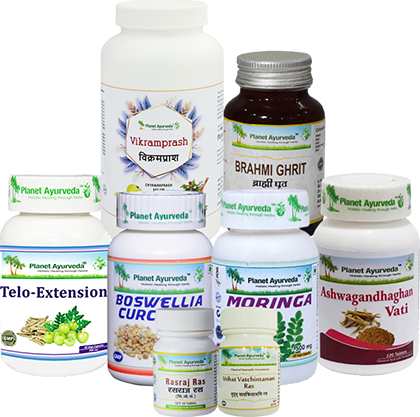
HERBAL REMEDIES BY PLANET AYURVEDA FOR ISAACS SYNDROME
Planet Ayurveda is an ISO certified company which formulates supplements for maintaining overall health. This company works with reference to Ayurveda – A Holistic Science. The supplements while maintaining health also assist in managing various disorders. These remedies are prepared from herbs and minerals that are free from any kind of added preservatives and synthetic materials. Due to this all the supplements are free from any kind of side effects. For managing the symptoms of Isaacs and making the quality of life better of that person the following remedies by Planet Ayurveda can be used:
- BOSWELLIA CURCUMIN
- ASHWAGANDHAGHAN VATI
- BRAHMI GHRIT
- VRIHAT VATCHINTAMANI RAS
- RASRAJ RAS
- VIKRAMPRASH
- MORINGA CAPSULES
- TELO-EXTENSION

PRODUCTS DESCRIPTION
1. BOSWELLIA CURCUMIN
Boswellia curcumin is a capsule formulation by Planet Ayurveda. These capsules consist of standardized extract of herbs shallaki (Boswellia serrata) and curcumin (Curcuma longa). Both these herbs consist of antioxidant properties that prevent the growth of free radicals in the body. This property helps in reducing ama dosha from the body and balances tridosha. These capsules also consist of analgesic properties that are very best in relieving the muscle pain.
Dosage: 1 capsule twice daily with plain water after meals.
2. ASHWAGANDHAGHAN VATI
Ashwagandhaghan vati is a classical Ayurvedic formulation which is prepared by Planet Ayurveda as per classical texts. This remedy is available in tablet form and consists of major ingredient ashwagandha (Withania somnifera). This herb is one of the best rasayana and has miraculous antioxidant properties. It also possesses immune boosting properties which by increasing immunity helps in preventing the immune system to destroy the body’s own tissues. Ashwagandha is also best for strengthening muscles thus it prevents symptoms such as muscle pain and muscle contraction.
Dosage: 2 tablets twice daily with plain water after meals.
3. BRAHMI GHRIT
Brahmi ghrit is an ayurvedic lhya preparation formulated by Planet Ayurveda as per classical Ayurvedic texts. This preparation consists of the ingredients such as brahmi (Bacopa monnieri), vacha (Acorus calamus), cow’s ghee and various others. Brahmi ghrit is one of the best remedies for brain health. It consists of wonderful vata pacifying properties that help in managing this condition as the condition is associated with the nervous system. By pacifying vata dosha this remedy helps in reducing muscle twitching or contraction which is the main symptom of Isaacs syndrome.
Dosage: ½ tsp twice daily with plain water after meals.
4. VRIHAT VATCHINTAMANI RAS
Vrihat Vatchintamani Ras is one of the best formulations used for vataj disorders since ancient times. Planet Ayurveda formulates this remedy as per classical Ayurvedic texts. This is a tablet formulation which consists of ingredients such as swarna bhasma (calyx of gold), abhrak bhasma (calyx of mica), rajata bhasma (calyx of silver) and various others. This remedy is vata pacifying and has rasayana properties. Both these properties by alleviating symptoms of Isaacs syndrome improves the quality of life of the patient.
Dosage: 1 tablet twice daily with plain water after meals.
5. RASRAJ RAS
Rasraj Ras is also one among those formulations which has been used since ancient times for vata vyadhi (neurological conditions). This remedy is in tablet form consisting of ingredients such as shuddha parada (purified mercury), shuddha abhrak (purified silica), vanga bhasma (calyx of tin), lavanga (Syzygium aromaticum) and various others. This remedy helps in preventing the formation of free radicals which restricts the accumulation of ama dosha. So if there is reduction of ama dosha in the body the immune system does not get hampered and the symptoms of Isaacs syndrome get resolved.
Dosage: 1 tablet once daily with plain water after meals.
6. VIKRAMPRASH
Vikramprash is an Ayurvedic jelly preparation full of miraculous herbs. This jelly formulation consists of herbs such as bilva (Aegle marmelos), agnimanth (Premna mucronata), patla (Stereospermum suaveolens), shalparni (Desmodium gangeticum) and various others. It has the best herbs that help in increasing the immunity and balances tridosha in the body. This remedy alleviates the various symptoms such as weight loss and gradual muscle loss. The remedy is also effective in increasing muscle strength as well as increasing muscle formation.
Dosage: 1 tsp twice daily with plain water after meals.
7. MORINGA CAPSULES
Moringa Capsules is a formulation by Planet Ayurveda which consists of standardized extract of herb moringa (Moringa oleifera). This herb assists in reducing the oxidative stress in the body thus preventing neurodegeneration. These capsules enhance the memory as well as help in reducing symptoms such as lack of coordination, hallucinations, memory loss, confusion, etc. Moringa capsules prevent nerve cell damage which further presents muscle twitching and contraction.
Dosage: 1 capsule twice daily with plain water after meals.
8. TELO-EXTENSION
Telo-Extension is one of the capsule formulations by Planet Ayurveda which is especially formed for improving nervous system health. These capsules consist of standardized extract of herbs such as Grapeseed (Vitis vinifera), giloy (Tinospora cordifolia), moringa (Moringa oleifera) and various others. These capsules promote brain health by preventing the immune system from killing the body’s own tissues. Thus the remedy Telo-extension assists in improving the quality of life of the person with Isaacs syndrome.
Dosage: 1 capsule twice daily with plain water after meals.
CONCLUSION
Isaacs syndrome is one of the autoimmune conditions which affects the peripheral nervous system. There is no exact correlation of this condition but it is considered an inherited and acquired type. Also the symptoms vary from patient to patient but commonly included symptoms are Muscle pain, Continuous twitching or contraction of muscles, Muscle stiffness and Muscle cramping. As per Ayurveda this condition occurred as a result of excessive ama accumulation in the body which further reduced the immunity of the body and caused an autoimmune effect. For eliminating this condition there is a need of removing ama dosha from the body and to balance vata dosha too. For this purpose Planet Ayurveda provides you with various miraculous herbal and herbomineral remedies that are 100% safe and have no side effects. So you can consume these remedies without worrying and can improve your quality of life.