Natural Treatment of Ankylosing Spondylitis (AS)

Abstract
Ankylosing spondylitis is complex and belongs to the group of rheumatic diseases. It causes severe back pain and spinal stiffness. People who are HLA-B27 positive, the Ankylosing spondylitis is common in 5% to 6% of people. According to the 2009 survey, rates of HLA-B27 were 7.5% among non-Hispanic whites, 4.6% among Mexican Americans, and 1.1% among non-Hispanic blacks.1.
We have discussed important points about ankylosing spondylitis like Ayurvedic aspect, causes, risk factors, complications, some herbs and herbal remedies with some home remedies which are highly effective on the disease.
Introduction of Ankylosing Spondylitis
Ankylosing spondylitis is a chronic and inflammatory disease that involves the spine; it also affects multiple other joints, such as the hips, knees, and chest. The severity and pattern of joint involvement vary from one individual to another. In the early stage of the disease, it results in inflammatory low back pain, with severe impairment of spinal mobility due to structural changes which ultimately leading to spinal fusion.

Ankylosing spondylitis is the type of arthritis within the rheumatic disease known as spondyloarthritis.
Genetics plays a significant role in this condition; 90% of cases with ankylosing spondylitis have a particular marker that can be found on their white blood cells, called HLA-B27. This means that the number of people with AS will have a family history of this condition, although it may be much more painful and involve multiple parts of the body in one family member to another.
Ayurvedic Aspect of Ankylosing Spondylitis
Ayurveda is an ancient and traditional form of medicine. Ayurveda is a holistic approach to the health of people. Ayurveda believes in maintaining a balance between mind, body, and soul which leads to the healthy state of the body. This balance between this mind, body, and soul is maintained by the balance between the Dosha, Dhatu, and Mala. Dosha is of three types Vata, Pitta, Kapha. Each Dosha is governed by a dominating factor-like Vata has Air dominating factor, Pitta has Fire, and Kapha has Water as a dominating factor which is present in our whole body. The balance between these Dosha helps in achieving a healthy state of body and imbalance between these Dosha causes various health problems.
According to Ayurveda, Ankylosing spondylitis is caused by the imbalance between the Vata dosha, the imbalance of Vata is caused due to genetic predisposing or wrong lifestyle. When Vata dosha gets aggravated, it gets loges in the bone tissue and causes gradual degeneration and depletion of bone tissue. When this disease is not treated on time it can cause severe back pain and stiffness and subsequently to structural abnormalities and disabilities.
Causes of Ankylosing Spondylitis
Ankylosing spondylitis specific cause is not known, genetic factor seems to be involved. In particular, Gene known as HLA-B27 are at great risk of Ankylosing Spondylitis.
Symptoms of Ankylosing Spondylitis
Symptoms of Early Stages
- Pain in one or both buttocks
- Pain that wakes up in the night
- Sometimes pain in the backs of the thigh
- Stiffness and pain in the lower back in the early morning that lasts at least 30 minutes.
Other Possible Symptoms of Ankylosing Spondylitis
- Pain and swelling in a toe and finger
- Tenderness at the base of the pelvis, which can make uncomfortable sitting on the hard chair.
- Soreness at the heel or in the arch of your foot
- Chest pain or tightness around the chest gradually. This can make difficult to take deep breaths. Coughing and sneezing may cause discomfort and pain.
- Depression and anxiety.
- Inflammation of the eye. The first signs are usually a painful or sometimes red eye. It may become uncomfortable to look at bright light.
- Inflammation of the bowel. Patients with Ankylosing Spondylitis can develop IBD (inflammatory bowel disease) or colitis.
- Fatigue which is severs tiredness that doesn’t get better with sleep or rest.
Risk factors of Ankylosing Spondylitis
- Age: It generally occurs in late adolescence or early adulthood.
- Heredity: Mostly people having Ankylosing Spondylitis have an HLA-B27 gene.
- Sex: Men are more likely to develop Ankylosing Spondylitis than women
Complications of Ankylosing Spondylitis
- Mood disorders
- Cauda Equina syndrome
- Aortic regurgitation
- Pulmonary fibrosis
- Chronic pain
- Disability
Herbs that are Helpful in Ankylosis spondylitis
1. Shallaki
The botanical name of Shalaki is Boswellia serrata. This herb contains Boswellia acid which contains strong anti-inflammatory and analgesic properties. It is very effective in chronic muscular and back pain. It works as a pain-killer.
2. Guggulu
The botanical name of Guggulu is Commiphora mukul. It works as a body detoxifier and promotes rejuvenation.it helps in balancing the Dosha. It supports the comfortable movements of the joints. It promotes strength and proper movement.
3. Shudh Laksha
The botanical name of Sudh Laksha is Laccifer lacca. This herb contains anti-arthritic, anti-inflammatory properties. It helps in balancing the aggravated Dosha. It is very useful in health problems like osteoporosis, osteomalacia, and osteoarthritis, etc.
4. Haridra
The botanical name of Haridra is Curcuma longa. This herb contains anti-inflammatory properties. It helps to soothe and look after the health of the bones. It helps in curing bone-related problems like stiffness in joints and difficulty in moving reduced flexibility.
Herbal Remedies of Ankylosing Spondylitis by Planet Ayurveda
Planet Ayurveda believes in treating people according to the principle of Ayurveda. They prepare their herbal remedies with the help of natural herbs. These herbal remedies are prepared according to the Ayurvedic principle. These herbal remedies are free from any chemical and preservative. The herbal remedies help in balancing the Dosha and provide healthy relief from the disease. These herbal remedies work on the root cause of the disease not just providing relief from the symptoms. These herbal remedies are 100% pure and vegetarian. For Ankylosing Spondylitis planet Ayurveda provides a joint care pack that includes different types of herbal remedies that work together on the disease.
JOINT CARE PACK
- Curcumin Capsules
- Joint aid plus
- Bone Support
- Coral calcium complex
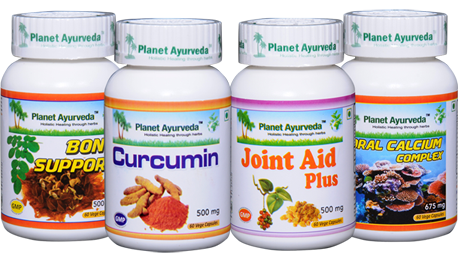

1. Curcumin Capsules
curcumin capsules contain Haridra herb which contains anti-inflammatory properties. It helps in purifies the blood and releasing toxins from the body. It helps in relieves aches and pains associated with arthritis. It provides strength to the immune system.
Dosage: 2 capsules twice daily with plain water after meals.
2. Bone Support
This herbal remedy contains various herbs like shudh laksha, Mukta, Arjuna, etc. these herbs help in strengthening and supporting the bones. It helps in improving the metabolism of calcium. It is very helpful in various health problems like osteoporosis, low bone density, and Ankylosing spondylitis. These capsules help in balancing the Dosha.
Dosage: 2 Capsules, twice daily with plain water after meals.
3. Joint Aid Plus
This herbal remedy contains herbs like Nirgundi, Shallaki, Guggul, etc. it contains anti-inflammatory and pain-relieving properties. it helps in balancing the aggravated Dosha which causes Ankylosing spondylitis. It is a great source of dietary nutrition for the bones.
Dosage: 2 Capsules, twice daily with plain water after meals.
4. Coral Calcium Complex
This herbal remedy contains different kinds of Phisti, Giloy satva, etc. these all are the great source of Calcium. It helps in balancing Vata Dosha which is responsible for Ankylosing spondylitis.
Dosage: 1 Capsule twice daily with plain water after meals.
Home Remedies for Ankylosing Spondylitis
Foods to Eat
1. Omega – 3 Fatty Acids
It works on joint inflammation. And omega-3 fatty acids work effectively on Ankylosing Spondylitis. Chia seeds, Flaxseeds, Flaxseed oil, walnuts are the good source of Omega-3 fatty acids.
2. Fruits and Vegetables
Eating different color fruits and vegetables in Ankylosing spondylitis is very beneficial. It contains a wide range of antioxidant compounds that help to protect against disease.
3. Whole Grains
A whole-grain includes – buckwheat, oatmeal, corn, and brown rice. This will help in reducing the inflammation.
4. Calcium-Rich Foods
Calcium-rich food includes- broccoli, Chinese cabbage, almonds, dark leafy greens, low-fat dairy products. It helps in providing strength to the bone.’
5. Vitamin D
Vitamin D helps in absorbing calcium and another vital nutrient for healthy bone. Vitamin D foods include- egg yolk, fortified products, such as juices, cereals, dairy, plant-based milk, and tofu.
Herbs and Spices
Specific herbs and spices contain anti-inflammatory properties like:
- Turmeric: It helps in reducing the inflammation.
- Garlic: Some compound in garlic works on inflammation.
- Ginger: It is used as an anti-inflammatory remedy for ages.
Other Tips
1. Heat Therapy
Fill a hot water bottle with warm water and apply a heating pad on the affected area it will help in reducing the stiffness and pain.
2. Stretching
Adding spine stretch or the low-back rotation to the daily activity helps in reducing pain.
3. Stop Smoking
Smokers are at a higher risk of spine damage.
Conclusion
Ankylosing spondylitis is a type of arthritis that causes severe back pain. By using herbal remedies by Planet Ayurveda and home remedies helps in fighting with this disease.
F&Q’s
Q1. What happens in ankylosing spondylitis?
A1. It is an inflammatory disease that causes swelling in the spine and nearby joints.
Q2. How serious is ankylosing spondylitis?
A2. If it is left untreated for a long time the disease progresses, pain and stiffness become more severe and regular.
Q3. Is ankylosing spondylitis painful?
A3. It can cause pain, stiffness, and inflammation from neck to lower back. The vertebra of the spine starts fusing.
Q4. What aggravates ankylosing spondylitis?
A4. Symptoms of ankylosing spondylitis may worsen in overweight patients. The extra weight puts pressure on the joints.
Q5. What is the best treatment for ankylosing spondylitis?
A5. Herbal Remedies by Planet Ayurveda are the best treatment for the ankylosing spondylitis. It works on the root cause of the disease and doesn’t cause any side effects.
Reference
- https://www.ncbi.nlm.nih.gov/books/NBK470173/