December 10, 2025
Canine Urolithiasis: Key Causes, Stone Types & Ayurvedic Support
Abstract
Urolithiasis in dogs refers to the formation of calculi within the urinary system, including the kidneys, ureters, bladder, and urethra. These stones develop when minerals such as calcium, oxalate, urate, cystine, xanthine, and phosphate reach supersaturation in urine due to altered metabolism, persistent infections, changes in diet, or genetic predispositions. The condition is increasingly observed in companion animals due to evolving lifestyles, dietary shifts, and metabolic diseases. This article examines the epidemiology, causes, clinical manifestations, diagnostic standards, and the role of Ayurveda and herbal management in supporting canine urinary health.
Introduction
Urolithiasis is a prominent health concern in veterinary practice, primarily due to its multifactorial nature and rising prevalence in domestic dogs. Over recent decades, the incidence of urinary stones in animals has shown a noticeable increase, paralleling trends seen in humans. The rise is attributed to modifications in nutrition, reduced physical activity, and growing rates of metabolic disorders. Dogs exhibit varying types of urinary stones depending on species-specific physiology, urinary pH, infection rates, and breed predisposition. Studies indicate that the occurrence of urolithiasis in dogs ranges between 0.2% and 3%, although the incidence of particular stone compositions varies widely. Understanding the pattern of stone formation in canines not only aids veterinary practitioners but also helps researchers explore dietary and metabolic links shared between animals and humans.
Types of Stones
1. Uric Acid Stones
Uric acid stones are commonly found in certain breeds, especially Dalmatians, due to inherited defects in purine metabolism. In these dogs, the liver is unable to convert uric acid efficiently, leading to elevated uric acid levels in urine. Another contributing issue is reduced tubular reabsorption of uric acid, causing high urinary concentrations. Although Dalmatians are most at risk, similar metabolic issues can also occur in other breeds.
Potential predisposing factors include:
- Higher purine breakdown and increased uric acid formation
- Reduced tubular reabsorption of uric acid
- Liver enzyme deficiencies
- Chronic urinary infections
- Low urine pH
Substances that promote uric acid crystal formation
2. Calcium Oxalate Stones
Excessive urinary calcium excretion is a major cause of calcium oxalate stone development in animals. Dogs consuming diets that influence calcium absorption and metabolism, or those with increased urinary acidity, are more prone. Lack of vitamin B6 and reduced activity of enzymes involved in oxalate metabolism may also contribute.
Calcium oxalate stones are commonly associated with:
- Hypercalciuria (too much calcium in urine)
- Acidic urine pH
- Increased consumption of oxalate-rich foods
- Certain metabolic conditions affecting calcium handling
- Genetic predisposition in some breeds
3. Calcium Phosphate Stones
These stones occur less commonly, and their exact mechanism is not fully understood in animals. However, metabolic diseases such as renal tubular acidosis, hyperparathyroidism, and persistent high calcium levels in the bloodstream can promote their formation. Altered urine pH and chronic metabolic imbalance further increase the risk.
Causes of Urolithiasis In Canines
The formation of urinary stones in dogs is the end result of several interlinked factors:
- Mineral Supersaturation: When the concentration of stone-forming minerals exceeds the solubility limit in urine, crystallisation begins. Variations in pH significantly determine which crystals form.
- Infections: Chronic or recurrent UTIs, especially those involving urease-positive bacteria, alter urinary pH and promote crystal aggregation, particularly struvite stones.
- Dietary Composition: Food rich in minerals such as calcium, oxalate, or purines contributes to stone formation. High-protein diets may increase urinary acidity, influencing calcium oxalate generation.
- Metabolic and Endocrine Disorders: Conditions such as hyperparathyroidism, Cushing’s disease, and renal tubular acidosis modify mineral handling at the renal level, promoting stone formation.
- Genetic Tendencies: Breeds like Dalmatians, Bulldogs, Schnauzers, and Poodles have been documented with increased susceptibility to specific stone types.
- Decreased Water Intake: Concentrated urine facilitates crystal nucleation and growth.
- Defects in Renal Reabsorption: Conditions such as cystinuria impair the kidney’s ability to reclaim amino acids, allowing accumulation and crystallisation of cystine.
Signs and Symptoms of Urolithiasis In Canines
Clinical manifestations vary depending on the location and size of the stone. Here are some of the common signs and symptoms of Urolithiasis:
- Frequent attempts to urinate
- Passing very small amounts of urine
- Straining during urination
- Painful urination (dysuria)
- Blood visible in urine (hematuria)
- Cloudy or foul-smelling urine
- Abdominal distension (in severe obstruction)
- Collapse in advanced cases of blockage
- Vocalisation or crying during urination
- Restlessness or pacing due to discomfort
- Lethargy or reduced activity
- Loss of appetite
- Vomiting (especially during urethral obstruction)
- Signs of distress due to the inability to pass urine
Diagnosis of Urolithiasis In Canines
A structured diagnostic approach helps identify the stone type and any underlying abnormalities:
- Clinical Examination: Assessment of bladder distension, pain, hydration, and overall health.
- Urinalysis: Evaluation of urine pH, crystal presence, infection indicators, and specific gravity.
- Urine Culture: Confirms bacterial infection and guides appropriate antibiotic selection.
- Imaging:
- Radiography for radiopaque stones (struvite, calcium oxalate)
- Ultrasonography for radiolucent stones (urate, cystine)
- Contrast studies to detect hidden obstructions
- Blood Tests: Kidney function, calcium levels, liver profile, and electrolytes to assess metabolic causes.
- Stone Analysis: Chemical examination of retrieved stones to determine precise composition and plan long-term prevention.
Management of Urolithiasis In Canines
Management of urolithiasis in dogs is tailored to the stone type, size, and severity of symptoms, combining dietary, medical, and procedural approaches. Special prescription diets help dissolve specific stones like struvite by altering mineral balance and urinary pH, while medical therapy may include antibiotics, pH-modifying agents, and drugs targeting metabolic causes. Surgical removal is required when stones obstruct urine flow, fail to dissolve, or arise from structural urinary tract issues, whereas minimally invasive options such as laser lithotripsy and endoscopic extraction offer faster recovery in equipped centres. Long-term success relies on regular monitoring through urine tests, imaging, and ongoing dietary adjustments to prevent recurrence.
Ayurvedic Overview of Urolithiasis In Canines
In Ayurveda, urinary stones in pets are understood as “Asmari,” a condition that develops from faulty digestion, accumulation of toxins, and imbalance of the doshas. When pets consume an inappropriate diet, drink insufficient water, experience urinary infections, or hold urine for long periods, their urine becomes concentrated and promotes the settling of salts. Kapha aids in binding these deposits, Vata encourages dryness and crystal buildup, and Pitta increases heat and acidity, making the stones harder and more compact. Gradually, these changes obstruct normal urine flow, leading to straining, pain, and discomfort in the abdomen or flank region. Thus, Ayurveda attributes stone formation and recurrent urinary problems in animals to poor detoxification, inadequate hydration, and improper dietary practices.
Herbal Remedies for Urolithiasis In Canines By Planet Ayurveda
Planet Ayurveda is a globally trusted herbal manufacturing brand dedicated to preserving the ancient wisdom of Ayurveda through pure, natural, and authentic formulations. All products are made using standardised extracts of herbs, free from chemicals, preservatives, steroids, and artificial additives. The company follows strict GMP-certified production, ensuring safety, potency, and high therapeutic value. Each formulation is created under the guidance of expert Ayurveda doctors using classical principles. With worldwide delivery and a strong reputation for quality, Planet Ayurveda continues to promote holistic healing and natural wellness through its premium herbal products.
In this Article, we will discuss some effective formulations of Planet Ayurveda for the management of Urolithiasis in Canines. Let’s Start!
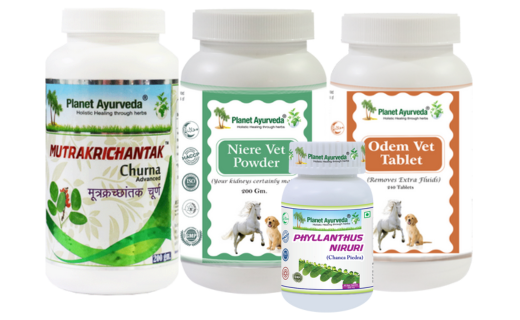
Product List
- Niere Vet Powder
- Odem Vet Tablet
- Mutrakrichantak Churna
- Phyllanthus Niruri Capsules

Product Description
1. Niere Vet Powder
Niere Vet Powder by Planet Ayurveda helps manage urolithiasis in pets through herbal ingredients that regulate crystallisation, ease inflammation, and support kidney function. Varun (Crateva nurvala) contains lupeol and sterols that help prevent crystal retention. Bhumi Amla (Phyllanthus niruri) provides phyllanthin compounds that inhibit stone aggregation. Gokshur (Tribulus terrestris) offers Protodioscin that soothes the urinary tract and supports smooth urine flow. Kaasni (Cichorium intybus) contains chicoric acid that aids kidney detoxification. Shirish (Albizia lebbeck) provides bioactive flavonoids that reduce irritation. Shigru (Moringa oleifera) supplies antioxidants that promote renal repair. Apamarg (Achyranthes aspera) helps break down mineral deposits, while Punarnava (Boerhavia diffusa) enhances diuresis to prevent further crystal formation.
Dosage: 5 gms twice daily (for dogs, cats, and small pets), 15 gms twice daily (for horses and large animals), or as directed by the physician.
2. Odem Vet Tablet
Odem Vet Tablet by Planet Ayurveda supports urolithiasis management in animals through herbs enriched with targeted phytochemicals that help balance minerals and maintain urinary clarity. Pippali (Piper longum) and Marich (Piper nigrum) supply piperine, which improves metabolic activity and reduces deposition of stone-forming ions. Sonth (Zingiber officinale) provides gingerols and shogaols that shield kidney tissues from oxidative irritation caused by crystals. Haritaki (Terminalia chebula) contains chebulagic acid and chebulinic acid, which discourage crystal adhesion and aid detoxification. Nishotha (Operculina turpethum) offers turpethin glycosides that help clear metabolic wastes associated with recurrent calculi. Gokshur (Tribulus terrestris) delivers protodioscin and steroidal saponins, promoting diuresis that flushes out micro-crystals and minimises stone recurrence.
Dosage: 2 Tablets twice daily (For Dogs, Cats, and Small Pets), 8 Tablets twice daily (For Horses and Big Animals) or as directed by a Physician.
3. Mutrakrichantak Churna
Mutrakrichantak Churna by Planet Ayurveda supports urolithiasis management in domestic animals through herbs packed with bioactive molecules that regulate crystal formation and enhance urinary purification. Varun (Crataeva nurvala) contains crataevine and lupeol acetate, which help soften mineral deposits and improve bladder contractility for easier stone elimination. Bhumi Amla (Phyllanthus niruri) offers nirurine and flavonoid glycosides that interfere with calcium-oxalate crystal nucleation and reduce stone growth. Gokshur (Tribulus terrestris) provides dioscin and tribulosin, promoting gentle diuresis that washes out urinary sediments. Kalmegh (Andrographis paniculata) delivers neoandrographolide and andrograpanin, which support renal detoxification and reduce irritation caused by crystal movement. Together, these phytocompounds maintain a cleaner urinary milieu and lower the chances of recurrent stone formation in animals.
Dosage: 5 gms twice daily (for dogs, cats, and small pets), 15 gms twice daily (for horses and large animals), or as directed by the physician.
4. Phyllanthus Niruri Capsules
Phyllanthus Niruri Capsules by Planet Ayurveda help manage urolithiasis in domestic animals through the targeted action of bioactive molecules naturally present in Phyllanthus niruri. The herb contains phyllanthin and hypophyllanthin, ellagic acid and corilagin, which interfere with crystal binding and discourage the layering of mineral salts that leads to stone enlargement. Its geraniin content stabilises urinary pH and reduces the tendency of calcium oxalate and urate crystals to cluster. Compounds like quercetin and rutin support smooth muscle relaxation, aiding the natural downward movement of stones. Brevifolin and nirurinetin offer strong renal-protective activity by reducing tissue irritation caused by crystal edges. Together, these phytochemicals help dissolve small deposits, maintain urinary clarity, and reduce the likelihood of recurrent stone formation in animals.
Dosage: 1 Capsule twice daily (for dogs, cats, and small pets), 2 Capsules twice daily (for horses and large animals), or as directed by the physician.
Conclusion
Urolithiasis in canines is a complex condition shaped by dietary patterns, metabolic imbalances, infections, and genetic factors. Rising prevalence in modern pets highlights the need for improved awareness and prevention. Accurate diagnosis, timely medical or surgical care, and appropriate dietary management form the cornerstone of veterinary treatment. Ayurveda enriches this approach by offering natural strategies that enhance urinary flow, support calculus breakdown, reduce inflammation, and improve overall renal health. The integration of both systems—veterinary science and traditional Ayurvedic wisdom—provides a comprehensive pathway for managing urinary stones in dogs while minimising recurrence and promoting long-term well-being.
FAQs
- What are the symptoms of Urolithiasis in dogs?
Dogs with urolithiasis often show painful urination, frequent attempts to urinate, blood in urine, straining, licking of the genital area, and sometimes complete urinary blockage. - What is the treatment of Urolithiasis in animals?
Ayurvedic management includes Mutrala (diuretic) and Ashmari-bhedana (stone-breaking) herbs like Gokshura, Varuna, Bhumi Amla, and Pashanbheda, along with dietary regulation and increased hydration. - What are the Struvite stones in Dogs?
Struvite stones are magnesium ammonium phosphate crystals that form in alkaline urine, commonly associated with urinary tract infections caused by urease-producing bacteria. - Explain Urolithiasis in Dogs?
Urolithiasis in dogs refers to the formation of stones (uroliths) in the urinary tract, leading to irritation, obstruction, infection, and difficulty in passing urine.

Dr. Vikram Chauhan
https://www.planetayurveda.comDr. Vikram Chauhan (MD - Ayurveda) is a Globally Renowned Ayurveda Physician with Expertise of more than 25 Years. He is the CEO & Founder of http://www.PlanetAyurveda.com, a leading Ayurveda Brand, Manufacturing, and Export Company with a Chain of Clinics and Branches in the US, Europe, Africa, Southeast Asia, India, and other parts of the World. He is also an Ayurveda Author who has written Books on Ayurveda, translated into Many European Languages. One of his Books is "Ayurveda – God’s Manual for Healing". He is on a Mission to Spread Ayurveda All Over the Planet through all the Possible Mediums. With his Vast Experience in Herbs and their Applied Uses, he is successfully treating Numerous Patients suffering from Various Ailments with the help of the Purest Herbal Supplements, Diet, and Lifestyle, according to the Principles of Ayurveda. For More Details, visit - www.planetayurveda.com, www.alwaysayurveda.com
View more posts from this author