November 21, 2026
Herbal Remedies of Piriformis syndrome – Causes, Symptoms, Diagnosis & Treatment
Abstract
Piriformis syndrome is a common cause of deep buttock and leg pain. It happens when a small muscle deep inside your buttock, called the piriformis muscle, becomes tight, swollen, or spasms and presses on the nearby sciatic nerve. Because the pain travels down the leg, people often confuse it with a slipped disc in the spine. The condition can be caused by unusual muscle anatomy present from birth, or by overuse, poor posture, heavy lifting, and long hours of sitting. When the muscle squeezes the nerve, it reduces blood flow and irritates the nerve fibers, causing pain, numbness, and a burning sensation. Doctors diagnose it by moving the leg in specific ways to see if it triggers the pain, and by using scans to make sure the spine is healthy. Modern treatments include gentle stretching, physical therapy, pain medicines, and injections. Traditional Ayurveda views this as an imbalance of Vata dosha causing stiffness and pain in the lower body, which is treated with warm oil applications, heat, and natural herbs. Most people recover well with early care and proper exercises.

Introduction
Piriformis syndrome is a condition that causes pain deep in the buttock and down the back of the leg. The piriformis is a flat, band-like muscle located deep inside the gluteal region near the hip joint. Its main job is to help turn the leg outward, move the hip sideways, and keep the pelvis stable when we walk or run. The main nerve of the leg—the sciatic nerve—runs right under or sometimes directly through this muscle. Because they are so close together, any swelling, tightness, or injury in the piriformis muscle can easily compress or pinch the sciatic nerve. This pinching causes sharp, burning pain or numbness that feels very similar to spinal sciatica. Understanding piriformis syndrome is important because treating the buttock muscle directly brings relief, whereas treating the lower spine by mistake will not solve the underlying problem.
Causes
Piriformis syndrome happens when the muscle becomes overworked, irritated, or irritated from birth. The causes are usually divided into two main categories:
Primary Causes (Anatomical)
Some people are born with a slight variation in their body structure. Instead of the sciatic nerve passing under the piriformis muscle normally, the nerve might run directly through the muscle belly or split around it. This makes the nerve much more likely to get squeezed whenever the muscle contracts.
Secondary Causes (Acquired)
Most cases happen over time due to daily habits or injuries:
- Direct Injury: Falling on the buttocks, getting into a car accident, or taking a direct hit during sports can cause swelling, bleeding, and scarring inside the muscle.
- Repetitive Overuse: Running, cycling, rowing, or climbing stairs repeatedly without proper rest can strain the muscle and make it swell.
- Prolonged Sitting: Sitting for long hours on hard chairs or driving long distances puts continuous pressure on the muscle, cutting off normal blood flow.
- Poor Posture and Muscle Imbalance: Having unequal leg lengths, weak hip muscles, or flat feet puts extra stress on the piriformis, forcing it to work harder and spasm.
Pathophysiology
Pathophysiology simply means what goes wrong inside the body to create the symptoms. When the piriformis muscle gets overworked or injured, it contracts tightly and cannot relax. This continuous spasm builds up pressure inside the muscle, squeezing the tiny blood vessels that feed it. Without enough blood and oxygen, the muscle produces waste products like lactic acid, which causes local pain and keeps the muscle locked in a spasm. At the same time, the tight muscle presses tightly against the sciatic nerve running beneath it. This constant mechanical friction and squeezing damages the outer protective cover of the nerve and slows down the nerve signals. It also causes swelling around the nerve tissues. The irritated nerve sends severe pain signals up to the brain, which you feel as a sharp ache, burning, or tingling down your thigh and calf.
Signs and Symptoms
The signs and symptoms of piriformis syndrome usually affect one side of the lower body and get worse with specific movements.
- Deep Buttock Pain: A constant, dull ache deep in the center of the buttock is the most common sign.
- Radiating Nerve Pain: Pain that shoots or burns from the buttock down the back of the thigh, sometimes reaching the upper calf.
- Numbness and Tingling: A “pins and needles” sensation or loss of feeling along the back of the leg.
- Pain During Sitting: Feeling severe discomfort when sitting for more than 20–30 minutes, driving, or sitting with crossed legs.
- Worse with Movement: Pain increases when walking up stairs, squatting, running, or turning the hip outward.
- Tenderness to Touch: Pressing firmly on the deep muscle in the buttock causes sharp, immediate pain.
Diagnosis
Diagnosing piriformis syndrome involves finding out if the buttock muscle is the true source of pain and ruling out spine problems.
Physical Tests
A doctor or physiotherapist will move your leg in specific ways to stretch or contract the piriformis muscle.
- They may push your knee up and inward toward your opposite shoulder (FAIR test) to stretch the muscle across the nerve. If this reproduces your exact pain, the test is positive.
- They will also press directly on the muscle to check for tight knots and tenderness.
Imaging Scans
Standard X-rays and basic MRI scans of the lower back usually show normal results in piriformis syndrome. However, doctors use them to make sure you do not have a herniated disc, spinal stenosis, or joint arthritis. Specialised neuro-MRI scans can sometimes show a swollen sciatic nerve near the hip.
Diagnostic Injections
If the diagnosis is unclear, a doctor might inject a tiny amount of numbing medicine directly into the piriformis muscle using ultrasound guidance. If your pain disappears right away, it confirms that the piriformis muscle was the cause.
Modern Management
Modern medical care focuses on relaxing the muscle, removing pressure from the nerve, and preventing future irritation.
Rest and Lifestyle Changes
Taking a break from heavy sports, avoiding sitting on hard surfaces for long periods, and taking short walk breaks during desk work help the muscle calm down.
Medications
Pain relievers, anti-inflammatory medicines (like ibuprofen), and muscle relaxants help lower swelling and ease muscle tightness.
Physical Therapy
This is the key long-term treatment. A therapist uses gentle gluteal stretches, deep tissue massage, and heat therapy to relax the muscle. Once the pain decreases, they teach you exercises to strengthen your hip and core muscles.
Targeted Injections
If stretching and medicine do not bring relief, doctors can inject a corticosteroid or botulinum toxin (Botox) directly into the muscle. This temporarily relaxes the muscle and calms nerve inflammation for several months.
Surgery
Surgery is very rare and only considered if all other treatments fail after many months. A surgeon makes a small incision to release the piriformis tendon and free the pinched nerve.
Ayurveda Insight
In traditional Ayurveda, piriformis syndrome is viewed as an imbalance in Vata dosha, which controls movement, nerve signals, and circulation in the body. When Vata becomes aggravated—often due to cold weather, overexertion, stress, or dry food—it settles in the lower back, pelvis, and muscles (Mamsa dhatu), causing dryness, stiffness, and pain. This condition strongly resembles Gridhrasi (sciatica). Ayurvedic care focuses on soothing Vata, relaxing stiff muscles, and nourishing nerve tissues through gentle, natural methods:
External Oil Application (Abhyanga)
Massaging the lower back and gluteal area with warm medicated oils like Mahanarayana Taila or Kottamchukkadi Taila helps soften tight tissues and improves blood flow.
Warm Heat Therapy (Swedana)
Applying herbal steam or a warm compress (Nadi Sweda) after oil massage helps relieve deep muscle spasms and stiffness.
Specialised Pelvic Therapy (Kati Basti)
Warm medicated oil is held over the lower back or gluteal region using a small frame made of dough. This deeply warms and nourishes the deep muscles and nerves.
Internal Herbal Remedies
Natural anti-inflammatory herbs such as Guggulu (like Yogaraja Guggulu), Rasna, and Ashwagandha are given to reduce internal swelling, strengthen the nerves, and pacify Vata.
Dietary Guidance
Eating warm, freshly cooked, and mildly unctuous foods while avoiding cold, dry, or stale meals helps keep Vata balanced.
Herbal Remedies by Planet Ayurveda
Planet Ayurveda focuses on promoting natural healthcare through a wide range of herbal formulations prepared with carefully selected ingredients. Its products are based on traditional Ayurvedic principles and aim to support different aspects of health and daily wellness. The brand combines classical Ayurvedic knowledge with quality-focused manufacturing to make herbal healthcare accessible to people worldwide. With a diverse product range for digestive, liver, joint, skin, and general health concerns, Planet Ayurveda encourages a natural approach to maintaining well-being. Its vision is to take Ayurveda to every home worldwide. Here, we will discuss some effective formulations for the management of Piriformis Syndrome, which are as follows:
- Neurogenie Capsules
- Boswellia Curcumin
- Rasnadi Guggul
- Hakam Churn
- Balashwagandha Oil
Herbal Remedies of Piriformis Syndrome
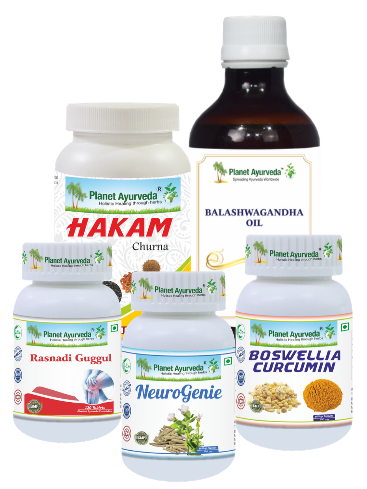

Product Description
1. Neurogenie Capsules
Planet Ayurveda’s Neurogenie Capsules, containing Brahmi (Bacopa monnieri) and Ashwagandha (Withania somnifera), provide targeted therapeutic support in managing piriformis syndrome by addressing both neural irritation and muscular hypertonicity. Ashwagandha acts as a potent anti-inflammatory, analgesic, and Vata-pacifying herb that helps reduce localised swelling and continuous muscle spasms within the deep piriformis muscle, thereby relieving mechanical compression on the adjacent sciatic nerve. Simultaneously, its muscle-relaxant properties alleviate local tissue hypoxia and tightness in the gluteal region, improving leg mobility. Brahmi functions as a neuroprotective and nervine tonic that enhances nerve repair, calms perineural oedema, and mitigates the sharp, burning neuropathic pain and paresthesias radiating down the sciatic distribution.
Dosage: 1 Capsule twice daily after meals with plain water.
2. Boswellia Curcumin Capsules
It combines Shallaki (Boswellia serrata) and Curcumin (Curcuma longa), providing powerful targeted relief for piriformis syndrome by directly disrupting the underlying inflammatory and ischemic cascade. Shallaki contains potent boswellic acids that inhibit the 5-LOX enzyme pathway, effectively suppressing localised perineural oedema and reducing inflammatory cytokine accumulation around the compressed sciatic nerve. Concurrently, Curcumin acts as a natural NF-kB and COX-2 inhibitor, mitigating deep gluteal myofascial inflammation and soothing the continuous muscle spasms of the hypertonic piriformis muscle. By decreasing local tissue swelling within the tight sub-gluteal space, this synergistic combination relieves mechanical pressure on the sciatic nerve trunk, thereby easing burning pain, numbness, and tingling radiating down the posterior leg. Additionally, their combined antioxidant and Vata-pacifying properties improve local microcirculation, preventing ischemic tissue hypoxia and accelerating the recovery of irritated neural and muscular fibres.
Dosage: 1 Capsule twice daily after meals with plain water.
3. Rasnadi Guggul
Rasnadi Guggul, formulated with key ingredients such as Rasna (Pluchea lanceolata), Guggul (Commiphora mukul), Eranda (Ricinus communis), etc., offers powerful targeted support for piriformis syndrome by pacifying aggravated Vata dosha and relieving deep musculoskeletal compression. Rasna acts as a premier anti-inflammatory and analgesic herb that specifically targets deep lumbopelvic pain, reducing perineural inflammation and radiating nerve discomfort along the sciatic path. Guggul acts as a potent bioavailability enhancer and tissue detoxifier, breaking down local metabolic stagnation, alleviating myofascial stiffness, and reducing swelling around the compressed sciatic nerve trunk. Eranda provides a deep-penetrating (Sukshma) property with natural purgative and muscle-relaxant actions, effectively relieving involuntary spasms within the hypertonic piriformis muscle and improving local microcirculation to prevent ischemic hypoxia.
Dosage: 2 tablets twice daily after meals with plain water.
4. Hakam Churna
Hakam Churna, a polyherbal formulation containing Chandurshoor (Lepidium sativum), Kalonji (Nigella sativa), Methi (Trigonella foenum-graecum), and Ajwain (Trachyspermum ammi), offers targeted management for piriformis syndrome through its strong Vata-pacifying, anti-spasmodic, and digestive-metabolic (Ama-pachana) properties. The deep-penetrating and warm potency (Ushna Virya) of Ajwain and Methi helps relieve persistent stiffness and involuntary spasms in the deep piriformis muscle, easing mechanical compression on the underlying sciatic nerve trunk. Kalonji acts as a powerful natural anti-inflammatory and analgesic agent that reduces localised perineural swelling and microvascular congestion in the gluteal space. Chandurshoor contributes potent nervine-strengthening and pain-relieving effects that help alleviate sharp, burning sensations and paresthesias radiating down the posterior thigh and calf. By clearing local tissue toxins (Ama) and restoring microcirculation, this herbal combination alleviates ischemic tissue hypoxia, relaxes tight myofascial fibers, and systematically restores smooth, pain-free leg movement.
Dosage: 1 tsp twice daily after meals with lukewarm water.
5. Balashwagandha Oil
Balashwagandha Oil, an Ayurvedic polyherbal formulation combining mainly Bala (Sida cordifolia) and Ashwagandha (Withania somnifera) along with other herbs, provides targeted therapeutic relief for piriformis syndrome through its deep-penetrating Vata-hara, anti-inflammatory, and muscle-nourishing properties. When applied topically through warm massage (Abhyanga) or localised oil pooling (Kati Basti), its warm potency (Ushna Virya) penetrates deep gluteal tissues to relieve involuntary spasms and hypertonicity in the piriformis muscle. This relaxation directly decompresses the underlying sciatic nerve trunk, reducing mechanical friction, local swelling, and tissue hypoxia in the sub-gluteal space. Bala acts as a potent muscle-strengthener and nerve tonic, enhancing local blood circulation and relieving deep myofascial stiffness around the pelvic joint. Simultaneously, Ashwagandha suppresses inflammatory mediators, calming perineural oedema and mitigating the burning pain, numbness, and paresthesias radiating down the leg.
How to Use: For local application or as directed by an Ayurvedic physician.
Conclusion
Piriformis syndrome is a treatable condition that occurs when a tight gluteal muscle pinches the main sciatic nerve of the leg. Although the radiating pain can feel frightening and mimic a serious spine injury, proper diagnostic testing helps pinpoint the muscle as the true cause. Modern medical treatments like targeted stretching, physical therapy, and anti-inflammatory care work effectively to release the muscle and free the nerve. Combined with Ayurvedic principles of warm oil applications, gentle heat, and Vata-balancing herbs, most people can get complete relief from pain, regain full leg mobility, and return to their daily activities without long-term problems.

Dr. Vikram Chauhan
https://www.planetayurveda.comDr. Vikram Chauhan (MD - Ayurveda) is a Globally Renowned Ayurveda Physician with Expertise of more than 25 Years. He is the CEO & Founder of http://www.PlanetAyurveda.com, a leading Ayurveda Brand, Manufacturing, and Export Company with a Chain of Clinics and Branches in the US, Europe, Africa, Southeast Asia, India, and other parts of the World. He is also an Ayurveda Author who has written Books on Ayurveda, translated into Many European Languages. One of his Books is "Ayurveda – God’s Manual for Healing". He is on a Mission to Spread Ayurveda All Over the Planet through all the Possible Mediums. With his Vast Experience in Herbs and their Applied Uses, he is successfully treating Numerous Patients suffering from Various Ailments with the help of the Purest Herbal Supplements, Diet, and Lifestyle, according to the Principles of Ayurveda. For More Details, visit - www.planetayurveda.com, www.alwaysayurveda.com
View more posts from this author