August 27, 2026
Chandrakala Rasa : Ingredients, Preparation, Ayurvedic Properties, Indications & Dosages
Abstract
Urinary disorders such as Mutrakrcchra (dysuria) and Raktapitta (bleeding disorders) described in Ayurveda occur due to vitiation of Pitta and Rakta Doshas, leading to inflammation, burning sensation, and disturbed fluid metabolism in Mutravaha Srotas (urinary channels). Chandrakala Rasa, a classical herbo-mineral formulation is renowned for its potent Pittashamaka (Pitta-pacifying), Raktashodhaka (blood-purifying), and Mutrala (diuretic) properties. It primarily acts on Rakta and Mutravaha Srotas (microchannels associated with blood and urinary system, cooling and cleansing the urinary system while promoting smooth urine flow. By pacifying Pitta and supporting Rakta Dhatu (blood tissues), Chandrakala Rasa serves as a comprehensive Ayurvedic remedy for urinary and bleeding disorders, ensuring internal cooling, tissue regeneration, and overall Pittaja Shamana (balance of aggravated Pitta).
Introduction
Chandrakala Ras is a classical Rasoushadh (herbo-mineral formulation) described in authoritative Ayurvedic texts under Mutrakrcchra Chikitsa Adhyaya (chapter on urinary disorders). The name “Chandrakala” signifies the cooling, soothing, and restorative qualities of the moon, symbolizing its profound efficacy in pacifying aggravated Pitta and Rakta Dosha within the urinary and reproductive systems. It is indicated in disorders such as Mutrakrcchra (dysuria), Mutraghata (urinary retention), Raktameha (hematuria), and Prameha (urinary disorders including diabetes).
This formulation acts as a potent Pittashamak (Pitta-pacifying), Mutral (diuretic), and Rasayana (rejuvenative) medicine, offering cooling and detoxifying action on the urinary tract. By alleviating inflammation, burning sensation, and urinary discomfort, Chandrakala Ras helps restore the normal flow of urine and ensures the proper balance of Dosha in Mutravaha Srotas (urinary channels). Its holistic impact extends to strengthening renal function, reducing oxidative stress, and enhancing systemic vitality, making it a valuable remedy for urinary and metabolic disorders rooted in Pitta vitiation.
Classical Indication
Mutrakrcchra (dysuria)
Ingredients
- Suta (Parada Shuddha) – Purified Mercury – 12 g
- Tamra Bhasma – Calcined Copper – 24 g
- Abhraka Bhasma – Calcined Mica – 12 g
- Gandhaka Shuddha – Purified Sulphur – 12 g
- Musta Kwatha – Decoction of Cyperus rotundus – Q.S. for Bhavana (trituration)
- Dadima Svarasa – Fresh Juice of Punica granatum (Pomegranate) – Q.S. for Bhavana (trituration)
- Durva Svarasa – Fresh Juice of Cynodon dactylon (Bermuda grass) – Q.S. for Bhavana (trituration)
- Ketaki Svarasa – Fresh Juice of Pandanus odoratissimus – Q.S. for Bhavana (trituration)
- Stamaja Drava (Go Dugdha) – Cow’s Milk – Q.S. for Bhavana (trituration)
- Sahadevi – Vernonia cinerea – Q.S. for Bhavana (trituration)
- Kumari – Aloe vera – Q.S. for Bhavana (trituration)
- Parpata – Fumaria indica – Q.S. for Bhavana (trituration)
- Ramasitalika Toya – water of Ramasitalika – Q.S. for Bhavana (trituration)
- Shatavari Rasa – Juice of Asparagus racemosus – Q.S. for Bhavana (trituration)
- Tikta (Katuka) – Picrorhiza kurroa (Root) – 12 g
- Guduchi Sattva – Tinospora cordifolia (Extract) – 12 g
- Parpata – Fumaria indica (Whole plant) – 12 g
- Usira – Vetiveria zizanioides – 12 g
- Madhavi – Hiptage benghalensis – 12 g
- Srigandha (Sveta Candana) – Santalum album (White sandalwood) – 12 g
- Sariva (Sveta Sariva) – Hemidesmus indicus – 12 g
- Draksha Kashaya – Decoction of Vitis vinifera (Grapes) – Q.S. for Bhavana (trituration)
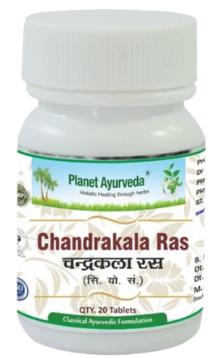
Chandrakala Rasa

Description of the Ingredients
1. Suta (Purified Mercury)
Is a potent Rasadravya possessing Yogavahi (catalytic) and Rasayana (rejuvenative) properties. It exhibits Madhura (sweet) and Tikta (bitter) Rasa, Snigdha (unctuous) and Sara (mobile) Guna. The metallic microform of mercury enhances cellular rejuvenation and acts as a carrier for other ingredients, ensuring deeper tissue penetration. In Chandrakala Rasa, it aids in pacifying aggravated Pitta and Rakta Dosha, regulates metabolism, and promotes smooth urine flow by cleansing the Mutravaha Srotas (urinary channels). The elemental property of mercury supports diuretic action, reducing burning micturition and inflammation associated with Mutrakrichha (urinary difficulty).
2. Tamra Bhasma – Calcined Copper
Tamra Bhasma (Calcined Copper) possesses Tikta (bitter) and Kashaya (astringent) Rasa, Laghu (light) and Ruksha (dry) Guna, Ushna Virya (hot potency), and Katu Vipaka (pungent post-digestive effect). It has a strong Lekhana (scraping) and Shothahara (anti-inflammatory) effect, making it effective in removing excess Pitta and Rakta Dushti (vitiation of blood). Bioactive copper ions assist in enzymatic detoxification, enhance liver function, and regulate lipid metabolism. In Chandrakala Rasa, it reduces burning sensation during urination and supports blood purification by improving the microcirculation of the Mutravaha Srotas. Its antimicrobial and astringent actions help prevent infection in Mutraghata (urinary retention) and Rakta-Pitta (bleeding disorders).
3. Abhraka Bhasma – Calcined Mica
Abhraka Bhasma (Calcined Mica) is a Rasayana renowned for its Balya (strengthening), Deepana (digestive stimulant), and Mutrala (diuretic) effects. It has Madhura (sweet) and Kashaya (astringent) Rasa, Laghu (light) and Snigdha (unctuous) Guna, and Madhura Vipaka (sweet post-digestive effect). Chemically rich in potassium, magnesium, and silicates, it rejuvenates urinary and reproductive tissues while maintaining electrolyte balance. In Chandrakala Rasa, it strengthens the Mutravaha Srotas (urinary microchannels) and enhances urinary output, reducing Daha (burning) and Shoola (pain) in Mutrakrichha (dysuria). It also stabilizes Pitta in the blood, preventing hematuria and promoting tissue healing.
4. Gandhaka Shuddha – Purified Sulphur
Gandhaka (Purified Sulphur) is known for its Krimighna (antimicrobial), Vishaghna (detoxifying), and Rakta-Pitta Shamaka (blood and Pitta pacifying) qualities. It has Tikta (bitter) and Madhura (sweet) Rasa, Snigdha (unctuous) Guna, Ushna Virya (hot potency), and Madhura Vipaka (sweet post-digestive effect). Sulphur compounds act as natural antimicrobials and antioxidants, detoxifying urinary and blood channels. In Chandrakala Rasa, Shuddha Gandhaka purifies Rakta Dhatu, alleviates Pittaja Daha (burning), and relieves Mutrakrichha by soothing mucosal irritation. It also supports regeneration of urinary epithelium, preventing infection and inflammation of the bladder.
5. Musta Kwatha – Decoction of Cyperus rotundu
Musta (Cyperus rotundus) is Tridosha Shamak with a special affinity for Pitta and Kapha. It has Tikta (bitter) and Katu (pungent) Rasa, Laghu (light) and Ruksha (dry) Guna, and Sheeta Virya (cold potency). Its main bioactive compounds—cyperol and rotundone—act as anti-inflammatory and diuretic agents. In Chandrakala Rasa, Decoction of Cyperus rotundus aids Bhavana (trituration) by imparting deep cooling and detoxifying effects, relieving Mutradaha (urinary burning) and Pittaja Shoola (heat-related pain). It purifies the Rakta Dhatu (blood tissues) and stabilizes urinary output, preventing recurrence of Mutrakrichha.
6. Dadima Svarasa (Fresh Juice of Punica granatum – Pomegranate)
Dadima Svarasa, extracted from the fresh fruit of Punica granatum (Pomegranate), is Madhura-Amla Rasa (sweet-sour taste) dominant with Laghu (light) and Snigdha (unctuous) Guna, Sheeta Virya (cooling potency), and Madhura Vipaka (sweet post-digestive effect). It primarily pacifies Pitta and Vata Dosha while nourishing Rakta Dhatu (blood tissue) and mutravaha srotas (urinary channels).
In Chandrakala Ras, Dadima Svarasa (Pomegranate juice) acts as a natural raktaprasadaka (blood purifier) and pittashamaka (coolant). Its bioactive constituents— punicalagin, ellagic acid, and anthocyanins— exhibit potent antioxidant and anti-inflammatory actions, soothing the inflamed urinary mucosa in Mutrakrichha (dysuria). By stabilizing oxidative stress and reducing microbial load, Dadima helps prevent burning micturition and Pitta-Rakta Dushti (deranged heat and blood vitiation) that commonly manifest as mutrakricchra, mutra daha (burning urine), and raktamutra (hematuria).
7. Durva Svarasa (Fresh Juice of Cynodon dactylon – Bermuda Grass)
Durva Svarasa, obtained from the fresh shoots of Cynodon dactylon (Bermuda grass), possesses Kashaya-Tikta Rasa (astringent-bitter taste), Laghu (light) and Ruksha (dry) Guna, Sheeta Virya (cool potency), and Katu Vipaka (pungent post-digestive effect). It pacifies Pitta and Rakta Dushti (vitiated heat and blood) and acts as a Mutrala (diuretic) and Rakta-stambhaka (hemostatic).
In Chandrakala Ras, Durva’s fresh juice functions as a Pitta-pacifying coolant, effectively reducing Mutra Daha (burning micturition) and Raktamutrata (blood in urine). The active phytoconstituents such as β-sitosterol, flavonoids, and alkaloids exhibit diuretic, anti-inflammatory, and antioxidant activities. They soothe the urinary tract mucosa, alleviate inflammation, and promote clear urine flow by balancing aggravated Pitta Dosha and detoxifying Rakta Dhatu (blood tissues).
8. Ketaki Svarasa (Fresh Juice of Pandanus odoratissimus – Kewda Flower)
Ketaki Svarasa is derived from the fragrant flowers of Pandanus odoratissimus (Kewda). It has Madhura-Tikta Rasa (sweet-bitter taste), Laghu (light) and Snigdha (unctuous) Guna, Sheeta Virya (cool potency), and Madhura Vipaka (sweet post-digestive effect). It primarily pacifies Pitta and nourishes the Rakta Dhatu.
In Chandrakala Ras, Ketaki Svarasa (juice of Kewda Flower) serves as a Tridosha-shamaka dravya with special affinity for the urinary system. The presence of phenolic compounds, flavonoids, and essential oils (notably linalool and methyl ether) grants it potent anti-inflammatory and soothing effects. It alleviates Pittaja Mutrakrichha (urinary irritation due to excess Pitta), reduces daha (burning sensation), and refreshes both the urinary and reproductive systems by enhancing natural diuresis and restoring balance in Rakta Pitta.
9. Stamaja Drava (Go Dugdha – Cow’s Milk)
Go Dugdha, or cow’s milk, holds a revered place in Ayurveda for its Pitta-shamaka (Pitta pacifying), Rakta-prasadaka (blood-purifying), and Balya (strength-promoting) properties. It possesses Madhura Rasa (sweet taste), Snigdha (unctuous) and Mridu (soft) Guna, Sheeta Virya (cool potency), and Madhura Vipaka (sweet post-digestive effect).
In Chandrakala Ras, cow’s milk acts as the Anupana (vehicle) and Bhavana dravya that enhances the cooling, nourishing, and rejuvenating effects of the formulation. Rich in lactalbumin, casein, calcium, and immunoglobulins, it strengthens urinary and reproductive tissues, pacifies burning sensations, and cools down Pitta-aggravated Rakta Dhatu. Its bioactive peptides also provide anti-inflammatory and cytoprotective support to urinary epithelium, aiding in chronic Mutrakrichha and Rakta Pitta conditions.
10. Sahadevi (Vernonia cinerea – Purple Fleabane)
Sahadevi, botanically known as Vernonia cinerea, is described in Ayurvedic texts as Tridosha-shamaka with special efficacy in Mutrakrichha (urinary retention and burning). It has Tikta-Kashaya Rasa (bitter-astringent taste), Laghu (light) and Ruksha (dry) Guna, Ushna Virya (hot potency), and Katu Vipaka (pungent post-digestive effect).
In Chandrakala Ras, Sahadevi serves as a Mutrala (diuretic) and Shothahara (anti-inflammatory) agent. Its active components — flavonoids, sesquiterpene lactones, and sterols — exhibit strong diuretic and anti-inflammatory activity that clear the urinary channels, reduce microbial irritation, and normalize urine flow. It supports the detoxification of Pitta and blood, particularly in burning micturition and reddish urine associated with Rakta Pitta.
11. Kumari (Aloe vera – Indian Aloe)
Kumari, known as Aloe vera, is one of the foremost Pittashamaka (Pitta pacifying) and Rakta-shodhaka (blood-purifying) herbs in Ayurveda. It has Tikta (bitter) and Madhura (sweet) Rasa, Snigdha (unctuous) and Sara (mobile) Guna, Sheeta Virya (cool potency), and Madhura Vipaka (sweet post-digestive effect).
In Chandrakala Ras, Kumari aids in cooling and detoxifying the urinary system, soothing inflammation of the urinary bladder, and normalizing urine pH. The bioactive constituents aloin, barbaloin, and emodin exhibit anti-inflammatory, nephroprotective, and antioxidant properties. These help alleviate Mutrakrichha (painful urination), reduce daha (burning), and purify the Rakta Dhatu, promoting systemic cooling and rejuvenation of Pitta-aggravated tissues.
12. Parpata (Fumaria indica — whole plant)
Parpata (Fumaria indica) is Tikta-Kashaya Rasa (bitter-astringent taste), Laghu (light) and Ruksha (dry) Guna, Sheeta Virya (cooling potency), and Katu Vipaka (pungent post-digestive effect). It is classically described as Pitta-shamaka (Pitta-pacifying) and Raktashodhaka (blood-purifying) with mild Mutrala (diuretic) action. In Chandrakala Rasa, Parpata (Fumaria indica) imparts hepatoprotective and blood-cleansing qualities: its active isoquinoline alkaloids (e.g., fumaricine) and phenolics support bile flow, reduce systemic Pitta (heat), detoxify Rakta (blood), and ease burning micturition (Mutradaha) by decreasing mucosal inflammation and promoting gentle diuresis.
13. Ramasitalika Toya (Water of Ramasitalika — sacred/mineral spring water –for Bhavana (trituration)
Ramasitalika Toya (water of Ramasitalika) functions as a Sheeta (cooling) and Shodhana (cleansing) Bhavana (trituration) medium with Laghu (light) and Snigdha (unctuous) subtle effects. As a vehicle for repeated Bhavana (trituration), Ramasitalika Toya (spring water) imparts cooling, electrolyte-balancing and demulcent properties to the final product. In Mutrakrichha (urinary disorders) and Pitta-Rakta vitiation, such mineral-rich cooling water soothes internal burning (Daha), helps restore urinary mucosal integrity, and diminishes Pitta-mediated inflammatory mediators via ionic and buffering action that favours diuresis and mucosal repair.
14. Shatavari Rasa (Juice of Asparagus racemosus — Shatavari juice) –for Bhavana (trituration)
Shatavari Rasa (Juice of Asparagus racemosus) is Madhura-Tikta Rasa (sweet-bitter taste), Snigdha (unctuous) and Mridu (soft) Guna, Sheeta Virya (cooling potency), and Madhura Vipaka (sweet post-digestive effect). It is a classical Rasayana (rejuvenator) and Mutrala (diuretic) that nourishes Dhatus (tissues) and soothes Pitta. In Chandrakala Rasa, Shatavari Rasa provides mucoprotective and epithelial-regenerative action: steroidal saponins (shatavarin) and polysaccharides enhance urinary tract mucosal healing, reduce Pitta-induced irritation, support haemostasis in minor Rakta (blood) disturbances, and restore proper urine flow in Mutrakrichha.
15. Tikta (Katuka — Picrorhiza kurroa root)
Tikta (Katuka — Picrorhiza kurroa) is Tikta Rasa (bitter taste), Laghu (light) and Ruksha (dry) Guna, Sheeta Virya (cooling potency), and Katu Vipaka (pungent post-digestive effect). It is a potent Pitta-shamaka (Pitta-pacifying) and Yakritodarak (hepato-protective) herb. In Chandrakala Rasa, Katuka (Picrorhiza) works by correcting metabolic Pitta and cleansing Rakta (blood) through its iridoid glycosides (picroside I and II), which exhibit hepatoprotective, anti-inflammatory and immunomodulatory effects—thereby reducing systemic heat load, improving bile/urinary metabolism, and easing Mutrakrichha related to Pitta–Rakta imbalance.
16. Guduchi Sattva (Tinospora cordifolia extract)
Guduchi Sattva (Tinospora cordifolia extract) is Tikta-Madhura Rasa (bitter-sweet taste), Laghu (light) and Snigdha (unctuous) Guna, Ushna–Sheeta (complex thermogenic-cooling) effects clinically leaning to Sheeta Virya (cooling effect in practice), and Madhura Vipaka (sweet post-digestive effect). It is a classical Raktashodhaka (blood-purifier) and immunomodulator. In Chandrakala Rasa, Guduchi Sattva mediates anti-inflammatory, antioxidant and immunoregulatory mechanisms via diterpenoid glycosides (tinosporaside) and alkaloids; these actions reduce Pitta-driven inflammation, stabilize Rakta (prevent oozing/hematuria), and promote renal resilience and diuresis—thereby alleviating Mutrakrichha and aiding systemic detoxification.
17. Parpata (Fumaria parviflora – Fumitory)
Parpata, known as Fumaria parviflora, is a renowned Pittashamaka (Pitta pacifying) and Raktaprasadaka (blood-purifying) herb mentioned in classical Ayurvedic texts for its cooling and detoxifying properties. It possesses Tikta (bitter) and Kashaya (astringent) Rasa, Laghu (light) and Ruksha (dry) Guna, and Sheeta Virya (cold potency) with Katu Vipaka (pungent post-digestive effect).
In Chandrakala Ras, Parpata plays a vital role in pacifying aggravated Pitta and Rakta Dosha, thereby supporting conditions like Raktapitta (bleeding disorders), Daha (burning sensation), and Mutrakrichha (painful urination). Its bioactive compounds such as fumaric acid, alkaloids, and flavonoids exhibit hepatoprotective, anti-inflammatory, and antioxidant activities. These actions collectively purify Rakta Dhatu, enhance liver function, and reduce heat and toxins from the system, promoting internal cooling, detoxification, and tissue rejuvenation.
18. Usira (Vetiveria zizanioides — Vetiver root — 12 g)
Usira (Vetiver root) possesses Tikta-Madhura Rasa (bitter-sweet taste), Laghu (light) and Snigdha (unctuous) Guna, Sheeta Virya (cooling potency), and Madhura Vipaka (sweet post-digestive effect). It acts as a Pitta-shamaka (Pitta-pacifying), Raktaprasadaka (blood-cooling and purifying), and Mutrala (diuretic) agent. In Chandrakala Rasa, Usira provides a cooling and soothing effect on urinary and vascular channels, alleviating burning micturition (Mutradaha) and Raktapitta (bleeding tendencies). The sesquiterpenoids (vetiverol, khusimol) and essential oils exhibit anti-inflammatory, antioxidant, and antimicrobial actions that protect urinary epithelial tissues and normalize heat dissipation in Pitta-vitiated states.
19. Madhavi (Hiptage benghalensis — Whole plant)
Madhavi (Hiptage benghalensis) is Tikta-Kashaya Rasa (bitter-astringent taste), Laghu (light) and Ruksha (dry) Guna, Sheeta Virya (cooling potency), and Katu Vipaka (pungent post-digestive effect). It is well recognized for its Pitta-Rakta Shamaka (Pitta and blood cooling) and Vranashodhana (wound cleansing) properties. In Chandrakala Rasa, Madhavi acts as a natural antioxidant and anti-inflammatory herb due to the presence of flavonoids and phenolic acids. It aids in healing urinary tract inflammation, soothes Rakta Dushti, and reduces Pitta-induced burning sensations in Mutrakrichha through systemic cooling and antimicrobial support.
20. Srigandha (Sveta Candana — Santalum album — White Sandalwood)
Srigandha (Sveta Candana — White Sandalwood) possesses Tikta-Madhura Rasa (bitter-sweet taste), Laghu (light) and Snigdha (unctuous) Guna, Sheeta Virya (cooling potency), and Madhura Vipaka (sweet post-digestive effect). It is one of the most potent Pittashamaka (cooling and Pitta-pacifying) and Raktaprasadaka (blood purifying) dravyas in Ayurveda. In Chandrakala Rasa, Srigandha acts as a urinary refrigerant and soother of burning sensation due to its essential oil component santalol, which exhibits antiseptic and anti-inflammatory effects on the urinary tract. It helps in reducing Raktadushti (blood impurity), Pitta hyperactivity, and urinary tract irritation while providing a calming aromatic influence.
21. Sariva (Sveta Sariva — Hemidesmus indicus — Indian Sarsaparilla)
Sariva (Hemidesmus indicus) is Madhura-Tikta Rasa (sweet-bitter taste), Guru (heavy) and Snigdha (unctuous) Guna, Sheeta Virya (cooling potency), and Madhura Vipaka (sweet post-digestive effect). It is celebrated as a Raktashodhaka (blood purifier), Mutrala (diuretic), and Dahaprashamana (reliever of burning sensation). In Chandrakala Rasa, Sariva works synergistically to soothe Pitta and Rakta vitiation while detoxifying the urinary system. Its key active constituents — hemidesmin and saponins — offer antioxidant and anti-inflammatory properties that reduce hematuria, burning urination, and cutaneous heat manifestations linked with Pitta Dushti (vitiation of Pitta).
22. Draksha Kashaya (Vitis vinifera — Grape decoction — Q.S. for Bhavana)
Draksha Kashaya (Grape decoction) has Madhura Rasa (sweet taste), Guru (heavy) and Snigdha (unctuous) Guna, Sheeta Virya (cooling potency), and Madhura Vipaka (sweet post-digestive effect). It acts as a Pittashamaka (cooling Pitta pacifier), Raktaprasadaka (blood tonic), and Mutrala (gentle diuretic). In Chandrakala Rasa, Draksha Kashaya serves as a natural rejuvenator that replenishes fluids, soothes the urinary tract, and alleviates Rakta-Pitta disorders. Resveratrol, flavonoids, and tannins present in grapes exhibit antioxidant and anti-inflammatory effects that protect renal epithelial cells, restore urine flow, and reduce Pitta-induced burning and inflammation in Mutrakrichha (dysuria).
Method Of Preparation
- Prepare Kajjali by triturating purified Parada (Mercury) and Gandhaka (Sulphur).
- Add Tamra Bhasma and Abhraka Bhasma to the Kajjali.
- Give seven Bhavana (triturations) each with Musta Kwatha, Dadima Svarasa, Durva Svarasa, Ketaki Svarasa, Go Dugdha, Sahadevi, Kumari, Parpata, Ramasitalika Toya, Shatavari Rasa, and Draksha Kashaya.
- Thereafter, add powdered ingredients from 15 to 21 (Katuka, Guduchi Sattva, Parpata, Usira, Madhavi, Srigandha, Sariva) and mix uniformly.
Medicinal Properties
- Raktapitta (Bleeding Disorders): With Mishri Jala – cools the system, purifies Rakta, and stops internal bleeding.
- Mutrakrichha (Painful Urination): With Gokshura Kwath – relieves burning and eases urinary flow.
- Mutraghata (Urinary Retention): With Punarnava Swarasa – reduces inflammation and promotes urination.
- Daha (Burning Sensation): With Usheerasava – pacifies aggravated Pitta and provides cooling relief.
- Pittaj Jwara (Fever due to Pitta): With Dhanyakadi Kwath – lowers temperature and detoxifies blood.
- Raktadosha (Impurities in Blood): With Guduchi Swarasa – acts as a blood purifier and enhances immunity.
- Twak Vikara (Skin Disorders): With Neem Patra Swarasa – clears Pitta-induced skin rashes and eruptions.
- Pradara (Leucorrhea / Excessive Vaginal Discharge): With Lodhra Churna & Honey – strengthens uterine tissues and controls discharge.
- Pittaj Atisara (Pitta-type Diarrhea): With Musta Churna & Buttermilk – reduces burning, restores digestion, and checks loose stools.
- Kshata-Kshina (Pitta-induced Weakness): With Shatavari Kalka & Milk – nourishes tissues and promotes healing.
Impact on Dosha
Chandrakala Ras is a classical herbo-mineral formulation primarily known for its Pitta-shamaka (Pitta pacifying) and Rakta-prasadaka (blood-purifying) properties. It exerts a Tridoshaghna (balancing all three doshas) action with a dominant effect on Pitta and Vata. The formulation possesses Sheeta Virya (cold potency) and Madhura-Tikta Rasa (sweet-bitter taste), which counteract the excessive Ushna (heat) and Tikshna (sharpness) qualities of aggravated Pitta.
Indications
- Pittaroga – Disorders caused by aggravated Pitta Dosha (heat and bile-related conditions).
- Vatapittaroga – Diseases involving vitiation of both Vata and Pitta Dosha, particularly those affecting urinary and nervous systems.
- Antardaha – Internal burning sensation due to excessive Pitta.
- Bahyadaha – External burning sensation on skin or extremities.
- Mahatapa – High-grade fever or excessive internal heat.
- Jvara – Fever with predominant Pitta Dosha.
- Mutrakṛcchra – Painful and burning urination (urinary tract infections, cystitis).
- Raktapradara – Excessive or irregular uterine bleeding (menorrhagia or metrorrhagia).
- Urdhvagatarakta Pitta – Upward movement of vitiated blood and Pitta, causing bleeding from nose, mouth, or eyes.
- Pitta – General Pitta aggravation leading to heat-related disorders.
- Raktavikara – Disorders of the blood such as inflammation, eruptions, and toxins.
- Mutradaha – Burning micturition.
- Mutrakrcchra – Strangury or difficulty in urination.
Dosage
Dosage: 250 mg once or twice daily.
Contraindications
Should be taken only under Ayurvedic physician supervision.
Conclusion
Chandrakala Rasa is a classical herbo-mineral formulation renowned for its Pittashamaka (Pitta pacifying), Raktashodhaka (blood-purifying), and Mutravirechaka (urinary cleansing) actions. Acting mainly on the Mutravaha (urinary) and Raktavaha Srotas (blood channels), it cools and detoxifies the system while relieving Daha (burning), Mutrakrichha (painful urination), and Raktapitta (bleeding disorders). By balancing Pitta and Rakta and soothing inflamed tissues, Chandrakala Rasa effectively restores urinary health and systemic equilibrium.

Dr. Vikram Chauhan
https://www.planetayurveda.comDr. Vikram Chauhan (MD - Ayurveda) is a Globally Renowned Ayurveda Physician with Expertise of more than 25 Years. He is the CEO & Founder of http://www.PlanetAyurveda.com, a leading Ayurveda Brand, Manufacturing, and Export Company with a Chain of Clinics and Branches in the US, Europe, Africa, Southeast Asia, India, and other parts of the World. He is also an Ayurveda Author who has written Books on Ayurveda, translated into Many European Languages. One of his Books is "Ayurveda – God’s Manual for Healing". He is on a Mission to Spread Ayurveda All Over the Planet through all the Possible Mediums. With his Vast Experience in Herbs and their Applied Uses, he is successfully treating Numerous Patients suffering from Various Ailments with the help of the Purest Herbal Supplements, Diet, and Lifestyle, according to the Principles of Ayurveda. For More Details, visit - www.planetayurveda.com, www.alwaysayurveda.com
View more posts from this author