Defeating Hepatitis B, Ayurvedic Treatment and Herbal Remedies
Abstract
It is a serious liver condition caused by HBV (Hepatitis B virus). It may be acute or chronic. Acute when it lasts for less than six months and chronic when it persists for more than six months. Starting from infection it leads to liver failure, liver cirrhosis, and liver cancer in later stages. A vaccine for Hepatitis B can prevent this disease but there is no cure for the disease. With prevention, it can prevent the spread of infections to others.

Introduction
It is caused by the Hepatitis B virus. As it spreads from person to person by direct contact with the body fluids like saliva, blood, semen, vaginal fluids, and also transmitted from mother to her baby. Sometimes people can recover on their own but in chronic conditions, it may be lifelong as there is no cure for the disease but regular testing and treatment can help to prevent this. As it stays for a long time it causes a serious condition that leads to liver cirrhosis or cancer or even death.
Causes
Hepatitis B includes the following causes-
Mode of transmission
- Sharing of needles
- Sexual contact
- Mother to child
- Accidental needle stick
Symptoms
The signs and symptoms are found according to the severity of the disease. It includes the following symptoms-
- Abdominal pain
- Nausea
- Vomiting
- Weakness
- Headache
- Hives
- Dark urine
- Joint pain
- Lethargy
- Fever
- Loss of appetite
- Jaundice (yellowing of the skin and whitening of the eyes)
- Clay-coloured bowel movements
- Pain in the right side of the abdomen
- Muscle ache
- Hepatomegaly
Diagnosis
- Liver function test
- Blood test
- Fibro scan
- Serological test for surface antigen (HBsAg)
- Alpha-fetoprotein
- Liver biopsy
- Abdominal USG
- Transient elastography
- Serum liver fibrosis biomarkers
Treatment
According to symptoms and severity of the disease following are the ways to treat-
- Antiviral medications
- Interferon injections
- Liver transplant
Complication
- Liver failure
- Liver cirrhosis
- Liver cancer
- Kidney disease
- Inflammation of blood vessels
- Reactivation of Hepatitis B virus
Ayurvedic Aspect For Hepatitis B
In Ayurveda, Hepatitis B is correlated with the Ubhayapatha Ashrita Swatantra kamla which is a part of Kamala. It is not a complication of Pandu roga (anaemia). It is kosha and Sakha Ashrit and dominates the pitta dosha. When the pitta dosha is increased in the amount it affects the rakta dosha with ashraya ashrayi bhava and leads to kamla and affects the Raktavaha srotas of the body. Kamla is a rakta Pradoshaja and Pittaja Nanatmaja vyadhi which affects the pitta and rakta dosha of the body. The liver is correlated with the yakrit (Liver) which is responsible for bile production when yakrit is affected it affects the bilirubin production which affects the digestive fire as digestive fire is responsible for digestion, absorption, and metabolism of the body. As pitta dosha ios increases it causes liver disease.
In च.चि.१६।७-९ Causes of Ubhayapatha Ashrita Swatantra Kamla
- Excessive intake of sour, amla, and salty products
- Use of pitta dominating aahar and vihar
- Fear, anger
Symptoms of Ubhayapatha Ashrita Swatantra kamla
In acute condition च.चि.१६।३५-३६
“ हारिद्रनेत्रः स भृशं हारिद्रत्वङ्नखाननः।
रक्तपीतशकृन्मूत्रो भेकवर्णो हतेन्द्रियः॥
दाहाविपाकदौर्बल्यसदनारुचिकर्षितः।
कामला बहुपित्तैषा कोष्ठशाखाश्रया मता॥ ”
- Eyes, nails, face, and skin yellowish in color
- Stool and urine are yellow and reddish in color
- Appearance like a frog
- Indigestion
- Burning sensation
- Loss of appetite
- Weakness
In chronic condition च.चि.१६।३७-
“ कृष्णपीतशकृन्मूत्रो भृशं शूनश्च मानवः॥
सरक्ताक्षिमुखच्छर्दिविण्मूत्रो यश्च ताम्यति।
दाहारुचितृषानाहतन्द्रामोहसमन्वितः॥ ”
नष्टाग्निसञ्ज्ञः क्षिप्रं हि कामलावान् विपद्यते।
- Urine and stool are black and yellow in color
- Excessive edema
- Face and eyes red in color
- Excessive vomiting
- Stool and urine come with blood
- Burning sensation
- Anorexia
- Constipation
- Excessive thirst
- Loss of consciousness
- Drowsiness
- Fainting
Ayurvedic Management Of Hepatitis
- Use of virechana – as the drugs are sharp, hot, penetrating, Vyavayi, and vikasi in nature.
- Use of Pitta dosha shamak Drayvas- as they are sweet, bitter, and astringent in nature.
- Use of triphala- suppress the production of free radicals and remove toxins from the body
- Use of Katuki churna- it has hepatoprotective properties
- Extract of Sarpunkha
- Use of Bhumi Amalaki- it contains anti-viral, anti-bacterial, anti-inflammatory, and acts as an immunomodulator.
Herbal Remedies For Hepatitis B By Planet Ayurveda
Planet Ayurveda is GMP certified and all products are made up of 100% natural ingredients and pure and has no side effect on the body. The products are made under the guidance of M.D. Ayurveda experts and all herbs are explained in the old age context of Ayurveda. All products are free from any type of preservatives, fillers, adulterants, yeast, binders, or chemicals. Planet Ayurveda provides an herbal remedy to cure hepatitis B in an effective way. The formulations are described below-
Product lists-
- Yakrit Plihantak Churna
- Arogyavardhini Vati
- Punarnava Capsules
- Liver Detox Formula
- Indian Echinacea
- Livo Plan Syrup
- Kamdudha Ras
Herbal Remedies For Hepatitis B


Product Description
1. Yakrit Plihantak Churna
The churna consists of Kalmegha (𝘈𝘯𝘥𝘳𝘰𝘨𝘳𝘢𝘱𝘩𝘪𝘴 𝘱𝘢𝘯𝘪𝘤𝘶𝘭𝘢𝘵𝘢), Sharpunkha (𝘛𝘦𝘱𝘩𝘳𝘰𝘴𝘪𝘢 𝘱𝘶𝘳𝘱𝘶𝘳𝘦𝘢), Bhringraj (𝘌𝘤𝘭𝘪𝘱𝘵𝘢 𝘢𝘭𝘣𝘢), and many more herbs. Bhumi amla contains antiviral and liver protective properties which help to keep the liver healthy and improve its function of the liver as it balances the pitta dosha of the body. Kalmegh contains the cleaning and purifying activity so it helps in improving digestive fire and liver functions. Kasni helps to reduce the swelling, enlargement, and inflammation of the liver.
Dosage-1 teaspoon twice a day
2. Arogyavardhini Vati
The vati consists of most parts of Kutki and other herbs. It is a mixture of various herbs such as Kutki (Picrorhiza kurroa), purified Commiphora mukul (Guggulu), Chitrak mool (𝘗𝘭𝘶𝘮𝘣𝘢𝘨𝘰 𝘻𝘦𝘺𝘭𝘢𝘯𝘪𝘤𝘢), and other herbs. Kutki contains an anti-oxidant and helps to reduce mortality due to hepatitis B hepatotoxicity as it contains hepatoprotective properties. Triphala increases the catalase amylase activity and enhances the antioxidant enzymes in the body and also helps in the suppression of the production of inflammatory mediators and free radicals in the body.
Dosage-2 tablets twice a day
3. Punarnava Capsules
The capsules are made up of a single extraction of Boerhavia diffusa (Punarnava). It contains the antioxidant property which fights against free radicals and liver cell-damaging toxins as it has the hepatoprotective property. It is madhura, tikta, and kashaya in rasa which balance the pitta dosha of the body. It has a diuretic property which helps to remove toxins from the body. It contains anti-bacterial and anti-inflammatory properties which help to protect from bacteria and prevent inflammation.
Dosage-1 capsule twice daily, with plain water, after meals
4. Liver Detox Formula
The capsules contain Andrographis paniculata (Kalmegh), Punarnava (𝘉𝘰𝘦𝘳𝘩𝘢𝘷𝘪𝘢 𝘥𝘪𝘧𝘧𝘶𝘴𝘢), Picrorhiza kurroa (Katuki), Biranjasipha (𝘈𝘤𝘩𝘪𝘭𝘭𝘦𝘢 𝘮𝘪𝘭𝘭𝘦𝘧𝘰𝘭𝘪𝘶𝘮- 𝘠𝘢𝘳𝘳𝘰𝘸), and many more herbs. Kalmegh increases the digestive fire which helps in digestion and improves the metabolism of the body. Katuki contains the hepatoprotective property which keeps the liver healthy and improves the function of the liver. Punarnava helps to remove toxins from the body and fight against the free radicals present in the body.
Dosage-1 capsule twice daily, with plain water, after meals
5. Indian Echinacea
The capsules are made up of pure extract of Andrographis paniculata (Indian Echinacea). With the help of cleaning and purifying properties of kalmegh, it helps to improve the digestive fire and helps in digestion and metabolism of the body. It has anti-inflammatory properties which protect the liver from inflammation. It helps to remove toxins from the body, protect from various liver diseases and keep a healthy functioning of the body.
Dosage-1 capsule twice daily, with plain water, after meals
6. Livo Plan Syrup
It is a mixture of many various herbs such as Phyllanthus niruri (Bhumi amla), Trayamana (𝘎𝘦𝘯𝘵𝘪𝘢𝘯𝘢 𝘬𝘶𝘳𝘳𝘰𝘰), Patol (𝘛𝘳𝘪𝘤𝘩𝘰𝘴𝘢𝘯𝘵𝘩𝘦𝘴 𝘥𝘪𝘰𝘪𝘤𝘢), and other herbs. Bhumi amla contains anti-viral, anti-bacterial, anti-oxidant, and anti-inflammatory properties which protect the liver and also act as an immunomodulator and improve the functioning of the liver. Kasni helps to reduce the swelling and inflammation of the liver. Bhringraj helps to remove toxins and helps in the reviving of liver cells.
Dosage-1 teaspoon twice a day
7. Kamdudha Ras
It is made up of a mixture of three herbs Abhrak Bhasma (Mica calx), Amrita satva (𝘛𝘪𝘯𝘰𝘴𝘱𝘰𝘳𝘢 𝘤𝘰𝘳𝘥𝘪𝘧𝘰𝘭𝘪𝘢), and Swarna Gairik (𝘎𝘰𝘭𝘥 𝘳𝘦𝘥 𝘰𝘤𝘩𝘳𝘦). Abhrak bhasma has deepan and pachan property which helps in digestion and metabolism keeps the liver healthy and balance the three doshas of the body. Amrita satva contains the tikta and kashaya rasa which help to balance the pitta and kapha dosha of the body and contain antipyretic properties which help to reduce the fever and improve the immunity of the body.
Dosage-1 tablet twice a day
Conclusion
As we know, the liver plays an important role in our body as it removes the toxins from the body, improves digestion and metabolism, and supports immunity. The defects in the liver cause various symptoms in the body and imbalance the functioning of the body. The treatment helps to reduce symptoms, control the infection and replication of the virus, and prevent further damage to the liver. Ayurveda involves Shodana chikitsa (𝘋𝘦𝘵𝘰𝘹𝘪𝘧𝘪𝘤𝘢𝘵𝘪𝘰𝘯 𝘵𝘳𝘦𝘢𝘵𝘮𝘦𝘯𝘵), shaman chikitsa (𝘗𝘢𝘭𝘭𝘪𝘢𝘵𝘪𝘷𝘦 𝘵𝘳𝘦𝘢𝘵𝘮𝘦𝘯𝘵), and Kayakalpa (Rejuvenation). The herbs, diet, and lifestyle modification help to cure hepatitis. Planet Ayurveda provides an herbal remedy to cure Hepatitis B in an effective way without any side effects to the body. The herbal remedies include the Yakrit plihantak churna, Arogyavardhini vati, Punarnava capsules, Liver detox formula, Indian echinacea, Livo plan syrup, and Kamdudha ras.
October 3, 2023
Ascites Causes, Symptoms, and Ayurvedic Treatment

ABSTRACT
Ascites is an abdominal fluid-related pathological condition caused by portal hypertension (increased blood pressure in certain arteries in the liver and low albumin protein in the blood). the protein produced by the liver). Bacteria that can cause serious liver damage can cause ascites. This article explains the types, causes, symptoms, problems, diagnoses, and Ayurvedic overview of ascites and herbal remedies. There is no specific medicine in modern science, but Ayurveda may give the best results for ascites treatment. In this article, we will discuss ascites treatment according to Ayurveda.

INTRODUCTION
As mentioned above, ascites is a condition in which fluid accumulates in the cavity (the abdominal region that includes the liver, intestines, and liver). In severe cases, it can cause pain. There is more than 25 ml of fluid in the peritoneal cavity. In this case, the fluid may enter the chest and surround the lungs, and breathing problems may occur. Ascites can affect your lungs, kidneys, and other organs. We may be interested in “JALODAR”, a type of Udara roga in Ayurveda.
TYPES OF ASCITES
Body fluids are divided into two types based on their protein content:
Transudate Ascites
This occurs when the patient’s overall serum ascites albumin gradient (SAAG) level is greater than 1.1 g. Transudate contains fewer cellular components (such as cells, proteins, substances, and dehydrogenases). It has a lower specific gravity. This process is passive and transparent. Widely used in portal hypertension, heart failure, etc.
Exudate Ascites
This condition occurs when the patient’s serum ascites albumin gradient (SAAG) is less than 1.1 g/dL. The exudate contains many cells such as polymorphs or lymphocytes. It has a high specific gravity. The process is active, and the liquid is clear or cloudy. It is found in peritoneal diseases such as tuberculosis and tumours.
CAUSES OF ASCITES
Liver cirrhosis is the most common cause of ascites. Cirrhosis is caused by the most common cause: excessive alcohol consumption. Ascites can be caused by many other problems.
- Congestive Heart Failure
- Kidney Failure
- Infection.
SYMPTOMS OF ASCITES
Ascites with the following symptoms
- Weight gain.
- A feeling of heaviness.
- Nausea.
- Vomiting.
- Swelling in the abdomen.
- Difficulty breathing.
- Swelling in the lower legs.
COMPLICATIONS
There are the following complications associated with ascites:
- Abdominal wall hernias
- Pleural effusion
- Bloody ascites
- Spontaneous bacterial peritonitis
DIAGNOSIS
This includes a physical exam and different tests performed and suggested by your doctor. Your doctor might arrange the accompanying tests
- Ultrasound of your abdomen to check your liver and abdominal fluid.
- A chest X-ray can show diaphragmatic pressure.
- CT scan: This will check for lumps.
Further testing should only be done if a particular diagnosis is suspected.
- Blood tests: CBC, SGOT, SGPT, protein, albumin.(A Blood test helps check the fluid level.)
- A urine test is done—sugar, sodium level, etc.
In mild ascites, it’s hard to diagnose or notice the disease externally. The fluid, when present, can only be detected by ultrasound.
In Moderate ascites, it may be noticed by examining the abdominal structure externally. When the patient turns on the other side and then notes the flanks, they will shift at that time.
In severe or massive ascites, the patient complains of stiffness of the abdomen, a feeling of pressure, abdominal heaviness, and Shortness of breath. When a patient’s abdomen is pressed slightly on one side, it will generate a wave through the fluid that is noticed on the other side. Padashotha (Edema of the feet) is also seen in cases of severe ascites.
TREATMENT
- Diuretics
- Anti-inflammatory drugs
AYURVEDIC OVERVIEW OF ASCITES
Ascites are associated with Jalodar in Ayurveda. It is a type of Udara roga (disease of the abdomen). In Ayurveda, there are eight types of udara rogas mentioned in the Samhitas. Ascites is the final stage of each udara roga. It is a chronic condition. Jalodar is not a sign or symptom of any disease; ascites is a disease in itself. This is a Tridoshaj vyadhi.
WHAT IS JALODARA?
रूद्ध्व स्वेद अम्बु वाहिनी दोषा: स्रोतांसि संचिता।
प्राण अग्नि अपानान संदूषय जनयन्ति उदरं नृणाम।। (Ch. Chi. 13)
Accumulation of aggravated vata in between skin and muscle tissue in the udara leads to swelling in udara Pradesh, which is termed as Jalodara.
NIDANA (CAUSE)
It results from
- High blood pressure in certain veins and a deficiency of albumin protein.
- Clotting of blood in the veins of the liver
- Pancreatitis.
- Swelling in the outer layer of the heart.
- Kidney dialysis.
- Alcohol consumption for a long time.
SAMPRAPTI (PATHOPHYSIOLOGY) OF JALODARA
स्नेहपीतस्य मन्दाग्नेः क्षीणस्यातिकृशस्य वा।
अत्यम्बुपानांन्नुष्ठेअग्नौ मारुत: क्लोमिन संस्थित:।।
स्रोत:सु रुद्धमार्गेषु कफश्चोदकमुर्षित:।
वर्धेयतां तदेवाम्बु स्वस्थानादुदराय तौ ।।
After snehapana (oleation therapy), when people with low digestive fire frail drink too much water, the agni (digestive fire) disappears and the kloma nalika (the vessel) is filled with air (pertaining to the pancreas). The passage of the source is blocked and the fluid in the stomach increases, causing ascites.
POORAV ROOP (PRELIMINARY SIGNS OF DISEASE)
- Shoth in feet (swelling)
- Kshudha naash (no hunger)
- Udavarta (vata reverse movement)
- Shvash Kashat (difficulty breathing)
- Aadhman (bloating)
LAKSHANAS (Signs and symptoms)
- Kasaa (cough)
- Shool (stomach ache)
- Hrida Spandan (palpitations)
- Udara Utsedha (flatulence)
- Samparivrita Nabhi (Everted umbilicus)
- Aruchi (anorexia)
- Dorbalya (Weakness)
Updrava (Complications)
- Vaman (vomiting)
- Hikka (hiccough)
- Mutraghata (urinary retention)
- Kaas (cough)
- Trishna (excessive thirst)
AYURVEDIC TREATMENT
HERBAL REMEDIES FOR ASCITES BY PLANET AYURVEDA
Planet Ayurveda has the best combination of excellent medicines, like the Liver Care Pack. This medicine is made from 100% natural herbs without the use of chemicals, colours, preservatives, or additives. This remedy has been prepared under the supervision of Ayurvedic experts.
PRODUCT List
- Punarnava Capsules
- Water-Ex Tablets
- Rencure Formula
- Liver Detox Capsules
- Jalodarari Rasa
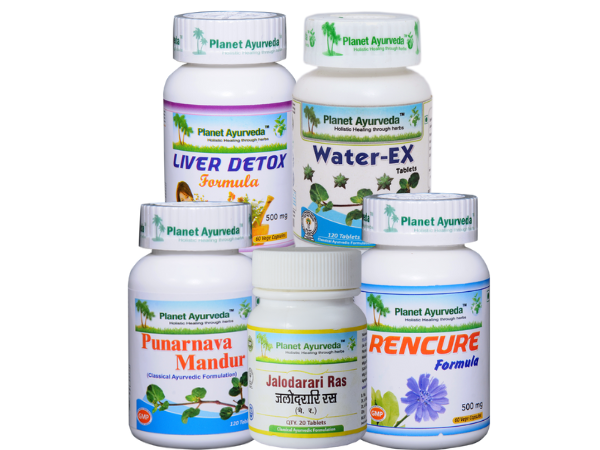

PRODUCT DESCRIPTION
1. PUNARNAVA CAPSULES
Punarnava capsule is a single herbal capsule. These capsules consist of the herb Punarnava (Boerhavia diffusa). Punarnava is effective in reducing fluid and ascites symptoms in the stomach. It balances the Vata and Kapha dosha. Punarnava has anti-inflammatory action.
Dosage: 2 capsules two times a day.
2. WATER-EX TABLETS
Water-Ex tablets are polyherbal tablets. It consists of the root extract of Punarnava (Boerhavia diffusa), bark extract of Varuna (Crataeva nurvala), fruit extract of Gokshura (Tribulus terrestris), and excipients. Gokshura possesses diuretic properties and is also helpful in obesity, headaches or stress. Varuna is helpful in reducing deep-seated suppurative inflammation.
Dosage: 2 tablets three times a day.
3.RENCURE FORMULA
Rencure formula is a polyherbal herbal capsule. This formulation is prepared using Punarnava (Boerhavia diffusa), Varun (Crataeva nurvala), Gokshur (Tribulus terrestris), Palaash (Butea monosperma), and Kasni (Cichorium intybus). Palaash has anti-inflammatory and diuretic action.
Dosage: 1 capsule two times a day.
4. LIVER DETOX FORMULA
Liver Detox Formula is a polyherbal capsule. It consists of Katuki (Picrorhiza kurroa), Kalmegh (Andrographis paniculata), Haritaki (Terminalia chebula), Makoy (Solanum nigrum), etc. It detoxifies the liver and improves blood flow from the liver. It helps stimulate new liver cells. Katuki clears Kapha and Pitta and promotes liver function and health. Kalmegh is used to treat hemolytic jaundice and other liver conditions. Haritaki regulates bowel movements, helps in virechana, and expels malas out of the body. Makoy is used as an analgesic.
Dosage: 2 capsules two times a day.
5. JALODARARI RASA
Jalodarari Rasa is a polyherbal tablet. It consists of Pippali (Piper longum), Maricha (Piper nigrum), Tamra Bhasma (Copper ash), Jaiphala (Croton tiglium), Snuhi Ksheera (), and Rajani/Haridra (Curcuma longa). It acts as a virechana dravya so it helps move out the fluid. Jalodrari Rasa also supports Liver health. It is also helpful in indigestion and discomfort.
Dosage: 1 tablet two times a day.
Diet Recommendation
Take
- Early morning: half a tablespoon of barley seed is soaked overnight in one glass of water and drunk in the morning.
- Breakfast: Dalia (wheat porridge), Vermicelli, veg oats, egg white portion only, Chapati with dal.
- Lunch: wheat roti without oil, boiled vegetables.
- Dinner: plain chapati with dal, boiled rice, khichdi, and Dalia
Avoid
Avoid tangy fruits like tomatoes, Mango, and oranges because they cause coughing and breathing difficulty. Avoid fast food. Avoid Alcohol, Potatoes, excess use of salt, etc.
Contact Planet Ayurveda Support Team to provide you the costing / ordering and delivery information at – costing.planetayurveda@gmail.com or Call at 0172-521-4040 (India), +91-172-521-4040 (Outside India) or Whatsapp at (+91) 9915-593-604
Conclusion
Ascites are a condition of fluid accumulation in the stomach. Ascites cause abdominal pain, nausea, vomiting, swelling, etc. JALODAR is defined in Ayurveda as a type of udara roga. Planet Ayurveda offers herbal combinations for ascites treatment, such as the Liver Care Pack, which includes Indian Echinacea, Yakrit Plihantak Churna, Phyllanthus niruri, and Liver Detox Formula. To get the best results, you should follow the diet plan and not skip the medication.
Click the CROSS button to close
