Hepatic Sarcoidosis – Causes, Symptoms, Diagnosis & Treatment in Ayurveda
ABSTRACT
Before moving on to hepatic sarcoidosis, it is useful to look at sarcoidosis in general. Sarcoidosis is a disease that occurs when groups of cells in the immune system form red, swollen (swollen) lumps called granulomas in various organs of the body. Most are lungs and lymph nodes. But it can also affect the eyes, skin, cardiovascular system (heart), and other organs. However, hepatic (Liver) involvement is also common in sarcoidosis. Most patients with hepatic involvement are asymptomatic. So most of the time to find the problem is to find the high enzymes most of the time. Right upper quadrant pain, fatigue, itching and jaundice may be associated with liver involvement. Portal hypertension and cirrhosis are complications associated with chronic hepatic sarcoidosis. In this article, we cover what is Hepatic Sarcoidosis, its aetiology, symptoms, Diagnosis, and Ayurvedic overview of Hepatic (Liver) Sarcoidosis.
INTRODUCTION
Sarcoidosis is a disease of unknown aetiology characterised by the presence of disease-free granulomas that can affect many organs in the absence of disease, other autoimmune diseases, and exposure to foreign agents. The incidence of sarcoidosis is more in young adulthood and early 60s. Liver cirrhosis and liver nodules are some of the lung manifestations associated with Sarcoidosis.

LIVER INJURY IN HEPATIC SARCOIDOSIS
- Jaundice
- Liver Cirrhosis
- Portal hypertension
- Ascites
ETIOLOGY
The reason is unknown, but can be caused by many things:
- Environmental Factors
- Genetic Factors
- Immune Interactions
SYMPTOMS
The effects of sarcoidosis vary according to its severity and the organs it affects. Whether you have chronic sarcoidosis or the sudden or gradual onset of symptoms prevents the body from functioning properly. Symptoms may include:
- Hepatomegaly
- skin rash
- swelling of the face, armpits, or groin
- tiredness and exhaustion
- Headache
Rarely, if the disease progresses, liver damage (cirrhosis) or liver failure may occur with the following symptoms:
- Abdominal pain
- Yellow skin and eyes (Jaundice)
- Ascites (Abdominal edema)
- Dark urine
- Itchy skin
RISK FACTORS
Several risk factors can increase your risk of developing sarcoidosis, such as:
- Infection or poisoning if you have genetics
- Females are at high risk than males
- 20-40 years old
- Black, Japanese or Northern European
DIAGNOSIS
- Blood Tests: In most cases, your liver enzyme tests will likely be normal. However, the most common blood test abnormality in liver sarcoidosis is an elevated alkaline phosphatase.
- MRI
- Ultrasonography
- CT scan- Hepatomegaly
Liver biopsy
- Liver biopsy reveals multiple noncaseating granulomas.
AYURVEDIC OVERVIEW OF HEPATIC SARCOIDOSIS
Ayurveda is a science of life aimed at improving the quality of life and treating the root causes of diseases. In Ayurveda, we can correlate liver sarcoidosis with the dhatugata vikara and the Ama (toxins). Indigestion, and staying awake, intake of dry or too-light food leads to vitiation of Vata dosha. Vitiation of Vata dosha along with Kapha and Pitta disturbs the normal cycle of the body and results in the formation of Ama. The presence of Ama can cause several health issues and if it starts spreading in your body then it starts destroying everything that comes in its way. Uncontrolled Ama in your body blocks the healthy flow of prana (life), and nutrients in the body. Ayurveda helps in the pachan of Ama (Removal of toxins from the body).
CAUSES OF AMA
- Improper mixing of food
- Overeating and unhealthy diet (especially fatty, sugary or fried)
- Irregular eating
- Disturbance in sleep pattern
- Stressful life
- Inactive for prolonged hours
SYMPTOMS OF AMA
- Heaviness
- Fatigue
- Indigestion
- Abnormal flow of Vata
- Heartburn
The following herbs are used to manage this condition:
- Neem
- Haridra
- Guggul
- Vasa
- Ashwagandha
- Tulsi
- Kanchnaar
- Amalaki
- Punarnava
Following herbal formulations that can be given in Hepatic sarcoidosis include:
- Giloy ghan vati
- Arogyavardhini vati
- Lavangadi vati
- Yashtimadhu ghan vati
- Tulsi ghan vati
- Shitopladi churna
- Ashwagandha rasayan
- Amalaki rasayan
- Haridrakhanda
- Triphala guggul
- Yograj guggul
- Guduchi satva
- Guluchyadi kashaya
- Patolkaturohiniadi kwath
- Nimbadi kwath
- Dashmularishta
PANCHKARMA PROCEDURES
- Nasya- administration of drugs by nasal cavity
- Raktamokshana- blood purification therapy
- Swedana- sweating therapy
- Snehana- oleation or lubricating therapy
- Viechana- laxatives (substances used to induce purging)
HERBAL REMEDIES FOR HEPATIC SARCOIDOSIS BY PLANET AYURVEDA
Planet Ayurveda is a manufacturer of Ayurvedic medicines derived entirely from plants. This medicine does not contain chemicals, additives or preservatives. All products are GMP certified and 100% vegan. Planet Ayurveda provides herbal remedies for Liver Sarcoidosis:
- KANCHNAAR GUGGUL
- BOSWELLIA-CURCUMIN
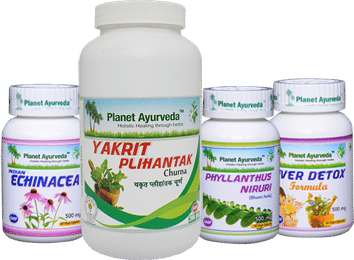
- LIVER DETOX FORMULA
- PHYLLANTHUS NIRURI
- KALMEGH GHAN VATI
- YAKRIT PLIHANTAK CHURNA


PRODUCT DESCRIPTION
1. KANCHNAAR GUGGUL
It is a herbal tablet that includes the bark of Kanchanar (Bauhinia variegata), Amalaki (Emblica officinalis), Haritaki (Terminalia chebula), Bibhitaki (Terminalia bellica), Guggul (Commiphora mukul), Trikatu (Zingiber officinale) and various other herbs. Kanchnaar has anti-inflammatory properties. It balances Prinicipal doshas- Vata, Pitta and Kapha. Amalaki has aphrodisiac properties (virshya) and helps to reduce the burning sensation. Amalaki is used for the detoxification of the body. It eliminates the excess ama dosha from the body. Haritaki prevents liver toxicity caused by some medications and balances the three doshas. Guggul is best for reducing the size of inflammatory cells. Trikatu is helpful in the regeneration of liver cells and it also improves the digestive fire and promotes the proper breakdown of food. Bibhitaki enhances the liver detoxification process.
Dosage: 2 tablets twice daily
2. BOSWELLIA CURCUMIN
Boswellia Curcumin is a polyherbal capsule. It is free of yeast, binders, fillers, starch, chemicals, etc. It contains shallaki (Boswellia serrata) and curcumin (haridra). It has anti-inflammatory properties, so it reduces inflammation and swelling. Shallaki is used to inhibit lipid peroxidation in the liver. Shallaki is also acting as a painkiller. Curcumin can reduce liver damage and has a dual impact on alcoholic liver injury.
Dosage: 1 capsule twice daily.
3. LIVER DETOX FORMULA
There are various herbs in these capsules that include Katuki (Picrorhiza kurroa), Punarnava (Boerhavia diffusa), Kalmegh (Andrographis paniculata), Haritaki (Terminalia chebula) etc. Katuki is used to treat liver problems such as jaundice, relapsing fever, and viral hepatitis. Punarnava is used to reduce the symptoms of ascites caused due to liver diseases. Kalmegh is beneficial for the fatty liver. Haritaki can help increase the liver’s ability to remove toxins from the body.
Dosage: 1 capsule twice daily
4. PHYLLANTHUS NIRURI
It is a single herbal capsule that includes Bhumi amla (Phyllanthus niruri). It helps to manage liver diseases. Bhumi Amla has hepatoprotective, antioxidant and antiviral activities that help treat liver disease and reverse liver damage.
Dosage: 1 capsule twice daily.
5. KALMEGH GHAN VATI
It is a herbal medicine containing Kalmegh (Andrographis paniculata). It is widely used in liver diseases due to its hepatoprotective properties. It has antioxidant and anti-inflammatory properties. It removes toxins from the body and it also improves digestion. Protects liver cells from free radicals.
Dosage: 2 Tablets twice daily
6. YAKRIT PLIHANTAK CHURNA
It is a poly-herbal churna containing Bhumyamalaki (Phyllanthus niruri), Bhringraj (Eclipta alba), Kalmegh (Andrographis paniculata) etc. Bhringa is a powerful liver tonic, used for the treatment of hepatitis and liver cirrhosis. For the treatment of fatty liver, Kalmegh is used.
Dosage: 1 teaspoon twice daily.
Contact Planet Ayurveda Support Team to provide you the costing/ordering and delivery information at – costing.planetayurveda@gmail.com or Call at 0172-521-4040 (India), +91-172-521-4040 (Outside India) or Whatsapp at (+91) 842-749-4030.
CONCLUSION
As a fundamental part of the human body, changes in its structure or function can have a significant impact. Therefore, care must be taken to avoid liver disease. Even after treatment, patients should have a clear understanding of health and wellness and behaviour and relapse should be avoided. The herbs that can be used for liver disorders are Kumari (Aloe Vera), Pippali (Piper longum), Draksha (Vitis vinifera), Guduchi (Tinospora cordifolia), Amalaki (Emblica officinalis), Bhoonimba (Andrographis paniculata), and Daruharidra (Berberis aristata), Bhoomyamalaki (Phyllanthus niruri) etc.