Herbal Remedies For Globus Pharyngis – Ayurvedic Treatment
Abstract
Globus pharyngitis is the condition of nonpainful sensation of a lump or foreign body in the throat and there is a feeling of having something stuck in the throat. The condition is often associated with persistent clearing of the throat, catarrh, cough, and hoarseness. Globus pharyngitis has the ability to reoccur, is long-lasting, and is difficult to manage. Let’s discuss in detail Globus pharyngitis.

Introduction
The Globus sensation is the functional esophageal disorder that is characterized by the sensation of a lump, tightness in the throat, and retained food bolus which is not due to any underlying structural lesion, a mucosal abnormality, esophageal motility disorder, or gastroesophageal reflux disease. Globus is relieved by the ingestion of the liquid and solids or tends to be worse on dry swallows. This is associated with dryness, soreness, catarrh, irritation, and constant throat clearing. This disease in Ayurveda is caused due to the aggravation of tridosha in which there is a predominance of Vata and Kapha dosha. The disease is simply manageable in Ayurveda by various remedies which are given in this article.
Facts
- Globus pharyngitis has the ability to reoccur
- Both men and women are equally affected by Globus pharyngitis
- The condition is not painful but is long-lasting
- In Ayurveda this disease is due to the aggravation of tridoshas but mainly Vata and Kapha dosha.
The causes of Globus Pharyngitis are
- Previously lodged objects
- Rare tumors
- Psychological factors like anxiety and stress
- Thyroid diseases
- Abnormal function of the upper esophageal sphincter.
- Gastroesophageal reflux disease
- Pharyngeal inflammatory conditions
- Thyroid disease
- Upper aerodigestive malignancy
- Retroverted epiglottis
- Rare- laryngopharyngeal tumors
Some of the other causative factors are
Stress: In some patients, stress is the common factor that provokes Globus pharyngitis.
Post nasal drip: Many patients often complain that the Globus sensation is caused by the mucus and catarrh. In that case, post-nasal drip needs to be considered.
Steroid inhalers: The steroids which are used in the management of Asthma, may result in dysphonia and also produce a Globus sensation. This may also be caused by secondary Candida infection.
Acid reflux: Acid reflux is the single commonest pathogenic cause of Globus pharyngitis and is often associated with an occasional croaky voice and clearing of the throat. In the morning the symptoms get worse.
Tiredness: Some people described that their symptoms get worse when they are tired, ie. at the end of the day.
Voice strain: In globus pharyngis some people also find that their voice fluctuates and also find the lump sensation is worse when their voice is particularly bad.
Symptoms of Globus pharyngitis
- A feeling of pressure and tightness in the throat
- Mucus/catarrh which is unable to clear
- Presence of swelling and itching in the throat
- Chronic cough and Hoarseness.
Diagnosis of Globus pharyngitis
Several tests or diagnoses are considered in Globus Pharyngitis which are
Flexible Esophagogastroscopy: This procedure is used to enable the full esophageal evolution and diagnosis of the cause of this disease.
Manometry: Manometry is very useful in assessing the lower esophageal sphincter pressure and peristaltic sequence.
Video fluoroscopy: Video fluoroscopy is used to identify pharyngeal dysfunction in a substantial proportion of global pharyngitis patients.
Barium Swallow: This is used to identify the benign lesions with Globus in the one- third of the patients hence Barium Swallow is important for the investigation of Globus patients.
Reflux symptom index and reflux finding score: The reflux symptom index is very useful in assessing the symptoms of Globus pharyngitis because globus pharyngis may also associate with the symptoms of the laryngeal conditions which are caused by allergy, vocal abuse, infection, and neurogenic mechanisms as well as non-pathological variations.
Management of Globus pharyngitis
In the management of this disease, there is various therapy involved which are
Vocal hygiene: Vocal hygiene includes measures like drinking more water, avoiding smoking, and decreasing the intake of coffee.
Speech and language therapy/ Relaxation techniques
Speech and language therapy mainly includes the exercises of the shoulder and neck, the therapy is very useful in the management of the symptoms of globus pharyngis.
Cognitive behavioral therapy
For the management of a variety of somatoform disorders cognitive therapy is very useful. The antidepressants present in this therapy are very effective in Globus Pharyngitis.
Anti-reflux treatment
The anti-reflux treatment is very effective in the main cause of global pharyngitis ie. gastroesophageal reflux, and this should be the first step to managing Globus pharyngitis patients.
There is some other management used in the controlling of Globus Pharyngis are
- Nasal spray therapy
- Muscle therapy
- Proton pump inhibitors
Prevention in Globus pharyngis are
- Give rest to your voice when you have cold
- Stop smoking
- Drinking plenty of water
Ayurvedic Overview of Globus Pharyngitis
Ayurveda is a science that has been preventing disease since ancient times. All the herbs and therapies described in Ayurveda are able to manage the root cause of the disease. As per Ayurveda, Acharya Sushruta has described health in Sushruta Samhita Sutrasthana chapter 15 Shloka 48
The Acharyas mentioned that the human body is mainly composed of doshas (Vata, Pitta, and Kapha), Mala (Sweda, Mutra, and Purisha), and Dhatu (Ras, Rakta, Masa, Meda, Asthi, Majja, and Shukra).
The disease occurs in the body due to the imbalance of the Dosha, Dhatu, and Mala, aggravation of these three components leads to acute or chronic disease. In Globus Pharyngis from the Ayurvedic point of view, there is an imbalance of all three doshas but mainly the predominance of Vata and Kapha dosha. Aggravated Vata results in swelling, tightness, and itching, and the Kapha aggravation causes catarrh/mucus. The Udavarta and Vatanolomna chikitsa is very effective in the management of Globus pharyngitis. By using salt and turmeric water gargles and yashtimadhu, the pressure and tightness in the throat can be reduced. To reduce the swelling in the throat, the use of steam or clove powder with honey is very effective. Some of the herbs which are used in the management of Globus Pharyngis are Sonth, Pippali, Marich, Amla, Mishri, and Yasthimadhu.
Herbal Remedies by Planet Ayurveda for Globus Pharyngis
Planet Ayurveda is US-FDA registered, GMP-certified, and ISO 9001: 2015 certified company established worldwide. All the remedies are made up of natural herbs, formulated under MD Ayurveda experts, and do not contain any toxins, chemicals, dyes, or preservatives. There are various herbal remedies are formulated for the management of Globus pharyngis which are given below:
Product List
1. Avipattikar Churna
2. Kaas Har Churna
3. Mahashankh Vati
4. Yashtimadhu Ghanvati
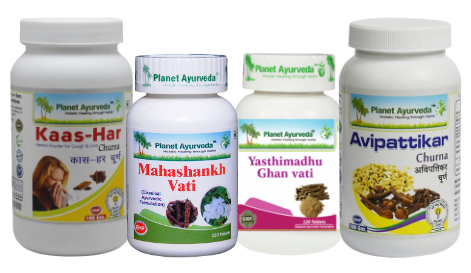

Product Description
1. Avipattikar Churna
This formulation mainly works on a healthy digestive system and the ingredients involved are Amla (Emblica officinalis), Vaividang (Embelia ribes), Tejpatra (Cinnamomum tamala), Nishoth (Operculina turpethum), Lavang (Syzygium aromaticum) and Nagarmotha (Cyperus scariosus), etc. The churna pacifies the aggravated dosha and improves digestion, Nagarmotha is mainly used to reduce the stomach issue and the formulation also boosts the immune system.
Dosage: 1 tsp twice daily with lukewarm water
2. Kaas Har Churna
As the name suggests this formulation mainly works on the cough and the ingredients present in this churna are Dalchini (Cinnamomum zeylancia), Pippali (Piper longum), Ela (Elettaria cardamomum), Vanshlochan (Bambusa arundinacea), and Mishri (Crystallised sugar lumps), etc. The churna has a great impact on the frequent attacks of the cough and cold. This formulation also increases the circulation of the lungs and encourages vasodilation, and maintains overall health of well-being.
Dosage: ½ tsp twice daily with plain water
2. Mahashankh Vati
This formulation is very helpful in abdominal pain and in indigestion, ingredients of this formulation are Vatsanabha (Purified aconitum ferox), Shankha bhasma (Ash of conch shell), Pippali (Piper longum) and Shunthi (Zingiber officinalis). Mahashankh vati is very effective in Globus pharyngitis and also provides relief from acidity and other stomach-related problems.
Dosage: 2 tablets twice daily to be chewed 20 minutes before the meal.
4. Yashtimadhu ghan vati
Yashtimadhu ghan vati has very great results in Globus pharyngitis and the ingredient present in this is Yashtimadhu (Glycyrrhiza glabra). The formulation helps in the liquefaction of mucus and facilitates its discharge from the body. It pacifies the aggravated dosha and gives strength to the immune system which leads to reduced symptoms of Globus pharyngitis.
Dosage: 2 tablets twice daily before the meal
CONTACT PLANET AYURVEDA TO PROVIDE YOU WITH THE COSTING / ORDERING AND DELIVERY INFORMATION AT – COSTING.PLANETAYURVEDA@GMAIL.COM OR CALL AT +91-172-5214040
Conclusion
Globus pharyngitis is not a painful condition but there is the sensation of something stuck in the throat like the presence of a lump. The condition is characterized by cough, hoarseness, and persistent clearing of the throat. Psychiatric, and psychological disorders, abnormalities of the upper esophageal sphincter, and gastroesophageal reflux disease are the main cause of this disease. As we see in Ayurveda, the disease is caused due to the aggravation of tridoshas in which Vata and Kapha are mainly responsible for globus pharyngis. The predominance of Vata and Kapha results in cough, pressure, and tightness of the throat. Here we have discussed the remedies which are very effective in the management of this disease.