Ayurvedic Treatment For Intestinal Tuberculosis With Herbal Remedies
Abstract
Intestinal Tuberculosis is a chronic disease that is associated with roughened, rugae-like appearance. Normally it is uncommon that tuberculosis involves the intestinal tract, peritoneum, and associated viscera. But it is more common that tuberculosis involves the esophagus, stomach, colon, rectum, anus, liver, bile duct, gallbladder, and pancreas. In this article, we are going to discuss Intestinal Tuberculosis and the Ayurvedic aspect of the disease along with the Ayurvedic treatment of Intestinal Tuberculosis.

Introduction
Intestinal Tuberculosis is not a common condition of tuberculosis and it most commonly affects the terminal ileum and cecum. The causative organism of Intestinal Tuberculosis is Mycobacterium Tuberculosis. The common symptoms of Mycobacterium tuberculosis are ulcers in the mouth or anus and these ulcers are difficult to heal, difficulty in swallowing, pain in the abdomen, infection of the small intestine, diarrhea, etc.
The Ayurvedic Point of view of this Disease
Ayurvedic point of view of Intestinal Tuberculosis is mainly correlated with Rajayakshma. Rajayakshma is a group of disorders in which all three doshas are aggravated and it also affects Sapta dhatu in our body. Rajayakshma is also known as the king of all diseases.
Causes of Intestinal Tuberculosis
The main cause of Intestinal Tuberculosis is Mycobacterium tuberculosis and Ingestion affected milk. So let’s see the symptoms
Symptoms Of Intestinal Tuberculosis
The symptoms of Intestinal Tuberculosis are listed below:-
- Non-healing ulcers of the mouth or anus
- Weight loss
- Low-grade fever
- Anorexia
- Cough
- Difficulty in swallowing
- Pain in the abdomen due to gastric and duodenal infection
- Infection of the small intestine known as malabsorption
- Due to colon infection Diarrhea and pain occurs.
Compolication Of Intestinal Tuberculosis
The following complication of intestinal Tuberculosis is,
- Intestinal obstruction
- Fistula
- Abscess and perforation with resultant peritonitis.
Diagnosis of Intestinal Tuberculosis
The following diagnostic method for Intestinal Tuberculosis is,
- Medical history
- Physical examination
- Blood tests
- Sputum tests
- Endoscopy
- Stool occult
- Mantoux test
- Abdominal X-ray
- USG
- CT scan
Treatment of Intestinal Tuberculosis
The following treatment of Intestinal Tuberculosis is :-
- ATT (Anti-Tuberculous Therapy)
Ayurvedic treatment for Intestinal Tuberculosis by Planet Ayurveda
In Ayurveda, one of the best methods to overcome Intestinal Tuberculosis is to Balance the all three doshas in our body. And planet Ayurveda provides the best herbal remedy to treat the aggravated tri dosha. Ayurvedic medicines help in treating the disease from its root cause and maintaining a good life. With Ayurvedic medicines, the recurrence of this disease is less and there is no such side effect of this herbal remedy. Its products are pure vegetarian and naturally extracted from the herb and medicinal plants.
The following herbal remedies for Intestinal Tuberculosis by Planet Ayurveda:-
- Suvarna Vasant Malti Ras
- Kanchnaar Guggul
- Pitta Balance
- Praval Panchamrit
- Kamdudha Ras (Moti Yukt)
- Belgiri Powder
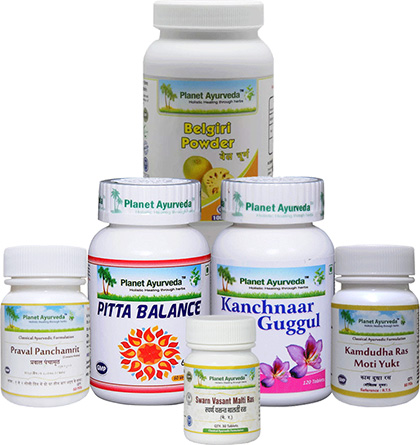

Products Description
1. Suvarna Vasant Malti Ras
Suvarna Vasant Malti Ras is beneficial in pacifying the Vata and Kapha dosha in the body. Suvarna Basant Malti Ras gives very good results in bronchitis and even tuberculosis. The main ingredients of Suvarna Vasant Malti Ras are Marich (Piper Nigrum), Gandhak (Purified sulfur), and many others. All of these herbs are very effective in boosting the function of the immune system and preventing infertility problems and maintaining a healthy respiratory system.
Dosage: 1 tablet twice daily to be chewed with lukewarm water after a meal.
2. Kanchnaar Guggul
Major ingredients of Kanchnaar guggul are kanchnar bark (Bauhinia variegata), Amalaki (Emblica Officinalis) Haritaki (Terminalia chebula), Bibhitaki (Terminalia Billerica), trikatu, Varuna (Crateva religiosa), etc. It helps in increasing appetite, nausea, and vomiting. It also helps in the fibroid uterus, and the reduction of cholesterol and unwanted fats. These tablets are very good for various conditions like cancer and also treat lymph node swelling, leprosy, glandular swelling, thyroid disorders, fistula, and other abnormal growth of cells in the body. These tablets excrete harmful toxins from the body and enhance the functioning of the lymphatic system in the body.
Dosage: 2 tablets twice daily with lukewarm water after a meal.
3. Pitta Balance
Planet Ayurveda provides the best herbal formulation in the form of pitta balance to balance the Pitta dosha in our body. The main ingredients of pitta balance are Parval pishti (coral calcium), Jehar mohra pishti, kamdudha ras, akik pishti, Giloy satva, Mukta pishti, and many others. Pitta balance helps in decreasing the burning sensation in the body. It also helps in decreasing acne and other skin-related disorders.
Doasge: 1 capsule twice a day after meal with plain water.
4. Praval Panchamrit
Praval panchamrit is a very effective herbal formulation by Planet Ayurveda. It helps in relieving indigestion, and gastritis. It is equally good and effective in treating liver and spleen disorders and also gives very good results in urinary tract infections. This also helps in improving cough, asthma, anorexia, and splenic disorders. It is also used in various disorders like bloating, ascites, splenic disorders, cough asthma , diarrhea, etc.
Dosage: 2 tablets twice a day after meal with plain water.
5. Kamdudha Ras (Moti Yukt)
Kamdudha Ras moti yukt is a polyherbal formulation of Planet Ayurveda. It is very effective in various disorders like bloating problems, flatulence, and gas-related health issues. It helps in improving digestion and also enhances the efficiency of metabolic activities. It is always recommended before having a meal for better results.
Dosage: 1 tablet twice a day before a meal, chew it.
6. Belgiri Powder
Belgiri churna is an herbal powder by Planet Ayurveda which is a single herbal formulation. This formulation contains Bilva (Aegle marmelos). Belgiri churna is very effective in the prevention of diarrhea and also helps in removing toxins from the body and giving relief from Mucus-related health problems (Aama Dosha). This churna is very effective in indigestion problems as well as helps in improving metabolism.
Dosage: 1 teaspoon with lukewarm water twice a day after a meal.
Conclusion
In this modern era, intestinal tuberculosis is the biggest health concern nowadays that people have faced. Many people don’t have particular signs and symptoms of intestinal tuberculosis and they don’t diagnose with tuberculosis for a longer interval of time. In this article, we discussed Intestinal Tuberculosis, the Ayurvedic aspect of the disease, its early signs, and symptoms, and also the Ayurvedic treatment of Intestinal Tuberculosis. There are no such side effects of herbal formulation but always intake under the doctor’s guidelines. Ayurveda treats patients with herbal remedies from ancient times and effectively cures the patients. So the above-mentioned medicines of herbal Ayurveda are best to treat this because all the medicines are free from any preservatives and other chemical agents that affect your health. All the herbs are purely vegetarian and made up of 100% naturally occurring organic herbs. For more detail on our products check out our website www.PlanetAyurveda.com