Category: Eyes Care

Metachromatic Leukodystrophy – Causes Symptoms & Ayurvedic Treatment

Abstarct

Metachromatic leukodystrophy is a rare genetic metabolic illness in which the myelin sheath, which covers almost all nerve fibres in the central nervous system and peripheral nervous system, inappropriately grows or is damaged, causing damage to the spinal cord and white matter. The accumulated sulfatide material appears as spherical, 15-20 micron-diameter granular masses that, when prepared from a frozen state, stain positively with the peripheral nervous system and metachromatically with an acid cresyl violet stain. These aggregates may exist in the perivascular spaces of macrophages in the central nervous system or in free tissue spaces. The subcortical fibres and axons remain comparatively unaffected. Segmental demyelination and the loss of nerve fibres are both present in the peripheral nervous system.

Metachromatic leukodystrophy

INTRODUCTION OF METACHROMATIC LEUKODYSTROPHY

A common hereditary disorder called metachromatic leukodystrophy damages the white matter of the central nervous system and peripheral nerves. It is an inherited autosomal recessive condition. Both peripheral nervous system and central nervous system myelin are broken down. There are three forms of Metachromatic leukodystrophy:

  1. Late infantile MLD: It typically affects babies between 12 to 20 months old. It is the most common form of Metachromatic leukodystrophy, with 50% to 60% of cases.
  2. Juvenile MLD: In this group, children are affected between the ages of 3 to 10 years old, with 20% to 30% of cases.
  3. Adult MLD: In this case, people are affected after the age of 16, with 15% to 20% of cases.

CAUSES OF METACHROMATIC LEUKODYSTROPHY

  1. A gene mutation that you inherit from both of your biological parents is the cause of metachromatic leukodystrophy.
  2. The ARSA gene, which provides instructions for producing the enzyme arylsulfatase A, is mutated in the majority of patients with MLD. This enzyme helps in sulfatide breakdown. Because of the mutation, people with MLD produce insufficient arylsulfatase A, which causes sulfatides to accumulate. The sulfatide is poisonous for the white matter of your nervous system, which harms these cells.

SYMPTOMS OF METACHROMATIC LEUKODYSTROPHY

1. In late infantile metachromatic leukodystrophy

  1. Weak muscle tone
  2. Difficulty walking
  3. Difficulty speaking
  4. Loss of vision
  5. Dysphagia
  6. Dementia
  7. Developmental delays

2. In juvenile metachromatic leukodystrophy

  1. Behavioural difficulties
  2. Personality changes
  3. Peripheral neuropathy
  4. Seizures
  5. Intellectual decline
  6. Dementia

3. In adult metachromatic leukodystrophy

  1. Alcohol use disorder
  2. Substance use disorder
  3. Seizures
  4. Psychiatric issues (psychosis, hallucinations, and schizophrenia)
  5. Peripheral neuropathy
  6. Dementia

DIAGNOSIS OF METACHROMATIC LEUKODYSTROPHY

  1. Genetic testing
  2. Biochemical testing
  3. Brain MRI
  4. Neurocognitive testing
  5. Neuropsychological testing
  6. Nerve conduction tests

COMPLICATIONS OF METACHROMATIC LEUKODYSTROPHY

  1. Aspiration pneumonia
  2. Malnutrition
  3. Blindness from optic atrophy
  4. Neurocognitive decline

AYURVEDIC ASPECT OF METACHROMATIC LEUKODYSTROPHY

According to Ayurveda, metachromatic leukodystrophy is related to vata dosha imbalance and beeja dusti (parental congenital factors). Variable bodily ailments caused by abnormal vata result in a variety of diseases. It influences complexion, longevity, and happiness as well. It interferes with the brain’s normal function, affects all of the senses, deforms, and eventually kills the embryo. Thus, it causes disorientation, anxiety, panic, and extreme delirium before finally stopping the breath.

TREATMENT OF METACHROMATIC LEUKODYSTROPHY

There is no proper treatment available for metachromatic leukodystrophy. Only supportive treatment will be given in this condition to delay the progression of the condition and increase the quality of life. Planet Ayurveda gives some supportive herbal remedies, which are described as follows

SOME HERBAL REMEDIES FOR METACHROMATIC LEUKODYSTROPHY BY PLANET AYURVEDA

Planet Ayurveda is a certified ayurvedic clinic, and the formulation of different types of remedies is performed here to provide relief from diseases. All formulations at Planet Ayurveda are made organically without the use of preservatives. All of the plants used to make medicine are pure, natural, and extremely effective. Planet Ayurveda offers a variety of herbal products that have no side effects for supporting the treatment of metachromatic leukodystrophy.

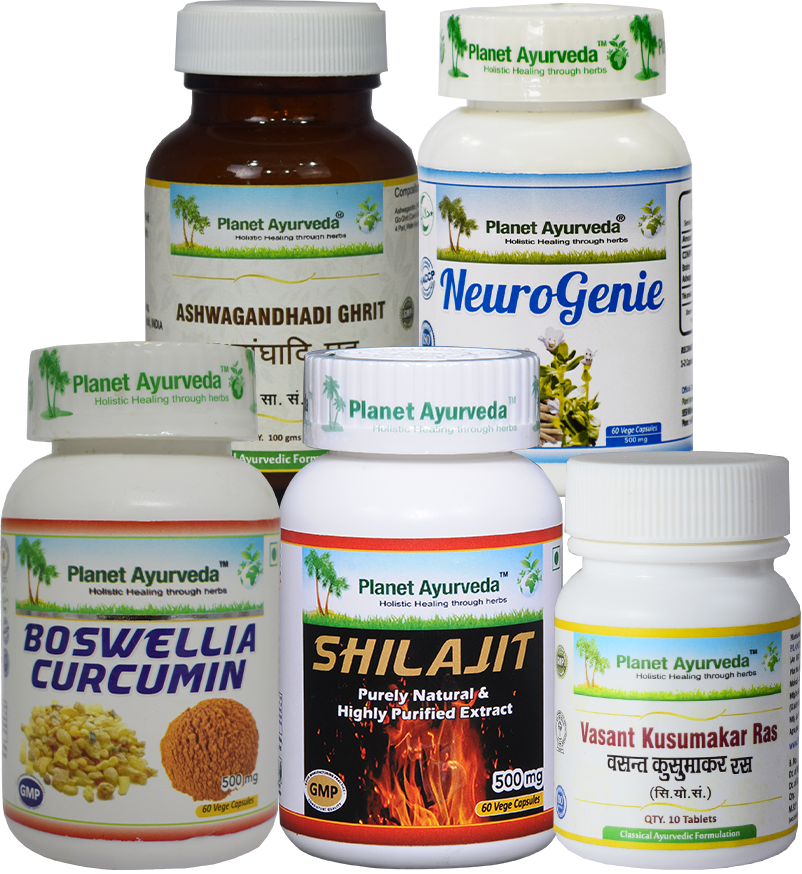
PRODUCT LIST

  1. SHILAJIT CAPSULES
  2. BOSWELLIA CURCUMIN
  3. NEUROGENIE CAPSULES
  4. ASHWAGANDHADI GHRIT
  5. CHANDRAPRABHA VATI
  6. VASANT KUSUMAKAR RAS

Herbal Remedies for Metachromatic Leukodystrophy

Herbal Supplements for Metachromatic leukodystrophy

1. SHILAJIT CAPSULES

Shilajit capsules are single herbal capsules that are formulated by Planet Ayurveda with the help of Shilajit (Asphaltum). Shilajit is the end result of a protracted process of mineral and plant matter degradation. It is a tar-like, sticky substance that comes from rocks and is only present in high mountain areas. Shilajit has a number of compounds that could support normal brain function and possibly aid in the Treatment of Alzheimer’s. Shilajit has been used for a long time to prolong life and slow ageing. The ingredients may help control cognitive problems. It is also beneficial for ageing, anaemia, antivirals, chronic fatigue, liver cancer, heart health, obesity, and male fertility.

Dosage: with milk or plain water, take 2 capsules twice daily, after meals.

2. BOSWELLIA CURCUMIN

Boswellia curcumin is a multi-herbal formulation that is formulated by Planet Ayurveda with the help of Boswellia (Boswellia serrata) and Curcumin (Curcuma longa). Boswellia has anti-inflammatory properties that prevent the release of cytokines and help decrease inflammation. It contains an antioxidant function that protects brain neurons and minimises skin wrinkles. It helps with blood production in the body and cleanses the blood. Because it is a natural antibacterial, it also works on cuts and bruises. It protects against skin and colon tumours.

Dosage: with plain water, take 1 capsule twice daily, after meals.

3. NEUROGENIE CAPSULES

Neurogenie capsules are a multi-herbal formulation that is formulated by Planet Ayurveda with the help of Ashwagandha (Withania somnifera) and Bacopa monnieri (Brahmi). It helps in boosting brain activity. If your digestive system is in good condition, you can take Brahmi and Ashwagandha together because both support healthy brain function. Brahmi has cold potency, which helps in calming the mind. It removes aggravated pitta and reduces headaches. It is also helpful for hair loss. Ashwagandha may improve mental activity and memory. The ability of ashwagandha to improve cognition was observed in the elderly and youngsters with impaired memory.
Dosage: with plain water, take 1 capsule twice daily, after meals.

4. ASHWAGANDHADI GHRIT

Ashwagandhadi ghrit is a multi-herbal formulation that is formulated by Planet Ayurveda with the help of Withania somnifera (Ashwagandha), Terminalia bellirica (Bhibhitaki), Go ghrit (cow ghee), Go dugdha (Cow milk), and water. It helps strengthen tendons, muscles, joints, and nerves. Due to its strong anti-inflammatory, anti-oxidant, anti-stress, and analgesic effects, it accelerates the healing process after an injury. It supports the nervous system.

Dosage: as guided by the physician, or 3 to 6 grams mixed with mishri.

5. CHANDRAPRABHA VATI

Chandraprabha vati is a multi-herbal formulation that is formulated by Planet Ayurveda with the help of Shilajit (Asphaltum), Commiphora mukul (Guggul), Cinnamomum camphora (Karpoor), Chavya (Piper chaba), and Shunthi (Zingiber officinalis). Chandraprabha Vati could help in blood purification and blood oxygenation improvement. Chandraprabha vati can be used by anaemia patients because it contains iron. Due to its anti-inflammatory and analgesic qualities, Chandraprabha vati is beneficial for treating conditions including spinal arthritis and lower back pain.

Dosage: with lukewarm water, take 2 tablets twice daily.

6. VASANT KUSUMAKAR RAS

Vasant kusumakar ras is a multi-herbal pill that is formulated by Planet Ayurveda with the help of Silver calx (Rajat bhasma), Iron calx (Loha bhasma), Vanga bhasma (Tin calx), Godugdha (Cow milk), and some other ingredients. It helps in the treatment of diabetes, memory loss, and urinary tract infections. Because of its Rasayana characteristic, it is mostly used for treating general weakness and regulating blood sugar. It is also a potent rejuvenator that boosts immunity.

Dosage: with plain water, take 1 pill twice daily.

Contact Planet Ayurveda Support Team to provide you the costing/ordering and delivery information at – costing.planetayurveda@gmail.com or Call at 0172-521-4040 (India), +91-172-521-4040 (Outside India) or Whatsapp at (+91) 842-749-4030.

CONCLUSION

Metachromatic leukodystrophy is a rare genetic metabolic illness in which the myelin sheath, which covers almost all nerve fibres in the central nervous system and peripheral nervous system, inappropriately grows or is damaged, causing damage to the spinal cord and white matter. A gene mutation that you inherit from both of your biological parents is the cause of metachromatic leukodystrophy. According to Ayurveda, metachromatic leukodystrophy is related to vata dosha imbalance and vija dusti (parental congenital factors). Variable bodily ailments caused by abnormal vata result in a variety of diseases. In Planet Ayurveda, there are some herbal remedies that give effective results in the treatment of metachromatic leukodystrophy without causing any side effects.

Treatment of Ocular Surface Disease (OSD) in Ayurveda

ABSTRACT

The eye is very sensitive not only to light and images but also to touch and pain. Therefore, problems with the eyes can often cause a conflict of symptoms, some of which are non-specific but others that can be diagnosed. Eye diseases can be divided into diseases caused by abnormalities in the eye, abnormalities of the ocular surfaces and abnormalities affecting the visual system. The article explains the information about different types of eye diseases.

INTRODUCTION

The damage to the surface layers of the eye- Cornea, Conjunctiva, and eyelids i.e. the ocular disease of the eye with symptoms such as red eye, foreign body, eyelid swelling, photophobia, and irritation. Corneal and conjunctival surfaces are sensitive. This will be a preventive measure that helps to avoid minor injuries at an early stage. There are various types of eye diseases including dry eye, blepharitis, neurotrophic keratitis, ocular rosacea, and meibomian gland dysfunction.

Ocular Surface Disease (OSD)

DISEASES OF OCULAR SURFACE WITH SYMPTOMS

1. Dry eye

Dry eye causes discomfort and poor vision when the tear film becomes unstable and recurs in the dry area of ​​the face, causing the face and face to become attached to evaporation.

Symptoms

  1. Difficulty wearing contact lens
  2. Eye irritation
  3. Discomfort
  4. Visual impairment with bone involvement
  5. Red eyes
  6. Watery eyes

2. Blepharitis

Blepharitis is the chronic inflammation of the margins of lids, appearing as a simple hyperaemia or as a true inflammation which may occur in two forms: Anterior and Posterior. Blepharitis caused by a parasite is called blepharitis acarica.

Symptoms

  1. Occasional lacrimation
  2. Swollen eyelids
  3. Blurred vision
  4. Sensitivity to light
  5. Eye discomfort
  6. Slow blinking
  7. Redness of eyes

3. Neurotrophic keratitis

This occurs in some cases in which the trigeminal nerve is paralysed, typically as a result of radical treatment for trigeminal neuralgia (a type of chronic pain that involves severe and sudden facial pain) and leads to decreased corneal sensitivity. Only a few cases develop neurotrophic keratitis, the tendency being decreased if there is an adequate tear film.

Symptoms

  1. Vision impairment
  2. Photophobia
  3. Lacrimation
  4. Redness of eyes

4. Ocular rosacea

It is the inflammation that can cause eye redness, burning and itching. It usually occurs in patients with rosacea, a chronic skin condition that affects the face. Sometimes ocular rosacea is the first sign that you will have this face later.

Symptoms

  1. Red eye
  2. Excessive watering
  3. Itching
  4. Irritation
  5. Blurred vision
  6. Photophobia
  7. Eyelid swelling

4. Meibomian gland dysfunction

Meibomian gland dysfunction (MGD) is a term used to describe a group of systemic and infectious diseases associated with dysfunction of the meibomian gland. MBD can cause tear changes, eye infections, eye and lid discomfort, and evaporative dry eye.

Symptoms

  1. Burning sensation
  2. Irritation
  3. Dry eye
  4. Watery eyes
  5. Red eyes
  6. Photophobia
  7. Blurred vision

DIAGNOSIS

The following are the diagnostic test

  1. Comprehensive eye exam- In this various eye tests are performed by a doctor to check out the abnormality of the eyes. It includes visual acuity, preliminary test, keratometry, refraction etc.
  2. Schirmer test: It measures the amount of tears produced. If the value drops below 6 mm after 5 minutes, a diagnosis of dry eye can be made and the normal value is 10-25 mm.
  3. Osmolarity test: It measures the osmolarity of your tears. It is done specially for dry eyes
  4. Magnetic resonance imaging It is the technique to rule out the cause of neurotrophic keratitis.

AYURVEDIC OVERVIEW OF OCULAR SURFACE DISEASES

In Ayurveda Eye diseases are Netra roga. Synonyms of the eye are Netra, Chakshu, Nayana, Akshi Golaka etc. Netra pramanam (size) is1 angula (breadth of thumb).

Netra Kriya Kalpa (Treatment procedure)

In our Ayurvedic Samhitas, local treatment procedures of Netra are known as Netra Kriya Kalpa.

According to Acharya Charak

  1. Bidalaka
  2. Aashchyotana
  3. anjanam

According to Acharya Sushruta

  1. Seka
  2. Aashchyotana
  3. Pindi
  4. Tarpana
  5. Putpaka

CAUSES OF EYE DISORDERS (NIDANA OF NETRA ROGA)

According to Acharya Sushruta(सु .उ.त. 1/26-27)

The below-mentioned are causes of eye disorders.

  1. Entering into the water after getting exposed to the heat of the sun.
  2. Anger in excess
  3. Excessive crying
  4. Disturbed sleep.
  5. Excessive grief
  6. Strain
  7. Injuries to eye
  8. Excessive indulgence in sexual intercourse
  9. Excessive consumption of horse and black gram.
  10. Eye exposure to smoke leads to eye disorders.
  11. Continuously viewing minute objects.

SAMPRAPATI (PATHOGENESIS)

According to Acharya Sushruta(सु .उ.त. 1/20)

By taking a false diet, the vitiated doshas travel through the Siras (Blood vessels) and then reach the upper parts of the body. After that, they afflict the eyes and cause dreadful diseases therein.

POORVAROOP OF EYE DISEASE (SIGNS)

According to Sushruta(सु .उ.त. 1/21-23)

  1. Eye discharge
  2. Anger, watery expression
  3. itching
  4. Eyelid adherence due to discharge
  5. Eyelid aggravation
  6. Burning
  7. Stinging
  8. Congestion
  9. Difficulty in opening, and closing eyelids and improper visualisation

HERBAL MEDICINES FOR OCULAR SURFACE DISEASES BY PLANET AYURVEDA

Planet Ayurveda offers you the best quantity and quality of Ayurvedic medicines. Planet Ayurveda, which is GMP-certified, gives you pure and natural products. The products are free from all kind of adverse effects and devoid of any additives, fillers and binders. You can check the herbal pack for Ocular Surface Diseases such as:

  1. ANGEL EYE VITALE
  2. SAPTAMRIT LOHA
  3. JASNOOR EYES DROP
  4. TRIPHALA GHRIT
  5. AMALAKI RASAYAN

Herbal Products for Ocular Surface disease

Herbal Supplements for Ocular Surface Disease

PRODUCT DESCRIPTION

1. ANGEL EYE VITALE

Angel Eye Vitale is a polyherbal capsule. It contains an extract of Amla (Emblica officinalis), extracts of Gotukola (Centella asiatica) and extracts of Bhringraj (Eclipta alba). Amla is helpful in the prevention of cataracts. The high antioxidant content of amla juice helps fight free radicals and preserve collagen in the cornea. The extract of Gotukola prevents visual impairment.

Dosage: 1-2 capsules, once or twice daily.

2. SAPTAMRIT LOHA

Saptamrit is a herbal tablet that contains yashti (Glycyrrhiza glabra), haritaki (Terminalia chebula), bibhitaki (Terminalia bellirica), Amalaki (Emblica Officinalis), loha bhasma (Iron) etc. Yashti is helpful to cure the dryness of the eyes and also improves the health of the eye. Haritaki is a potent nerve tonic and it is useful in diseases like loss of eyesight and conjunctivitis. Amalaki is used because of its antioxidant property. Amalaki is also called Chakshusya (a rasayan for strengthening the eyes). Loha bhsam has great importance in eye disorders.

Dosage: 1-2 tablets, twice daily.

3. JASNOOR EYES DROP

It is one of the best eye drops which is very useful for eye health. It contains ingredients such as Neem (Azadirachta indica), Shobhanjana (Moringa oleifera), Bhringaraja (False daisy), Punarnava (Boerhavia diffusa), Nirgundi (Vitex negundo) and tulsi (Holy Basil). Neem is good for eye health and is also used to get relief from redness in the eye or irritation. Shobhanjana is used to treat eye allergies. Bhringaraja is useful for eyesight. Punarnava is useful in eye diseases such as corneal opacity, watery eyes and itching in the eyes. Nirgundi is used for its anti-inflammatory and antiseptic properties. Tulsi can delay and even prevent the formation of cataracts.

Dosage: 1-2 drops in each eye 3 to 4 times daily or as directed by a physician.

4. TRIPHALA GHRIT

It contains herbs such as Triphala (Amalaki (Emblica Officinalis), Bibhitaki (Terminalia bellirica), Haritaki (Terminalia chebula), swarasa dravya (Bhringraj (Eclipta Alba), Vasa (Adhatoda vasica), Shatavari (Asparagus racemosus) etc, Kalka dravya- Munnaka (Vitis vinifera) etc. It is useful in the treatment of eye problems like eye pain with itching and eyelid-related diseases.

Dosage: 3 to 6 grams mixed with mishri or as prescribed by a doctor.

5. AMALAKI RASAYAN

It is a single herbal capsule that includes Amla (Emblica officinalis) which is a rich source of vitamin C. It works on the Pitta Dosha, that’s why it is beneficial for eye disorders. It is also an immunity booster herb. It provides energy to fight against any disease.

Dosage: 1-2 capsules twice daily.

Contact Planet Ayurveda Support Team to provide you the costing/ordering and delivery information at – costing.planetayurveda@gmail.com or Call at 0172-521-4040 (India), +91-172-521-4040 (Outside India) or Whatsapp at (+91) 842-749-4030.

CONCLUSION

Eye diseases are eye problems that are often associated with pitta dosha. Most of the time, pitta heaviness causes pain. But we can treat these diseases with herbs like Saptamrita loha, Amalaki rasayan, Triphala ghrit and Jasnoor Eye drops. In Panchakarma, Tarpan, ghee, nasya (oil from the nose) etc. All these drugs and procedures stimulate the blood vessels in our eyes, allowing us to see things more clearly.