Herbal Remedies for Type 2 Macular Telangiectasia – Causes, Symptoms, Diagnosis & Treatment
ABSTRACT
The human eye is one of the most vital and intricate organs, responsible for perceiving the surrounding environment and enabling daily functioning. Maintaining optimal eye health is essential for overall well-being, as visual impairment can significantly impact quality of life. Factors such as aging, lifestyle, diet, environmental exposure, and systemic health conditions can influence ocular function and contribute to degenerative or inflammatory changes. Prevention and early intervention through proper nutrition, antioxidant support, lifestyle modifications, and regular eye examinations play a critical role in preserving vision. Ayurveda emphasizes holistic approaches for eye care, focusing on maintaining balance among the doshas, nourishing ocular tissues, and supporting microcirculation and detoxification. Various herbal formulations and therapies are utilized to strengthen vision, reduce oxidative stress, and enhance ocular resilience. In this study, we focus on Type 2 Macular Telangiectasia and its Ayurvedic management, so let’s have a look!
INTRODUCTION
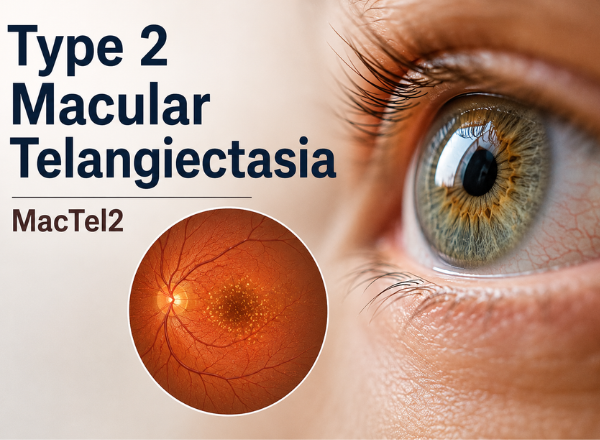
Type 2 Macular Telangiectasia (MacTel2) is a progressive retinal disorder that primarily affects the macula, the central region of the retina responsible for detailed vision. It involves structural and vascular changes in the macular region, leading to gradual impairment of central visual function over time. Although relatively rare, it is considered a significant cause of central vision deterioration in middle-aged adults and can impact quality of life if not properly managed. The condition has been studied extensively to understand its pathophysiology and potential supportive interventions. Now let’s have a look at its causes!
SOME FACTS ABOUT TYPE 2 MACULAR TELANGIECTASIA
- Usually affects both eyes but may progress differently in each eye
- Early changes start near the central vision, not always at the center
- Often goes undiagnosed because early symptoms are subtle
- Involves degeneration of retinal support cells called Muller cells
- Vision loss is slow, allowing patients to retain some central vision for years
- May be linked to diabetes, hypertension, or lipid problems
- Only a few patients develop new abnormal blood vessels requiring treatment
CAUSES OF TYPE 2 MACULAR TELANGIECTASIA
The clinical presentation of Type 2 Macular Telangiectasia (MacTel2) varies depending on the stage of disease progression. Patients often experience subtle changes in central vision initially, which gradually become more noticeable as the condition advances. The key symptoms can be summarized as follows:
- Exact cause is unknown; multiple factors contribute.
- Genetic predisposition: Some cases show familial clustering.
- Vascular abnormalities: Abnormal dilation and leakage of retinal capillaries.
- Neurodegenerative changes: Degeneration of retinal support cells (Müller cells).
- Metabolic and systemic factors: Age-related changes, vascular health, and metabolic disorders may influence progression.
- Macular tissue alterations: Disruption of photoreceptors and retinal metabolism in the macula.
- No direct environmental or lifestyle cause has been conclusively identified.
SYMPTOMS OF TYPE 2 MACULAR TELANGIECTASIA
The symptoms of Type 2 Macular Telangiectasia (MacTel2) usually develop gradually and may initially be subtle, making early detection challenging. The common clinical manifestations can be summarized as follows:
- Gradual loss of central vision in one or both eyes.
- Difficulty in reading or recognizing faces due to reduced visual clarity.
- Distortion of straight lines; objects may appear wavy or bent.
- Central scotoma (a shadow or blind spot in the central visual field).
- Decreased color perception or contrast sensitivity.
- Visual changes typically progress slowly over several years.
- Peripheral vision generally remains unaffected.
DIAGNOSIS OF TYPE 2 MACULAR TELANGIECTASIA
The clinical presentation of Type 2 Macular Telangiectasia (MacTel2) varies depending on the stage of disease progression. Patients often experience subtle changes in central vision initially, which gradually become more noticeable as the condition advances. The key symptoms can be summarized as follows:
- Ophthalmoscopic Examination
- Optical Coherence Tomography (OCT)
- Fluorescein Angiography (FA)Fundus PhotographyVisual Function Tests
- Autofluorescence Imaging
APPLIED ASPECT OF TYPE 2 MACULAR TELANGIECTASIA
- Helps in early detection of central vision problems using Optical Coherence Tomography / Optical Coherence Tomography Angiography.
- Useful for monitoring progression so doctors can know when new vessels (neovascularization) form.
- Guides treatment – anti-VEGF (Anti–Vascular Endothelial Growth Factor) is used only when abnormal new vessels appear in modern practice. It is generally a medicine that stops unwanted blood vessel growth in the eye.
- Helps in differential diagnosis so it is not confused with diabetic macular edema or AMD (Age-related Macular Degeneration).
- Assists in patient counselling as vision may slowly decline but complete blindness is rare.
- Encourages low-vision rehabilitation (magnifiers, reading support).
- Supports systemic evaluation i.e. often associated with diabetes / metabolic changes, so metabolic control is advised.
AYURVEDIC OVERVIEW OF TYPE 2 MACULAR TELANGIECTASIA
In Type 2 Macular Telangiectasia (MacTel2), Ayurveda considers the imbalance of Pitta Dosha as central, since Pitta governs vision and microcirculation in the eyes. Vata Dosha may also play a role in progressive degenerative changes affecting ocular tissues. The primary dhatus (Bodily Tissues) involved are Rakta (blood), Majja (neural and retinal tissues), and Meda (ocular fat and supportive tissue), which are essential for maintaining retinal structure, nourishment, and function. Imbalance or depletion of these dhatus (Bodily Tissues) can lead to reduced tissue integrity and impaired ocular metabolism. Ayurvedic management focuses on pacifying Pitta, supporting Vata balance, and nourishing the key dhatus (Bodily Tissues) through herbal formulations, rejuvenative therapies, and dietary and lifestyle practices to maintain ocular health and function.
Panchkarma Procedures that can help in the management of Type 2 Macular Telangiectasia
Netra Tarpana (Eye Nourishment Therapy)
- Therapeutic procedure where medicated ghee is retained around the eyes.
- Nourishes Netra Dhatu and strengthens retinal tissues.
- Supports microcirculation in ocular structures.
Nasya (Nasal Administration of Herbal Oils)
- Administration of Anu Taila or Shadbindu Taila through nostrils.
- Helps balance Pitta and Vata dosha, improves ocular tissue health, and enhances visual function.
HERBAL REMEDIES FOR TYPE 2 MACULAR TELANGIECTASIA BY PLANET AYURVEDA
Planet Ayurveda is a globally recognized herbal healthcare company that specializes in pure, natural, and authentic Ayurvedic products. It is established with a mission to provide safe and effective herbal remedies, the company focuses on maintaining dosha balance and nourishing dhatus (Bodily Tissues) for overall health. Using classical Ayurvedic formulations, standardized extracts, and traditional preparation methods, Planet Ayurveda ensures high-quality products free from chemicals, additives, or preservatives. The organization emphasizes holistic wellness, integrating dietary guidance, lifestyle recommendations, and herbal therapies to manage various health conditions naturally. Now, we will discuss what Planet Ayurveda provides for the management of Type 2 Macular Telangiectasia.
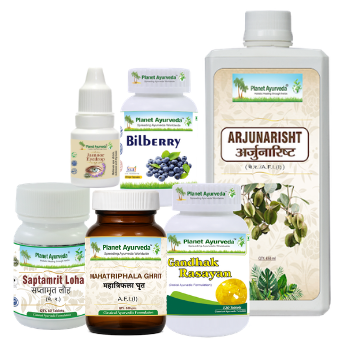
- Mahatriphala Ghrit
- Gandhak Rasayan
- Bilberry Capsule
- Saptamrit Loha
- Jasnorr Eye Drops
- Arjunrisht
Herbal Remedies For Type 2 Macular Telangiectasia

PRODUCT DESCRIPTION
1. Mahatriphala Ghrit
Mahatriphala Ghrit is a classical herbal ghee preparation prepared by Planet Ayurveda under strict guidance of M.D. Ayurveda practitioners. This herbal oil consists of ingredients such as Amalaki (Emblica officinalis), Haritaki (Terminalia chebula), and Bibhitaki (Terminalia bellirica), along with other rejuvenative herbs. It is primarily used for Netra Tarpana (ocular nourishment therapy) and systemic rejuvenation. This formulation helps nourish Netra Dhatu (ocular tissues), pacify Pitta Dosha responsible for vision and microcirculation, and support Raktadi and Majja Dhatus, strengthening both vascular and neural components of the eyes. Additionally, it acts as a natural antioxidant, protecting retinal tissues from oxidative stress. Maha Triphala Ghrit can be administered in Netra Tarpana or internally to help maintain eye health and support retinal nourishment in conditions like Type 2 Macular Telangiectasia (MacTel2).
Dosage: 1 tsp twice daily with plain water after meals.
2. Gandhak Rasayan
Gandhak Rasayana is a tablet formulation prepared by Planet Ayurveda using Shuddha Gandhak (purified Sulphur). Traditionally, Gandhak is known for its Rasayana (rejuvenation), Raktashodhak (blood-purifying), Krimighna (microbial-protective), and Ojas-promoting properties. In Ayurvedic ophthalmology, its Rasayana effect is considered beneficial for Majja Dhatu (Bone Marrow) and Raktadi Dhatus (Other Bodily tissues), which contribute to retinal nourishment and vascular integrity. Thus, it is helpful to maintain ocular tissue health and support retinal nourishment in chronic degenerative conditions such as Type-2 Macular Telangiectasia.
Dosage: 2 tablets twice daily with plain water after meals.
3. Bilberry Capsule
Bilberry Capsules are a single-herbal formulation prepared by Planet Ayurveda with standardized extract of Bilberry (Vaccinium myrtillus). This herb is rich in anthocyanins, natural antioxidants, and bioflavonoids that help support eye health, microcirculation, and retinal protection. In traditional science it is recognized as a vision-supporting herb, helps maintain macular function, night vision, and vascular strength in delicate retinal tissues. Hence, it is useful in maintaining ocular tissue integrity and supporting retinal nourishment in chronic degenerative conditions such as Type-2 Macular Telangiectasia.
4. Saptamrit Loha
Saptamrit Loha is a classical Ayurvedic formulation prepared by Planet Ayurveda using Haritaki (Terminalia chebula), Bibhitaki (Terminalia bellirica), Amalaki (Emblica officicnalis), Yashtimadhu (Glycyrrhiza glabra) and fortified with Loha Bhasma (Iron calyx). This classical Ayurvedic formulation is known for its Chakshushya (eye-supporting), Rasayana (rejuvenating), Tridosha-pacifying, and Raktaprasadana (blood-nourishing) actions. In Ayurvedic ophthalmology, it is used to support visual strength, reduce ocular strain, and nourish all the contents of eyes. Its rejuvenative effects are considered beneficial for Pitta-mediated ocular stress, microvascular balance, and Majja (Bone Marrow) associated neural components of the retina. Therefore, it is helpful in maintaining ocular tissue vitality and supporting retinal nourishment in chronic degenerative conditions such as Type-2 Macular Telangiectasia.
Dosage: 1 tablet twice daily with plain water after meals
5. Jasnorr Eye Drops
Jasnoor Eye Drops are an herbal ocular support prepared by Planet Ayurveda, formulated to provide soothing, Rasayana-based nourishment to the eyes. These drops help in moisturizing the ocular surface, reducing irritation, and supporting tear-film stability, which is important for individuals experiencing visual strain or dryness associated with degenerative retinal conditions. These herbal drops provide herbal antioxidants and cooling Pitta-pacifying effect at the local ocular level, help maintain surface comfort and may indirectly assist retinal well-being by minimizing oxidative and inflammatory stress triggers. This is not considered as a treatment for retinal degeneration but serves as a supportive adjunct to maintain ocular comfort and promote gentle nourishment in chronic conditions such as Type-2 Macular Telangiectasia.
Administration: 2-3 drops in each eye 2-3 times a day.
6. Arjunrisht
Arjunarisht is a classical Ayurvedic fermented herbal formulation prepared by Planet Ayurveda using standardized extract of Arjuna (Terminalia arjuna) bark along with other rejuvenative herbs. In Type-2 Macular Telangiectasia, maintaining healthy retinal microcirculation and vascular integrity is crucial. Arjunarisht supports microvascular health, antioxidant defense, and nourishment of Raktadi Dhatus (bodily tissues), which contribute to retinal protection and neural support. Hence, it may serve as a supportive Ayurvedic formulation to help maintain ocular tissue vitality and assist in the nutritional support of the retina in Type-2 Macular Telangiectasia.
Dosage: 2 tsp twice daily with plain water after meals.
CONCLUSION
Type-2 Macular Telangiectasia is a progressive retinal disorder affecting central vision and overall quality of life. Early detection, regular monitoring, and supportive care are essential to slow disease progression. Ayurvedic management focuses on pacifying Pitta, nourishing dhatus (bodily tissues), and supporting microvascular and neural health. Planet Ayurveda offers a range of classical and herbal formulations including Mahatriphala Ghrit, Gandhak Rasayan, Bilberry Capsules, Saptamrit Loha, Jasnoor Eye Drops, and Arjunarish, that provide antioxidant support, ocular nourishment, and rejuvenation. These therapies serve as safe, natural, and supportive measures to maintain retinal health and overall ocular vitality in Type-2 Macular Telangiectasia.