Category: Eyes Care

Ayurvedic Treatment of Crocodile Shagreen

Abstract

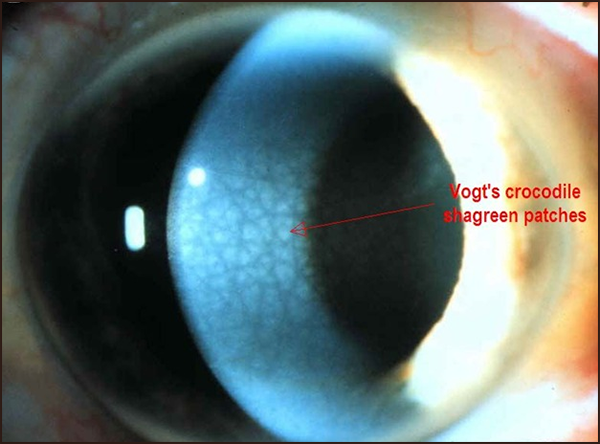
Crocodile shagreen is the opacity within the central posterior corneal stroma. The opacities are without any defining edges with clear spaces. The pattern closely resembles crocodile skin. That’s why it is termed as Crocodile Shagreen. Crocodile shagreen is a benign and degenerative condition of the cornea which is mostly asymptomatic.

Crocodile Shagreen
In Ayurveda, due to the resemblance in clinical pictures and manifestations we can correlate the corneal opacities with AvranaShukra as described by Achayara Shusrutha & Acharya Bhagbhatta. AvaranShukra comes under the heading of Krishan mandal rogas. Avrana Shukla means opacity without ulcer which indicates healed corneal ulcer or the senile changes that are occurring in cornea leading to the formation of such opacities.
Here, in this article we are going to discuss Crocodile Shagreen and show a better way for treating it with Ayurvedic Remedies.

Introduction

Crocodile shagreen appears as bilateral, polygonal in shape, grayish-white opacities of the corneal stroma. These opacities have indefinite edges with clear spaces. This disease is usually seen in the elderly, as it is a degenerative disorder. According to Ayurveda, AvarnaShukra based on location comes in the Netra KrishangataRoga. It is a Raktaja Netra Rog i.e. caused due to vitiated blood. Acharya described it under the heading of Aushadsadhyavikaar which means this disease is treatable with medicines, no surgical intervention is required.

Causes of Crocodile Shagreen

Causes can be any of the following:

  • Maybe seen in association with corneal degeneration
  • As a complication of conjunctivitis.
  • Following corneal ulcer which is healed
  • After any trauma
  • Crocodile shagreen is mostly a degenerative condition of the cornea with a non-familial type of occurrence
  • Familial type (very rare) occurs with X-linked enlargement of cornea.

Clinical features (Sign & Symptoms) of Crocodile Shagreen

In Modern Science

Symptoms

It is usually an asymptomatic condition but in rare cases it may present with blurring of vision or night glare, etc.

Signs

  • Appears as polygonal, grayish-white opacities.
  • Anterior shagreen are observed in the deep layers of the epithelium or in Bowman’s layer.
  • Posterior shagreen is mostly seen in the central deep cornea.

According to Ayurveda

Ancient References
The above shloka is quoted by Acharya Bhagbhatta: (Ref- Ashtaang Hridaya, Uttarsthan, 10/25)

Meaning of Shloka: The Shloka states that Avaranashukra (innocuous corneal opacity) looks like Shankha (Conch shell) which is white in color and featuring Kapha dosha having mild / no pain, is curable.

  • Whiteness of the black part of the eye (cornea)
  • No severe pain
  • No excessive discharge of tears.

As described by Acharya Madhava in his book Madhava Nidana, the features of this harmless corneal opacity is that it appears like a shell / moon / white lotus or thin white clouds.

Diagnosis of Crocodile Shagreen

Clinically, examination with slit lamp biomicroscopy is the standard for diagnosis. Vivo confocal microscopy is started to be used recently which shows dark striae in the extracellular matrix and a mosaic pattern of the collagen lamellae. Electron microscopy shows the presence of vacuoles in corneal stroma and collagenous lamellae look like a sawtooth. These changes may lead to polygonal opacities which are seen clinically.

Differential Diagnosis of Crocodile Shagreen

Following are the differential diagnosis of Crocodile shagreen :-

  • Ocular hypotony
  • Central cloudy dystrophy of francois.
  • Flattening of cornea by a hard contact lens
  • Band keratopathy,
  • X-linked megalocornea (enlarged cornea).

Prognosis

Good, if present without any associated progression or any kind of visual disturbances. This condition is considered curable both by Sushruta and Vagbhata. Though it is a treatable condition, Avarna Shukra is said to be located in the deep layers of cornea i.e. 2nd and 3rd layers (tunics of eye), thicker, chronic and is difficult to treat. Features given by Acharaya Bhagbhatta for the condition after which the disease becomes incurable. (Ref. Ashtaang Hridaya, Uttarsthan, 10/31)

  • When there is loss of internal vision due to the Shukra (corneal opacity)
  • When starting to give somewhat blackish or reddish appearances internally.
  • When it is inflamed or too deep.
  • When it starts creating sinuses filled by tears.
  • With it becomes chronic, having cuts in the middle.

Food items Recommended for Crocodile Shagreen (Pathya Ahara)

  • Cold-water fish such as salmon, tuna, sardines and mackerel which are rich in omega-3 fatty acids
  • Green leafy vegetables
  • Eggs
  • Whole grains
  • Citrus fruits and berries
  • Nuts
  • Legumes
  • Carrots
  • Sweet potato

Ayurvedic Treatment of Crocodile Shagreen

As Crocodile Shagreen is mostly an asymptomatic condition, in those cases treatment is not that much required. But if the symptoms begin to appear and the signs persist, following are the considerable Ayurvedic treatment principles as described by Acharyas for Avarnashukra.

Ancient References

The above shloka describes the line of management of AvarnaShukra as quoted by Acharya Vagbhata. (Ref- Ashtaang Hridaya, Uttarsthan, 11/29)

Meaning of Shloka: Triphala can be used in wet or dried form according to doshas, in Shukar Roga. Use of tikatghrit, use of Jaloka etc. (leech therapy) for blood-letting, Virechan (detoxification method of the whole body), Aaschyotan, trepan and putpaak etc. (Ayurvedic Panchakarma procedures beneficial for eyes) can be done.

Herbal Remedies for Crocodile Shagreen from Planet Ayurveda

Planet Ayurveda is a leading manufacturing unit that makes herbal / herbo-mineral products with the adherence of Ayurvedic texts as well as experts’ guidance. All the medicines here are made from natural sources with ancient time-tested formulas. The herbal medicines as suggested by our experts for Crocodile shagreen are:

  1. Bilberry Capsules
  2. Angel Eye Vitale
  3. Pitta Balance
  4. Vrihat Vatchintamani Ras
  5. Brahmi Chyawanprash
  6. Saptamrit Loha tablets
  7. Jeevantyadi Ghrita
  8. Curcumin Capsules

Products Description

1. Bilberry Capsules

It is single herb capsules’ formulation which has the extract of Vaccinium Myrtillus containing flavonoids, anthocyanin pigments, and other naturally occurring antioxidants that are very much beneficial for the eyes. Vaccinium Myrtillus (bilberries) is the main source of this medicine.

Dosage: 1-2 capsules once or twice a day after meals with plain water.

2. Angel Eye Vitale Capsules

Angel eye vitale is an herbal formulation that contains grape seed oil, almond oil and vitamin rich ingredients .This formulation gives great results for the patients of eye defects. All these elements give proper nutrition to eyes.

Dosage: 1 capsule twice daily after meals with plain water

3. Pitta Balance

It is a capsule formulation made by the mixture of many herbal ingredients. As this disease involves the Pitta Dosha, so the drug helps to balance the vitiation of Pitta. Ingredients include Praval pishti (Coral compound), Akik pishti (Agate compound), Jawahar Mohra Pishti, Kamdudha Ras, Mukta Pishti (Pearl compound) and Giloy Satva (Tinospora cordifolia).

Dosage: 1 capsule once or twice a day after meals with plain water.

4. Vrihat Vatchintamani Ras

It is a classical natural product made from minerals, available in tablet form. It is a dietary supplement that is prepared using Swarna Bhasma, Rajata Bhasma, Abhraka Bhasma and various other minerals in powdered and purified form. It helps to maintain a healthy nervous system. By improving the nervous system, it plays a key role in keeping the eyes healthy as well.

Dosage: 1-2 tablets twice a day with lukewarm water after the meals.

5. Brahmi Chyawanprash

It is a poly herbal classical preparation in avleha form, which is very much beneficial for the brain and eyes. It helps in maintaining balance of the doshas (body energies), the dhatus (body tissues) and the malas (body waste). Its ingredients include Brahmi (Bacopa Monnieri), Dashmoola, bala (Sida Cordifolia), Ashwagandha (Withania somnifera), Bhumi Amla (Phyllanthus Niruri), etc.

Dosage:2 teaspoonful, twicedaily after meals, preferably with milk.

6. Saptamrit Lauh Tablets

It is also a classical polyherbo-mineral compound which contains loh bhasma (ash of iron) along with triphala, which are very effective for healthy eyes. Avarna shukra as we know is a raktaj disorder so these ingredients aid in maintaining the vitiated rakta dosha, and ultimately supports in treating Crocodile Shagreen. Other ingredients include Haritaki (Terminalia chebula), Bibhitaki (Terminalia bellerica), Amalaki (Emblica officinalis) along with Yastimadhu (Glycyrrhiza Glabra) and Loh Bhasma (detoxified ash of iron).

Dosage: 2 to 3 tablets twice a day with Honey or Ghee, after meals.

7. Jeevantyadi Ghrita

It is a poly herbal classical preparation in ghrita form. This medicine has ghee as its base. According to Ayurveda, this ghrita is used for snehana karma (internal oilation therapy) which is very much beneficial for all the Netra rogas. It can be used for various netravasti and netratarpan. Here, in this disease we will use it for vata kapha Ghana properties and for snehan to get better results.

Dosage
o For internal use: 1 teaspoon with lukewarm water or with food (as suits the patient).
o For external use: Quantity sufficient or as directed by the physician.

8. Curcumin Capsules

It is the single drug formulation available in capsule form and is an effective medicine for many ailments. It is basically the standardized extract of Turmeric (Curcuma longa 95%). It exhibits a wide range of pharmacological properties such as, antioxidant, anti-inflammatory, antimutagenic, and antimicrobial. Curcumin belongs to a group of natural antioxidants. It exists in the form of strong antioxidant agents, vitamin C and E. The effect of curcumin on free radicals is carried out by several different mechanisms. It may also scavenge various forms of free radicals, such as ROS and reactive nitrogen species. (Refrence for Curcumin – https://www.ncbi.nlm.nih.gov/)

Dosage – 2 capsules twice a day with plain water, after meals.

Contact my assistant to provide you the costing / ordering and delivery information at – costing.planetayurveda@gmail.com or call at +91-172-5214030 Or Check Website – www.PlanetAyurveda.com

CONCLUSION

For a better life it is necessary to keep our eyes healthy and free from any ailment. So, take the top most care of your eyes. As, in early stages the disease seems to be asymptomatic it is not necessary that it can’t proceed further to any complication. To avoid such conditions, one must be concerned in the early stages. Therefore, as explained above with Ayurveda and herbal products, there is a great scope of preventing and treating eye related disorders including Crocodile Shagreen.

Ayurvedic Treatment for Dry Eyes

Abstract

The main focus of this article is on Dry eyes. This article includes the information such as epidemiology, symptoms, causes, risk factors, herbal remedies, dietary tips, and lifestyle changes. Dry eye disease is more common among women than men. The effect of eye syndrome increases with aging in each sex. It becomes common as more folks spend their time watching laptop screens. Optical device vision correction may be a common explanation for dry eye, usually for three to four months post-op. Those who have inherent dry eyes are vulnerable to have laser or optical device vision correction as their contact lenses are uncomfortable.

Introduction

The dry eye could be a disorder of the tear film that happens because of tear deficiency. It may also happen due to excessive tear evaporation. It causes harm to the interpalpebral ocular surface and is related to a range of symptoms reflective of ocular discomfort. (1) Dry eye syndrome additionally referred to as keratoconjunctivitis sicca (KCS), could be a common condition that is characterized by inflammation of the ocular surface and lacrimal glands. Dry eye symptoms could also be a manifestation of a general unwellness, thus timely detection might cause recognition of a critical condition. Also, patients with dry eyes are vulnerable to infections, like microorganisms keratitis (2) associated with an increased risk of complications following common procedures like optical device refractive surgery.

Dry Eye Syndrome

Knowledge of the pathophysiology of dry eye has recently been improved and therefore the condition is currently understood to be a complex disease, characterized by inflammation of the ocular surface and reduction in tear production. There are two types of eye syndrome. The first one is a deficiency of water component in the tears. It is so because the lacrimal gland present in our eyes may fail to produce enough water component to maintain a healthy tear. The second one is a problem related to the lipid layer. In this problem, the Meibomian gland fails to maintain the lipid layer and the oil surface of the tear behaves abnormally. This may unstable the tear firm and allows tears to evaporate easily.

Epidemiology

(3)According to the research, 17% of 2,127 patients visiting a hospital in Japan were diagnosed with dry eye, while 14.6% in an exceeding cluster of 2,520 older people reported symptoms of dry eyes. Dry eye syndrome will occur at any age. It is common among old people when the individual produces fewer tears. In addition to it, it is common in women than in men. Generally, it is found in places wherever deficiency disease ends up in a fat-soluble vitamin deficiency (Vitamin A).

Symptoms

If you work on the computer and spend long hours on it then, you are suffering from dry eye syndrome. You may come in contact with bacterial infection and your eyes become inflamed. This may be scarring your cornea and make you feel uncomfortable with your vision.

There are Many Symptoms of Dry Eye Syndrome That are Mentioned Below

  1. Feeling like sand in the eyes.
  2. Double vision
  3. Redness in eyes.
  4. Tearing.
  5. Sensitivity to light.
  6. Difficulty keeping the eyes open.
  7. Eyelids sticking together.
  8. Eyes fatigue.
  9. Discomfort when wearing lenses.
  10. Soreness in the eyes.
  11. Itchy eyes.
  12. Photophobia.

Causes of Dry Eyes

Dry eyes are caused due to deficiency of tears in the eyes. Tears are a complex mixture of fatty oils, mucus, and water. This mixture will keep your eyes clean and smooth. It also protects your eyes from many external infections. There are some causes of dry eyes that are discussed below:

1. Decreased Tear Production

Dry eyes syndrome can occur when there is a deficiency of tears in your eyes. The medical term for this situation is known as Keratoconjunctivitis sicca. The issue of tear production occurs due to aging, damage of the tear gland from radiation, diabetes, thyroid disorders, lack of Vitamin A, etc.

2. Increased Tear Evaporation:

Tear evaporation is caused due to wind, air, smoke, eyelid problem, blinking less often, etc.

3. Imbalance In Tear Composition

The tear is a mixture of oil, mucus, and water. If there is any problem with all these layers then it may damage your eyes. For example, the oil glands produce oil film on the edge of the eyelids that might become clogged.

Risk Factors of Dry Eyes Syndrome

There are The Number of Factors that increases the Risk of Dryness in the Eyes

  • Being older than 50.
  • Eating a diet with a deficiency of vitamin A.
  • Wearing contact lenses.
  • Being a woman.

Treatments

There are many treatments available to treat dry eye syndrome. We discussed some treatments that may help you with these issues and these are:

Herbal Remedies

Planet Ayurveda offers many products that are helpful in treating dry eye syndrome. All the products are made under the observation of many Ayurvedic experts. The herbs used in these products are pure and natural. So, we mentioned these products below:

  • Amalaki Rasayan.
  • Bilberry capsules.
  • Ankur eye drop.

Treatment of Dry Eye Syndrome

Ayurvedic Medicine for Dry Eye Syndrome

1. Amalaki Rasayan

It is also known as Indian Gooseberry which contains vitamin C. it provides protein to your body and reduced unwanted fat. It is the best fruit for our aging eyes. It supports the health of our eyes. Ingredient used in these capsules is standardized extract of Amalaki.

Dosage: 1-2 capsules twice daily, after meals.

2. Bilberry Capsules

Vaccinium myrtilus): It helps to improve blood circulation and build strong blood vessels. It contains anti-oxidant properties and produces rhodopsin, this pigment improves the night vision of a person. It is anti-inflammatory in nature.

Dosage: 1-2 capsules twice daily, after meals.

Ankur Eye Drop

It has good distilled herbs that are good for the lubrication of our eyes. It has an amla-tulsi ark. It is anti-allergic and anti-bacterial in nature. It helps to improve your eye-sight.

Dosage: 1-2 drops twice or thrice daily a day.

Dietary Tips

It is important to maintain a Healthy Vision. It is not a big deal if you eat quality and healthy food in your diet. So, there are the number of dietary tips that are mentioned below and are able to treat dry eye syndrome.

  1. Almond, figs, and raisins: These are really good at improving your vision of the eyes. Soak some almonds, raisins, and figs in water overnight and take them in the morning. They contain lots of fibers and vitamins.
  2. Carrots: It is rich in Vitamin A. It supports the health of our eyes and reduces stress as well.
  3. Amla juice: It is highly beneficial for maintaining the healthy vision. It is anti-oxidant in nature and having a glass of Amla juice in the morning keeps your eyesight strong.
  4. Green leafy vegetables: It provides many benefits to our eyes and it is anti-oxidant in nature. It reduces the deficiency of water in our eyes. Green leafy vegetables such as spinach, leutin, kale, etc.
  5. Fatty fish: Fishes such as tuna, sardines, etc. are rich in omega-3 fatty acids and provides many benefits to our eyes. It resolves vision-related problems.

Lifestyle changes:

  • Regular exercise.
  • Take a good amount of sleep for 8-9 hours daily.
  • Avoid air blowing in your eyes.
  • Take small breaks during long tasks.
  • Position your laptops and computer screen below your eye level.
  • Avoid smoking.
  • Avoid dust, pollen, smoke, etc.
  • Wash your eyes with clean water.
  • Cover your eyes to avoid the harmful rays of the sun.
  • Do not take any medicine without consulting a doctor.

Conclusion

Most people with mild dry eye syndrome don’t have any permanent complications, however, severe symptoms will result in eye inflammation, infection, and harm to the surface of the tissue layer. This harm will result in ulceration or scarring, which might be painful and have an effect on the patient’s vision. Conjunctivitis caused by the dry eye doesn’t commonly need treatment.

However, if the effect of eye syndrome increases in a person then, it is advised to take medical help. Some individuals with dry eye syndrome typically have perpetually watery eyes as a result of they turn out too many tears. Planet Ayurveda also offers some herbal medicines that are able to treat dry eyes syndrome. All the products are made with natural herb and are pure