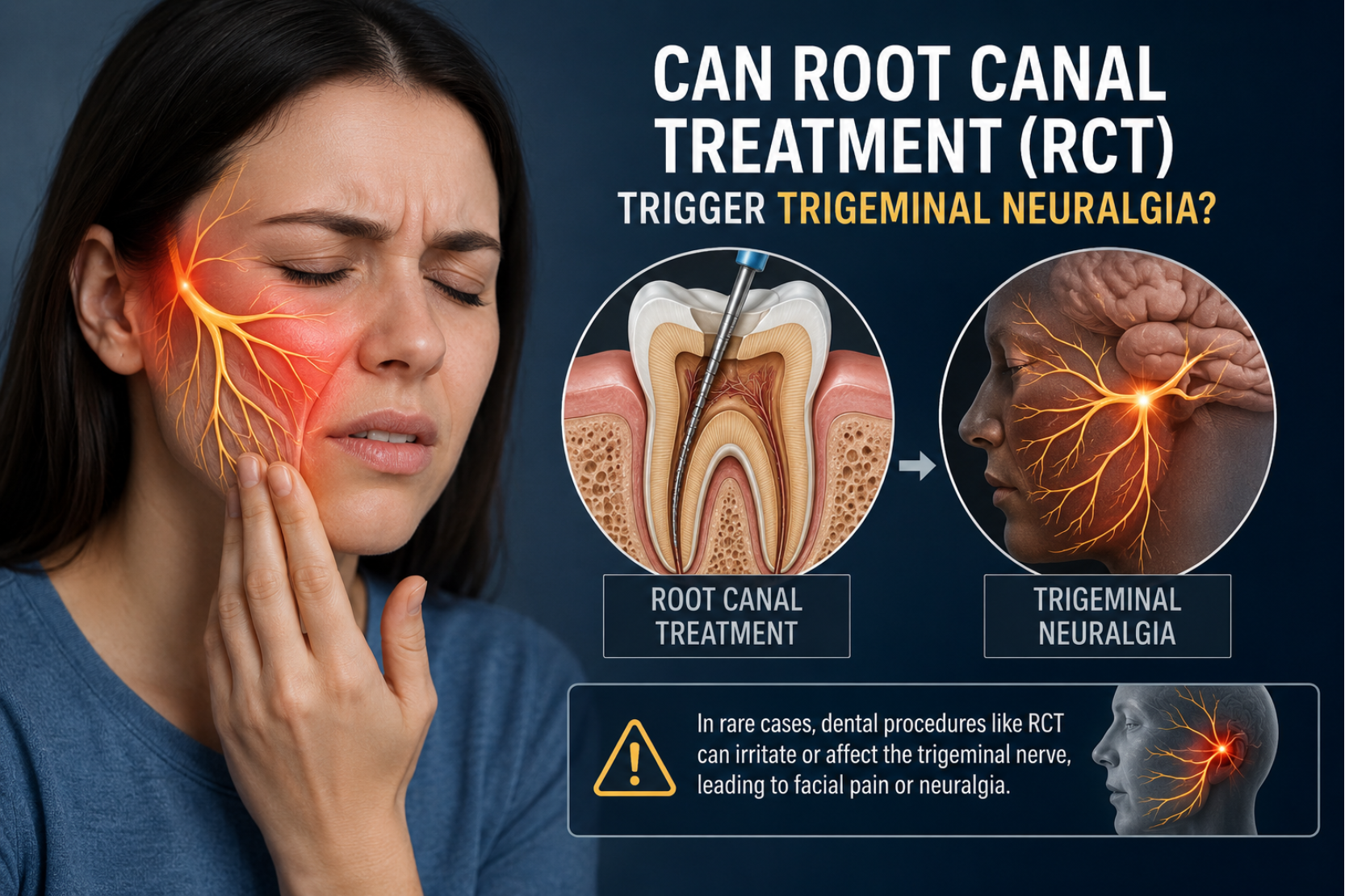
Can Root Canal Treatment Trigger Trigeminal Neuralgia?
Abstract
Root canal treatment is not considered a direct cause of classical trigeminal neuralgia; dental procedures may occasionally result in trigeminal nerve injury or irritation, leading to a condition known as post-traumatic trigeminal neuropathic pain (PTTNP). This condition is of idiopathic and neuropathic origin that becomes a diagnostic challenge for the doctors. Neuropathic pain is caused by dysfunction of the nervous system or a primary lesion or for a secondary reason like Root Canal Treatment. With limited studies or information about the association of endodontic therapy and trigeminal neuralgia leads to a wrong diagnosis, making the patient unwilling to seek help often. So, there is a need to identify characteristics of the condition. Trigeminal neuralgia is usually a secondary trauma while treating the tooth endodontically, also referred to as ‘Post Traumatic Trigeminal Neuralgia’(PTTN), causing local sensory defects to its branches- Lingual nerve, Inferior Alveolar Nerve, branches of Maxillary nerve. Proper dental care and intervening on time are important in managing and preventing the onset of this painful condition.
Statistics of Trigeminal Neuralgia
Prevalence
- Nerve injury occurs in approximately 2.11% of dental cases.
- Endodontic treatments are associated with roughly 7–10% of diagnosed cases of post-traumatic trigeminal nerve injuries.
Demographics: Research indicates that Post-Traumatic Trigeminal Neuropathy (PTTN) following endodontic treatment predominantly affects middle-aged women, typically in their mid-40s.
Location and Cause
- Trigeminal neuralgia most commonly affects one side of the face, with the right side being affected slightly more often than the left.
- In approximately 90–95% of classical trigeminal neuralgia cases, pain is caused by compression of the trigeminal nerve by a blood vessel near its entry into the brainstem.
Facts About Trigeminal Neuralgia
- Trigeminal neuralgia is often referred to as the “suicide disease” because of the extreme severity of pain experienced by some patients.
- In rare cases, it can affect both sides of the face (bilateral involvement).
- Because the pain is frequently felt in the jaw, gums, or teeth, it may initially be mistaken for a dental problem, sometimes leading to unnecessary dental procedures, including root canal treatment.
- The condition may have unpredictable periods of remission.
- Painful episodes may occur daily for weeks or months, disappear for years, and then recur unexpectedly.
- Trigeminal neuralgia usually responds poorly to conventional analgesics (painkillers).
- The annual incidence of trigeminal neuralgia is approximately 12 cases per 100,000 people per year.
Introduction
The term “Trigeminal” is derived from the Latin words tria, meaning three, and geminus, meaning twin. The trigeminal nerve is the fifth cranial nerve and is responsible for facial sensations. It possesses both sensory and motor functions and supplies the maxilla, mandible, and orbital region. Trigeminal neuralgia (TN) is considered one of the most excruciating pain conditions known to medicine. The pain mainly involves the lower face and jaw and sometimes the area around the nose and above the eye. It is usually unilateral, meaning it affects only one side of the face, and is characterized by brief, sudden, shock-like episodes of pain. Various forms of trigeminal neuralgia have been described, including classical, secondary, and idiopathic trigeminal neuralgia. Dental procedures such as root canal treatment are performed to preserve the natural tooth and eliminate infection. Although root canal treatment is not considered a direct cause of trigeminal neuralgia, trauma or irritation to branches of the trigeminal nerve during dental procedures may occasionally result in neuropathic pain symptoms that resemble trigeminal neuralgia. During a root canal procedure, local anesthesia is administered to ensure patient comfort and minimize pain. Proper administration of local anesthesia and careful treatment techniques help reduce the risk of nerve irritation, which, in rare cases, may contribute to persistent post-treatment pain.
Branches of the Trigeminal Nerve
The trigeminal nerve is the fifth cranial nerve and is the primary nerve responsible for sensation in the face. It is divided into three major branches:
- Ophthalmic Branch (V1): The ophthalmic branch is purely sensory in function. It supplies sensation to the forehead, scalp, upper eyelid, cornea, and the bridge of the nose. Pain arising in this branch is often felt around the eye, forehead, and upper part of the face.
- Maxillary Branch (V2): The maxillary branch is also purely sensory. It provides sensation to the lower eyelid, cheeks, side of the nose, upper lip, upper teeth and gums, and the roof of the mouth. Trigeminal neuralgia affecting this branch can cause severe pain in the upper jaw and cheek region.
- Mandibular Branch (V3): The mandibular branch contains both sensory and motor fibers. It supplies sensation to the lower jaw, lower teeth and gums, lower lip, chin, and part of the tongue. Its motor component controls the muscles involved in chewing. Trigeminal neuralgia involving this branch commonly produces pain in the lower jaw and chin area and may interfere with eating and speaking.
Pain Characteristics Of Trigeminal Neuralgia
- Pain may be mild, absent for certain periods, or extremely severe.
- The pain is often described as an electric shock-like sensation.
- Each painful episode usually lasts from a few seconds to about 2 minutes.
- The condition is usually unilateral, affecting one side of the face, more commonly the right side than the left.
- Pain may be triggered by gentle stimulation of the lips, face, or ala of the nose, as well as by speaking, chewing, brushing teeth, or washing the face.
- The pain is typically sharp, shooting, stabbing, radiating, or excruciating in nature.
Triggering Factors of Trigeminal Neuralgia
The painful attacks of trigeminal neuralgia may be triggered by simple daily activities such as:
- Washing the face
- Touching the face
- Shaving
- Brushing the teeth
- Eating, chewing, or drinking
- Talking
- Smiling
- Exposure to light air or wind on the face
- Applying pressure to the cheek or jaw area
These activities stimulate specific trigger zones on the face and may provoke sudden, electric shock-like pain in affected individuals.
Criteria for Trigeminal Neuralgia According to the International Headache Society (IHS)
- Recurrent episodes of unilateral facial pain occurring in the distribution of one or more divisions of the trigeminal nerve, with no radiation beyond the trigeminal distribution.
- Pain has all of the following characteristics:
- Lasts from a few seconds to 2 minutes
- Severe in intensity
- Electric shock-like, shooting, stabbing, or sharp in nature
- Pain is triggered by innocuous stimuli within the affected trigeminal nerve distribution.
- The pain is not better accounted for by another ICHD-3 (International Classification of Headache Disorders, 3rd Edition) diagnosis.
Risk Factors for Developing Chronic Pain After Dental Treatment
Certain individuals may be more prone to developing chronic pain following dental procedures. Factors that may increase the risk include:
- The technique used during the procedure
- The type and severity of pain present before dental treatment
- Psychosocial factors, such as stress and anxiety
- Older age
- Female sex
- Genetic predisposition
How Does Root Canal Therapy (RCT) Work ?
A root canal is a dental treatment designed to eliminate infection or injury within the tooth pulp and save the affected tooth. During the procedure, the infected or inflamed pulp tissue is removed, the root canals are thoroughly cleaned and disinfected, and then sealed with a filling material. The treated tooth is often restored with a crown (tooth cap) to strengthen it and restore its function.
Symptoms that may require RCT include:
- Swelling
- Pain
- Sensitivity to hot or cold foods and beverages
However, procedural errors or complications such as:
- Excess filling material passing beyond the natural end of the root canal
- Overextension of endodontic files beyond the root canal
- Incorrect handling of dental instruments or equipment can lead to injury of nearby nerve structures, especially the inferior alveolar nerve (IAN).
Injury to branches of the trigeminal nerve may lead to post-traumatic trigeminal neuropathic pain (PTTNP), which can present as persistent pain, tingling, numbness, burning sensations, or altered sensory perception affecting the face, jaw, lips or tongue. In some cases, these symptoms may resemble trigeminal neuralgia. Such nerve damage can have a substantial impact on an individual’s quality of life, making routine activities such as eating, drinking, chewing, speaking, and smiling difficult.
Why dental treatment triggers trigeminal pain ?
- Dental procedures are performed in tight anatomical spaces within the oral cavity. Structures such as the teeth, tooth roots, surrounding bone, dental instruments, and drills lie close to branches of the trigeminal nerve. Therefore, when nerve-related pain begins after a dental procedure, it may be due to chemical irritation, mechanical trauma, or inflammatory compression.
- Mechanical trauma may occur due to contact, bruising, or compression of the nerve by nearby structures or instruments. Patients may experience numbness, tingling, or sharp pain when the nerve is irritated or compressed.
- Chemical irritation may result from the use of irrigants, disinfectants, antibiotic pastes, or local anesthetic injections. If these substances extend to the root apex or beyond, they may irritate nearby nerve tissues.
- Inflammatory compression may occur as a post-treatment complication when swelling, tissue pressure, bleeding, or inflammation develops within the confined anatomical space around the nerve.
Conclusion
Trigeminal neuralgia is a painful condition often described as a “lightning bolt” to the face. These short-lasting pain spasms can occur several times a day in affected individuals. Trigeminal neuralgia is usually unilateral and can involve any division of the trigeminal nerve. The most common cause of trigeminal neuralgia is compression of the trigeminal nerve root by a blood vessel. Several therapeutic interventions are available for trigeminal neuralgia, with pharmacological therapy being the primary treatment regardless of the underlying cause. The course of the disease is variable; some patients may experience episodes for several weeks or months, followed by periods of complete remission. The diagnosis of trigeminal neuralgia should be considered in patients presenting with idiopathic tooth pain that does not respond to conventional dental interventions. By recognizing the characteristic features of this neuropathic pain condition and establishing an early diagnosis, patients can be spared months of suffering and unnecessary dental treatment.