Healing Power of Ayurveda for Your Beloved Animals – A Comprehensive Guide to Pashu Ayurveda
Abstract
Ayurveda is a vast science and an ancient Indian system of medicine, which is not only for humans but also for animals. The concept of Pashu Ayurveda or Ancient veterinary science points towards the relation Man and animals have shared since ages. From the past golden days till now humans have adored the role of animals in their life and till now they know what is the importance of animals in their lives. Since ages animals are a very good accompaniment for man and we, as humans have dependence on animals and also domesticated animals for food products, farming, earlier it was for transportation as well, man adores dogs as its the best companion he or she can have.
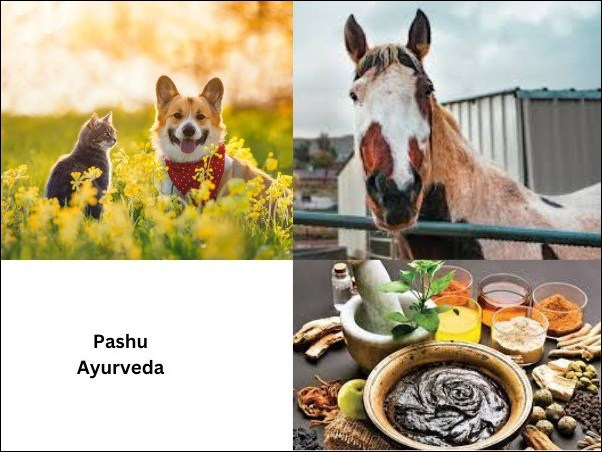
Though prehistoric man was a wanderer. He used to hunt animals and birds for eating and used their skin as clothes. Gradually the man evolved and changed his lifestyle and made settlements. Then man developed a very satisfying equation with animals and birds thus developing a very close association with them. Many animals were taken as pets and animals became the wealth of ancient aryans. Animals were used for farm work and also to pull vehicles. Elephants and horses were used extensively for warfare.
Like this, animals and birds became a part and parcel of human life. Thus special care was done for their health and finally man developed Pashu Ayurveda or veterinary science to take care of animals and birds and also to attend to their health.
Introduction
During the vedic time maharishis or sages observed that animal health is equally important as human health. Hence they decided to develop knowledge about animal health as well and named it Pashu Ayurveda. During vedic period medicine science was divided into three parts/categories
- Ayurveda – For Health of mankind
- Pashu Ayurveda – For Health of Animal Welfare
- Vriksha Ayurveda – For Plant Health Pashu
Ayurveda or veterinary science enjoys an equal status in medical science because animals are useful to human beings. Pashu Ayurveda was developed in various branches like Ashwa shastra (Study of horses), Gaja shastra (Study for Elephants), Go shastra (Study of Cows) etc.
Shalihotra , who is considered as the founder of veterinary science, composed Shalihotra samhita in the third century BCE. Shalihotra, who was son of Haya ghosha, is said to have lived in Sravasti Uttar Pradesh. His work was a large treatise on the care and management of horses. The Shalihotra samhita has around 1200 shlokas in Sanskrit and it has been translated into Persian, Arabic, Tibetan and English languages.
So, If you think that veterinary science is something that has originated in the modern era then you need to go through history once again and see that when there was no modern science or techniques, at that time also, people used to take care of their animals with herbal preparations or herbo mineral preparations. Such preparations were used for subsiding a simple fever and also for healing an open wound.
- Don’t worry it’s not the end, it’s just a start.
- You need to know a lot about Pashu Ayurveda or Ayurveda for Animals
- Elaborated details about Pashu Ayurveda / Ayurveda For Animals and History of Veterinary Medicine In India
Animals are viewed as a part of the natural world and their health is also closely related or connected with their diet along with the environment provided to them. After understanding the living animal body as per Ayurveda certain herbs, herbal preparations, herbo mineral or mineral preparations are used to help various types of animals in different health-related situations.
Some Points of History for Indian Veterinary Medicine
We should take a walk back to history about the references of animal husbandry and treatment in Ancient India. Some examples are as follows
- Athrava veda provided interesting information regarding the ailments of animals, herbal medicines and cure for diseases.
- As mentioned before, Shalihotra was the first known veterinarian of the world and an expert in horse care and husbandry.
- Gaja Ayurveda was composed by sage Palakapya, who was expert in dealing with the elephants and ailments related to elephants.
- In the period of Mahabharata, two Pandava brothers Nakula and sahadeva were experts of horse and cattle/cow husbandry respectively
- Lord Krishna was an excellent caretaker of the cow husbandry. That’s why till now Gokul and Mathura are famous for excellent breeds of cows, high production of milk, good quality of curd and butter.
- Even Buddha was a great protector for all kinds of animals and Ashoka was the first person in the entire world to build a hospital for animals. He even arranged cultivation of herbal medicines for men and animals in his empire and adjoining kingdoms.
- Sage Sushruta, who is the father of surgery, has also mentioned about the animal ailments and their treatment.
- Sage Charak has also mentioned about the diseases of animals and also about its treatment.
References of Pashu Ayurveda in various Classical Ayurvedic Texts
Pashu Ayurveda, as mentioned before, has been mentioned by various sages or acharyas in their formal texts. Some of them are as below
By Aacharya Charak (Charak samhita)
In chapter 11 “Phalamatra Siddhi Adhyaya” of Siddhi Sthana, ceratin types of enema are mentioned which can be given in various animals. Stating this Sage Charak has mentioned common recipe and specific enema which can be given in animals and provides impressive results.
Common recipe for all types of veterinary enemas as per Aacharya Charak
कलिङ्गकुष्ठे मधुकं च पिप्पली वचा शताह्वा मदनं रसाञ्जनम्|
हितानि सर्वेषु गुडः ससैन्धवो द्विपञ्चमूलं च विकल्पना त्वियम्||Charak samhita 12/23||
The above verse suggests a recipe for all types of Veterinary enemas. the recipe has ingredients like kaliga (Holarrhena antidysenterica), kustha (Saussurea lappa), madhuka (Madhuca indica ), madana (Randia dumetorum), pippali(Piper longum ), vacha (Acorus calamus), satahva (Anethum sowa) and rasanjana added with jaggery, rock salts and two variety of panchamula bilva (Aegle marmelos), syonaka (Oroxylum indicum), gambhari (Gmelina arborea), patala (Stereospermum suaveolens), prishna- parni (Uraria picta), gani-karika (Piper longum), shala-parni (Desmodium gangeticum), brihati (Solanum indicum), kantakari (Solanum surattense), and goksura (Tribulis Terrestris).
Further Aacharya Charak has also mentioned specific enema for managing diseases in animals.
Specific Enema for Diseases of Elephants
गजेऽधिकाऽश्वत्थवटाश्वकर्णकाः सखादिरप्रग्रहशालतालजाः|
तथा च पर्ण्यौ धवशिग्रुपाटली मधूकसाराः सनिकुम्भचित्रकाः||Charak samhita 12/24||
For Elephants the recipe mentioned in verse 23 should be added with the decoction of following for giving medicated enema
- Ashvattha (Ficus religiosa)
- Banyan (Ficus benghalensis)
- Khadira (Acacia catechu)
- Pragraha (Oroxylum indicum)
- Hala (Shorea robusta)
- Fruit of tala (Borassus flabellifer)
Specific Enema for Diseases of Cattle
पलाशभूतीकसुराह्वरोहिणीकषाय उक्तस्त्वधिको गवां हितः| ||Charak samhita 12/25||
In case of cattles, once again the ingredients in verse 23 are to be added with the decoction of the following
- Madhuka-sara(Madhuca Indica)
- Nikumbha (Baliospermum montanum)
- Hitraka(Plumbago zeylanica)
- Palasha (Butea monosperma)
- Mudga-parni (Vigna trilobata)
- Masa-parni(Teramnus labialis)
- Dhava(Anogeissus latifolia)
- Shigru (Moringa oleifera)
- Patali(Baliospermum montanum)
- Bhutika (Cymbopogon citratus)
- Deva-daru (Cedrus deodara)
- Katu-rohini (Picrorhiza kurroa)
Specific Enema for Diseases of Horse, Donkey, Camels, Sheep & Goat
पलाशदन्तीसुरदारुकत्तृणद्रवन्त्य उक्तास्तुरगस्य चाधिकाः
||Charak samhita 12/25||
For Horses, the Decoction of Following Herbs is to be Mixed with the Ingredients of verse 23
- Palasa (Butea monosperma)
- Danti (Baliospermum montanum)
- Sura-daru (Cedrus deodara)
- Kattarina(Sterculia urens)
- Dravanti( Croton tiglium)
खरोष्ट्रयोः पीलुकरीरखादिराः शम्याकबिल्वादिगणस्य च च्छदाः
||Charak samhita 12/26||
For Donkeys and Camels, the decoction of following herbs is to be mixed with the ingredients of verse 23
- Pilu (Salvadora persica)
- Karir (Capparis decidua)
- khadira (Acacia catechu)
- Samyaka and leaves of drugs belonging to bilvadi-group
अजाविकानां त्रिफलापरूषकं कपित्थकर्कन्धु सबिल्वकोलजम्
||Charak samhita 12/26||
In case of goats and sheeps, the decoction of following herbs is to be taken and mixed with the herbal decoction mentioned in verse 23
- Triphala (Terminalia chebula, Terminalia belerica and Emblica officinalis) Parusaka (Grewia asiatica)
- Kapitha (Limonia acidissima)
- karnakandu (Ziziphus jujuba)
- Bilva(Aegle marmelos) & Kola
Reference in Sushruta Samhita
On the other hand Sushruta samhita has described Practicing various surgical procedures on the different parts of plants and animals. This is the proof that Ancient Aacharyas have the knowledge of animal anatomy and thus were providing treatment for various types of animal related conditions. Acharya Sushruta had mentioned about this in the Yogasutriya Adhaya, Chapter 9 Verse 4 of Sutra sthana, Sushruta Samhita. The special methods include application of cauterization, removing foreign bodies along with obstructions, surgical grafting and also managing fractures, dislocations and fistula.
So, yes, before the modern medicine system was introduced in India, the Ethno veterinary medicine system was there in the context of animals. Not only this detailed context was shared for treating various categories of animals and birds.
Moving on to the third reference
Garuda Purana (Chapter 201, Volume 2, Chapter Name: Medical treatment of Horses & Elephants) In this chapter ulcers in Horses are explained.
Mentioning about ulcers it is said that in horses there are two types of ulcers. teh types are as follows
- Extraneous Ulcers (Ulcers due to external reasons like weapon injury etc.)
- Due to derangement of humors (Further divided into 4 types)
Types
1. Vataja Type
Ulcers marked by delayed suppuration
2. Pitaja Type
This is marked by Burning Sensation at throat
3. Kaphaja Type
Marked by quick suppuration
4. Raktaja Type
Particular feature is, it do not cause pain
Treatment of various Types of Ailments in Horses
1. Extraneous Ulcers can be treated by washing them with the following
- Roots of Eranda, two shoots of Haridra, Citraka, Vishva bheshaja and Rasona or Saindhava well ground with buttermilk and sour gruel helps in purification and healing of wound or ulcer
- Tila, fried grain flour pasted with curd and salt or a paste of Nimba leaves and ball of rice applied over a wound purifies and heals it
2. Vataja ulcers
Powdered Patola, Nimba leaves, Vacha, Chitraka & Adhrak given to the horse with water for a drink destroys worms, mucous discharges, intoxication and deranged Vayu. In case of cutaneous infection the horse must be bled and a decoction of Nimba leaves, Patola, Triphala and Khadira must be given to the horse
3. Use of Errhines
Errhines is a medicine which is to be stuffed up the nostrils to promote sneezing and increased discharge. In certain afflictions errhines become necessary. For this juice of Matulunga or Mamsi should be used. The first day’s dosage is two pala (80 grams). Everyday one pala is increased (that is 48 grams of dosage is increased). For a first class horse the highest dosage is 18 pala (720 grams). For a middling horse it is 14 pala (560 grams) and for a lowest class horse it is 8 pala (320 grams). However, Errhines are prohibited in autumn and summer.
In case of Vataja type of disease, the medium for Errhines is oil along with sugar, butter or milk. In pittaja ailment triphala mixed with water can be used as a medium. In the case of Kaphaja vyosa (trikatu) along with mustard oil can be the medium.
- A horse slightly injured should be given Guggulu and fed on milk pudding. It will be immediately relieved and be normal.
- In a Vataja ailment the diet of a horse is Sali grains and milk
- In a Pittaja ailment a Karsa of gravy with Mudga soup, honey and butter shall be given.
- In Kaphaja diseases mudga or Kulattha can be given. If the horse is affected with deafness and deranged kapha it should be fed with pungent and bitter articles of diet. If the ailment is of Tridosha origin Guggulu is to be administered along with its mouthfuls (of grass, etc)
- In all ailments Durva should be given along with other grasses
- If the horse is affected by Kustha, ulcers, or lame- ness it shall be administered with the decoction of Triphala
- In case if it is affected by impaired digestion or tumor it shall be ad- ministered with cow’s urine
- If it is affected by Vatapitta or ulcers, it is to be administered with cow’s milk and butter
- In case of lean horses the diet shall be supplemented by meat.
- In the mornings during Autumn and summer horses should be given five Palas (200 grams) of well powdered Guduci with butter. It quells ailment, nourishes and increases strength. It can be given alone or in a combination with Alkali.
Further in this chapter of Garuda Purana Gaja Ayurveda (Ayurveda for Elephants) is explained.
- It explains that decoctions and food articles mentioned for horses are to be given in four times dosage of that of horse.
- The aforementioned historical examples and references from different books is the proof that Pashu Ayurveda had significance in Ayurveda and Ayurvedic herbs are boon for humankind as well as for animals too.
Some Common Ayurvedic treatments which can be given in Animals are as follows
Dietary changes
Ayurveda emphasizes the importance of a balanced diet for good health. For animals, this might mean feeding them a diet that is rich in whole foods and free from artificial additives and preservatives.
Herbal remedies
Many herbs used in Ayurvedic medicine can be beneficial for animals as well. For example, turmeric is a natural anti-inflammatory that can help relieve joint pain in dogs, horses and even in cats as well.
Massage
Ayurvedic massage called abhyanga can be used to help animals relax and reduce stress.
Aromatherapy
Essential oils can help humans as well as animals too. they can be used to support an animal’s overall health and well-being. Lavender, for example, is a calming scent that can help reduce anxiety in dogs and cats.
Keeping in mind the health of your pet, It’s important to note that while Ayurvedic remedies can be beneficial for animals, they should be used in conjunction with veterinary care. If your animal is sick or injured, always consult with a qualified veterinarian before trying any new treatments.
Planet Ayurveda products for Animals
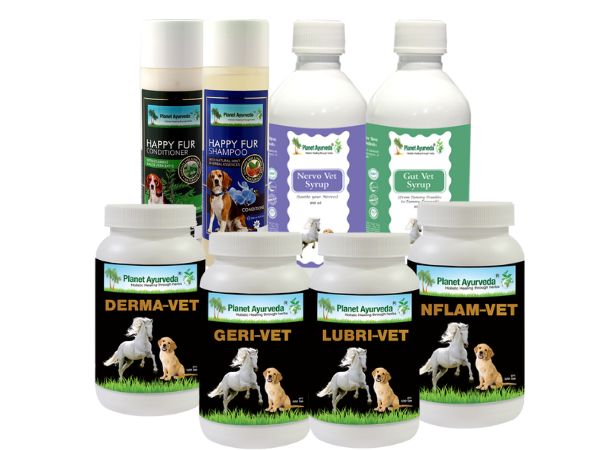
Planet Ayurveda is a leading Herbal manufacturing company who has now stepped its foot forward to help your pets as well with the herbal formulations. Planet Ayurveda has various products for pets. following is the list of products
- Derma vet – For skin related conditions
- Geri Vet – For maintaining overall health
- Gut Vet – For maintaining gut health
- Happy fur shampoo and conditioner – For keeping the fur of your pets soft and shiny
- Inflam Vet – For any type of inflammation in the body
- Lubri vet – For lubricating joints in animals along with
- Nervo Vet – For maintaining the nervine health of your pet
Ayurvedic Products List for Animals
- Derma Vet
- Geri Vet
- Gut Vet
- Inflam Vet
- Lubri Vet
- Nervo Vet
- Happy Fur Shampoo
- Happy Fur Conditioner

Product Description
1. DERMA VET
Derma vet is an exclusive formulation especially prepared to support and nourish the dermal health or skin health of your animals. It has haridra (Curcumin longa) and neem (Azadirachta indica) as its ingredients. Both of these herbs give great impact not only on human skin but on animal skin as well. Haridra helps in the alleviation of Vata dosha and thus reduces swelling over the skin. Neem on the other hand helps with burning or itching present in various type of skin conditions
2. GERI VET
Geri vet is another fantastic formulation which is manufactured to maintain the overall health of your pet. Geri Vet has ingredients like wheat grass (Triticum aestivum), Giloy (Tinospora cordifolia) along with tulsi (Ocimum sanctum). All these herbs have an impressive effect in boosting the body’s metabolism thus helping in building a powerful defense system. The herb works by balancing the three humors of the body and hence stabilizes the entire body.
3. GUT VET
Gut vet, as its anime suggests, is a formulation exclusively manufactured to take care of your pet’s gut health. Ayurveda believes that, for any living individual, a healthy gut is the key to a healthy body and happy mind. That’s why a product like Gut vet is exclusively dedicated to maintaining Gut health in animals. The product has ingredients like Brahmi (Bacopa monnieri), Shatavari (Asparagus racemosus) and Mulethi (Glycyrrhiza glabra). These all herbs help in balancing three humors as well.
4. Happy Fur Shampoo
The happy fur shampoo gives very good results in maintaining the quality of fur. Your pet’s fur can get rough and thin with time if not taken care of properly the fur may tangle and whenever you comb it will shed more and more in quantity. But not any more as now Happy fur shampoo is here to help your beloved pets. The formulation has ingredients like Pudina (mint extract), Amla Extract (Emblica officinalis), Jatamansi Extract (Nardostachys jatamansi), Tulsi (Basil Extract) and many others.
5. HAPPY FUR CONDITIONER
The happy fur conditioner is very important once you are done with the happy fur shampoo application and rinsing. conditioner helps in the maintenance of smoothness of pets fur and also keeps the fur full of fragrance as well. Due to the presence of Vitamin E, Aloe vera extract, Argan oil etc. in a happy fur conditioner it nourishes the base of fur and thus keeps it strong and stops it from falling.
6. INFLAM VET
The Inflam vet is a very impressive formulation which is specially manufactured for the inflammatory conditions in animals. The inflammation can take place over any sight in the body and thus can result in pain and discomfort. Such pains and discomfort can be easily managed with this product. The Inflam vet has ingredients like shallaki (Boswellia serrata) and guggul (Commiphora mukul). Both of these herbs have an impressive impact in subsiding pains and inflammation. This can be used in the swelling of joints, pain in joints, and swelling or pain in abdominal organs as well.
7. LUBRI VET
Lubri vet is a product which is especially composed to lubricate the joints. The two bones articulate to form a joint and between two bones there is a cushion of fluid. When this cushion starts depleting (due to daily wear and tear, advancing age), pains and problems with joint movements occur. So, Here Lubri vet plays its role by rejuvenating the cushion required for adequate movement of joints. the product has ingredients like Pipal (Ficus religiosa), Guggul (Commiphora mukul), Asthisamharaka (Cissus quadrangularis), Arjuna (Terminalia arjuna) and Ashwagandha (Withania somnifera).
8. NERVO VET
From the name Nervo vet, you might have guessed about its use. Nervo Vet is the exclusive Nervine tonic which thus helps in many types of neurological conditions. With age your pet may develop degeneration of myelin sheath which is present as an insulator and protector on the nerves which results in many types of problems. but such problems can be easily overcome with Nervo Vet. The product has ingredients like Ashwagandha (Withania somnifera), shatavari (Asparagus racemosus) and mulethi (Glycyrrhiza glabra).
The dosages of these products vary from breed to breed and animal to animal. The preparation of these herbal formulations for pets is done with the best quality of herbs as mentioned in classics keeping in mind the derangement of humors, which is usually associated.
The products by Planet Ayurveda are totally herbal and are free from any type of side effects. The above mentioned products are free from any type of preservative, coloring agent, flavoring agent, dyes etc.
Why Planet Ayurveda Herbal Formulations for Pets ?
-
-
-
- Totally Natural
- Free from Additives or Adulterants
- Prepared with age old herbs
- Effective in various type of conditions
- Can be given to any breed
-
-
Contact Planet Ayurveda Support Team to provide you the costing / ordering and delivery information at – costing.planetayurveda@gmail.com or Call at 0172-521-4040 (India), +91-172-521-4040 (Outside India) or Whatsapp at (+91) 9915-593-604
Conclusion
As shared above, the Ayurveda has references of Animal treatment. It is not like it’s just in thoughts but the aforementioned references and examples from history is the proof that Ayurveda has a branch which is for animals especially and it is called as Pahsu Ayurveda. The herbs and its preparation which are prepared exclusively for animals like in garuda purana shows that in ancient times people were caring about their domestic animals and used to provide them with good treatment in order to maintain or sustain their health. Even references from Charak samhita also proves that panchkarma is quite possible in animals if done by an expert hand. The examples from history like of Nakula or Sehdeva (Younger two of five Pandava brothers) for caring cows and horses, King Ashoka, who has build first ever hospital for animals in India are the best Examples that Ayurveda for Animals exists and it is better than any other system of Medicine.
Dr. Vikram Chauhan (MD – Ayurveda) is the CEO and Founder of Planet Ayurveda Pvt. Ltd. He is Author of the Book “Ayurveda – God’s Manual For Healing”. He is an Ayurveda Expert Serving People worldwide through all the Possible Mediums, Operating from Main Branch in Mohali, India. With his Vast Experience in Herbs and their Applied Uses, he is successfully treating Numerous Patients suffering from Various Ailments with the help of Purest Herbal Supplements, Diet, and Lifestyle, according to the Principles of Ayurveda. For More Details, visit www.PlanetAyurveda.com.