Meralgia Paresthetica – Causes, Symptoms & Management With Ayurveda
ABSTRACT
The nervous system is an important system of the animal’s body, which coordinates human behavior and transmits signals to different parts of the body. Two main parts of the Nervous system are known as CNS (Central nervous system) and PNS (Peripheral nervous system). Nerves are part of the Peripheral Nervous System. The nervous system is responsible for the reflex action of the body, that it receives and sends messages and also processes them into chemical signals known as impulses in the human body. Many types of disease can occur due to improper functioning of nerves. Meralgia Paresthetica is occurring, when the LFCN (Lateral femoral cutaneous nerve) is compressed.
In this article, we are going to discuss Meralgia Paresthetica, its symptoms, causes, risk factors and different herbs used to manage this disease.
INTRODUCTION
This disease is also known as Bernhardt-Roth syndrome. It is a condition distinguished by numbness, tingling, and severe pain in your outer thigh. When the nerve which is responsible to supply sensation to the skin surface of your thigh is compressed, it leads to Meralgia Paresthetica. Myelin is the outer covering or protective sheath of the nerve. Myelin sheath irritation or Nerve irritation occurs due to compression or pressure which leads to loss of conduction of sensory impulses to the brain results in numbness. Inflammation due to this damage can lead to injury and damage that result in Paresthesia. Paresthesia is a tingling or a prickling sensation. It is also called a pinched nerve. Pain is the very first warning sign of a pinched nerve. If this disease is left untreated for a long period of time, permanent nerve damage may occur.

SYMPTOMS
Some common symptoms experienced by people suffering from Meralgia Paresthetica
- Tingling and numbness sensation
- Burning and aching in the thigh
- Terrible pain when your thigh is touched lightly
- Worse pain after standing or walking for long periods of time
- All symptoms on only one side of the body
- Occasionally, Proliferation of pain to the buttocks
- Weakness with certain activities
- Aching in the area of compression mainly in the neck and lower back
CAUSES
The largest sensory nerve of the body is LFCN. LFCN stands for Lateral femoral cutaneous nerve. It moves from your spinal cord and down the outside of your thigh through the pelvic region. When this LFCN (Lateral femoral cutaneous nerve) is compressed it leads to some symptoms of Meralgia Paresthetica. Several kinds of factors cause compression of this nerve such as,
- Wearing clothing that is too tight such as corsets and tight pants
- Belts in the waist area
- Weight gain or Obesity
- Pregnancy
- Past surgery
- Bulging disc or Disc herniation
- Water retention
- Hypothyroidism
- Repetitive activities
Risk factors
Some risk factors that might increase your chance of Meralgia Paresthetica. These are
Age: Age group of 30 to 60 having a higher risk of this disease.
Diabetes: Nerve injury due to diabetes results in Meralgia Paresthetica
Pregnancy: Groin receives added pressure from a growing belly, through which the LFCN (Lateral femoral cutaneous nerve) passes.
Treatment
When your pain is severe and the symptoms persist for more than two months, treatment of this disease is a must. In modern medicine, they prescribe the following medications with several side effects such as,
Tricyclic Antidepressants
Side effects: Dry mouth, drowsiness, constipation, impaired sexual functioning etc.
Gabapentin, Phenytoin, or Pregabalin
Side effects: Nausea, Dizziness, Lightheadedness, etc.
Corticosteroid Injections
Side effects: Nerve Damage, Joint infection, Pain, and whitening of the skin around the injection site.
Sometimes when symptoms are severe and long-lasting surgical procedure is recommended. In Ayurveda, this disease is treated with the help of several herbs. A healthy lifestyle and proper diet along with herbal medicines are very effective for the management of pinched nerves.
HERBAL MEDICINES PROVIDED BY PLANET AYURVEDA
Herbal products of Planet Ayurveda are 100% natural such as Ashwagandha Capsules, Boswellia Curcumin capsules, Vrihat vat Chintamani ras, Hakam churna. These products are used in the management of Meralgia Paresthetica. These herbal products are safe, effective, and easy to use. These products are also free from chemicals, preservatives, binders, colors, etc.
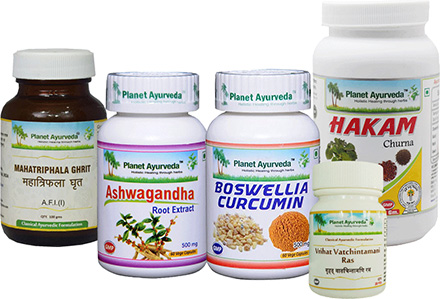

Our Experts Proposed Herbal Drugs To Treat Meralgia Paresthetica
- Ashwagandha Capsules
- Boswellia Curcumin
- Vrihat Vatchintamani Ras
- Hakam Churna
- Mahatriphala Ghrit
Full Description of Herbal Drugs Proposed By Our Experts
1. Ashwagandha Capsules
Ashwagandha capsules are prepared with the help of a standardized extract of Ashwagandha (Withania somnifera). Ashwagandha acts as a powerful antioxidant. It is also used to improve blood circulation. It is also used to enhance the functions of the nervous system, and also act as a nervine tonic. Ashwagandha provides smoothness to nerves. Due to this activity, it is used in the Treatment of Meralgia Paresthetica.
Dosage: 1-2 Capsules twice daily, with plain water, after meals.
2. Boswellia Curcumin Capsules
These capsules are formulated with the help of two anti-inflammatory and anti-arthritic herbs such as Shallaki (Boswellia serrata) and Haridra (Curcuma longa). These capsules have a protective effect on the nervous system. The active ingredients present in both of the ingredients are used to prevent neurological diseases. These capsules are also used to relieve tingling and numbness.
Dosage: capsule twice daily, after meals with plain water.
3. Vrihat Vatchintamani Ras
Vrihat Vatchintamani ras pills are prepared with the help of Swaran Bhasma (Calx of Gold), Loha Bhasma (Calx of Iron), Abhrak Bhasma (Calx of Mica), Mukta Bhasma (Calx of Pearl) Rajat Bhasma (Calx of Silver), and several other ingredients. It is beneficial to maintain the healthy functioning of the nervous system and brain. It is beneficial to relax the muscles and give better results in stressed nerves and stiff joints.
Dosage: 1 twice daily (chew it with warm ghee).
4. Hakam Churna
This churna is manufactured with the help of 4 herbal ingredients such as Kalonji (Nigella sativaa), Ajwain (Trachyspermum ammi) and Chandersoor (Lepidium sativum), Methi (Trigonella foenum graecum). It is beneficial to balance all three body energies (Vata, Pitta, and Kapha). It is very helpful for the management of strains and sprains in the muscles and tendons. In the case of nerve stiffness, muscle rupture, this herbal formulation is very useful.
Dosage: 1 tsp twice daily with warm water.
4. Mahatriphala Ghrit
Mahatriphala ghrit is a classical ayurvedic formulation which has been used since ancient times for various diseases due to its various medicinal properties. It consists of ingredients such as haritaki (Terminalia chebula), bibhitaki (Terminalia billerica), amalaki (Emblica officinalis) and various others. It possesses mainly the property of snehana (oleation) which aids in pacifying vata dosha. Also this ghrita preparation is enriched with antioxidant properties which prevents the degeneration of the cells. As in this condition vata dosha is the main cause along with degeneration of the nerve cells so this ghrita is very effective in the condition of Meralgia paresthetica.
Dosage: 1 tsp twice daily with warm water
CONTACT MY ASSISTANT TO PROVIDE YOU THE COSTING/ORDERING AND DELIVERY INFORMATION AT – COSTING.PLANETAYURVEDA@GMAIL.COM OR CALL AT +91-172-5214030 OR CHECK WEBSITE – WWW.PLANETAYURVEDA.COM
CONCLUSION
At the end of this article, we can see that there is no specific treatment in modern medicine for the management of Meralgia Paresthetica. They only prescribe antidepressants, corticosteroids, etc. These drugs have their own adverse effects that are mentioned above. But in Ayurveda, No surgical procedure is prescribed; they only manage this disease with herbal medications along with a proper diet and lifestyle. These herbal medicines are free from any side effects. These herbal medicines can target the main root cause of the disease