Author: Dr. Vikram Chauhan

Bartholin Gland Cancer Symptoms And Treatment By Ayurveda

ABSTRACT

Bartholin Gland Cancer is a cancer of the vulva which arises in the Bartholin Gland. Cancer is a group of diseases with abnormal growth that gets spread to all parts of the body. It can start at any part of the human body and it can be cancerous and not cancerous (benign). Cancer is a genetic disease that is caused by changes in the structure which controls the function of cells. The cells grow old and damage to the new cells takes place. The cells may form tumors which are lumps of tissue. When these lumps turn cancerous they travel to distant places and form new tumors (metastasis). The bar tholin’s glands are located on each side of the vaginal opening. The duct of the gland becomes obstructed and fluids get back up and form a cyst. Bartholin Gland was first described in 1677 by a Danish anatomist. In this article, we are going to discuss the causes, symptoms, and Ayurvedic aspects in detail.

Bartholin Gland Cancer


INTRODUCTION

It is a type of vulvar cancer that arises in the Bartholin Gland and is present as a painless mass at one side of the vaginal opening and can be similar to a Bartholin cyst. Vulvar Cancer is an abnormal growth of the cells in the vulva and usually affects the edges of the vulvar lips. Vulva is the female external genitalia, and more than 70% of vulvar cancer involve labia and 10-20% involve the perineum. The mass may be big or small, can be deep, or appear near the surface as an overlying ulcer. 50% of the Bartholin gland originates from Squamous cell carcinomas (looks like a wart). Mostly seen in postmenopausal women whose age ranges are between 50-65 years. The first symptom is painful sex and the growth of the tumor spreads to nearby areas such as the ischiorectal fossa and inguinal lymph nodes. These can be Squamous cell carcinoma, Adenocarcinoma (a rarer type of carcinoma), Adenoid cystic carcinoma, and many other variants.

ETIOLOGY

  • It is due to a strong association between Human papillomavirus (HPV) and Squamous Cell Carcinoma of the Bartholin gland.
  • Lichen Sclerosus
  • Smoking
  • Alcohol
  • Immunosuppression
  • Squamous hyperplasia

CAUSES

There are two independent pathways of the carcinogenesis of the vulva

  • The first is related to Mucosal HPV (Human papillomavirus)
  • The second is related to the Chronic Autoimmune process.  

TYPES OF VULVAR CANCER

  • Vulvar Squamous cell carcinoma- It begins in the flat cells which usually line the parts of the vulva. The most common type of vulvar cancer looks like a wart.
  • Vulvar Melanoma- It begins in the pigment-producing cells which are found in the skin of the vulva.  

SIGNS/SYMPTOMS  OF VULVAR CANCER

  • Itching
  • Pain and tenderness
  • Bleeding
  • Changes in the color of skin (thickening)
  • Wart and open sore (ulcer)
  • Burning urination
  • The pungent odor from the vagina.  

CLINICAL FEATURES

  • Vulvar Pruritus
  • Pain and dysuria
  • Large metastatic mass in the groin region
  • Post Menopausal female (age 65 yrs)

ROUTES OF SPREAD

  • Direct Extension
  • Lymphatic
  • Hematogenous

STAGES OF VULVAR CANCER

1. Stage 1: It is found only in the vulvar area.

  • Stage 1A- In this tumor is confined to the perineum which spreads less or equal to 2 cm
  • Stage 1 B- This tumor spreads more than 2 cm and is 1 mm deep.

2. Stage 2: Cancer spread to the anal part, the outer half of the urethra, and the third portion of the vagina.

3. Stage 3: It gets spread to the groin region of the lymph nodes.

  • 3A involves one lymph node which is equal to or bigger than 5 mm.
  • 3B involves two or more lymph nodes bigger than 5 mm
  • 3C involves lymph nodes with nodes outside.

4. Stage 4:  It is a type of cancer that spreads to areas beyond the vulva and by its nearby lymph nodes.

  • 4A-  It involves an organ that is present near the vagina and bladder.
  • 4B- Organs distant from the vagina such as in the pelvic region and in lungs and other organs.  

RISK FACTORS

  • Increasing age- as the risk get increases with age
  • HPV (Human Papillomavirus)– a sexually transmitted disease that increases the risk of cervical cancer.
  • Smoking
  • Weak Immune system
  • Skin disease which involves the vulva

DIAGNOSIS

  • Physical examination (to examine vulva)
  • Biopsy
  • Colonoscopy
  • CT (Computerised tomography)
  • MRI (Magnetic resonance imaging)
  • PET (Positron emission tomography)
  • X-Ray

TREATMENT

  • Excision (Removal of healthy tissue)
  • Vulvectomy (Removal of the entire vulva)
  • Sentinel lymph node (Removal of the nearby lymph node)
  • Radiation therapy
  • Chemotherapy
  • Immunotherapy  
  • Marsupialization
  • Sitz Bath

AYURVEDIC ASPECT

According to Acharya Sushruta, The aggravated doshas which get accumulated in a particular area of the body. It is due to an imbalance of three doshas in the body and some cells get intoxicated and grow uncontrollably. These toxic cells harm normal cells and cause many medical issues. The tumor is a Vata-Kapha origin responsible for the cells’ faulty division. Vata Pushes Kapha out of balance which forms a tumor. In the Malignant state, Pitta doshas are vitiated, and this condition becomes Sanntipatika which affects the Agni and makes tissues aggressive and slowly digests the tissues of the body. Ojas get affected in the tissue where cancer begins. This abnormal prominent growth is the cancerous mass (Arbuda). 

HOW AYURVEDA HELPS IN TREATING CANCER

  • Removes the free radicals and impaired doshas which impairs the functions of Agni.
  • It restores and strengthens the metabolic functioning of the Agni.
  • Absorbs the Lactic Acid which produces Cancerous cells.
  • Improves the immunity
  • Some herbs such as Turmeric block the TNF Alpha which is responsible for inflammation.

TYPES

  • Vataja Arbuda
  • Pittaja Arbuda
  • Kaphaja Arbuda
  • Raktarbuda
  • Mamsarabuda- Constant trauma leads to quick transformation and multiplication of abnormal cells which results in the formation of tumors.
  • Medo Arbuda- It is the growth of adipose tissue. 

LINE OF TREATMENT

1. Vata Cancerous Growth

  • Mild sedation
  • Bloodletting

2. Pittaja Cancerous Growth

  • Mild Sedation
  • Purgation
  • Scraping

3. Kaphaja Cancerous Growth

  • Emesis
  • Purgation
  • Bloodletting

4. Medo Arbuda

  • Open the wound and clean the blood and suture quickly.
  • Apply External ointment over it

HERBS USEFUL IN BARTHOLIN GLAND CANCER

  • Ashwagandha- Ashwagandha (Withania somnifera) is the most potent herb useful in healing. Strengthen the immune system and provide good body mass and provide nourishment. Has Anti-inflammatory properties so promotes healthy joints. Is loaded with Anticancer property which slows down growth and enhances healthy cell growth.
  •  Amalaki- Amalaki (Emblica Officinalis) is a powerhouse of nutrients that keeps skin healthy and strengthens the immune system. Has Aphrodisiac properties and reduces burning sensation. Amla is the best Anti-aging herb and has Rasayan properties. Amalaki has antioxidant and anti-inflammatory properties. Possess Anti-cancer properties.
  • Turmeric- Turmeric (Curcuma longa) has many medicinal properties and is used as a blood purifier that removes the accumulation of blood vessels and expels excess media (adipose tissue) and kapha from the body. Has anti-inflammatory properties and is antioxidant and anti-bacterial in nature. Reduces extra toxins and protects from free radicals in the body.
  • Giloy- Giloy (Tinospora cordifolia) is an excellent blood purifier and has anti-inflammatory and anti-cancerous properties. Builds the immune system and protects against infections. Promotes the regeneration of the liver against hepatic toxicity. Protects the stomach and duodenum by increasing the production of mucin.

HERBAL REMEDIES BY PLANET AYURVEDA FOR BARTHOLIN GLAND CANCER

Planet Ayurveda is a natural herbal supplement, medication, and tonic which are manufactured without any additives and chemicals. These herbal products are offered worldwide and are prepared under the supervision of expert Ayurvedic doctors. These formulations which are prepared at Planet Ayurveda are safe and cause no side effects. These supplements acting on the body correct the imbalance of doshas. Planet Ayurveda provides various herbal formulations which are helpful in this disease and here are the following medications

PRODUCTS LIST

1. Curcumin Capsules

2. Ashwagandha Capsules

3. Chandraprabha Vati

4. Kanchnaar Guggul

5. Mahamanjishthadi Kwath

6. Female Health Support


Herbal Remedies For Bartholin Gland Cancer

Herbal Remedies For Bartholin Gland Cancer

Product Description

1. Curcumin Capsules

Curcumin Capsules are single herbal capsules consisting of a single extract of Haridra (Curcuma longa). It is a well-known blood purifier that is helpful in removing toxins from the body and is effective in the treatment of diabetes. Has antibacterial and antioxidant properties and is beneficial in treating anemia. Reduces extra toxins and protects from extra free radicals and is anti-inflammatory in nature.

Dosage: 1 capsule twice daily after meals

2. Ashwagandha Capsules

Ashwagandha Capsules from planet Ayurveda are formulated using a standardized extract of Ashwagandha (Withania somnifera). It is rich in antioxidants property and boosts the immune system and is helpful in pacifying the nervous system. They Support a good heart and are helpful in strengthening the muscles of the heart and maintaining the proper flow of blood.

Dosage: 1 capsule twice daily after meals

 3. Chandraprabha Vati

Chandraprabha Vati is a herbal tablet from planet Ayurveda using various ingredients such as Shilajit (Asphaltum), Karpoor (Cinnamomum camphora), Hardira (Curcuma longa), Chavya (Piper chaba) and many more. It is helpful in the treatment of urinary tract infections and relieves constipation and is a natural aphrodisiac and is anti-aging in nature. It has anti-inflammatory properties thus improving overall health.     

Dosage: 2 tablets twice daily after a meal

4. Kanchnaar Guggul

Kanchnaar Guggul is an herbal tablet using ingredients such as Kanchnaar Bark (Bauhinia variegata), Amalaki (Emblica officinalis), Cardamom (Elettaria cardamomum), Tejapatra (Cinnamomum tamala) and many more. It is helpful in treating various growth and extra growth in the skin and sinuses. Promotes the functioning of the lymphatic system and gets rid of toxins.     

Dosage: 2 tablets thrice daily after meals

 5. MahaManjishthadi Kwath

Mahamanjishthadi Kwath is a classical Ayurvedic product which is formulated by planet Ayurveda using ingredients such as Manjistha (Rubia cordifolia), Sonth (Zingiber officinale), Neem (Azadirachta Indica), Daruhaldi (Berberis aristata) and many more. It is helpful in various diseases such as skin diseases and in non-healing wounds.

Dosage: 2 teaspoons twice daily after meals

6. Female Health Support

Female Health Support is polyherbal Capsules from planet Ayurveda using ingredients such as Ashok (Saraca indica), Lodhra (Symplocos racemosa) and Shatavari (Asparagus racemosus). These capsules are helpful in maintaining overall health in females and balancing hormones. Relieves premenstrual tension and irregular menses and strengthens the reproductive organs.  

Dosage: 1 capsule twice daily after meals.

CONTACT  PLANET AYURVEDA  TO PROVIDE YOU WITH THE    COSTING / ORDERING AND DELIVERY INFORMATION AT – COSTING.PLANETAYURVEDA@GMAIL.COM OR CALL AT +91-172-5214040

CONCLUSION

Bartholin Gland Cancer is a cancer of the vulva which arises in the Bartholin Gland. Cancer is a group of diseases with abnormal growth that gets spread to all parts of the body. Vulvar Cancer is an abnormal growth of the cells in the vulva and usually affects the edges of the vulvar lips. Vulva is the female external genitalia, and more than 70% of vulvar cancer involve labia and 10-20% involve the perineum. Tumour is a Vata-Kapha origin responsible for the cells’ faulty division. Vata Pushing Kapha out of balance forms a tumor. Planet Ayurveda provided many herbal supplements which are helpful in managing the disease without causing any complications.

 

How to Get Rid of Nasal Polyps Through Ayurveda

Abstract

Air is such an important aspect of life to survive, also called as “pranavayu”. Nose is our prime organ of olfaction. One cannot imagine life without a nose. It is the passage of pure filtered air to the lungs. But there are certain conditions where the passage of air is blocked. And one such condition is nasal polyps. They are bump like structures inside the nasal cavity that block air flow and prevent filtration of the air. It gives the feeling of irritation to the person. These are commonly non cancerous growth (benign). These are the result of recurrent inflammation or infections, aleeries, asthma etc. They may vary in size, big or small. Estimated population having this condition is around 4-40 %. Nasal polyps are usually more common in males than females. Affected population is young adults or middle aged adults. So let’s begin with reading all about nasal polyps in detail, their causes, their symptoms, what do we call it in ayurveda, how to manage the situation according to the Indian system of medicine and Modern aspects.

Nasal Polyps

Introduction

Nasal polyps are painless, soft, benign (non cancerous) round growth (cyst) found in the sinuses and nasal passage. They can be small or big in size. Small nasal polyps may be symptomless. Nasal polyps that are big in size that may block the nasal cavity, that may raise some serious breathing issues, loss of smell etc. Nasal polyps result from the chronic inflammation in the mucus membrane due to recurrent respiratory infections, asthma, some immune disorder or some drug sensitivity (NSAIDS). Nasal polyps are most common in adults but can happen at any age. After it resolves its chances of recurrence are there. Sometimes inheritance is responsible for the nasal polyps.

Four stages of polyps

  1. Limited only to middle turbinate
  2. Extending beyond middle turbinate
  3. Approaching towards inferior turbinate
  4. Extending upto the floor of the nose

According to the location there are mainly two types of polyps

Ethmoidal polyp

  • Located in ethmoid cavity
  • Common in adults
  • Tendency to grow forward
  • Tendency to recurrence
  • They are usually multiple in number

Antrochoanal Polyp

  • Located in antrum
  • Common in children and young adults
  • Tendency to grow backwards or posterior
  • Recurrence is rare after removal

Causes and Risk factors

Nasal polyps are usually associated with some diseased condition as given below

  • Frequent Asthma attacks
  • Hay fever or allergic rhinitis
  • Allergic fungal sinusitis
  • Chronic rhinitis
  • Repeated sinus infections
  • Cystic fibrosis
  • Drug sensitivity non steroidal anti inflammatory drugs(NSAIDs) like aspirin. Ibuprofen
  • Inheritance
  • Churg-Strauss syndrome (inflammation of blood vessels)
  • Low in immunity
  • Vitamin D deficiency

Signs and symptoms

  • Person suffers from runny nose (nasal drainage)
  • Nasal fullness or stuffiness
  • Blocked nose
  • Nasal congestion
  • Anosmia (loss of smell)
  • Rise of snoring
  • Sleep apnea
  • Secretions or mucus runs down the back of the throat or post nasal drip
  • Frequent bleeding from the nose
  • Headache or facial pain
  • Feeling of pressure over forehead, face, sinuses or top tooth
  • Difficulty in breathing
  • Rarely blurred vision or reduced vision
  • High fever
  • Pain in the nose

Complications

  • Obstructive sleep apnea
  • Flaring up of asthma
  • Recurrent sinus infections

Diagnosis

  • Medications to reduce infla
  • Based on history of especially recurrent infections, asthma attacks, allergies
  • Based on symptoms
  • Nasal endoscopy
  • CT scan
  • MRI
  • Allergy test

Prevention

  • Maintaining good hygiene
  • Taking proper medications for asthma or allergies
  • Using humidifier at home to keep air moist
  • Washing nasal passage with saline
  • Avoiding dust or allergens
  • Steam to clear nasal passage
  • Stay hydrated
  • Stop smoking

Management

  • To shrink the polyps one should spray steroids
  • Decongestant nasal drops
  • Oral steroidal medication (budesonide, fluticasone etc)
  • Injection under the skin (dupilumab, prednisolone)
  • Antihistamine (montelukast)
  • Antibiotics
  • Endoscopic removal of the polyp
  • Polypectomy (smaller polyps)

Note

Nasal polyps show recurrence about 15% of people, they often revert back after treatment.
Many people follow repeated surgery or prolonged steroid intake.

Ayurvedic aspect and management of Nasal polyp

Ayurveda is an Ancient Indian System of medicine that has been existing for thousands of years. Ayurveda is a systematic and planned procedure aiming at balancing the elevated doshas (vata, pitta and Kapha) and dhatus with the help of certain herbal drugs, panchkarma, diet and lifestyle modification. Its prime focus is prevention of the ailment and providing higher quality of health. Ayurveda believes in the natural process of healing. Ayurveda has a solution to every problem.
Nasal polyp as per ayurveda is called “Nasa Arsh”. Acharya sushrut mentioned four types of nasa Arsh in ancient texts: vata, pitta, kapha and sanipataj. And symptoms are according to the predominant dosha.

“अरिवत् प्राणिनो मांसकीलका विशसन्ति यत्

( Ashtanga sangraha)
Or “Arivat pranan shrinoti hinasti iti arshah”)

Above quoted lines explained that Arsha is a disease in which patienst’s vital force (prana) is being tortured as enemy. The twak (skin), maans dhatu (muscles), meda dhatu (fatty tissues) are vitiated due to vata, pitta and kapha dosha which give rise to polyp-like growth. Arsha is considered to be tridoshaj Vyadhi that means it vitiates all three doshas vata, pitta and kapha.

Ghranjeshu pratishayayoati matram seivathu krichhoucchvasta, Putinasyam saanunasikvakyatvam shirodukham.”

(Sushrut nidan)

The symptoms of nasa arsha according to acharya sushrut are pratishaya (flu or cold), shyavthu (sneezing), difficulty in breathing, putinasya ( foul smell in nose), nasal speech and headache.

There are four types of treatment protocol has been mentioned in Ayurveda

  1. Aushadh (medications)
  2. Shastra (surgical removal)
  3. Kshara ( topical alkali application)
  4. Agni karma (cautery)

The classical management of Nasa Arsha includes

  1. Application of infused oil with the herbs like Rakta karveer (Nerium indiucum) and jati ( Jasminum grandiflorum)
  2. Grahdhoom taila nasya (aacharya sharangdhar)

Herbal Remedies for Nasal polyp by Planet Ayurveda

Planet Ayurveda is a herbal manufacturing renowned company and is a GMP certified company promoting Ayurveda at its best level. Formulations prepared by the Planet Ayurveda are in the form of asav, aristas, vatis (tablets), avaleha (jams), churan (powder), liquids (syrups), capsules. All the herbal formulations prepared by Planet Ayurveda are 100% pure, herbal, vegetarian and natural. Supplements are formulated under the strict eye of MD Ayurveda experts. With the goodness of magical herbs, Planet Ayurveda has formulated various preparations to manage nasal polyp. The procedures and the content of the formulation are referred from ancient ayurvedic text. The herbs used are pure, uncontaminated and unadulterated. All these herbal remedies are free from preservatives, additives and chemicals. These are safe to use. The herbal formulations for the management of Nasa Arsha or nasal polyps are as follows:

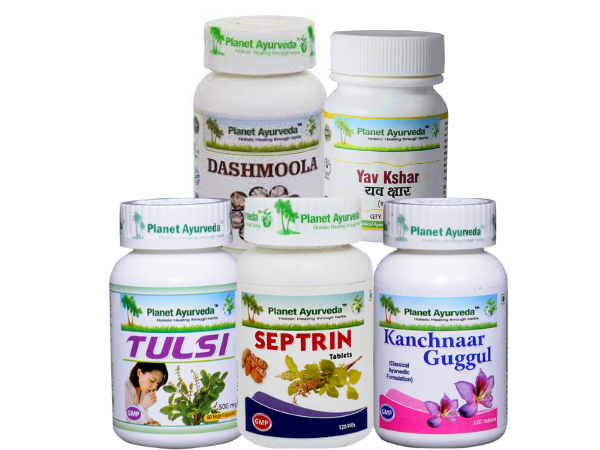
  1. Septrin Tablets
  2. Kanchnaar Guggul
  3. Tulsi Capsules
  4. Dashamoola Capsules
  5. Yavakshar Application

Herbal Remedies for Nasal Polyps Buy Now : Herbal Remedies for Nasal Polyps

Product description

1. Septrin Tablets

Septrin tablet is a wonderful preparation by Planet Ayurveda. Which has amazing properties like anti inflammatory, anti analgesic, antimicrobial, antiseptic. The herbs Septrin includes pippali (Piper longum), haridra (Curcuma longa), shunthi (Zingiber officinale), tulsi (Ocimum sanctum), marich (Piper nigrum) and guggul (Commiphora mukul). It balances Vata, pitta and kapha dosha. It has properties that help in removal blockage of the channels reversing the flow of all the doshas. It aids in healthy digestion that further leads to formation of healthy dhatus. It increases the immunity of the person. This magical herbal formulation helps in managing the nasal polyps.

Dosage: 2 tablets twice a day after meals

2. Kanchnaar Guggul

Kanchnaar guggul is an amazing polyherbal formulation mentioned in ancient ayurvedic text. It reformulated by Planet Ayurveda with the pure herbs including kachnar bark (Bauhinia variegata), amalaki (Emblica officinale), bibhitaki (Terminalia billerica), haritaki (Terminalia chebula), ginger (Zingiber officinale), pippali (Piper longum), varuna bark (Crataeva religiosa), marich (Piper nigrum), tejapatra (Cinnamomum tamala), guggul (Commiphora mukul) etc. It has potent anti-inflammatory properties. It is helpful in reducing the size of the abnormal growths just like in nasa arsha or it shrinks the tissues, providing newness to the mucous membrane of the nose. Thus kanchnar guggul is effective in the management of nasa arsh.

Dosage: Two tablets twice a day after meals

3. Tulsi Capsules

Tulsi capsule is a single herb formulation prepared by Planet Ayurveda. These capsules contain standardised extract of the tulsi herb (Ocimum sanctum). It has amazing immunomodulatory properties. Along with this tulsi fights with the infections going inside the body. It is a potent antipyretic, anti-inflammatory and analgesics. Moreover it possess rasayanic properties that are helpful in rejuvenation of the cells or the tissues. It balances all three doshas. It has skin healing properties, provides healing of the mucous membrane. It helps in excretion of excessive mucous secretions. Tulsi capsules are amazing herbal formulations to manage nasal polyps.

Dosage: one tablet two times a day after meal

4. Dashamoola Capsules

Dashamoola capsules is the patent manufacturing of Planet Ayurveda. It is the amalgam of 10 herbs such as bilva (Aegle marmelos), shyonak (Oroxylum indicum), patla (Stereospermum suaveolens), agnimantha (Clerodendrum phlomidis), gokshur (Tribulus terrestris), prishniparni (Uraria picta), brihati (Solanum indicum), agnimantha (Clerodendrum phlomidis), shalparni (Desmodium gangeticum), kantakari (Solanum surattense), gambhari (Gmelina arborea), gokshur (Tribulus terrestris). According to Ayurveda dashmool has very good anti-inflammatory, analgesic, antipyretic properties. It is the best among vatahar formulations along with pacification of other two doshas. Due to its anti-inflammatory properties it is useful in nasa arsha.

Dosage: One capsule twice a day with plain water after meals.

5. Yav Kshar

Yav khshar is a classical preparation which is known to an alkali. It is prepared from Yava panchang ((Hordeum Vulgare). Basically kshar possesses properties of lekhana ( tissue scraping) helpful in abolishing the abnormal growths present on the body. It is preferred more than surgery because it has fewer complications than surgeries. And also it is easy to apply. Kashar reduces the excess kapha and vata anulomana (maintaining flow of vata). It is best suited over surgery for the management of Nasal Polyps with very less chances of recurrence.

Dosage: local application over the nasal polyp with a cotton swab.

Contact Planet Ayurveda Support Team to provide you the costing / ordering and delivery information at – costing.planetayurveda@gmail.com or Call at 0172-521-4030 (India), +91-172-521-4030 (Outside India) or Whatsapp at (+91) 9915-593-604

Conclusion

Nasal Polyp is a very common condition in children and young adults. It is non cancerous (benign) outgrowth of the mucous membrane of nasal mucosa giving the symptoms of nasal blockage and irritation. This condition has chances of recurrence. In modern medicine the only cure is oral or topical steroids or either surgical removal. But in ayurveda there are numerous herbal preparations that are very effective in the management of nasal polyps with the rare chances of otis recurrence. Nasal polyps are known as nasa arsha in Ayurveda. All the detailed description its causes its management in Indian As well as the modern system of medicine has already been discussed in this above article.