Author: Dr. Vikram Chauhan

Ayurveda for Rhino-Orbital Mucormycosis Infection

Abstract

This article is about the ayurvedic management and prevention of Rhino-orbital mucormycosis, also known as rhino orbital zygomycosis, is a disease of the nasal-ocular cavity. It is a form of fungal infection affecting cavities of the head. It is caused by the ‘mucorale’ type of fungus, hence the name mucormycosis. It usually affects a person whose immune system is not as strong compared to other healthy individuals. Most commonly reported symptoms are double vision, partial or total loss of vision in one or both eyes, and weakness of the eye muscles. It can lead to permanent blindness and even death. Herbal remedies are provided for its management.

Introduction

Rhino Orbital Mucormycosis is a kind of mucormycosis. Mucormycosis is the name of a fast growing infection caused by a fungus of the family Mucoraceae (order Mucorales). It majorly affects the people whose immunity is compromised i.e. is not able to perform as well as it used to before the person was exposed to certain environmental factors or medication. Depending on the region of the body that it affects, mucormycosis infection is categorized as of the following types:

  • Rhino – cerebral mucormycosis: it involves the nose, the sinuses and the brain. The following are also ultimately recognized as rhino cerebral mucormycosis:
    • Rhino – nasal mucormycosis: it involves only the nasal cavity and the paranasal sinuses (rhino meaning nose, nasal standing for the sinuses).
    • Rhino – orbital mucormycosis: it affects the nose, the paranasal sinuses and the whole eyes (rhino meaning the nose, orbital standing for the hollow cavity of the eye).
    • Rhino – orbito – cerebral mucormycosis: it affects the nose, the sinuses, the eyes and the brain (rhino meaning nose, orbito meaning hollow of the eye, and cerebral standing for the brain).
  • Pulmonary Mucormycosis : when the airways and the lungs are also affected, it is called pulmonary mucormycosis (pulmonary meaning lung related).
  • Cutaneous Mucormycosis : when the fungal spores (cells) enter the body through ruptures in the skin, it is called Cutaneous mucormycosis (Cutaneous meaning skin related).
  • Gastrointestinal Mucormycosis : when the spores manifest in the stomach and then travel to the intestines, it is called gastrointestinal mucormycosis (gastrointestinal stands for stomach and the intestines).
  • Disseminated Mucormycosis : when the fungal; infection spreads in all the blood and through it to the rest of the body, it is called disseminated mucormycosis (disseminated meaning ‘spreading throughout’).

Symptoms of Rhino Orbital Mucormycosis

  • Fever
  • Pain in the eyes
  • Redness in the eyes
  • Swelling in cheeks
  • Loss of sensation in the face
  • Paralysis of the facial muscle
  • Formation of layer of dead cells
  • Damage of the hard palate
  • Lumps in the nasal passage
  • Fluid retention in the eyelids
  • Protrusion of eye muscles
  • Reduced movement of eye muscles
  • Reduced vision in one or both eyes
  • Loss of vision in one or both eyes
  • Eye lenses become opaque
  • Cornea becomes extra curved
  • Unable to focus
  • Inflammation of the sinuses
  • Ulcers inside the mouth
  • Black Ulcers inside the mouth and the nose
  • Totally closed eyes due to extreme swelling and edema in eyelids

Causes

Various factors contribute to the development of any condition in an individual.  In case of mucormycosis, the inhalation of fungus cells is the only cause. Mucormycosis becomes aggravated so fast that its immediate treatment is very important.

  • Fungal cells (called spores) are present everywhere. If these are inhaled, they spread fast into the nasal sinuses and from there affect the brain.

Risk Factors

Some factors decide the severity and susceptibility of a condition affecting a particular individual. Those factors are:

  • Diabetes Mellitus
  • Diabetic ketoacidosis
  • Hypertension
  • Immunosuppressant therapies
  • Tumors
  • Tumor suppressing treatments
  • Chemotherapy
  • Protein deficiency
  • White blood cell deficiency
  • Organ transplantation
  • Bone marrow transplantation
  • HIV AIDS infection
  • Anemia i.e. lack of iron
  • Hemochromatosis i.e. excess of iron
  • Chronic kidney disease

Complications

  • Complete loss of vision
  • Exenteration i.e. Removal of eyes may be required
  • Removal of various glands may be required
  • Nervous failure
  • Total paralysis
  • Death

Herbal Remedies for Rhino-Orbital Mucormycosis Infection
Buy Now

Herbal Remedies By Planet Ayurveda

Planet Ayurveda manufactures pure herbal formulations that are used as medications and tonics worldwide. These formulations are carefully sourced from authentic texts on Ayurveda written in ancient India thousands of years ago. The formulations are chemical free and additive free and thus safe for consumption by people of all ages and individual conditions. The products are suitable for people with all dietary preferences and restrictions since these are completely plant-based, halal and completely organic. A combination has been created by experts at Planet Ayurveda for ayurvedic management of rhino-ocular mucormycosis infection.

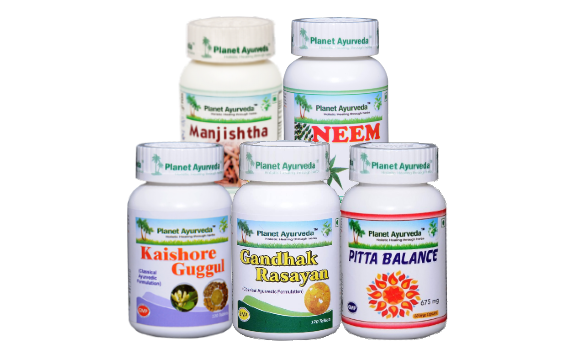
Product List

  1. Gandhak Rasayan
  2. Kaishore Guggul
  3. Manjishtha Capsules
  4. Neem Capsules
  5. Pitta Balance

Product Description

1. Gandhak Rasayan

These tablets are made with purified Sulphur which aims at purifying the deepest levels of tissues in the body, thus preventing as well as eliminating the microbial growth in the nose and the eyes.

Dosage : 1-2 tabs thrice daily with lukewarm water after meals.

2. Kaishore Guggul

a formulation of Guggul (Commiphora mukul) with other herbs including Amla (Emblica officinalis), Haritaki (Terminalia chebula), Bibhitaki (Terminalia bellirica), Red physic nut, etc. which aims to prevent spread of microbes through the blood, Kaishore guggul is recommended in mucormycosis because it is an effective antimicrobial too.

Dosage : 2 tabs twice daily with warm water after meals.

3. Manjishtha Capsules

made with the pure extract of Manjishtha (Rubia cordifolia) these capsules will help to purify the skin and blood and hence prevent fungal growth in the cavities of the body.

Dosage : 2 caps twice daily with plain water after meals.

4. Neem Capsules

made with the pure standardized extract of Neem (Azadirachta indica) in the form of capsules, it is known widely for its beneficial properties on the whole body internally as well as externally. It is also an antimicrobial in nature.

Dosage : 2 caps twice daily with plain water after meals.

5. Pitta Balance

a herbo -mineral formulation consisting of Kamdudha Ras (calcium compound), Mukta Pishti (Pearl calcium), Giloy Sattva (Tinospora cordifolia), etc., Pitta Balance capsules are immune boosting and also help promote growth of white blood cells required to fight fungal infections.

Dosage : 1 cap twice daily with plain water after meals.

CONCLUSION

Mucormycosis of the rhino-ocular cavity is affecting many people presently. It may be associated with Covid – 19 and other contemporary microbial infections because the cases have surged especially in the people who are receiving modern treatment of Covid – 19. The medications used in modern treatment are quite strong and can have many side effects. It is recommended that herbal remedies be sought whenever possible. The herbal remedies described here are generally safe for everyone. These are formulated keeping in mind the requirement of their suitability for all individuals. However, pregnant women and people with multiple conditions should consult an ayurvedic physician before beginning any medication.

Acyanotic Congenital : Causes, Symptoms, Diagnosis & Treatment

ABSTRACT

Acyanotic heart disease or defects are congenital (present from birth) malformations in the heart that usually affect the ventricular or atrial walls, large blood vessels or heart valves. There can be various reasons resulting in this unfortunate situation like genetic defects, use of alcohol or drugs by mother during pregnancy or infections to mother specifically rubella while she was pregnant. Acyanotic congenital heart disease or defects result in right heart hypertrophy and pulmonary hypertension. Causes of congenital heart diseases can be many, however they can be categorized into two types, one resulting in increased pulmonary vascularity and other having normal vascularity. In this article we have written all about the acyanotic congenital heart disease and a few herbal remedies to manage it.

INTRODUCTION

Acyanotic congenital heart diseases are also known as left to right shunting lesions which are the most common type of congenital heart defects or diseases. Most of these defects get corrected with time spontaneously but some of them may remain significant usually if the child is premature. Even certain congenital heart defects previously are manifested as acyanotic congenital heart diseases and later in stages get converted to cyanotic congenital heart disease. Understanding it more clearly, left to right shunt lesions initially are acyanotic which over the time get converted due to certain maladaptive changes in the pulmonary vasculature and right ventricle, into cyanotic heart diseases causing Eisenmenger syndrome and pulmonary hypertension. In this situation the shunt is reversed leading to entrance of deoxygenated blood into the systemic circulation.

Earlier when the defect is acyanotic, due to a certain structural defect like hole in the interventricular septum, the blood flows from left to right side of the heart but in the systemic circulation the oxyhemoglobin saturation remains same. However there occurs maladaptive changes over the time resulting in reversing of shunt and blood becomes deoxygenated causing cyanosis.

Acyanotic Congenital

SIGNS AND SYMPTOMS

There are certain signs and symptoms which characterizes the disease condition:

  • Congestion is chest and cough
  • Fatigue and weakness
  • Shortness of breath
  • Recurrent respiratory tract infections
  • Heart murmur causing machine like sounds
  • Increased heart rate
  • Abnormally rapid breathing
  • Respiratory distress
  • Too much sweating
  • Mild cyanosis
  • Poor development and growth
  • Feeding difficulties
  • Pain in chest
  • Dizziness
  • Cyanosis when present causes a bluish color of baby’s skin

CAUSES

Acyanotic congenital heart disease is caused due to the developmental defect in the structure of the heart. Normal blood flow in the heart is disturbed due to the defect resulting in various signs and symptoms. However the exact cause behind acyanotic congenital heart disease is not known but there are certain factors which can lead to this condition:

  • Genetic predisposition, i.e. the defects or anomalies in heart run in the family
  • Usage of certain drugs and alcohol during pregnancy by mother
  • Taking over the counter medications or certain prescribed medicines by mother can lead to congenital heart defect
  • Viral infection like rubella to mother during pregnancy’s first trimester may increase the chances of heart defects
  • Diabetic mother having increased blood sugar levels during pregnancy predisposes for early developmental defects in heart

DIAGNOSIS

Acyanotic congenital heart defects or disease is often diagnosed through ultrasound of the mother during pregnancy. During an ultrasound when an abnormal heart rhythm is detected, the doctor usually suggests further investigations which become the means for diagnosis. These tests are:

  • MRI (Magnetic resonance imaging) scan
  • Chest X-ray
  • Echocardiogram
  • Electrocardiogram (ECG)
  • Pulse oximetry
  • Cardiac CT (Computed tomography) scan

TREATMENT

Type and severity of the defect or disease define the mode of treatment as few defects go away on their own with passage of time. However severe defects require immediate treatment and intensive care. Conventionally there are certain medications given for the prevention of formation of blood clots and to regulate the arrhythmic heart beats. There are certain implantable heart devices used in treatment like pacemaker or implantable cardioverter defibrillators. In severe care open heart surgery may also be advised and performed in order to close the defect, usually a hole, widen the blood vessels or repair valves of the heart.

In such cases Ayurveda can help in supporting the treatment and improving certain complaints with the help of herbal remedies which possess natural therapeutic properties for the heart. Giving some Ayurvedic remedies along with the conventional treatment can increase the chances of success of given treatment and also relieves the existing signs and symptoms. These time tested Ayurvedic remedies also strengthen the inner musculature of the child so that the certain defects can heal on their own with time.

herbal-remedy-for-acyanotic-congenitalBuy Now

HERBAL REMEDIES BY PLANET AYURVEDA

Planet Ayurveda is a well known name in the field of Ayurvedic and herbal pharmaceuticals which deals with the production of herbal remedies as per the strict Ayurvedic principles mentioned in classical literature. Authenticity and quality of each and every ingredient used in these products are tested through various quality check processes and all of these are prepared under the strict and expert supervision of MD Ayurveda doctors. All these herbal medicines and products are purely vegetarian, organic and herbal without any chemicals, additives, preservatives, yeast, binders, colors or fillers being used in them. For Acyanotic congenital heart disease Planet Ayurveda offers two specific herbal remedies which act as supportive treatment when given along with the conventional treatment to the child and increases the chances of success of the ongoing treatment.

Products List

  1. Arjuna Powder
  2. Energo Plan Syrup

Products Description

1. Arjuna Powder

It is the single herb powder, i.e. Arjuna (Terminalia arjuna) which is a very well known and widely used herb for the treatment of various cardiac troubles. Arjuna powder possesses many medicinal properties specifically related to heart like cardioprotective. This powder helps in preventing and treating any damage and defect in the heart by strengthening it. It also improves the blood circulation in the coronary arteries and ischemic damage to the heart is also prevented by Arjuna herb. Along with these properties Arjuna powder also helps to regulate the blood pressure by relaxing and dilating the blood vessels.

Dosage : ½ teaspoon twice daily mixed with the syrup

2. Energo Plan Syrup

This multi herbal syrup is prepared using several herbs like Jeevanti (Leptadenia reticulata), Shatavari (Asparagus racemosus), Amalaki (Emblica officinalis), Pippali (Piper longum), Ashwagandha (Withania somnifera), Gokshura (Tribulus terrestris) etc. As the name suggests this syrup helps in re energizing the body and treats the complaints like fatigue, weakness and dizziness.

Dosage : One teaspoon twice daily with plain water

CONCLUSION

Acyanotic congenital heart diseases can affect the life quality as well as life expectancy of a baby. These defects are usually structural anomalies in the septum of the heart resulting in improper blood pumping and sometimes deoxygenation of blood. Some of them heal on their own and others require extensive treatment. Conventional treatment along with the herbal remedies discussed above when given, increases the chances of successful treatment.