Author: Dr. Vikram Chauhan

Treatment of Dvt/ Varicose Vein (Sira Vikar) in Ayurveda

Abstract

The venous system in our body is a huge branching network of structures that carry deoxygenated blood away from the systemic tissues to the heart. It would not be wrong to say that beneath the layer of visible skin we have a huge spread meshwork of Veins, venules, capillaries, arterioles, arteries etc. Ayurveda has considered a total of 700 Sira (Veins) in the human body. Its massive expansion in the body is beautifully compared to the venation pattern of the leaves. Ayurveda believes the common origin of all the veins is Nabhi (the naval). It is from this point that the veins diverge in the upper (urdhva), lower (adho) and the diagonal (tiryak) directions.The vein being functional for an entire-time until the person lives, are vulnerable to the obvious wear, tear, and also the complicated pathologies. Ayurvedic correlation of the same can be made to Sira Granthi.  This article discusses a very common venous pathology “Varicose vein”. This is a complete pathology in itself and is also a mere etiology for complicated conditions such as DVT. This article discusses the cause, pattern,sign-symptoms, pathology and management of this disease.

Introduction

Varicosity of the vein pertains to dilation, elongation and torsion of the vein. It is found commonly in the “superficial venous system of long or short saphenous”,  “esophageal varix”, “hemorrhoidal veins”,”spermatic veins” etc.

Varicose vein

The venous drainage in undertaken via

  1. Deep Veins
  2. Superficial Veins
  3. Perforating or connecting veins

1. Deep veins

Anatomically these veins are located in the close proximity to arteries.These have a better build-up of veins in them which directs the flow of blood upwards and prevents its regurgitation due to gravity. Examples of such kinds of veins are- Peroneal vein,popliteal vein,tibial vein,femoral veins etc.

2. Superficial Veins

These veins lie between the skin and the deep fascia. It is found where the subcutaneous fat is seen. Examples of subcutaneous veins are Long (begins in the medial marginal vein of foot and ends in the femoral vein) and Short (begins in the lateral marginal vein of foot and ends in the popliteal vein) Saphenous veins.

Perforating or communicating Veins

These veins join deep veins to superficial veins.These veins have a good build-up of valves that prevent the backflow of blood from superficial veins to the deep veins. It is due to the failure of these valves that the blood retrogates back to the superficial veins and causes “Varicose veins”.

Etiology

There are many factors that are causative to varicose veins and they are

  1. Prolonged standing– When a person occupationally or habitually stands for really longer durations,his blood in the lower limbs pressures ( due to gravity) against the valves.This dysfunctions valves and brings the retrograde flow of blood.
  2. Obesity– Adiposity or the fat accumulation offers poor support to the veins.
  3. Gereatric Degeneration– In old age the vein walls experience atrophications which makes them incompetent.
  4. Athletes– Due to over activity the veins get exerted pressures by the contractions of calf muscles which forces blood in reverse direction through perforating veins. This brings destruction to the Valves and causes “Varicose veins”.
  5. Pregnancy-The pregnant state is accompanied with the release of progesterone hormone which brings dilatation and relaxation of the veins of the lower limb (most common in the first trimester of pregnancy). The pregnant uterus also puts more pressure over inferior vena cava which becomes a reason of obstruction in the normal flow.

Types

There are three different types of Varicosities

  1. Primary varicose veins– This type is mainly a result of valve failure. For example a pathology in a saphenofemoral valve causes varicosity in long saphenous veins.
  2. Secondary varicose veins– This type of various vein is due to some obstructions such as physical growths (tumours, fibroids,cysts), DVT, progesterone (in multiparous), arteriovenous fistula etc.
  3. Congenital varicose veins– This type is majorly seen among the children less than 20 years of age.The reason may be arteriovenous fistula ,haemangioma etc.

Clinical Features

Below are the clinical features of DVT

  1. Fatigued aching legs
  2. Severe pain while walking
  3. Tortuous and dilated veins
  4. Swollen ankles
  5. Pigmented skin associated with itching

Investigations

Following investigations should be done to rule out DVT

  1. Venography ( X ray of veins after an injection of a dye)
  2. Doppler Ultrasound(to measure the amount of blood flow)
  3. Photoplethysmography( to see volumetric changes of the blood )
  4. Duplex ultrasound  (an imaging of blood flow and the vessels)
  5. Local examination tests like Brodie Trendelenburg test,Tourniquet test,Perth’s test,Cough impulse test,Fegan’s method test etc.

Complications

If the disease is not treated in the first place that can cause severe complications in the later stages of life.  It might cause “Thrombophlebitis”, “Pigmentation”, “Eczema”, “Venous ulcer”, “ Hemorrhage”

Treatment

  1. Palliative managementThe use of long stockings all day long (not in the night) and practising the exercises such as cycling of feet while lying down on the back.
  2. Operative treatment-Several operative procedures such as Ligation (of long saphenous vein), Ligation with stripping,Sclerotherapy or Fegan’s injection therapy,Radiofrequency ablation ,Endovenous laser surgery etc are performed.

Deep Vein Thrombosis

If the pathology like varicose veins is not treated properly then it might result in the severe complications such as “Deep Vein Thrombosis”or Phlebothrombosis. The predisposing factors of DVT are stasis, increased blood coagulability, and injury to the vascular wall. Varicose veins and several other causative factors such as minor injuries, visceral cancer, surgery, diabetes, pregnancy, infection, obesity, use of contraceptive pills are contributory to hypercoagulation of the blood thereby leading to the condition of “ Venous thrombosis”. Venous thrombosis may be superficial or deep. Buerger’s disease and visceral cancer can cause visible Trousseau’s sign of superficial venous thrombosis.

Deep Vein Thrombosis or Phlebothrombosis is a condition in which the thrombus is loosely attached to the vein wall from which the emboli displaces causing fatal pulmonary embolism.

Clinical Features of Dvt

  1. This condition may be asymptomatic for the majority of the patients.
  2. A severe aching pain at the site of thrombus can be felt. This usually aggravates standing.
  3. Minimal inflammation too can be seen.

Physical Findings

  1. Physically swelling, tenderness is visible
  2. Homan’s sign is positive- In this test on dorsiflexion of the foot, the calf veins that are thrombosed, pains.
  3. Mose’s sign is positive- In this test the calf muscle on being squeezed, pains.
  4. Lab investigations such as Phlebography, plethysmography, Doppler ultrasound and Duplex ultrasound can confirm DVT findings.

Management of Dvt

Prevention

  1. Venous intimal injury and hypercoagulability must be avoided in any form.
  2. Leg must be elevated above the level of heart.
  3. Exercises like plantar flexion can be beneficial considerably.
  4. Elastic stockings must be worn.
  5. Bed rest is advised ( it prevents thrombus emboli from spreading)
  6. Sitting and standing idly should be avoided.

Medications

  1. Anticoagulants such as heparin ( should not however be discontinued abruptly)
  2. Coumarin derivatives such as warfarin
  3. Fibrinolytic drugs such as streptokinase ( converts plasminogen into plasmin)

Surgery

  1. The affected vein is by- passed if possible.
  2. The vein if larger (such as vena cava, iliac vein) can be repaired via prosthetic material.
  3. Venous transplant
  4. Venous thrombectomy
  5. Insertion of umberally filter (this prevents pulmonary embolism)

Ayurvedic Understanding of Varicose Veins

The probable correlation of varicose vein can be made to the concept of Sira Granthi in Ayurveda. Ayurveda considered the vitiated Vata dosha the main culprit behind this pathology. Vitiated vata increases the pressure over valves and hence dysfunctions them. It also distorts the elasticity of veins.

Ayurvedic Management

Ayurveda manages this pathology by balancing the vitiated Vata doshas. It makes use of Vatrakt chikitsa, abhyanga(massage),dhara,Sira vyadha and leech therapy.There are several herbs provided by our mother nature that can be very beneficial (due to their ras,gun,virya,vipak) against these diseases.

Herbs for varicose veinTreatment of varicose vein

Herbal Remedies for Varicose Veins

Planet Ayurveda has made use of ancient wisdom and has come up with very effective results against fibroids. Planet ayurveda is a globally emerging herbal manufacturing hub that formulates herbomineral /herbal formulation that are obtained from 100% natural sources with strict adherence to ayurvedic texts and principles .These herbal medications are being made under strict vigilance and guidance of expert ayurvedic physician using ancient time tested formula.

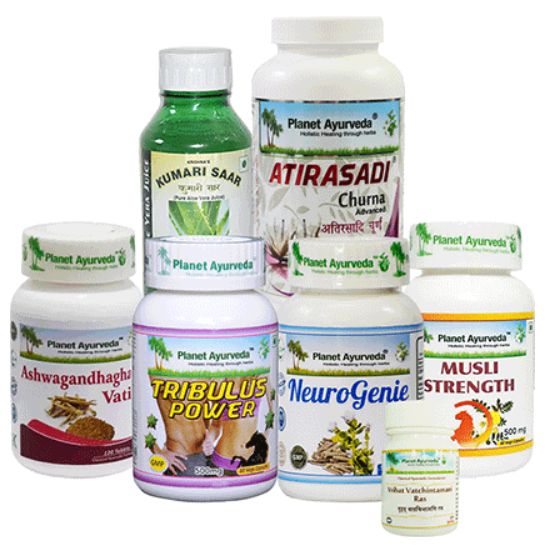
Planet Ayurveda offers a Varicose Vein care pack which includes the following

  1. Gotu kola Capsules
  2. Curcumin Capsules
  3. Triphala Guggul

Products Description

1. Gotu kola Capsules

This formulation is made up of pure standardized extract of Mandookparni (Centella asiatica) which supports healthy blood circulation. The effective action of balancing the vitiated tridoshas in the pathology behind varicose vein brings enormous relief. This drug also balances the psychic energies and alleviates the stress (which is a major causative  factor behind the further compilation such as DVT)

Dose- 1 Capsule twice a day

2. Curcumin Capsules

This formulation has standardized extract of Curcuma longa which works amazingly over inflammations, pathogenic infestations, pain etc that could be associated along with varicose vein or the thrombotic embolisms.

Dose-1 Capsule twice a day

3. Triphala Guggul

This formulation has

  • Emblica officinalis (Amla)
  • Terminalia billerica ( Bibhitaki),
  • Terminalia chebula ( Haritaki)
  • Piper longa(Pippali)
  • Purified Commifora mukul( Guggul) in it.

This formulation boosts metabolism,flushes toxins out of the body and pacifies the inflammation.

Dose– 2 Tablets twice a day

Conclusion

This pathology is very severe but unfortunately goes unnoticed for the majority of the time. Nowadays stress has become an inevitable part of everyone’s life, and this stress is the major hypercoagulability factor. Stress should be reduced to minimal levels and then accordingly its management should be advised.

Herbal Remedies for Discoid Lupus in Ayurveda

Introduction

Discoid lupus can be defined as the chronic autoimmune disorder affecting the health of the skin. The name “Discoid” is taken from the coin-shaped lesions observed in this disorder. This disorder causes a harsh rash which can get worse if exposed to sunlight. The rashes can be developed anywhere on the skin but mainly rashes are observed on the hands, feet, neck and scalp areas of the patient. In severe cases, hair loss, hyper-pigmentation and permanent scarring can also be seen.

Discoid Lupus

Don’t get confused between Discoid lupus and Systemic lupus, as they both are different. Mild rashes, more commonly on the face are observed in Systemic lupus also but it harms internal organs also. Patients suffering from systemic lupus can also have discoid lesions. The rash tends to become more severe but the internal organs are not affected in Discoid lupus.

Symptoms of Discoid Lupus

Skin rash can vary from mild patches of pink skin to the skin appearance of red and raw. This can develop at any part of the body, especially the neck, soles, palms, the area beneath the elbows and sometimes ear canal.

Some other symptoms include:

  • Round coin-shaped lesions
  • Peeling
  • Thick scales on the skin and scalp
  • Blistering lesions
  • Skin thinning
  • Thickening of the scalp
  • Skin pigmentation, which could be permanent effect
  • Permanent scarring
  • Development of ulcers inside the lips
  • Bent or brittle fingernails
  • Hair-loss patches

Causes of Discoid Lupus

There is no exact cause of discoid lupus known yet. But studies assume that it appears as an auto-immune disease involving a mixture of environmental and genetic triggers. Discoid lupus is not a contagious disease as it doesn’t get transferred from one person to another.

Risk Factors of Discoid Lupus

Discoid lupus can be developed in anyone but it is rare in children. Females aged between 20 and 40 are at increased risk of discoid lupus. Some triggering factors of this disease include trauma, infection, and stress which can make the condition more severe.

Treatment of Discoid Lupus

In modern science, there is no exact treatment of Discoid lupus. The doctors prescribe only steroids to the patient which act as temporary relievers. Prolonged use of steroids can show negative impact on the patient’s health and give annoying side-effects which will be difficult for the patient to handle along with the ongoing disease. So, it’s not a wise choice to go with treatment of modern science for treating Discoid lupus. But, there is no need to be anxious as the Ayurveda system of medicines has the treatment for every disease with Ayurvedic medicines prepared by herbs collected from nature of God.

From one of the top five ayurvedic companies, planet Ayurveda has prepared some wonderful herbal remedies to help the patients of discoid lupus. Herbal remedies by planet Ayurveda are totally natural and treat the patient in an effective manner by staying his body natural and free from any kind of side effect. A team of ayurvedic experts ensures that no chemical, preservative, color, binder, starch, flavor or any synthetic material would not be used in preparing these remedies. Take a look at these marvelous products.

Herbal Remedies for Discoid Lupus By Planet Ayurveda

  1. Gandhak Rasayan
  2. Radiant Skin Hair Nails Formula
  3. Manjishtha Capsules
  4. Neem Capsules
  5. Gotu Kola Capsules
  6. Nirgundi Oil
  7. Jatyadi TailamHerbal remedies for Discoid lupusbuy-now

Products Description

1. Gandhak Rasayan

Gandhak Rasayan tablets are prepared by Planet Ayurveda using standardized extract of Shuddha Gandhak (Purified Sulphur). These tablets are very beneficial in providing health to the skin and prevent various diseases of skin such as discoid lupus, scabies, ringworm, fungal infections and itching. Consumption of these tablets will improve your skin quality and enhance overall health.

Dosage: 2 tablets twice daily with lukewarm water after meals.

2. Radiant Skin Hair Nails Formula

Planet Ayurveda’s Radiant Skin Hair Nails  formula is formulated with high quality extract of herbs such as Manjishtha (Rubia cordifolia), Pit Papda (Fumaria officinalis), Sariva (Hemidesmus indicus) and Ghrit kumari (Aloe barbadensis). All these herbs work in a synergistic manner to maintain health of skin and hairs. Intake of these capsules will provide you relief from discoid lupus and make your skin more attractive.

Dosage: 2 capsules twice daily with normal water after meals.

3. Manjishtha Capsules

A well known herb Manjishtha(Rubia cordifolia) is extracted and used to process Manjishtha capsules in the house of Planet Ayurveda. This herb is very well described in Ayurvedic literature for its contribution in enhancing skin and voice quality. These capsules also act as an antidote, pacify Kapha dosha (cough, cold and congestion), treat disorders of eye, vagina, skin, blood and provide relief in diabetes.

Dosage: 2 capsules twice daily with normal water after meals.

4. Neem Capsules

Neem is an ancient herb tremendously used for treating the disorders of skin. Planet Ayurveda’s Neem capsules are formulated with the best quality extract of Neem (Azadirachta indica) herb. These capsules will treat the skin disorders, purify the blood, and provide relief from arthritis, malaria, fever, cold, sore throat, flu, fungal infections and many other body ailments.

Dosage: 2 capsules twice daily with normal water after meals.

5. Gotu Kola Capsules

Planet Ayurveda’s Gotu Kola capsules are made with standardized extract of Gotu Kola (Centella asiatica) herb which is very advantageous in improving blood circulation, maintaining body metabolism, regulating the functioning of brain, strengthening the immune system, making skin healthy and balancing the Tridoshas (Vata, Pitta and Kapha).

Dosage: 2 capsules twice daily with normal water after meals.

6. Nirgundi Oil

Herbs such as Manjistha (Rubia cordifolia), Haridra (Curcuma longa), Nirgundi (Vitex negundo), and Kalahari (Gloriosa superba) are used along with the Tila oil (Sesamum indicum) to prepare Nirgundi oil. This oil acts as an analgesic, and used to treat disorders of skin such as discoid lupus, leprosy, leucoderma, and vitiligo.

Dosage: Mix this oil with Jatyadi Tailam and apply over the affected area twice a day.

7. Jatyadi Tailam

Jatyadi Tailam consist the potency of 18 herbs as this oil is manufactured with the extracts of 18 herbs such as Shweta sariva (Hemidesmus indicus), Harad (Terminalia chebula), Padmaka (Prunus cerasoides), Daruharidra (Berberis aristata) and 14 other herbs. All these herbs provide you relief from skin diseases and relief pain or itching from the affected area.

Dosage: Mix this oil with Nirgundi oil and apply over the affected area twice a day.

Other Preventable Measures

Other preventable measures to be followed by patients of discoid lupus:

  • Don’t get your skin exposed to the sun for long hours.
  • Make use of good quality sunscreen having SPF value equal or more than 70. Reapply it on skin after every few hours.
  • You can also wear a hat and types of clothes that provide protection to your skin.
  • Quit smoking, it can make your condition more severe. Visit a doctor if it is hard for you to quit the habit of smoking.
  • Several types of medications like diuretics and antibiotics can make you highly sensitive to sunlight. You can ask your doctor if your ongoing medicines contribute to increased sensitivity towards light or not.
  • Avoid artificial makeup to look smart as it can make your condition more serious and complicated.

Conclusion

After going through this article, we get enough knowledge about discoid lupus. Above mentioned herbal remedies can be used to get rid of this disease in a natural manner as Ayurvedic medicines treat the exact cause of disease and don’t possess any side-effect in the patient’s body. Any person of any age can consume these medicines for getting relief from Discoid lupus.