Risk In Pregnancy After Age Of 35 – How Ayurveda Can Help
Abstract
Pursuing motherhood beyond 30-35 years of age has seemed to create a trend, and more individuals are doing so, as seen by the fact that more women are pregnant in their 30s than in their 20s. If you have a blemish on your record, you should be more aware of it. It is a well-known truth that the incidence of pregnancy decreases as you get older. This is due to the constant changes that occur in your body. Improved fertility choices have also generated a feeling of security for later-life pregnancy.

Introduction
It is more difficult to get pregnant later in age, and it is much tougher to remain pregnant, due to changes in the hormones required to maintain the pregnancy. A lot of factors have led to this large change in the age range of pregnant mothers. Late pregnancy, on the other hand, presents a plethora of complications and hazards. It’s because your body changes on the inside and outside. Women above the age of 35 who are pregnant are referred to as senior primigravida in medical terminology. These pregnancies are also referred to as geriatric pregnancy and advanced maternal age, indicating that you are having a high-risk pregnancy. A high risk in pregnancy does not suggest that you or your baby are sick; it just implies that the chances of something going awry are higher.
Reason Behind The Complexity
"Fertility" is the driving force behind it all. Fertility declines as a woman get older, and this is an entirely normal process. When a girl is born, she has all of the egg cells she will ever need, and no additional cells form in her body throughout her life. As a consequence, as her monthly ovulation cycles pass, these eggs diminish, and by the time she enters her 30s, the bulk of them have perished. This diminishes the chances of getting pregnant. However, increased age has an effect not just on women’s fertility, but also on men’s fertility. The quantity and quality of a man’s sperm decreases as he ages, making it more difficult for a woman to conceive.
Conceiving beyond the age of 35 puts you at risk for the following pregnancy difficulties, as well as a higher chance of giving birth to a baby:
- Diabetes and hypertension: High blood pressure and diabetes are more likely to develop and cause issues during pregnancy, such as miscarriage, infant development, and delivery complications.
- Birth defects: Women who have children later in life are more likely to have children with genetic disorders like Down’s syndrome.
- Premature delivery and low birth weight of the baby-women over 35 have a higher likelihood of giving birth before 37 weeks and have babies weighing less than 5.5 pounds on average.
- Miscarriage: As you become older, your chances of having a miscarriage rise.
- Placental issues: Any problems with the placenta might result in excessive bleeding during delivery.
You can have a healthy pregnancy if you follow a few guidelines.
Take care of your general health since any illness might damage your ability to conceive.
- Avoid passive smoking and quit if you already do.
- Check for sexually transmitted infections and get them treated if necessary.
- Alcohol should be avoided at all costs.
- Eat a well-balanced, nutritious diet and limit your intake of junk food.
- Avoid bringing phones or computers into your bedroom and maintain a decent sleeping pattern and cleanliness.
- Maintaining a good weight since obesity and being underweight are both factors that reduce your chances of becoming pregnant.
- Do regular workouts to stay in shape.
- Avoid becoming too anxious for an extended period of time.
Besides these bits of advice, there is a branch of science that can help you become pregnant and safely birth your child. Ayurveda! Indeed, several herbs in this ancient school of medicine or science of life have been demonstrated to have a good influence on a woman’s reproductive system and may assist in conceiving and upkeep.
Planet Ayurveda’s Herbal Remedies
Planet Ayurveda is a well-known firm in the field of herbal medicines, providing a wide range of herbal supplements and drugs that are prescribed to patients either individually or in combo, based on the ailment. These herbal treatments are free of preservatives, solvents, colors, sweeteners, binders, and additives, making them very efficient over time.Some herbal compositions may assist women over the age of 30 or 35 in becoming pregnant and sustaining their pregnancy.
- Shatavari Capsule
- Chandraprabha Vati
- Ashokarisht
- Spirulina Capsules
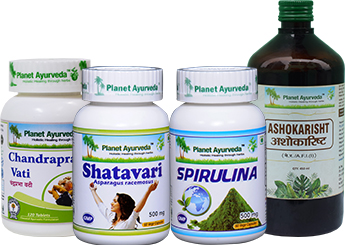

Product’s Description
1. Shatavari Capsule
These are pure herb capsules manufactured from a refined extract of the extraordinary plant Asparagus racemosus (Shatavari), a well-known women’s health care booster. Shatavari tablets aid in pregnancy by maintaining a healthy balance of all hormone levels.
Dosage: Take 1 capsule twice a day with plain water after meals.
2. Chandraprabha Vati
Haridra (Curcuma longa), Shilajit (Asphaltum), Chavya (Piper chaba), Vacha (Acorus calamus), Guggul (Commiphora mukul), Mustak (Cyperus rotundus), and other medicinal herbs are utilized in the manufacture of Chandraprabha Vati. These herbal pills aid in the maintenance of a healthy reproductive system in females as well as the prevention of illnesses.
Dosage: 2 pills twice a day with plain water after meals.
3. Ashokarisht
The major component in this traditional Ayurvedic composition is Ashoka (Saraca asoca). Amalaki (Emblica officinalis), Haritaki (Terminalia chebula), Shunthi (Zingiber officinale), Dhataki (Woodfordia fruticosa), and other herbs are also utilized. It is a liquid herbal preparation with several health benefits, including balancing female hormones, curing illnesses of the female reproductive system, and aiding in the treatment of menstruation discomfort, polycystic ovarian syndrome, and other similar conditions.
Dosage: Take 2 teaspoons twice daily with plain water after meals.
4. Spirulina Capsules
Spirulina, blue-green algae, is used to make these incredible capsules. These capsules are packed with medicinal capabilities as well as other beneficial elements. It has a high concentration of Vitamin B12, which aids in the synthesis of hemoglobin and healthy red blood cells.
Dosage: 1 capsule twice a day with plain water after meals.
CONCLUSION
Your objective of getting pregnant after 35 years may come true if you follow the guidelines and depend on natural supplements. A woman’s responsibilities have expanded with time, resulting in an increase in the age at which she may conceive. Nature, on the other hand, may assist you in conceiving if you put it in the correct location at the appropriate time. In case of any query kindly visit www.PlanetAyurveda.com. For more queries, you can send your queries to our email id herbalremedies123@yahoo.com.


