Management of Acute Bacterial Disease or Diphtheria in Ayurveda
Abstract
Nowadays the rate of infectious diseases is increasing day by day due to poor hygiene or lack of immunity. With modern civilization and lifestyle, the immunity of the people becoming poor due to improper lifestyle and unhealthy diet. These factors gave chances to many bacterial and viral infections to develop inside the body. Usually the infection spreads through poor hygiene, or through coming in contact with an infected person. In Modern medicine, the infections are controlled by antibiotics or antivirals but Ayurveda has a different approach to this. One of the acute bacterial diseases is diphtheria which is generally a bacterial infection of the mucous layer of the throat and nose. Although due to the vaccination this disease is rare now but still there are some cases we still came across. Here in this article, we are going to discuss all about Diphtheria or acute bacterial disease and its Ayurvedic aspect.
What is Diphtheria?
Diphtheria is an acute bacterial infection caused by Corynebacterium diphtheriae bacteria. This bacteria spreads quickly and affects the mucous membrane of the nose and throat. Corynebacteria are nonmotile, Gram-positive, aerobic, rod-shaped bacteria. It causes a gray thick coating at the back of your throat that makes it hard to breathe and results in suffocation. The toxins produced by the Corynebacteria may also affect other tissues and organs of the body and result in serious problems like paralysis, inflammation of the heart or heart failure.
Diphtheria is now rare in the developed countries due to the vaccination against the disease but many countries with limited vaccination or health care options are still experiencing the high rates of Diphtheria.

Types of Diphtheria
- Respiratory Diphtheria – It involves the nose, throat and the tonsils.
- Cutaneous Diphtheria – It involves the skin only.
Ayurvedic concept of Diphtheria or Acute bacterial disease
Ayurveda is an ancient heritage science. The basic principle of Ayurveda is based on the balance of three doshas – Vata, Pitta, and Kapha. The imbalance of these doshas due to any other internal and external factors leads to the disease state. In Ayurveda, Diphtheria can be related to Rohini. Rohini is a disease of the throat and nose that generally affects the children. It has been described in Charaka and Sushruta Samhita as a fatal disease. There is a vitiation of all the three doshas – Vata, Pitta, Kapha and Rakta in which a mansakura (fleshy growth) is produced in the throat causing obstruction. Acharya Sushruta described Rohini under Kanthagata roga and Acharaya Charaka said that if this is left untreated then it is fatal in three nights. This is considered as Kapha dominant Tridoshaj disease. The common symptoms of Rohini are- Naaditej (pulse is quick), Teevra jwara (high grade fever), Hoarseness of voice, sore throat, and swaskrechchhta (difficulty in Breathing) etc. Acharayas had classified Rohini into 5 types
- Vattaj
- Pittaj
- Kaphaj
- Sannipattaj
- Raktaj
Symptoms of Rohini according to the Doshas involvement
Vattaj Rohini – vedna (pain) in Hanu (jaw) and karna (ear), Kanthavrodha (obstruction in the throat), around the tongue, and can be fatal in 7 days if not treated.
Pittaj Rohini – jwara (fever), Pipasa (thirst), shighra (frequent) Paka (ulcers) and Daha (burning sensation), Sparshanasaha (intolerance to touch), and sore throat. It is more toxic and can be fatal in 4 days.
Kaphaj rohini – obstruction of pranvaha strotas (respiratory tract), sthir, mandpaak, and pichchil kantha. It can be Fatal in 3 days.
Sannipattaj rohini – paak in Dhatoos (starting from mamsa dhatu) and whose vega (flow) is impossible to stop with medicine. It includes symptoms of all the three doshas (vata, pitta, kapha).
Raktaj rohini – usually characteristic of the pittaj Rohini and the fleshy growth formed in the throat covered with small vesicles. This type of Rohini is incurable.
What are the common causes of Diphtheria?
Diphtheria is a bacterial infection that infects the throat, nose, and skin caused by Corynebacterium diphtheriae. It is mainly spread from one person to another through direct contact with the infected people by using his hanky, towel, cup, or other belongings. Usually it is spread through droplet infection but it can also spread through the bloodstream.
What are the common signs and symptoms of Diphtheria?
The common signs and symptoms of diphtheria are
- Bad sore throat
- Drooling
- Mild fever and chills
- Bloody and watery drainage from nose
- Feel weakness
- Swollen glands
- Fatigue
- High pulse rate
- Gray covering at the back of your throat, making difficulty in breathing
- Bluish coloration of the skin as diphtheria can also infect your skin
- Swollen lymph nodes on both sides of the neck
Children infected with diphtheria may have symptoms like –
- Nausea
- Vomiting
- Chills
- High fever
As the infection progresses further, the person may have –
- Complaint of double vision
- Have slurred speech
- Signs of going into shock
- Heart failure or arrhythmia
Diagnosis
Diphtheria can be diagnosed by a physical examination by the doctor by seeing the gray covering of dead tissues in the back of the throat. He may perform other tests like –
- Sample analysis through a throat swab
- Serological and blood tests like complete blood count, diphtheria antigen, antibodies to diphtheria, etc.
Ayurvedic management
In Ayurveda, Rohini or diphtheria is managed with both Shodhana and Shamana chikitsa. Shodhan chikitsa include Panchakarma procedures like – Raktamokshana, Dhoomapana, Vamana, Nasya karma, and Gandhusha, etc. Shamana chikitsa includes the use of herbs like Kanchnaar, Haridra, shallaki, etc.
Vattaj rohini is managed with Pratisaran (application of medicinal paste) from Panchalavana, Gandusha by Sneha and Raktamokshana.
In pittaj rohini – Kwatha of Parushak and Draksha is useful as kawal (gargles), pratisaran by Sarkra and Patanga mixed with Madhu.
In kaphaja rohini – Pratisaran by Kutki Choorna and Grahdhoom, and Siddha tail with Vidanga, Danti, and Sweta along with Saindhav lavana is used as Nasya and kawal.
In raktaj rohini – should be treated like pittaj rohini.
Herbal remedies for acute bacterial disease or Diphtheria by Planet Ayurveda
Planet Ayurveda is a herbal manufacturing firm which is internationally certified. This is a WHO-GMP certified manufacturing company based in India founded in 2002 by Dr. Vikram Chauhan and this company came into existence as a subsidiary or as a brand name known as Krishna herbal company. The products of the company are 100% herbal, pure and vegetarian. The products are made from the extracts of potential ayurvedic herbs. Planet Ayurveda offers the following herbal remedies for the treatment of acute bacterial disease or Diphtheria
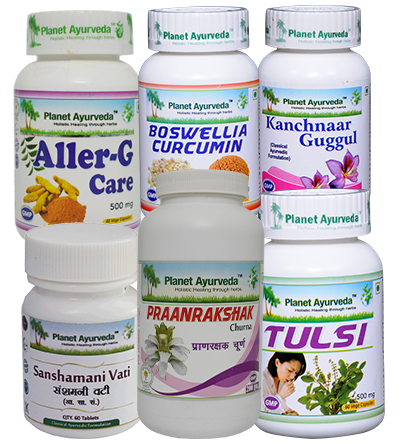

- Sanshamani vati
- Kanchnaar guggul
- Tulsi capsules
- Praanrakshak churna
- Aller-g care capsule
- Boswellia curcumin
Description of the products
1. Sanshamani vati
Sanshamani vati is a herbal formulation by Planet Ayurveda prepared from the pure extract of Giloy (Tinospora cordifolia) as a major ingredient. It has anti-inflammatory, antipyretic, antioxidant, immune booster properties and helps to fight against the infection by increasing the immunity. It helps to balance the Vata and Pitta doshas and thus helps in lowering the body temperature and inflammation. Thus it is beneficial in diphtheria.
Dosage – 2 tablets twice a day after meals with plain water.
2. Kanchnaar guggul
Kanchnaar guggul is a classical herbal formulation by Planet Ayurveda in a tablet form prepared from the pure extract of wonderful herbs like Kanchnaar (Bauhinia variegata), Guggul (Commiphora mukul) along with other potent herbs. Kanchnaar guggul helps to balance all the three doshas of the body and also prevents abnormal cell growth. It helps to reduce the inflammation, swelling and size of the fleshy growth and promotes the growth of the healthy cells and have good results in curing diphtheria.
Dosage – 2 tablets twice a day with plain water after meals.
3. Tulsi capsules
Tulsi capsules is a single herbal formulation by Planet Ayurveda prepared from the pure extract of holistic herb Tulsi (Ocimum tenuiflorum). Tulsi has been known for multiple health benefits from ancient times. It has anticancer, antioxidant, antiseptic, antipyretic, antibacterial and antifungal properties.Tulsi is used in strengthening the immune system, lung disorders, treating heart disorders, treating disorders of skin and blood and also increasing the digestive fire. It helps in curing bacterial infection and thus useful in Diphtheria.
Dosage: 1 capsule twice a day with plain water after meals.
4. Praanrakshak churna
Praanrakshak churna is a classical herbal formulation in powder form by Planet Ayurveda prepared from the pure extract of herbs like Shirish (Albizia lubbock), Bharangi (Clerodendrum serratum), Vaasa (Adhatoda vasica), Mulethi (Glycyrrhiza glabra), along with other herbs which are very beneficial in treating the diseases of respiratory system. Also it gives relief from the symptoms of diphtheria like difficulty in breathing, sore throat, etc. and also boosts your immunity. Thus it is used in the management of Diphtheria.
Dosage: 1 teaspoon two times a day with normal water after meals.
5. Aller-g care capsule
Aller-g care capsule is a polyherbal formulation by Planet Ayurveda prepared from the pure extract of haridra (Curcuma longa), neem (Azadirachta indica), shirish (Albizia bebbock), ashwagandha (Withania somnifera). These capsules are very effective in allergic conditions, maintaining health and regulating the normal respiratory system. The herbs used in this formulation have anti-inflammatory, antioxidant, antihistamine properties and are thus used in the management of Diphtheria.
Dosages -1 capsule twice a day with normal water after meals.
6. Boswellia curcumin
Boswellia curcumin is the polyherbal formulation by Planet Ayurveda made from the most effective combination of anti-inflammatory herbs like Shallaki (Boswellia serrata) and Curcumin (Curcuma longa). These two herbs are helpful in reducing inflammation as well as pain. The powerful combination of these herbs promotes healing, reduces swelling and boosts the immune system. Thus this is very effective in Diphtheria.
Dosage – 1 capsule twice daily with water after meals.
Conclusion
At last we can conclude that Diphtheria is a life threatening condition and it should be treated as soon as possible. Though now the cases are rare after the availability of vaccination but still there are some countries where the cases of diphtheria are still seen. In Ayurveda we manage this disease from its root cause through Ayurvedic herbs. Planet Ayurveda offers effective herbal formulations which have very good results in this condition. Planet Ayurveda products are 100% pure, effective, vegetarian, and natural. We hope the above-mentioned information regarding Diphtheria and its ayurvedic treatment will be beneficial for the one who suffers. For more details of our products, you can check our website www.planetayurveda.com. For more queries, you can send your queries to our email id herbalremedies123@yahoo.com.