Natural Cure For Myasthenia Gravis With Herbal Remedies
Abstract
Myasthenia gravis is a neuromuscular disorder associated with weakness of voluntary muscles. The most active muscles generally are most severely affected such as those involved in facial expression, swallowing, and respiration. The course and severity of the disease are extremely variable. In some patients the muscular weakness may be confined to the extra ocular muscles, and the disease is not progressive and relatively benign. In others, the disorder rapidly becomes generalized to involve virtually all of the somatic musculature and is fatal. The basic tendency in this problem is muscular weakness. In this article we will discuss the Myasthenia gravis, its basic associated concerns and Ayurvedic point of view.
Introduction
Myasthenia gravis is a chronic autoimmune, neuromuscular disease that causes weakness in the skeletal muscles that worsens after periods of activity and improves gradually. These muscles are responsible for functions involving breathing and moving parts of the body, including the arms and legs. At first the weakness takes the form of failure of contraction after sustained effort, but in more advanced stages the muscles will no longer contract, even after prolonged rest. The disease may occur at any age. The peak age of onset is 20 years, and among these individuals the female to male ratio is 3:1. A second smaller peak occurs in late adult life when males predominate. Although the exact cause is not known, the various evidence supports that Myasthenia gravis results from a reduction of available acetylcholine receptors in neuromuscular junctions. Acetylcholine is responsible for the transfer of the nervous impulse from the motor nerve terminals to the muscle endplate. Acetylcholine is stored in vesicles in the nerve terminals to the muscle endplate. It is stored in the vesicles in the nerve terminals and is released by a process of exocytosis at specialized release sites. We will discuss this acetylcholine further in this article.
Causes
The causes of Myasthenia gravis are unknown, although basic mechanism to cause the Myasthenia gravis is as follows
- As it is an autoimmune problem, the basic cause is faulty transmission of nerve impulses to muscles. There is interruption in communication between nerves and muscles at the neuromuscular junction. It means there is disturbed in the connection between nerve cells and muscles.
- Impaired muscle contraction– Neurotransmitters are the basic chemicals used to pass or communicate the information. Acetylcholine is a neurotransmitter released by nerve endings when impulses travel a motor nerve. Acetylcholine binds on the sets of acetylcholine receptors on muscle. It activates muscle contraction. In the condition like Myasthenia gravis, as it is an autoimmune disorder, antibodies secreted destroy the receptor for acetylcholine at neuromuscular junction. It leads to poor contraction of muscles and leads to conditions like Myasthenia gravis.
- The concept of thymus is also there and is associated with control on immune function. It is responsible for production of T cells, a type of W.B.C which helps to protect the body from infection and acts as a line of defense for the body. Impaired defense may lead to autoimmune problems.
Symptoms
Symptoms of Myasthenia gravis are as below:
- Paralysis or partial paralysis of eye movements.
- Diplopia i.e. double vision.
- Problem in swallowing and fatigue in neck
- Associated in chewing.
- Ocular myasthenia i.e. eye muscle weakness.
- Ptosis o.r. drooping of one or both eyelids
- Altered face expressions.
- Breathlessness
- Speech impairment
- Overall body weakness.
- Respiratory failure
Diagnosis
- Physical Examination– It is the most important way to find out Myasthenia gravis. In physical examination there is a clear picture regarding muscle strength and coordination, muscle tone, sense and movement of eyes.
- Edrophonium Test– Edrophonium chloride is injected to the person of Myasthenia gravis. It helps to pacify the symptoms of Myasthenia gravis by blocking the breakdown of acetylcholine and helps to increase the level of neurotransmitter. This test also helps to check out ocular weakness.
- A Blood Test– Myasthenia gravis patients have elevated levels of acetylcholine antibodies. Another antibody called an anti-musk anti-musk antibody is found in maximum individuals who have Myasthenia gravis. It can be detected in blood tests and may signify the Myasthenia gravis.
- Diagnostic Imaging– Diagnostic imaging is done for the chest using CT scan or MRI. It helps to check the presence of thymoma (metastatic stages).
- Pulmonary Function Testing– as the name indicated it helps to check the pulmonary function or the breathing capacity of the patients in Myasthenia gravis.
Ayurvedic Aspect
According to Ayurveda Myasthenia gravis is associated with vata and kapha dosha vitiation. Vitiation of vata and kapha are associated with predominance of aam dosha due to incompatible aahar vihar (lifestyle and eating habits). Aam dosha which are basically the toxins or kapha dosha block the channels of dhatus and aggravate the vata by obstructing the path. This leads to several complications.
Management
In modern sciences the cholinesterase inhibitors are used to manage the conditions like Myasthenia gravis. Mestinon a drug is able to enhance the communication between muscles and nerves. The basic aim of management is to maintain the normal contraction of the muscles. Ayurvedic management includes the shaman (with the aid of medications via oral routes predominantly) and shodhana therapy (based on detoxification). Shaman therapy can be done by using the herbs mentioned in Ayurvedic texts to digest the aam (toxins) upto strengthening the nervous system. First step is to digest the aam dosha and then enhancement of the digestive fire is done. Shodhana includes Panchkarma predominantly, the procedures associated to manage the Autoimmune disorders are abhyang (massage), swedana (fomentation), virechana (purgation), basti (medicated enema), shirodhara etc. Various yoga poses are able to manage the conditions of Myasthenia gravis. The mutual approach with herbs and panchkarma help to promote the conditions of the neuromuscular system and is best to manage the Myasthenia gravis.
Herbal Remedies By Planet Ayurveda
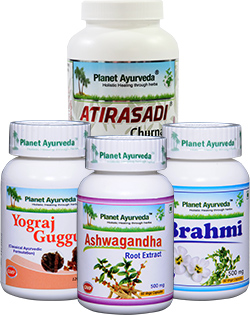
Planet Ayurveda is a GMP certified hub for the management of modern day problems with classical solutions. The herbal products are best, authentic and result oriented formulations. Following are the herbal products used to manage the Myasthenia gravis and associated concerns
- Ashwagandha Capsule
- Brahmi Capsule
- Yograj Guggul
- Atirasadi Churna

Product’s Description
1. Ashwagandha Capsule
Ashwagandha capsules are the classical herbal formulation of Planet Ayurveda. The ashwagandha capsules are best, authentic and result formulation in conditions like Myasthenia gravis or other autoimmune problems. The conditions associated with aggravated vata or vitiation of other doshas may cause debilitating conditions, fatigue, nervous system breakdown, chronic fatigue or plenty of other symptoms. In all such conditions ashvagandha capsules are best. These capsules are loaded with the extract of Ashwagandha (W. sominifera). It acts as a rejuvenator and hence promotes nerve and immunity strengthening. It helps to prevent the stunted growth of children and old age people also. Ashwagandha enhance the mental stamina as well as sexual potency and strength.
Dosage– 1-2 capsules twice daily, with plain water after meals
2. Brahmi Capsule
Bramhi (Bacopa Monneri) is the herbal formulation based on classical texts. It is loaded with pure extract of Brahmi. Brahmi is a well known rejuvenator and brain tonic. It helps to enhance the transmissions of neuromuscular junctions. These herbal formulations help to promote the healing and regeneration of neurons. Also it promotes digestive fire and prevents anxiety. In various kinds of autoimmune conditions there is presence of aam dosha. Brahmi helps to enhance the metabolism of the liver, manage stress, balance the neurotransmitters, lose weight and enable the growth of cancerous cells. Brahmi is useful to strengthen the nerves of children and promotes their mental as well as physical strength. It is a herb of choice in conditions like insomnia and widely used to manage the condition of Myasthenia gravis.
Dosage– 1 cap twice daily with plain water after meals.
3. Yograj Guggul
Yograj Guggul is the classical herbal formulation. It is loaded with Shuddha Guggulu (Commiphora mukul), Chitraka (Plumbago zeylanica), Pippali (Piper longum), Amalaki (Emblica officinalis), Mustaka (Citrus rotundus), Haritaki (Terminalia chebula) and Ardraka (Zingiber officinale), Jeeraka (Cuminum cyminum), Devdaru (Cedrus deodara), Ela (Elettaria cardamomum) etc. Guggul formulations are able to drain out the toxins from the body. It helps to clear the channels and open the pathways. Other herbs in this formulation are able to enhance the metabolism and digestive fire of the body. The aam dosha is predominantly responsible to vitiate the vata, pitta and kapha in the body. Yograj guggul helps to clear the aam hence pacifies the doshas.
Dosage–2 tabs twice daily with plain water after meals.
4. Atirasadi Churna
The atirasadi churna of Planet Ayurveda is loaded with Indian Ginseng, Gokshur (Tribulus terrestris), Shatavari (Asparagus), Shilajit (Asphaltum), Kesar (Saffron) etc. Atirasadi churna helps to enhance the body strength and prevent the shukra kshaya (the deprivation of semen) hence promoting the strength of shukra dhatu. Due to the above properties it helps to maintain the good reproductive system, prevent erectile dysfunction and lack of libido. It also promotes the strength of the nervous system and manages autoimmune problems.
Dosage– 1 tsp twice with warm milk.
Conclusion
Myasthenia is an autoimmune disorder having no exact significant cause. The neurotransmitters and neuromuscular junctions are important to understand for better management. In Ayurveda the concept of tridoshas is very important. The herbal medicines mentioned above are able to manage this autoimmune problem. It is important to follow the herbal solutions to avoid the side effects of synthetic medicines. The herbal remedies of Planet Ayurveda mentioned above are able to manage this condition are GMP certified, good quality herbs, based on classical texts and are result oriented formulations. In case of any query kindly visit www.PlanetAyurveda.com. For more queries, you can send your queries to our email id herbalremedies123@yahoo.com.