What is Chronic Kidney Disease? – Treatment through Ayurveda
ABSTRACT
Chronic Kidney Disease (CKD) also known as chronic kidney failure, involves progressive loss of kidney functions over time. Because of slow damage to the kidney over a long period of time, the word chronic is used. The main function of the kidney is to remove the waste product and toxins from the body and retain protein, nutrients in blood. But in severe conditions, wrestling from various kidney disorders, the kidneys may stop working. It is the last stage of kidney disease. In this article we are going to discuss chronic kidney disease, its symptoms, cause and how Ayurvedic herbal medicines are helpful in Chronic Kidney Disease.
INTRODUCTION
Kidneys are the pair of bean shaped organs located in the abdomen towards the back, behind the belly, below the ribs. Gradual disturbance in kidney functions due to various kidney disorders, persistently raised blood pressure & diabetic conditions are the common causes for CKD. It is rarely reversible and leads to progressive decline in renal function. Renal mass is reduced which may lead to hypertrophy of the remaining nephrons with hyper filtration. And the glomerular filtration rate of these nephrons is at extraordinary levels. This transformation places a burden on remaining nephrons which may lead to interstitial fibrosis and glomerulosclerosis, advising that hyper filtration may worsen renal function. Chronic kidney disease is categorized in five different stages. The end stage of all the kidney diseases is CKD.

Now let’s know about a brief about Chronic kidney disease.
SIGNS and SYMPTOMS
Some clinical features of Chronic Kidney Disease are
- Loss of appetite
- Nausea and Vomiting
- Swelling in body parts due to water retention specifically in feet, hands, ankles etc.
- Puffiness in the face and inflammation around eyes mostly in the morning.
- Insomnia (Sleeping difficulty)
- Chest pain
- Muscle cramps
- Shortness in breath on exertion
- Raised blood pressure
- Itching and dry skin
- Tiredness and fatigue
- Abnormal urination specifically nocturia (need to pass urine multiple times during night hours)
- Erectile dysfunction in males.
CAUSES
Some common cause of Chronic Kidney disease are
1. Type 1 or type 2 diabetes
High blood sugar level is responsible for the destruction of blood vessels that are present in the kidney. Due to this, damaged blood vessels are unable to perform their work efficiently which ultimately results in gradual loss of kidney functions & leading to CKD.
2. High blood pressure
Due to high blood pressure arteries around the kidney become narrow and weak. These affected arteries can’t supply enough blood to the kidney which may lead to chronic kidney disease.
3. Interstitial Nephritis
In Interstitial Nephritis, renal tubules (kidney’s filter) become swollen. It is caused by the long term use of some medicines such as NSAIDs (Nonsteroidal anti-inflammatory drugs).
4. Polycystic kidney disease
Polycystic kidney disease may reduce the kidney functions and lead to kidney failure. It is caused due to genetic inheritance i.e. mutation in genes such as PKD1,PKD2 etc.
5. Pyelonephritis
This is an inflammatory disease of the kidney caused as a result of an infection mostly bacterial infection and that may lead to damage to the kidney permanently. In the urinary tract, prolonged obstruction may occur due to enlarged prostate, kidney stones, cancer etc.
AYURVEDIC ASPECT
All the kidney and urinary system related disorders lead to general conditions Mutravastrotodusti as mentioned in Ayurveda that means the vitiation of micro-channels of urine. The chronology of disease starts with Nidan (Causative factors and risk factors consumption) i.e. best explained by this shloka given by Acharya Charka in “Prameha chikitsa”.
अस्यासुखं स्वप्न सुखं दधिनि ग्राम्योदकानुपरसाः पयांसि।
नवानंपानं गुडवैकृत्तं च प्रमेहहेतु कफकृच्च सर्वम।। (चरक
चिकित्सा स्थान 6/4)
This means that the person who enjoys too much in food and indulged in taste (i.e. more use of junk and fast foods), who sleeps to much (even during day hours), excessive consumption of curd, contaminated water, non-vegetarian items, consume more sweet products and similar kapha increasing diet will end up in various diseases.
Over consumption of these Nidan (causative factors) will lead to Mandagni which will result in Ama (endotoxins) formation, that ama is considered as the cause of many diseases. This Ama blocks the various srotas (micro environment channels) of body tissues, specifically Medovaha srotas in this case (fat tissue channel). Ama vitiates the medovaha stotras and the kidney are the basic seat of meda (fat tissue) according to Ayurveda, which will affect the kidney functioning. As already discussed, the main function of the kidney is urine formation and maintaining balance of water and electrolyte, but if this problem persist this will lead to vitiation of urinary micro channels (Mutravahastrotadusti) and results in various kidney & urinary system diseases like nephritic syndrome, polycystic kidney disease, obstructive uropathy, glomerulonephritis that ultimately end in Chronic Kidney Disease.
DIAGNOSTIC CRITERIA FOR CKD
Kidney damage is measured using some markers that either one or more of these markers may be present for more than 3 months is required for diagnosis of CKD. These include:
- Presence of albumin in urine (Albuminuria) (ACR ≥ 30 mg/g)
- Sedimental deformities of urine.
- Tubular diseases or other kidney disorders that create water & electrolyte imbalance.
- Histology suggests some deformity.
- Structural abnormality seen by imaging techniques.
- Reduced GFR (Glomerular Filtration Rate) (GFR <60 ml/min/1.73 squared meter)
Treatment for Chronic Kidney Disease
Mainstay in managing patient with CKD with Ayurvedic aspect include:
- Nidana parivarjana
- Shodhan Chikitsa
- Shaman Chikitsa
1. Nidana Parivarjana
It is the avoidance of all the nidan i.e. risk/causative factors mentioned for disease. It can also be understood as detection of diseased conditions in early stages & then preventing its further progression.
2. Shodhan Chikitsa(Purification methods)
The detoxification procedure is done by examining the condition, strength & body built of the person. The suitable patient for the procedure must be advised for Virechana (therapeutic purgation) as it removes all the toxins (causative factors) from the body even at cellular levels. Also, raktmokshan (bloodletting) is also considered as a useful detoxification method in early phases of the disease.
3. Shaman chikitsa
The main Shaman chikitsa is based on preventing the diseased condition from deteriorating further by giving the drugs/herbs that have great role in improving renal functions & aids in managing the condition along with some herbal based diuretics for both kidneys & systemic wellbeing.
HERBAL MEDICINES PROVIDED BY PLANET AYURVEDA
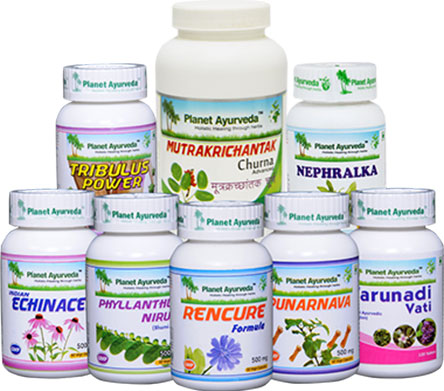
Planet Ayurveda provides 100% vegetarian formulation and formulated by our experts Ayurvedic Doctors, to prop up the health of kidneys. The main role of these herbal medicines is to treat the root cause of chronic kidney disease and prevent the disease from further progression. Herbal remedies are the finest and safest way for managing patients with kidney issues. Our experts proposed herbal drugs for chronic kidney disease under the name of Revive Kidney for Advanced stages
- Phyllanthus niruri capsules
- Punarnava capsules
- Varunadi vati
- Rencure formula capsules
- Nephralka capsules
- Echinacea capsules
- Mutrakrichantak churna
- Tribulus Power Capules

Product Description
1. Phyllanthus niruri
Phyllanthus niruri (Bhoomi amla) also known as “stone breaker”. It is the most active ingredient used in herbal therapy for kidney stones and also very much beneficial in maintaining or even improving the functioning of kidneys. It is also used to boost up the removal of potassium and magnesium from the body along with urine, thus reducing electrolyte load on kidneys. The standardized extract of this herb is available with us in the form of capsules.
Dosage: 1 capsule, twice daily with plain water after meals.
2. Punarnava capsules
The basic constituent of these capsules Punarnava (Boerhavia diffusa) is used for the treatment of chronic kidney failure because of its antitoxic and rejuvenation properties. It is useful in the elimination of various contaminants from blood due to its diuretic properties (Mutravirechan).
Dosage: 2 capsules, twice daily with plain water after meals.
3. Varunadi vati
It is the combination of many herbal ingredients such as Gokshur (Tribulus Terrestris), Varun (Crataeva Nurvala) etc. It is useful to improve the flow rate of urine. These herbs are well known since ancient times for improving various kidney & urinary tract ailments.
Dosage: 2 tablets , twice daily with plain water after meals.
4. Rencure formula capsules
Various herbal ingredients used in the preparation of this product are: Kasni (Cichorium intybus), Palash (Butea Monosperma) etc. It is one of the best herbal diuretics. These capsules also give relief from painful micturition.
Dosage: 2 capsules, twice daily with plain water after meals.
5. Nephralka Capsules
Herbal ingredients, Revandchini (Rheum Emodi), Mooli Satva (Raphanus Sativus) etc. are used in the reduction of urinary calculi. All the herbal ingredients which are used in Nephralka capsules lead to healthy kidney functions.
Dosage: 1 capsule, twice daily with plain water after meals.
6 Echinacea Capsules
Echinacea capsules (Andrographis paniculata) is a very useful plant which is used in the treatment of many kinds of disease, especially kidney and urinary systems. It also helps to maintain functions of the kidney and urinary system.
Dosage: 1 capsule, twice daily with plain water after meals.
7. Mutrakrichantak churna
Mutrakrichantak churna is the combination of several herbal medications such as; Shigru (Moringa Oleifera), Apamarg (Achyranthes aspera), Shirish (Albizia lebbeck) etc. Main property of this churna is antioxidant and it is useful in the reduction of toxicity level of the kidneys. It is also used to reduce renal injury and maintain renal function.
Dosage: 1 teaspoon twice daily with water.
For better results: Boil 1 teaspoon in 300-400 ml of water until it remains 50-60ml. filter the preparation and drink. Drink this preparation twice a day after 45-60 minutes of breakfast and dinner.
8. Tribulus Power Capules
This is a single herb formulation. It is made from the extracts of Gokshura (Tribulus terresteris). This is also known as Gokharu. This herb is very useful in water retention. It improves the function of liver and kidneys. This Ayurvedic herb is very beneficial in increasing the level of albumin in the body. It is very helpful in enhancing sexual power. It improves the strength of the body by eliminating the toxins from the body.
Dosage: 1 capsule twice a day after meals with plain water
CONCLUSION
At the end of this article we can see that in modern medicine there is no any kind of specific treatment for chronic kidney disease, they only give medications to lower down the symptoms of disease and start dialysis and finally recommend for kidney transplant which have various kinds of life-threatening side effects. In Ayurveda, herbal remedies are prescribed that are 100% pure, safe, and effective with no or very less side effects. Herbal remedies are used to target the main cause of chronic kidney disease & manage the condition.
