November 18, 2026
Cervical Rediculopathy/ Nerve Root Compression
Abstract
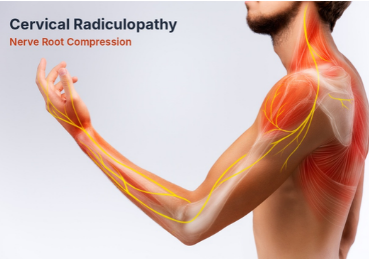
Cervical radiculopathy is a neurological condition that develops when one or more nerve roots in the cervical spine (neck region) become irritated or compressed. It commonly occurs due to age-related changes in the intervertebral discs, cervical spondylosis, disc herniation, or narrowing of the spinal openings through which nerves pass. The condition can cause neck pain that radiates towards the shoulder, arm, forearm, and fingers. Patients may also experience tingling, numbness, muscle weakness, and reduced reflexes depending on the affected nerve root. Diagnosis involves clinical examination and imaging investigations such as MRI when required. Modern management focuses on pain reduction, physiotherapy, posture correction, and surgical intervention in selected cases. From an Ayurvedic perspective, its clinical features can be understood through Vata-dominant disorders, particularly those involving the neck, muscles, bones, and nervous system. Understanding the underlying cause and severity of nerve compression is essential for appropriate management.
Introduction
The cervical spine is the uppermost portion of the vertebral column, consisting of seven vertebrae extending from the base of the skull to the upper back. These vertebrae are identified as C1 to C7 and provide support to the head while allowing movements such as bending, rotation, and turning of the neck. Between the vertebrae are intervertebral discs that act as cushions, absorb mechanical stress, and help maintain flexibility. Nerve roots emerge from the cervical spinal cord through small openings called intervertebral foramina. These nerves carry sensory and motor signals between the spinal cord and different parts of the upper body, including the shoulders, arms, wrists, and hands. Cervical radiculopathy occurs when a cervical nerve root becomes irritated, inflamed, or compressed. This may happen because of a herniated disc, bone spurs, degenerative changes, or narrowing of the intervertebral foramina. Depending on the affected nerve root, symptoms may appear in specific regions of the shoulder, arm, or hand. For example, compression involving the C6 nerve root may cause pain or altered sensation extending towards the thumb, while C7 nerve root involvement may affect the middle finger and associated arm muscles. The exact distribution can vary between individuals. Cervical radiculopathy is different from cervical myelopathy. Radiculopathy involves irritation or compression of an individual nerve root, whereas myelopathy occurs when the spinal cord itself is compressed. This distinction is important because spinal cord compression can cause more serious neurological problems and requires timely medical assessment.
Causes
A nerve in the neck usually gets pinched due to structural changes that narrow the nerve’s exit path. The main causes include:
1. Slipped or Herniated Disc
In younger adults, sudden heavy lifting, twisting, or neck injury can cause the soft inner gel of a spinal disc to bulge or leak out. This disc material pushes directly against the nearby nerve root.
2. Bone Spurs (Osteophytes)
As people age, the spinal discs lose water and flatten. To compensate for this extra pressure, the body grows tiny extra pieces of bone called bone spurs around the joints. These bone spurs narrow the nerve openings and press on the nerve.
3. Degenerative Disc Disease
General wear and tear over time causes the discs to shrink, bringing the neck vertebrae closer together and reducing the vertical space available for the nerve roots.
4. Poor Posture and Micro-trauma
Looking down at screens for long periods (text neck), repetitive overhead work, or sudden whipping movements of the neck can strain the spinal structures and trigger nerve compression.
Pathophysiology
Pathophysiology explains how physical pressure on the nerve creates painful symptoms throughout the arm. When a disc or bone spur presses against a cervical nerve root, it squeezes the tiny blood vessels that supply blood and oxygen to that nerve. This lack of blood flow causes local tissue hypoxia (oxygen starvation) and leads to internal swelling within the nerve sheath. As fluid builds up in the tight space, pressure on the nerve increases even more. At the same time, a ruptured disc releases irritating inflammatory chemicals around the nerve. This chemical irritation combined with physical pinching damages the protective outer layer of the nerve fibers. As a result, the nerve begins firing abnormal, uncontrolled electrical signals. Your brain receives these signals as sharp, shock-like pain, burning sensations, or numbness spreading down your arm. If the compression continues for a long time, signal transmission drops, leading to muscle weakness in the arm or hand.
Signs and Symptoms
The signs of a pinched neck nerve depend on which specific nerve root is compressed, but symptoms usually affect only one side of the body:
- Radiating Arm Pain: Sharp, burning, or electric-shock-like pain that starts in the neck and shoots down into the shoulder, arm, forearm, or fingers.
- Numbness and Tingling: A “pins and needles” feeling or loss of skin sensation in specific parts of the arm or fingers (such as the thumb, middle finger, or pinky finger).
- Muscle Weakness: Difficulty lifting the arm, bending the elbow, gripping objects tightly, or doing fine tasks like buttoning a shirt or holding a pen.
- Neck Stiffness: Constant aching pain and tightness in the neck and upper shoulder muscles.
- Worse with Neck Movement: Pain gets worse when turning the head, bending the neck backwards, or coughing and sneezing.
- Relief Position: Patients often find temporary relief by resting the hand of the painful arm on top of their head, which takes physical tension off the pinched nerve.
Diagnosis
Doctors use a combination of physical movement tests and imaging scans to pinpoint the exact nerve involved.
1. Physical and Neurological Exam
The doctor tests your muscle strength, skin sensation, and arm reflexes. They also perform specific physical tests:
- Spurling’s Test: The doctor gently tilts your head toward the painful side and applies mild downward pressure. If this causes pain to shoot down your arm, the test is positive.
- Distraction Test: The doctor gently pulls your head upward to temporarily increase space between the neck bones. If your arm pain decreases, it confirms nerve root compression.
2. MRI Scan
An MRI is the best imaging test for this condition. It provides clear, detailed pictures of soft tissues, showing exactly where a herniated disc or bone spur is pressing on the nerve.
3. CT Scan
Used if an MRI cannot be performed, showing detailed images of the bone spurs and spinal joints.
4. Nerve Conduction Studies (EMG)
Tiny needle tests that measure how fast electrical signals travel along your arm nerves, helping rule out other conditions like carpal tunnel syndrome.
Modern Management
Treatment for cervical radiculopathy starts with gentle, non-surgical methods, as most people recover within a few weeks to months.
1. Rest and Activity Modification
Avoiding heavy lifting, overhead work, and sudden neck twisting helps lower immediate inflammation.
2. Medications
Pain relievers and anti-inflammatory drugs (like ibuprofen) help reduce pain and swelling around the nerve. Neuropathic pain medicines (like gabapentin) may be used to calm burning nerve pain, and short courses of muscle relaxants help ease neck spasms.
3. Physical Therapy
A physical therapist guides you through gentle neck stretches, posture correction, deep neck muscle strengthening, and shoulder exercises to relieve pressure on the spine.
4. Cervical Traction
Gently stretching the neck using specialised traction equipment opens up the nerve gaps and gives quick pain relief.
5. Epidural Steroid Injections
If severe pain continues despite therapy, a doctor can inject anti-inflammatory steroid medicine directly into the space around the pinched nerve to reduce swelling.
6. Surgery
Surgery is rarely needed and is only considered if you have severe arm weakness, worsening nerve damage, or constant pain that does not improve after 6–12 weeks of non-surgical treatment. Surgeons clear away the disc or bone spur to free the nerve.
Ayurveda Insight
In traditional Ayurveda, cervical radiculopathy is understood as Vishwachi, a disease caused by an imbalance in Vata dosha. It is also closely linked with Griva Stambha (neck stiffness). Vata controls all movements and nerve functions in the body. When Vata becomes aggravated due to ageing, overexertion, dry food, or poor posture, it leads to dryness (Rukshata) and degeneration in the neck joints (Asthi) and nerve tissues (Majja). Additionally, localised accumulation of Kapha (stagnant fluid or stiffness) can block the functional channels (Srotas) in the neck, trapping Vata and causing sharp radiating pain (Toda), numbness (Sauptya), and arm weakness (Karmakshaya). Ayurvedic treatment aims to pacify Vata, clear channel blockages, and nourish the cervical spine:
1. Warm Oil Massage (Abhyanga)
Gentle application of warm medicated oils like Mahanarayana Taila or Karpurasadi Taila over the neck and shoulders softens tight muscles and improves circulation.
2. Cervical Oil Pooling (Griva Basti)
A pool of warm medicated oil is held over the back of the neck inside a dough boundary for 20–30 minutes. This deeply hydrates dried spinal discs, reduces muscle spasms, and relaxes pinched nerves.
3. Herbal Steam (Swedana)
Applying herbal steam or warm cloth boluses (Patra Pinda Sweda) helps reduce stiffness, swelling, and nerve pain.
4. Nasal Oil Drops (Nasya)
Administering medicated drops (like Kshirabala or Anu Taila) into the nostrils is a key treatment for head and neck disorders, as it directly nourishes the cervical nerve pathways.
Home Remedies for Cervical Radiculopathy by Planet Ayurveda
Planet Ayurveda is a healthcare company dedicated to promoting the ancient science of Ayurveda through a diverse range of herbal medicines and natural wellness products. The company combines traditional Ayurvedic principles with carefully selected herbal ingredients to address various health concerns and support overall well-being. Located in Mohali, India, Planet Ayurveda serves customers across the globe by making Ayurvedic healthcare accessible and affordable. Its approach focuses on natural formulations, quality products, and the preservation of traditional Ayurvedic wisdom. In this article, we will discuss some formulations for nerve root compression management. Let’s start!
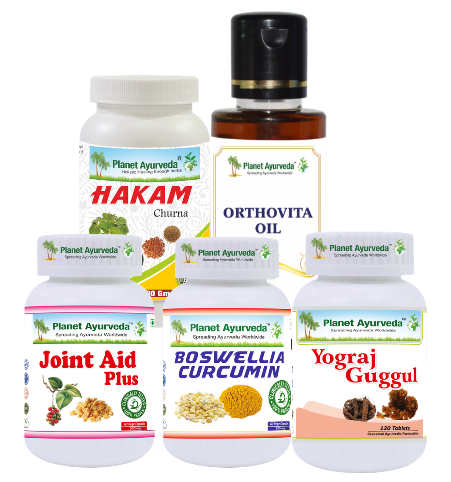
- Yograj Guggul
- Boswellia Curcumin
- Joint Aid Plus
- Hakam Churna
- Orthovita Oil

Product Description
1. Yograj Guggul
Yograj Guggul effectively manages cervical radiculopathy by combining powerful anti-inflammatory, analgesic, and Vata-pacifying herbs. It contains Commiphora mukul (Guggulu), Cyperus rotundus (Musta), Plumbago zeylanica (Chitraka), Emblica officinalis (Amalaki), Terminalia bellirica (Bibhitaki), Terminalia chebula (Haritaki), and many more. Commiphora mukul (Guggulu) penetrates deep tissue channels to reduce nerve root inflammation, relieve pain, and clear metabolic toxins around cervical compression sites. Plumbago zeylanica (Chitraka) and Cyperus rotundus (Musta) boost local microcirculation and digestive fire (Agni) to ease neck muscle spasms and stiffness. Additionally, the Triphala herbs (Emblica officinalis, Terminalia bellirica, and Terminalia chebula) deliver potent antioxidants that protect intervertebral discs from degeneration and promote tissue recovery. Together, these botanicals help relieve radiating neck-to-arm pain, numbness, and nerve impingement while restoring smooth cervical spine mobility.
Dosage: 2 tablets twice daily with plain water after meals.
2. Boswellia Curcumin
It serves as a highly effective herbal combination for managing cervical radiculopathy by targeting neuro-inflammatory cascades and joint degeneration in the cervical spine. Boswellia serrata (Shallaki) contains active boswellic acids that inhibit the 5-LOX enzyme pathway, effectively reducing swelling, oedema, and chemical irritation around impinged cervical nerve roots. Curcuma longa (Curcumin) complements this action by blocking NF-kB and COX-2 inflammatory pathways, alleviating sharp radiating neck-to-arm pain, stiffness, and burning sensations. Together, these potent extracts improve microvascular blood supply to damaged nerve sheaths and intervertebral joints, accelerating tissue healing and reducing muscle guarding.
Dosage: 1 capsule twice daily with plain water after meals.
3. Joint Aid Plus Capsules
It aids in managing cervical radiculopathy by combining nerve-soothing, anti-inflammatory, and neuroprotective herbs like Vitex negundo (Nirgundi), Boswellia serrata (Shallaki), Commiphora mukul (Guggul), Zingiber officinale (Sonth), and Withania somnifera (Ashwagandha). Vitex negundo and Boswellia serrata act rapidly to suppress inflammatory pathways, relieving oedema, stiffness, and sharp pain around compressed cervical nerve roots. Commiphora mukul and Zingiber officinale improve local microcirculation, clear metabolic waste (Ama), and alleviate chronic neck muscle spasms. Simultaneously, Withania somnifera works as a powerful nerve tonic and adaptogen, helping to strengthen damaged nerve fibers and reduce numbness or tingling sensations radiating down the arm. Together, these botanical extracts help restore cervical spinal mobility, reduce compressive irritation, and support overall neuromuscular health.
Dosage: 1 capsule twice daily with plain water after meals.
4. Hakam Churna
Hakam Churna plays an important role in managing cervical radiculopathy by targeting metabolic sluggishness, nerve irritation, and muscle stiffness around the cervical spine through its potent digestive and Vata-pacifying ingredients: Lepidium sativum (Chandershoor), Nigella sativa (Kalonji), Trigonella foenum-graecum (Methi), and Trachyspermum ammi (Ajwain). Its key constituent, Nigella sativa (Kalonji), contains thymoquinone, which specifically blocks neuro-inflammatory mediators to relieve sharp, burning radicular pain radiating down the arm. Lepidium sativum (Chandershoor) provides essential micronutrients and phyto-estrogen precursors that nourish weakened cervical vertebrae, strengthening structural support around compressed spinal disc spaces. Concurrently, Trigonella foenum-graecum (Methi) acts as a targeted anti-spasmodic to relax tense paraspinal muscles, while Trachyspermum ammi (Ajwain) clears systemic arterial and channel blockages (Srotorodha) to restore normal neural impulse conduction.
Dosage: 1/2 tsp twice daily with plain water after meals.
5. Orthovita Oil
Orthovita Oil provides direct transdermal relief for cervical radiculopathy by combining fast-acting topical analgesics with traditional Vata-pacifying medicated oils including Shul Gajendra Oil, Gandhapura oil, Turpentine Oil, Saindhavadi Taila, Prasarini oil, and Camphor. Gandhapura oil (Wintergreen) delivers natural methyl salicylate through the skin to rapidly numb sharp, radiating neuralgic pain, while Camphor acts as a counter-irritant to induce hyperaemia and distract local pain signalling. Prasarini oil specifically targets severe joint rigidity and tendon contractions, restoring range of motion to trapped cervical vertebrae and stiff paraspinal muscles. Additionally, Saindhavadi Taila, Shul Gajendra Oil, and Turpentine Oil deeply penetrate cutaneous layers to promote microvascular vasodilation, clearing localised inflammatory fluid accumulation around pinched nerve roots.
How to Use: For local application.
Conclusion
Cervical radiculopathy is a treatable condition that occurs when a nerve root in the neck becomes pinched by a slipped disc or bone spur, sending radiating pain, numbness, and weakness down into the arm. Although the burning pain can feel severe, accurate physical checks and MRI scans make it easy to diagnose correctly. Modern treatments focus on physical therapy, posture correction, anti-inflammatory medications, and gentle neck traction, which successfully resolve the majority of cases without surgery. Combined with Ayurvedic principles of warm oil therapies like Griva Basti, nasal administration (Nasya), and Vata-pacifying herbs, individuals can achieve deep pain relief, rebuild neck strength, and regain full, healthy use of their arm.

Dr. Vikram Chauhan
https://www.planetayurveda.comDr. Vikram Chauhan (MD - Ayurveda) is a Globally Renowned Ayurveda Physician with Expertise of more than 25 Years. He is the CEO & Founder of http://www.PlanetAyurveda.com, a leading Ayurveda Brand, Manufacturing, and Export Company with a Chain of Clinics and Branches in the US, Europe, Africa, Southeast Asia, India, and other parts of the World. He is also an Ayurveda Author who has written Books on Ayurveda, translated into Many European Languages. One of his Books is "Ayurveda – God’s Manual for Healing". He is on a Mission to Spread Ayurveda All Over the Planet through all the Possible Mediums. With his Vast Experience in Herbs and their Applied Uses, he is successfully treating Numerous Patients suffering from Various Ailments with the help of the Purest Herbal Supplements, Diet, and Lifestyle, according to the Principles of Ayurveda. For More Details, visit - www.planetayurveda.com, www.alwaysayurveda.com
View more posts from this author