April 11, 2026
CA 27.29 Test – Uses, Normal Range, Results & Role in Cancer Monitoring
ABSTRACT
The CA 27.29 test is a blood test used as a tumor marker to monitor certain cancers, especially breast cancer. CA 27.29 (Cancer Antigen 27.29) is a protein that may be released into the bloodstream by cancer cells, particularly those that arise from breast tissue. The level of this protein in the blood can change depending on how active the disease is. This test is mainly used to monitor treatment response, detect recurrence, and assess disease progression in individuals who have already been diagnosed with breast cancer. It is not usually used to detect cancer at an early stage because some early cancers may not produce high levels of this marker. However, when used along with imaging tests and physical examination, it provides valuable information about the patient’s condition and helps doctors make better treatment decisions.
WHAT IS THE CA 27.29 TEST?
The CA 27.29 test is a laboratory blood test that measures the amount of Cancer Antigen 27.29 present in the blood. This antigen is a type of protein that is normally present in very small amounts in healthy individuals. However, in certain conditions, especially breast cancer, this protein may be released into the bloodstream in larger quantities. The purpose of this test is not to diagnose cancer on its own but to help doctors observe changes in the disease over time. When used regularly, it helps track whether the cancer is responding to treatment or if it is growing or spreading. By comparing results from different time periods, doctors can better understand how the disease is behaving and whether treatment changes are required.
WHY IS THE CA 27.29 TEST DONE?
The CA 27.29 test is mainly performed for individuals who have already been diagnosed with breast cancer. One of its most important uses is to monitor how well treatment is working. When cancer treatment such as chemotherapy, radiation therapy, or hormone therapy is effective, the level of CA 27.29 usually decreases. Another important reason for performing this test is to detect recurrence of cancer after treatment has been completed. Even after successful treatment, cancer may sometimes return. Regular testing helps doctors identify early signs of recurrence so that timely treatment can be started. In advanced or metastatic cancer, this test helps doctors monitor the spread of cancer to other organs. Increasing levels over time may indicate disease progression, while stable or decreasing levels may suggest that treatment is controlling the disease.
HOW IS THE CA 27.29 TEST PERFORMED?
The CA 27.29 test is performed using a simple blood sample. A healthcare professional collects blood from a vein, usually from the arm, using a sterile needle. The procedure is quick and generally takes only a few minutes. After collection, the blood sample is sent to a laboratory where special techniques are used to measure the level of CA 27.29 in the blood. Most people do not need to fast or follow any special preparation before the test, although instructions may vary depending on the laboratory. Results are usually available within one to two days. Once the results are received, the doctor compares them with previous results and other clinical findings to determine their significance.
NORMAL RANGE OF CA 27.29
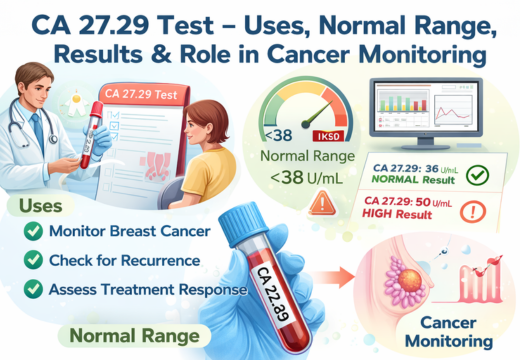
The normal range of CA 27.29 levels may vary slightly depending on the laboratory method used. In most cases, levels below 38 U/mL are considered within the normal range. However, it is important to understand that normal levels do not always rule out disease, and slightly elevated levels do not always indicate cancer. Doctors interpret the results carefully by considering the patient’s medical history, symptoms, physical findings, and results of imaging studies. Repeated testing over time is often more useful than a single result because it helps identify patterns or trends in marker levels.
WHAT DO THE RESULTS MEAN?
The results of the CA 27.29 test provide useful information about disease activity and treatment response. When levels remain low or decrease over time, it usually suggests that treatment is effective and the disease is under control.
If the levels increase gradually, it may indicate that the disease is progressing or returning after treatment. A sudden or significant rise in levels may prompt doctors to order additional tests such as imaging studies to locate possible cancer activity. It is important to remember that this test alone cannot confirm the presence or absence of cancer. Instead, it serves as a monitoring tool that supports other diagnostic methods.
CONDITIONS OTHER THAN CANCER THAT MAY INCREASE CA 27.29
Elevated CA 27.29 levels are not always caused by cancer. Certain non-cancerous conditions can also lead to increased levels of this marker. These conditions may include liver disorders, benign breast diseases, kidney problems, ovarian cysts, and inflammatory conditions. Pregnancy and certain chronic illnesses may also influence marker levels. Because of these possibilities, doctors do not rely on this test alone to diagnose cancer. Instead, they evaluate the results along with other clinical findings and investigations to make an accurate diagnosis.
LIMITATIONS OF THE CA 27.29 TEST
Although the CA 27.29 test is helpful in monitoring disease, it has certain limitations. One of the main limitations is that it is not suitable as a screening test for early detection of cancer. Many early-stage cancers may not produce high levels of this marker, which means the test may appear normal even when cancer is present. Another limitation is the possibility of false-positive results, where levels appear elevated even in the absence of cancer. This can occur due to certain non-cancerous medical conditions. For these reasons, the CA 27.29 test is always used along with other investigations such as imaging studies, clinical examination, and patient history.
WHEN IS THE CA 27.29 TEST REPEATED?
The CA 27.29 test is usually repeated at regular intervals to monitor changes in marker levels over time. During active cancer treatment, doctors may recommend performing the test every one to three months to evaluate how well the treatment is working. After completion of treatment, the test may be repeated every three to six months as part of follow-up care. Regular monitoring helps detect recurrence at an early stage and allows doctors to adjust treatment plans when necessary. The exact frequency of testing depends on the individual patient’s condition, stage of disease, and treatment plan.
DIFFERENCE BETWEEN CA 27.29 AND CA 15.3
| Feature | CA 27.29 | CA 15.3 |
|---|---|---|
| Full Name | Cancer Antigen 27.29 | Cancer Antigen 15.3 |
| Type of Test | Blood test tumor marker | Blood test tumor marker |
| Main Use | Monitoring breast cancer, especially advanced or metastatic cases | Monitoring breast cancer treatment response and recurrence |
| Specificity | Slightly more specific to certain breast cancer–related proteins | Widely used and well-established tumor marker |
| Clinical Use | Often used in advanced stages of breast cancer | Commonly used in routine clinical practice |
| Role in Treatment Monitoring | Helps assess disease progression and spread | Helps evaluate treatment response and detect recurrence |
| Use Together | Often used along with CA 15.3 for better accuracy | Frequently combined with CA 27.29 for reliable monitoring |
| Screening Role | Not used for early cancer screening | Not used for early cancer screening |
| Reliability | Useful for monitoring disease trends over time | Highly trusted for long-term monitoring |
| Overall Purpose | Monitoring disease activity in certain cases | Monitoring treatment effectiveness and follow-up care |
AYURVEDIC PERSPECTIVE OF CANCER CELLS
According to Ayurveda, abnormal tissue growth is associated with imbalance of Doshas, especially Kapha Dosha, along with accumulation of Ama (toxins) in the body. When digestive fire (Agni) becomes weak, proper metabolism of food and tissues does not occur, leading to formation of toxins. These toxins may accumulate in tissues such as Rakta (blood) and Mamsa Dhatu (muscle tissue) and obstruct the normal functioning of body channels known as Srotas. This obstruction may contribute to abnormal tissue growth and disease progression. Ayurvedic principles focus on restoring digestive strength, removing accumulated toxins, balancing Doshas, and strengthening body tissues to support overall health.
AYURVEDIC SUPPORT FOR PREVENTING DAMAGE FROM OXIDATIVE STRESS
- Ashwagandha (Withania somnifera): Ashwagandha (Withania somnifera) is a well-known rejuvenating herb that helps improve physical strength, enhance stamina, and reduce stress. It supports the immune system and helps the body cope with physical and mental strain. Its nourishing properties help strengthen tissues and promote overall vitality.
- Haridra (Curcuma longa): Haridra (Curcuma longa) is valued for its ability to support a healthy inflammatory response and maintain proper cellular function. It helps protect tissues from damage caused by oxidative stress and supports purification of the blood. Haridra also supports skin health and enhances the body’s natural healing capacity.
- Kanchanar (Bauhinia variegata): Kanchanar (Bauhinia variegata) is traditionally used in Ayurveda to support glandular and lymphatic health. It helps maintain the normal function of lymphatic channels and supports the healthy movement of fluids within the body. This herb is often included in formulations aimed at supporting tissue balance and proper glandular function.
- Manjistha (Rubia cordifolia): Manjistha (Rubia cordifolia) is known for its blood-purifying properties and its role in improving circulation. It supports healthy blood flow and helps remove impurities from the blood. Manjistha also supports skin health and assists in maintaining proper tissue nourishment.
- Tulsi (Ocimum sanctum): Tulsi (Ocimum sanctum) is a sacred herb valued for its immune-enhancing and protective properties. It helps improve resistance against environmental stressors and supports respiratory and general health. Tulsi also acts as an antioxidant, helping protect body cells from oxidative damage.
CONCLUSION
The CA 27.29 test is an important tumor marker that plays a valuable role in monitoring breast cancer and assessing the effectiveness of ongoing treatment. It helps detect possible recurrence, evaluate disease progression, and observe changes in the condition over time. Although it is not recommended as a screening test for early detection, it becomes highly useful when used along with clinical evaluation and imaging investigations. Regular monitoring through this test allows timely medical decisions and improves overall disease management. From an Ayurvedic perspective, maintaining balanced digestion, strengthening immunity, and supporting tissue health through appropriate herbs and lifestyle practices may help protect cells from oxidative stress and support overall well-being during long-term health management.

Dr. Vikram Chauhan
https://www.planetayurveda.comDr. Vikram Chauhan (MD - Ayurveda) is a Globally Renowned Ayurveda Physician with Expertise of more than 25 Years. He is the CEO & Founder of http://www.PlanetAyurveda.com, a leading Ayurveda Brand, Manufacturing, and Export Company with a Chain of Clinics and Branches in the US, Europe, Africa, Southeast Asia, India, and other parts of the World. He is also an Ayurveda Author who has written Books on Ayurveda, translated into Many European Languages. One of his Books is "Ayurveda – God’s Manual for Healing". He is on a Mission to Spread Ayurveda All Over the Planet through all the Possible Mediums. With his Vast Experience in Herbs and their Applied Uses, he is successfully treating Numerous Patients suffering from Various Ailments with the help of the Purest Herbal Supplements, Diet, and Lifestyle, according to the Principles of Ayurveda. For More Details, visit - www.planetayurveda.com, www.alwaysayurveda.com
View more posts from this author