March 12, 2026
Herbal Remedies for Hilar Tumor Management with Ayurveda
Abstract
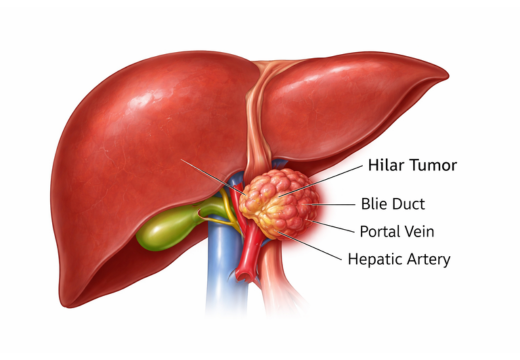
Hilar tumor, commonly referred to as perihilar cholangiocarcinoma (Klatskin tumor), is a malignant neoplasm arising from the bile duct epithelium at the hepatic hilum—the anatomical region where the right and left hepatic ducts converge. It represents the most frequent subtype of cholangiocarcinoma and is characterized by insidious onset, progressive biliary obstruction, and late clinical presentation. This article provides a research-based, plagiarism-free overview of hilar tumors, covering etiological factors, clinical manifestations, diagnostic approaches, contemporary management strategies, and a detailed Ayurvedic correlation with holistic management principles.
Introduction
A hilar tumor originates at the junction of the intrahepatic and extrahepatic bile ducts and poses unique diagnostic and therapeutic challenges due to its proximity to major vascular and biliary structures. Unlike distal bile duct cancers, hilar tumors often present without an early mass lesion and progress silently until significant biliary obstruction develops. The disease is typically diagnosed in advanced stages, limiting curative options. Multidisciplinary management is essential, integrating imaging, endoscopic or surgical interventions, and supportive care to improve survival and quality of life.
Causes
- Chronic biliary inflammation leading to epithelial dysplasia
- Primary sclerosing cholangitis (PSC), particularly in patients with inflammatory bowel disease
- Congenital biliary anomalies such as choledochal cysts and Caroli disease
- Hepatolithiasis (intrahepatic bile duct stones)
- Parasitic infections involving the biliary tract
- Exposure to toxins and carcinogens including nitrosamines
- Chronic liver disease and cirrhosis
- Genetic and epigenetic alterations affecting bile duct epithelial cells
These factors contribute to sustained bile stasis, oxidative stress, and malignant transformation at the hepatic hilum.
Signs and Symptoms
- Progressive painless jaundice
- Dark-colored urine and clay-colored stools
- Generalized pruritus due to bile salt deposition
- Anorexia and unintended weight loss
- Fatigue and malaise
- Right upper abdominal discomfort
- Cholangitis in advanced cases presenting with fever and chills
Pain and palpable mass are late findings and usually indicate advanced or unresectable disease.
Investigations
- Liver function tests
- Tumor markers, particularly CA 19-9
- Ultrasonography
- Contrast-enhanced CT scan
- MRI with MRCP
- Endoscopic or percutaneous cholangiography
- Brush cytology or biopsy
Staging systems such as Bismuth–Corlette classification help guide therapeutic decisions.
Management
Surgical Management
- Complete surgical resection with negative margins remains the only curative option
- Procedures may include extended hepatectomy with biliary reconstruction
- Liver transplantation is considered in highly selected cases with strict criteria
Non-Surgical and Palliative Care
-
- Endoscopic or percutaneous biliary drainage to relieve jaundice
- Systemic chemotherapy
- Radiotherapy including external beam or brachytherapy
- Supportive care focusing on nutrition, pruritus management, and infection control
Despite advances, overall prognosis remains guarded due to late diagnosis.
Ayurvedic Aspect and Management
Hilar tumor closely correlates with Yakrit Arbuda (यकृत् अर्बुद) in Ayurveda. Arbuda is described as a deep-seated, gradually enlarging, firm mass arising from vitiation of Tridosha, predominantly Kapha dosha and Pitta dosha, with involvement of Rakta and Mamsa Dhatu. Obstruction of Raktavaha and Annavaha Srotas and impaired Yakrit function form the core pathophysiology, which aligns with biliary obstruction, jaundice, and systemic depletion seen in hilar tumors.
Furthermore, the symptoms resemble those described in Kamla.
हारिद्रनेत्रः स भृशं हारिद्रत्वङ्नखाननः | रक्तपीतशकृन्मूत्रो भेकवर्णो हतेन्द्रियः
दाहाविपाकदौर्बल्यसदनारुचिकर्षितः | कामला बहुपित्तैषा कोष्ठशाखाश्रया मता ||
Charak Nidana 16/35–36
The clinical presentation includes intense yellow discoloration of the eyes, skin, nails, and face. The stool and urine appear reddish-yellow, while the complexion assumes a frog-like hue. The patient experiences burning sensation, indigestion, weakness, fatigue, and loss of appetite. This form of Kamala is classified as Koshtha-Shakhashrita Kamala.
Ayurvedic Therapeutic Approach
Dosha Shamana
Pacification of aggravated Pitta and Kapha to reduce inflammation and obstruction.
Yakrit Uttejaka and Yakrit Shodhaka Chikitsa
Use of herbs that support hepatic metabolism and bile flow.
Rakta Prasadana
Purification and nourishment of blood tissue.
Aama Pachana and Srotoshodhana
Removal of metabolic toxins and restoration of microchannel patency.
Herbal Support
-
-
- Bhumyamalaki (Phyllanthus niruri)
- Kalmegh (Andrographis paniculata)
- Punarnava (Boerhaavia diffusa)
- Kutki (Picrorhiza kurroa)
- Guduchi (Tinospora cordifolia)
- Kanchnaar (Bauhinia varigata)
- Haridra (Curcuma longa)
-
Pathya – Apathya
-
-
- Light, easily digestible Pitta-pacifying diet
- Avoid alcohol, fried, fermented and excessively spicy foods
- Adequate rest and stress management
- Gentle yogic practices
-
Herbal Remedies by Planet Ayurveda for Hilar Tumor
Planet Ayurveda is a well-recognized Ayurvedic wellness organization dedicated to promoting natural healing through authentic plant-based formulations. The organization integrates classical Ayurvedic knowledge with modern manufacturing practices to provide holistic health solutions.
Product List
-
-
-
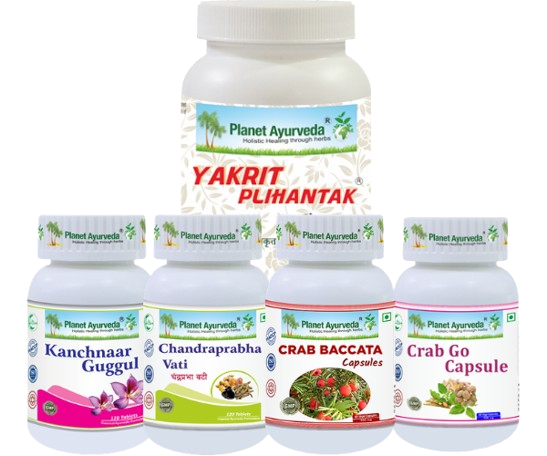
- Kanchnaar Guggul
- Yakritplihantak Churna
- Crab Go Capsules
- Chandraprabha Vati
- Crab Baccata Capsules
-
-

1. Kanchnaar Guggul
Kanchnaar Guggul is a classical Ayurvedic formulation that helps manage abnormal tissue growth and supports hepatobiliary health by reducing Kapha accumulation and clearing obstructed channels.
Dosage : Two tablets twice daily.
2. Yakritplihantak Churna
This formulation contains hepatoprotective herbs that improve liver metabolism, support bile flow, and help detoxify the blood while supporting liver regeneration.
Dosage : One teaspoon twice daily.
3. Crab Go Capsules
Crab Go Capsules contain herbs with antioxidant, anti-inflammatory, and immunomodulatory properties that help support the body’s defense mechanisms and overall systemic resilience.
Dosage : Two capsules twice daily.
4. Chandraprabha Vati
Chandraprabha Vati supports metabolic balance, improves digestion, and assists in detoxification while promoting strength and vitality.
Dosage : Two tablets twice daily.
5. Crab Baccata Capsules
Crab Baccata Capsules contain standardized extract of Taxus baccata which supports regulation of abnormal cellular growth and promotes cellular balance.
Dosage : One capsule twice daily.
Conclusion
Hilar tumor is a complex malignancy of the biliary tract that often presents at an advanced stage. Early diagnosis is difficult and treatment options remain limited. From an Ayurvedic perspective the condition resembles Yakrit Arbuda and Koshtha-Shakhashrita Kamala where Pitta and Kapha aggravation leads to obstruction of channels and impaired liver function. Integrative Ayurvedic approaches aim to slow disease progression, relieve symptoms, and improve overall quality of life.
Disclaimer
Ayurveda does not replace surgical or oncological treatment in subglottic cancer but serves as an integrative approach to support healing, reduce complications, and promote holistic well-being. We do not claim the above mentioned products will treat Subglottic Cancer.

Dr. Vikram Chauhan
https://www.planetayurveda.comDr. Vikram Chauhan (MD - Ayurveda) is a Globally Renowned Ayurveda Physician with Expertise of more than 25 Years. He is the CEO & Founder of http://www.PlanetAyurveda.com, a leading Ayurveda Brand, Manufacturing, and Export Company with a Chain of Clinics and Branches in the US, Europe, Africa, Southeast Asia, India, and other parts of the World. He is also an Ayurveda Author who has written Books on Ayurveda, translated into Many European Languages. One of his Books is "Ayurveda – God’s Manual for Healing". He is on a Mission to Spread Ayurveda All Over the Planet through all the Possible Mediums. With his Vast Experience in Herbs and their Applied Uses, he is successfully treating Numerous Patients suffering from Various Ailments with the help of the Purest Herbal Supplements, Diet, and Lifestyle, according to the Principles of Ayurveda. For More Details, visit - www.planetayurveda.com, www.alwaysayurveda.com
View more posts from this author