VIDARIKAND / INDIAN KUDZU / PUERARIA TUBEROSA
ABSTRACT
Vidarikand (Pueraria tuberosa), commonly known as Indian Kudzu, is a highly valued medicinal herb in Ayurveda recognized for its rejuvenating, nourishing, and strengthening properties. It is widely used as a Rasayana herb to promote vitality, enhance immunity, and support overall physical strength. Classical Ayurvedic texts describe Vidarikand as beneficial in conditions associated with weakness, debility, emaciation, infertility, and disorders caused by aggravated Vata and Pitta doshas. The tuberous root of the plant is rich in nutrients and bioactive compounds that contribute to its therapeutic potential. Modern scientific studies suggest that Pueraria tuberosa possesses antioxidant, anti-inflammatory, adaptogenic, aphrodisiac, immunomodulatory, cardioprotective, and antidiabetic properties. It is also traditionally used to support reproductive health, improve lactation, strengthen muscles, and maintain healthy body tissues. Due to its cooling and nourishing nature, Vidarikand is frequently incorporated into classical Ayurvedic formulations aimed at restoring energy and promoting tissue rejuvenation. This article discusses the botanical profile, Ayurvedic properties, phytochemistry, medicinal uses, health benefits, and therapeutic significance of Vidarikand in maintaining holistic health.
CLASSICAL REFERENCE OF VIDARIKAND (PUERARIA TUBEROSA)
Bhavprakash Nighantu Guduchyadi Varga Page No. 374
SCIENTIFIC CLASSIFICATION OF VIDARIKAND (PUERARIA TUBEROSA)
- Kingdom: Plantae
- Subkingdom: Tracheobionta (Vascular plants)
- Super Division: Spermatophyta (Seed plants)
- Division: Magnoliophyta (Flowering plants)
- Class: Magnoliopsida (Dicotyledons)
- Subclass: Rosidae
- Order: Fabales
- Family: Fabaceae (Leguminosae)
- Genus: Pueraria
- Species: Pueraria tuberosa
SYNONYMS OF VIDARIKAND (PUERARIA TUBEROSA)
- Vidari: A plant that tears or bursts through the ground; refers to a heavily sprawling, expansive creeper.
- Svadukanda: Means a plant having a sweet-tasting underground tuber.
- Kroshtri: Jackal’s choice; traditionally implies a plant whose tubers are frequently dug up or liked by wild animals like jackals.
- Sita: White or bright; refers to the clean, white inner flesh of the tuber.
- Ikshugandha: Having a sweet smell or taste reminiscent of fresh sugarcane juice.
- Kshiravalli: A climbing creeper that yields a milky latex when cut or bruised.
- Kshirashukla: Kshira (milk) + Shukla (pure white). As white as milk, referring to the color of its juice or inner root pulp.
- Payasvini: Abounding in milk or fluid; full of nourishing, milky sap.
- Shukla: Refers to the white internal color of the tuberous root.
- Svadukanda: Having a sweet tuber
- Shrigalika: Resembling a jackal’s tail or having a horn-like, clustered growth pattern.
- Vrishyakanda: An aphrodisiac tuber
- Vrishyavalli: An aphrodisiac creeper or vine
- Vidalika: Cat-like, or referring to a structure that expands and stretches out.
VERNACULAR NAMES OF VIDARIKAND (PUERARIA TUBEROSA)
- Sanskrit: Vidari, Bhukushmanda, Swadukanda, Ikshugandha
- Hindi: Vidarikand, Bidarikand
- English: Indian Kudzu
- Punjabi: Vidarikand
- Bengali: Bhumikushmanda
- Gujarati: Vidarikand
- Marathi: Bhui Kohala, Vidarikand
- Tamil: Nilapoosani Kilangu
- Telugu: Nelagummadi
- Kannada: Nelagumbala Gadde
- Malayalam: Nilapooshanikizhangu
- Urdu: Vidarikand
HABITAT & DISTRIBUTION OF VIDARIKAND (PUERARIA TUBEROSA)
Natural Habitat
Vidarikand (Pueraria tuberosa) is a perennial tuberous climber naturally found in tropical and subtropical regions. It commonly grows in dry deciduous forests, open woodlands, shrublands, and forest margins where moderate humidity and seasonal rainfall are available. As a climbing plant, it spreads over shrubs, bushes, and trees for support, adapting well to semi-wild ecological environments. Research observations indicate that the species thrives in areas with moderate vegetation cover, allowing access to sunlight while maintaining soil moisture. It is also found in uncultivated lands and hilly terrains where environmental conditions support healthy tuber formation.
Climatic Requirements
Vidarikand grows best in warm and moderately humid climates. Studies suggest that temperatures ranging from 20°C to 35°C are ideal for proper vegetative growth and tuber development. The plant benefits from moderate to high seasonal rainfall, particularly during the monsoon season, which promotes vigorous vine growth and enhances root expansion. However, excessive moisture and waterlogging can adversely affect the tubers by causing fungal infections or root decay. The plant can tolerate both partial shade and full sunlight, although filtered sunlight in forest ecosystems is considered favorable for balanced growth.
Soil Preference
The growth and medicinal quality of Vidarikand are significantly influenced by soil conditions. It prefers well-drained sandy loam or loamy soils rich in organic matter, which facilitate healthy root penetration and tuber enlargement. Fertile soils with good moisture-retaining capacity are considered ideal for optimum growth. Research-based cultivation studies also indicate that slightly acidic to neutral soil pH supports better nutrient absorption and plant vigor. Heavy clay soils and poorly drained lands are generally unsuitable because stagnant water can inhibit tuber development and increase the risk of root damage.
Geographical Distribution in India
Vidarikand is widely distributed throughout India and occurs naturally in diverse ecological regions. It is commonly found in the sub-Himalayan tracts, extending up to altitudes of approximately 1,200–1,500 meters, where warm temperatures and suitable rainfall favor growth. In northern India, the plant is distributed in states such as Punjab, Haryana, Uttar Pradesh, Uttarakhand, and Bihar, while in central India it grows abundantly in Madhya Pradesh and Chhattisgarh. It is also reported in western states like Rajasthan and Gujarat, and southern regions including Tamil Nadu, Karnataka, Andhra Pradesh, Telangana, and Kerala. Its broad distribution reflects its adaptability to varied climatic and soil conditions.
Global Distribution
Although Pueraria tuberosa is primarily native to the Indian subcontinent, it is also found in neighboring countries with similar climatic conditions. The plant has been reported in Nepal, Pakistan, Bangladesh, and certain regions of Southeast Asia, where tropical and subtropical environments support its growth. In these regions, Vidarikand commonly occurs in forests, grasslands, and semi-natural ecosystems, contributing to traditional medicinal practices similar to Ayurveda.
Cultivation and Conservation
Due to its increasing medicinal demand in Ayurveda and herbal industries, Vidarikand is now cultivated in medicinal plant farms and herbal gardens. The plant is propagated mainly through seeds and tuberous roots to ensure sustainable production. However, excessive harvesting from natural habitats has created concerns regarding the depletion of wild populations. Therefore, research-based conservation strategies and organized cultivation practices are being encouraged to preserve biodiversity and maintain a continuous supply of high-quality medicinal raw material for pharmaceutical and Ayurvedic purposes.
MORPHOLOGY OF VIDARIKAND (PUERARIA TUBEROSA)
Habit
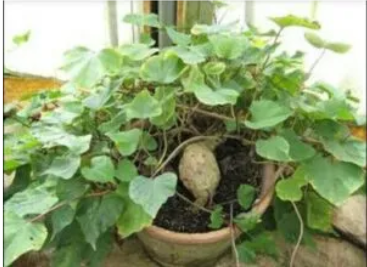
Vidarikand (Pueraria tuberosa) is a large perennial climber or twining herb belonging to the family Fabaceae. It is characterized by vigorous growth and a spreading nature, often climbing over nearby shrubs and trees for structural support. The plant develops large underground tuberous roots that store nutrients and water, enabling it to survive under varying environmental conditions. Due to its climbing habit, the plant can extend over considerable distances in forested and semi-wild habitats.
Root (Tuber)
The most distinctive morphological feature of Vidarikand is its large tuberous root system. The tubers are fleshy, elongated, spindle-shaped to irregularly globular, and often attain a considerable size. Externally, they appear brownish or greyish-brown, while internally they are white, soft, and starchy. These tubers serve as storage organs for nutrients and possess important medicinal properties in Ayurveda. The roots have a mildly sweet taste and are rich in starch, making them valuable for rejuvenating and nourishing purposes.
Stem
The stem of Vidarikand is slender, twining, and climbing in nature, allowing the plant to spread over surrounding vegetation. Young stems are generally soft, green, and covered with fine hairs (pubescent), while mature stems become somewhat woody and stronger with age. The climbing mechanism helps the plant access sunlight efficiently in dense vegetation.
Leaves
The leaves of Pueraria tuberosa are trifoliate (compound leaves with three leaflets) and arranged alternately on the stem. Each leaflet is broad, ovate to rhomboid in shape, with smooth or slightly hairy surfaces. The upper surface of the leaves is dark green, while the lower surface may appear lighter with fine hairs. The leaf margins are generally entire, and the apex may be pointed or rounded. These broad leaves aid in efficient photosynthesis and adaptation to tropical environments.
Flowers
The flowers of Vidarikand are papilionaceous (pea-like), typical of the Fabaceae family, and usually appear in clusters or racemes. They are generally bluish-purple, violet, or purplish-blue in color, making the plant visually distinctive during the flowering season. The flowering period mainly occurs during the rainy and post-rainy months. The flowers possess both male and female reproductive organs, facilitating pollination and seed formation.
Fruits
The fruit of Vidarikand is a flat, linear pod (legume) that develops after fertilization. The pods are elongated, slightly curved, and covered with fine brownish hairs. As the fruit matures, it turns dry and splits open to release seeds. Each pod generally contains several seeds arranged in a row.
Seeds
The seeds are small, hard, and kidney-shaped to oval, with a brownish coloration. They are enclosed within the pod and contribute to the natural propagation of the plant. Seeds remain viable under suitable environmental conditions and germinate effectively in warm and moist soil.
Size and Growth Pattern
Vidarikand is a rapidly spreading climber that may grow extensively depending on environmental support and climatic conditions. The underground tubers can become very large and heavy, often serving as the principal medicinal part of the plant. Its robust growth pattern allows it to thrive in forests, grasslands, and semi-wild habitats.
CLASSICAL CATEGORISATION OF VIDARIKAND (PUERARIA TUBEROSA)
- Bhavprakash Nighantu: Guduchyadi Varga
- Dhanwanthari Nighantu: Guduchyadi Varga
- Raj Nighantu: Mulakadi Varga
ANCIENT VERSE FOR VIDARIKAND (PUERARIA TUBEROSA)
Verse No. 1
विदारी स्वादुकन्दा च सा तु क्रोष्ट्री सिता स्मृता ।
इक्षुगन्धा क्षीरवल्ली क्षीरशुक्ला पयस्विनी ॥
विदारी मधुरा स्निग्धा बृंहणी स्तन्यशुक्रदा ॥
शीता स्वर्या मूत्रला च जीवनी बलवर्णदा ।
गुरुः पित्तास्रपवनदाहान् हन्ति रसायनी ॥
Bhavprakash Nighantu Guduchyadi Varga Verse No. 180-182
Verse Interpretation
Synonyms of Vidarikand
- Vidari: A plant that tears or bursts through the ground; refers to a heavily sprawling, expansive creeper.
- Svadukanda: Means a plant having a sweet-tasting underground tuber.
- Kroshtri: Jackal’s choice; traditionally implies a plant whose tubers are frequently dug up or liked by wild animals like jackals.
- Sita: White or bright; refers to the clean, white inner flesh of the tuber.
- Ikshugandha: Having a sweet smell or taste reminiscent of fresh sugarcane juice.
- Kshiravalli: A climbing creeper that yields a milky latex when cut or bruised.
- Kshirashukla: Kshira (milk) + Shukla (pure white). As white as milk, referring to the color of its juice or inner root pulp.
- Payasvini: Abounding in milk or fluid; full of nourishing, milky sap.
Properties of Vidarikand: Possessing a sweet taste, being unctuous, nourishing, heavy to digest, and cold in potency; it increases breast milk production and semen quality, improves voice quality, acts as a natural diuretic and rejuvenator, enhances vitality, imparts strength and complexion, and pacifies Pitta, Rakta, Vata, and burning sensations.
Verse No. 2
विदारिका मता शुक्ला स्वादुकन्दा शृगालिका ।
वृष्यकन्दा विदारी च वृष्यवल्ली विडालिका ॥
Dhanwanthari Nighantu Guduchyadi Varga Verse No. 143
Verse Interpretation
Synonyms of Vidarikand
- Shukla: Refers to the white internal color of the tuberous root.
- Svadukanda: Having a sweet tuber
- Shrigalika: Resembling a jackal’s tail or having a horn-like, clustered growth pattern.
- Vrishyakanda: An aphrodisiac tuber
- Vidari: The primary name, referencing how the massive tubers split the ground as they grow.
- Vrishyavalli: An aphrodisiac creeper or vine
- Vidalika: Cat-like, or referring to a structure that expands and stretches out.
Verse No. 3
विदारी शिशिरा स्वादुर्गुरुः स्निग्धा समीरजित्।
पितास्त्रजित्तथा बल्या वृष्या चैव प्रकीर्तिता ॥
Dhanwanthari Nighantu Guduchyadi Varga Verse No. 144
Verse Interpretation
Properties of Vidarikand
This herb possesses cooling, sweet, nourishing, and unctuous qualities. It helps calm aggravated Vata dosha, supports strength and vitality, and is beneficial in conditions involving excessive bleeding. It also acts as a rejuvenating tonic and is believed to improve reproductive health by supporting semen quality and vitality.
Verse No. 4
विदारिका स्वादुकन्दा सिता शुक्ला शृंगालिका ।
विदारी वृष्यकन्दा च विडाली वृष्यवल्लिका ।।
भूकुष्माण्डी स्वादुलता गजेष्टा वारिवल्लभा ।
ज्ञेया कन्दफला चेति मनुसंख्याह्वया मता ।।
विदारी मधुरा शीता गुरुः स्निग्धाऽस्रपित्तजित् ।
ज्ञेया च कफकृत्पुष्टि-बल्या वीर्य्यविवर्द्धिनी ।।
Raj Nighantu Mulakadi Varga Verse No. 99-101
Verse Interpretation
Synonyms of Vidarikand
- Vidarika: A small splitter, referring to how the growing tuber cracks or splits the soil.
- Svadukanda: Sweet tuber, describing the taste of the plant’s root.
- Sita: White, referring to the light color of the inner root.
- Shukla: Pure white, further emphasizing the clean, light color of the tuber.
- Shrgalika: Jackal’s plant, a traditional name associated with the plant’s wild habitat.
- Vidari: The primary name, referencing how the massive tubers split the ground as they grow.
- Vrshyakanda: Aphrodisiac root, describing the root’s property of promoting strength and vitality.
- Vidali: Divided, referring to the large, lobed structure of the underground tuber.
- Vrshyavallika: Vitality-giving creeper, describing the plant as a strength-promoting vine.
- Bhukushmandi: Earth pumpkin, because the large, round tuber looks like a pumpkin buried in the ground.
- Rasa (Taste): Madhura (Sweet)
- Guna (Qualities): Guru (Heavy for digestion), Snigdha (Slimy / Unctuous)
- Vipaka (Post Digestion Effect): Madhura (Undergoes sweet taste after digestion)
- Veerya (Potency): Sheeta (Cold)
Earth pumpkin, because the large, round tuber looks like a pumpkin buried in the ground. - Svadulata: Sweet creeper, referring to the sweet-tasting nature of the vine.
- Gajeshta: Liked by elephants, indicating that the plant is a favorite food for elephants.
- Varivallabha: Lover of water, indicating the plant thrives in moist environments or stores significant moisture.
- Kandaphala: Tuber fruit, describing a plant where the primary useful part is the underground tuber.
Properties of Vidarikand: Vidari is sweet in taste, cooling in nature, heavy, and unctuous (oily). It helps in managing Rakta-Pitta (bleeding disorders). It increases Kapha, provides strength to the body, improves semen quality, and acts as a nourishing tonic for overall health.
AYURVEDIC PROPERTIES OF VIDARIKAND (PUERARIA TUBEROSA)
ACTION ON TRIDOSHA OF VIDARIKAND (PUERARIA TUBEROSA)
Vata-pitta Shamaka
THERAPEUTIC INDICATIONS OF VIDARIKAND (PUERARIA TUBEROSA)
- Hepatic diseases (Liver disorders)
- Skin discoloration
- Fever (Jwara)
- Low breast milk production (Lactation insufficiency)
- General weakness and debility
- Low body mass / emaciation
- Joint swelling and inflammation
- Low sperm count
- Reduced libido
- Sexual weakness and low vigor
- Hepatic tissue degeneration
- Splenic tissue degeneration
- Poor complexion / skin dullness
- Burning sensation disorders
- Bleeding disorders
- Nasal bleeding
- Heavy menstrual bleeding (Menorrhagia)
- Hoarseness of voice
- Cough due to Vata and Pitta imbalance
- Dysuria (painful urination)
- Urinary disorders
- Blood-borne disorders
- Constipation
- Dryness of intestinal mucosa
- Pitta disorders
- Skin diseases
- General fatigue and weakness
- Reduced immunity and low strength
SYSTEMIC ACTIONS OF VIDARIKAND (PUERARIA TUBEROSA)
Digestive System
Vidarikand acts as a mild digestive tonic and nourishing herb that helps support healthy digestion without aggravating Pitta. Due to its cooling (Sheeta) and nourishing (Brimhana) properties, it may help soothe gastric irritation, hyperacidity, and burning sensations. It also supports tissue nourishment by improving nutrient assimilation and maintaining digestive balance.
Reproductive System
Vidarikand is well known for its Vrishya (aphrodisiac) and Shukrala (semen-promoting) properties. It supports male reproductive health by helping maintain sperm quality, reproductive strength, libido, and stamina. In females, it provides nourishment to reproductive tissues and may support hormonal balance and lactation.
Nervous System
As a Rasayana (rejuvenative) herb, Vidarikand exerts nourishing effects on the nervous system. It may help reduce nervous exhaustion, physical fatigue, and stress-related weakness by supporting overall vitality and tissue nourishment. Its rejuvenative nature contributes to improved endurance and recovery.
Cardiovascular System
Vidarikand demonstrates supportive effects on the cardiovascular system due to its antioxidant-rich phytoconstituents. It may help maintain healthy circulation, support cardiac tissue function, and reduce oxidative stress that can affect cardiovascular wellness.
Respiratory System
Traditionally, Vidarikand is used in respiratory weakness, cough, and dryness of respiratory tissues. Its soothing and nourishing nature may help support respiratory comfort and maintain mucosal health, especially in Vata-Pitta predominant respiratory disturbances.
Urinary System
Vidarikand exhibits cooling and soothing actions on the urinary tract. It may help alleviate burning urination and urinary discomfort associated with aggravated Pitta. Its nourishing properties also support healthy urinary function.
Musculoskeletal System
Due to its strengthening and tissue-building properties, Vidarikand supports muscles, joints, and overall body strength. It is commonly used in weakness, emaciation, and age-related tissue depletion to improve stamina and physical endurance.
Immune System
Vidarikand acts as an immunomodulatory Rasayana, helping support natural immunity and body resilience. By promoting nourishment of tissues (Dhatus) and enhancing vitality, it contributes to better resistance against weakness and recurrent illness.
Endocrine and Metabolic System
Research suggests that Vidarikand may support metabolic balance and glucose regulation. It may contribute to maintaining healthy metabolism and reducing oxidative stress associated with metabolic dysfunctions.
Integumentary System (Skin)
Vidarikand supports skin nourishment and complexion due to its rejuvenating and cooling nature. It is traditionally indicated in burning sensations, skin dryness, and conditions associated with tissue depletion, helping maintain healthy skin appearance.
CHEMICAL COMPOSITION OF VIDARIKAND (PUERARIA TUBEROSA)
Isoflavonoids
Vidarikand acts as a mild digestive tonic and nourishing herb that helps support healthy digestion without aggravating Pitta. Due to its cooling (Sheeta) and nourishing (Brimhana) properties, it may help soothe gastric irritation, hyperacidity, and burning sensations. It also supports tissue nourishment by improving nutrient assimilation and maintaining digestive balance.
Flavonoids and Phenolic Compounds
Vidarikand is well known for its Vrishya (aphrodisiac) and Shukrala (semen-promoting) properties. It supports male reproductive health by helping maintain sperm quality, reproductive strength, libido, and stamina. In females, it provides nourishment to reproductive tissues and may support hormonal balance and lactation.
Carbohydrates and Starch
As a Rasayana (rejuvenative) herb, Vidarikand exerts nourishing effects on the nervous system. It may help reduce nervous exhaustion, physical fatigue, and stress-related weakness by supporting overall vitality and tissue nourishment. Its rejuvenative nature contributes to improved endurance and recovery.
Proteins and Amino Acids
Vidarikand demonstrates supportive effects on the cardiovascular system due to its antioxidant-rich phytoconstituents. It may help maintain healthy circulation, support cardiac tissue function, and reduce oxidative stress that can affect cardiovascular wellness.
Steroidal Compounds and Phytosterols
Traditionally, Vidarikand is used in respiratory weakness, cough, and dryness of respiratory tissues. Its soothing and nourishing nature may help support respiratory comfort and maintain mucosal health, especially in Vata-Pitta predominant respiratory disturbances.
Minerals
Vidarikand exhibits cooling and soothing actions on the urinary tract. It may help alleviate burning urination and urinary discomfort associated with aggravated Pitta. Its nourishing properties also support healthy urinary function.
PRACTICAL USES / HEALTH BENEFITS OF VIDARIKAND (PUERARIA TUBEROSA)
- Vidarikand is widely used to improve physical strength, stamina, and overall vitality. Due to its nourishing and rejuvenating properties, it helps reduce fatigue, weakness, and physical exhaustion, especially after illness or prolonged stress.
- It is traditionally valued for supporting male reproductive health, including reproductive strength, libido, semen quality, and stamina. Research studies also suggest its beneficial role in maintaining healthy sperm parameters and reproductive wellness.
- Vidarikand may help in healthy weight gain and body nourishment because of its Brimhana (body-building) properties. It is beneficial in underweight individuals, muscle loss, malnutrition, and tissue depletion.
- Due to its rich nutritional composition, including starch and proteins, Vidarikand supports muscle nourishment and recovery, helping improve endurance and physical performance.
- It may support female reproductive wellness by nourishing reproductive tissues and helping maintain hormonal balance. Traditionally, it has been used in weakness associated with menstruation and reproductive health concerns.
- Because of its cooling (Sheeta) nature, Vidarikand helps reduce burning sensations, excessive body heat, and Pitta-related discomfort, promoting internal cooling and comfort.
- Vidarikand may help soothe gastric irritation, hyperacidity, and digestive discomfort due to its cooling and demulcent properties, supporting digestive balance.
- It is also traditionally used to support urinary health, especially in conditions involving burning urination and irritation associated with excess body heat.
- Research studies suggest that Vidarikand contains antioxidant phytochemicals that help combat oxidative stress and cellular damage, thereby supporting healthy aging and tissue vitality.
- As a Rasayana (rejuvenative) herb, Vidarikand may help strengthen immunity, improve recovery from weakness, and support overall body resilience.
- Some pharmacological studies indicate that Pueraria tuberosa may support healthy glucose metabolism and metabolic balance, contributing to overall wellness.
- Regular use of Vidarikand in Ayurvedic practice is associated with improved energy, nourishment, vitality, and general well-being, particularly in individuals suffering from weakness and tissue depletion.
HOME REMEDIES WITH VIDARIKAND (PUERARIA TUBEROSA)
Vidarikand Milk for Strength and Vitality
Mix ½–1 teaspoon of Vidarikand powder in a glass of warm milk and consume once daily. This traditional remedy is commonly used to improve physical strength, stamina, body nourishment, and general weakness. It may also support recovery after illness and promote vitality.
Vidarikand with Honey for Fatigue
Take ½ teaspoon of Vidarikand powder with 1 teaspoon of honey once or twice daily. This remedy is traditionally used to help reduce fatigue, weakness, and low energy levels while supporting nourishment and rejuvenation.
Vidarikand with Ghee for Body Nourishment
Mix Vidarikand powder with a small quantity of cow’s ghee and consume daily. In Ayurveda, this combination is considered beneficial for improving body strength, nourishing tissues (Dhatus), and supporting healthy weight gain in weak or undernourished individuals.
Vidarikand Drink for Burning Sensation
Mix Vidarikand powder in cool milk or water and consume to help reduce excessive body heat, burning sensation, and Pitta-related discomfort. Its cooling (Sheeta) nature may provide soothing effects.
Vidarikand for Male Reproductive Wellness
Traditionally, Vidarikand powder mixed with warm milk and Mishri (rock sugar) is used to support reproductive strength, stamina, and vitality. It is considered useful for maintaining reproductive tissue nourishment.
Vidarikand for Digestive Comfort
A small amount of Vidarikand powder with lukewarm water may be taken to soothe acidity, gastric irritation, and digestive discomfort due to its cooling and demulcent properties.
Vidarikand Herbal Blend for Weakness
Vidarikand powder can be combined with nourishing herbs such as Ashwagandha and Shatavari in equal proportions and taken with milk to support strength, immunity, and overall body nourishment.
PART(S) USED OF VIDARIKAND (PUERARIA TUBEROSA)
- Tuberous Root (Kand / Tuber)
- Seeds
- Leaves
DOSAGE OF VIDARIKAND (PUERARIA TUBEROSA)
- Powder (Churna): 3–6 grams per day
- Decoction (Kwath): 50–100 ml
- Fresh Juice (Swarasa): 10–20 ml
CLASSICAL PRODUCTS WITH VIDARIKAND (PUERARIA TUBEROSA)
- Vidaryadyasavam
- Amritaprasha ghrit
- Gopichandanadi gulika
- Shatavari Ghrit
- Vidaryadi Lehyam
- Prasarani Thailam
- Mahamash Oil
- Mahanarayan thailam
- Sarawatarisht
- Ashwagandharisht
- Kamdev Ghrit
PLANET AYURVEDA PRODUCTS WITH VIDARIKAND (PUERARIA TUBEROSA)
- Atirasadi Churna
- Vidarikand Powder
- Fertipush Capsules
- Shatavari Ghrit
- Brahmi Chyawanprash
- Bustonica Oil
- Sarawatarisht
- Ashwagandharisht
- Jai Shree Dhanwantharam Oil
- Kamdev Ghrit
RESEARCH ON VIDARIKAND (PUERARIA TUBEROSA)
properties in both traditional Ayurveda and modern scientific research. Various experimental and pharmacological studies suggest that Vidarikand possesses antioxidant, rejuvenating, anti-inflammatory, immunomodulatory, aphrodisiac, anti-diabetic, nephroprotective, hepatoprotective, and cardioprotective activities.
Anti-Diabetic Activity
Mix ½–1 teaspoon of Vidarikand powder in a glass of warm milk and consume once daily. This traditional remedy is commonly used to improve physical strength, stamina, body nourishment, and general weakness. It may also support recovery after illness and promote vitality.
Aphrodisiac and Reproductive Health Benefits
Take ½ teaspoon of Vidarikand powder with 1 teaspoon of honey once or twice daily. This remedy is traditionally used to help reduce fatigue, weakness, and low energy levels while supporting nourishment and rejuvenation.
Antioxidant Properties
Mix Vidarikand powder with a small quantity of cow’s ghee and consume daily. In Ayurveda, this combination is considered beneficial for improving body strength, nourishing tissues (Dhatus), and supporting healthy weight gain in weak or undernourished individuals.
Immunomodulatory Effects
Mix Vidarikand powder in cool milk or water and consume to help reduce excessive body heat, burning sensation, and Pitta-related discomfort. Its cooling (Sheeta) nature may provide soothing effects.
Kidney-Protective (Nephroprotective) Potential
Traditionally, Vidarikand powder mixed with warm milk and Mishri (rock sugar) is used to support reproductive strength, stamina, and vitality. It is considered useful for maintaining reproductive tissue nourishment.
Liver-Protective (Hepatoprotective) Activity
A small amount of Vidarikand powder with lukewarm water may be taken to soothe acidity, gastric irritation, and digestive discomfort due to its cooling and demulcent properties.
Anti-Inflammatory and Pain-Relieving Effects
Several studies have highlighted the anti-inflammatory potential of Vidarikand. It may help reduce swelling, inflammation, and discomfort associated with various inflammatory conditions.
Cardioprotective Activity
Some research findings suggest that Vidarikand may support heart health by reducing oxidative stress and helping maintain healthy circulation and cardiovascular function
Neuroprotective Potential
Emerging studies indicate that Vidarikand may support nervous system health and cognitive function due to its antioxidant and rejuvenating properties.
CONCLUSION
Vidarikand ( Pueraria tuberosa ) holds an important place in traditional Ayurvedic medicine and continues to attract interest because of its diverse therapeutic applications. Its long-standing use reflects its relevance in maintaining strength, nourishment, reproductive wellness, and general health. The plant has also been investigated for several biological activities that may contribute to its broader medicinal significance. The tuber remains the principal part used in traditional preparations and is incorporated into various formulations according to individual health needs. Its role in rejuvenative care makes it particularly relevant to traditional approaches focused on restoring vitality and maintaining physiological balance. The available knowledge highlights the importance of Vidarikand as both a classical medicinal plant and a subject of modern pharmacological research. Overall, it represents a valuable botanical resource with considerable scope for continued study and responsible therapeutic use.
