Natural Ayurvedic Option for Cholesterol Control
Abstract
High cholesterol is among the most common conditions and a major contributing factor to various lifestyle disorders, characterized by abnormally elevated levels of certain lipids in the blood. Cholesterol is a type of fatty substance produced by the liver and is essential for various bodily functions, including the synthesis of hormones, bile acids, and vitamin D. However, when the level of bad cholesterol (LDL) rises beyond normal limits, it increases the risk of developing diabetes, serious heart diseases and other complications. Over the past two decades there has been a growing concern on screening for high cholesterol and implementing measures to lower cholesterol levels, aiming to reduce the risk of heart disease. Now, let’s see what we can do to manage it in the most safest way.
Introduction
High cholesterol or also known as Hypercholesterolemia is mainly due to inadequate diet, lack of exercise, obesity, stress and some underlying diseases like type II diabetes. Although it is asymptomatic in early stages, it may cause hazardous effects in the long term like atherosclerosis which will further affect the related organ. In such conditions statins are used. There are various statins used like Lovastatin, Simvastatin, Atorvastatin, Fluvastatin, Rosuvastatin, etc.
Atorvastatin is the most popular and potent statin. It has a plasma half life of 18 – 20 hours which is much longer than other statins. It also helps in reduction of raised Triglycerides. It is available in the market under the brand name Lipitor. Another statin is Simvastatin which is also very efficacious and has better oral absorption. Its plasma half life is 2-3 hours. Unlike other statins it significantly raises the low HDL levels. It is available under the brand name Zocor.
MODE OF ACTION
- Statins competitively inhibit HMG-CoA reductase, the enzyme responsible for converting HMG-CoA to mevalonate which is a precursor of cholesterol.
- Due to inhibition, intracellular cholesterol levels in hepatocytes decrease.
- The resulting drop in intracellular cholesterol levels signals the liver cells to increase the number of LDL receptors on their surface.
- These extra receptors capture and remove more LDL cholesterol from the bloodstream, lowering the concentration of LDL that is the bad cholesterol in the blood.
Indications
- Hypercholesterolemia
- Secondary Prevention of CVD
- Primary Prevention of CVD
- Mixed Dyslipidemia
- Hypertriglyceridemia
Contraindications
- Hypersensitivity
- Active liver disease
- Pregnancy
- Breastfeeding
- Severe renal impairment
Adverse effects
- Nausea
- Abdominal pain
- Dyspepsia
- Acute renal injury
- Headache
- Dizziness
- Myalgia
Though statins are frequently recommended in high cholesterol, it has its own limitations and side effects. Given the various side effects associated with these drugs, there has been a growing interest in natural approaches such as herbal medicines, lifestyle modifications, and dietary interventions to manage cholesterol levels. Among these, Ayurvedic medicine stands out as one of the world’s oldest healthcare systems. This 5,000 years old Indian tradition emphasizes treatment based on the fundamental laws of nature. As per ayurveda, high cholesterol is correlated with Meda Roga (fat disorders) which is a type of Santarpana vyadhi (diseases due to over nourishment ) and is controlled by drugs that are opposite in action. Some of those drugs are as follows:
Guggulu
- Guggulu (Commiphora mukul) is a widely used drug in ayurveda. It has Tikta (Bitter taste) and Katu rasa (Pungent taste), ushna virya (hot potency) and has lekhana (scrapping) and medohara (fat reducing) properties.
- Its active compound Guggulsterones increases bile acid synthesis, facilitating excretion of cholesterol from the body and its antioxidant properties prevent lipid peroxidation, reducing the formation of atherosclerotic plaques.
Garlic
- Lashuna (Garlic, Allium sativum) is a prominent herb in Ayurveda, noted for its hypolipidemic properties.
- It possesses Ushna (hot) and Tikshna (sharp) qualities, which help in controlling kapha and reducing excess Meda Dhatu. The principal active compound, allicin inhibits cholesterol biosynthesis and protects against lipid peroxidation. It significantly lowers LDL and VLDL cholesterol levels while increasing HDL cholesterol thus supporting its use in the management of hyperlipidemia.
Arjuna
- Arjuna or Terminalia arjuna is an ancient Ayurvedic herb traditionally used to support heart health and has shown potential in helping to manage high cholesterol.
- It has Tikta and Kashaya rasa ( bitter and pungent taste ) and has ushana virya (hot potency). Its active compounds include triterpenoid saponins, flavonoids, tannins, etc. inhibit HMG-CoA reductase, the key enzyme in cholesterol biosynthesis thus reducing LDL (bad cholesterol) and total cholesterol.
Pushkarmool
- Pushkarmool or Inula racemosa is used for cardiovascular health. It is recognized in Ayurveda as a potent herb with vasodilatory and cardioprotective properties.
- Its principal active compounds include alantolactone, isoalantolactone, flavonoids, etc. It protects vascular endothelium from oxidative stress, which is crucial in atherosclerosis prevention. Flavonoids and sesquiterpene lactones in pushkarmool can help reduce LDL cholesterol and triglycerides while maintaining or enhancing HDL levels.
Turmeric
- Turmeric or Curcuma longa is known for its cardioprotective properties. Its bioactive compound curcumin has antioxidant, anti-inflammatory, lipid-lowering, and anti-thrombotic effects making it beneficial in managing and preventing cardiovascular diseases (CVDs).
- It enhances nitric oxide (NO) bioavailability thus promoting vasodilation and reducing blood pressure. Its Lekhana (scraping) and Kaphahara (pacifying kapha) properties help dissolve lipid deposits (Medo Dhatu Dushti) and prevent Srotorodha (channel obstruction).
Fenugreek
- Fenugreek or Trigonella foenum-graecum helps to reduce blood cholesterol levels. It helps to manage high cholesterol by lowering total and LDL and triglycerides due to its high soluble fiber content. High fiber content binds to cholesterol in the digestive system and removes it from the body.
- Its saponin rich extracts reduce blood cholesterol levels as it inhibits its absorption in intestines. The fibrous fraction of seeds also helps in reduction of blood lipids.
Ginger
- Ginger or Zingiber officinale pacifies Kapha and Vata doshas, which are responsible for obstruction of channels (Srotorodha) and metabolic sluggishness that can lead to fat accumulation and cholesterol elevation.
- Ginger can inhibit HMG-CoA reductase, a key enzyme in endogenous cholesterol production, similar to how statins work.
- Its rhizome has hypocholesterolemic action thus is specifically used in high cholesterol.
Triphala
- Triphala is a polyherbal ayurvedic formulation of Amalaki (Emblica officinale), Bibhitaki (Terminalia Bellerica), Haritaki (Terminalia chebula) and possesses hypolipidemic and antioxidant properties.
- It reduces oxidative stress, supports liver function, and improves lipid metabolism by inhibiting hepatic HMG-CoA reductase, a mechanism that is comparable to statins.
- It reduces excess meda (fat tissue) and acts as a natural cholesterol scavenger, decreasing LDL and triglycerides through its Lekhana (scraping) and Kaphahara (reducing kapha) properties.
Planet Ayurveda’s Remedies For High Cholesterol
Planet Ayurveda offers a wide range of herbal formulations and wellness packs rooted in classical Ayurvedic principles, manufactured using standardized extracts, vegetarian capsules, and chemical-free ingredients. Their products target various conditions globally and emphasize purity, quality-control and natural wellness. Planet Ayurveda offers natural remedies for high cholesterol, focusing on detoxification and fat metabolism. Some of the products that are highly beneficial in high cholesterol are:-
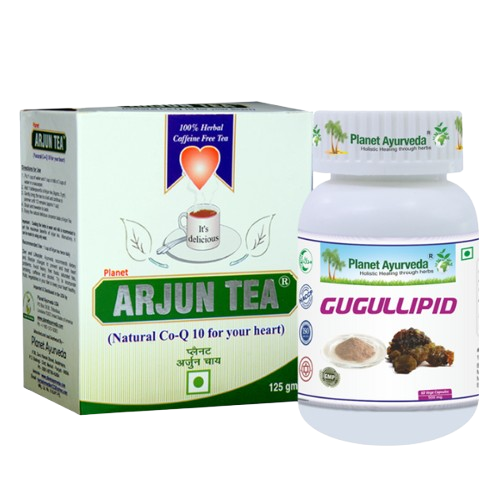
Arjuna Tea
Planet Ayurveda’s Arjun Tea is a caffeine-free herbal blend crafted to support heart health and overall well-being. It is prepared using Arjuna ( Terminalia arjuna), Punarnava (Boerhavia diffusa), Dalchini (Cinnamomum zeylanicum), etc. It is a natural source of Coenzyme Q10 which supports heart health. It contains tannins, flavonoids, glycosides which helps to strengthen cardiac muscles, improves myocardial contractility, and protects heart tissue from oxidative damage. It supports metabolism of cholesterol and triglycerides.
Directions to use : Put 1 cup of water and 1 cup of milk or 2 cups of water in a saucepan. Add 1 tablespoonful of Arjun tea (approx. 5 gm). Gently bring the tea to a boil and continue to simmer until ½ remains (approx 1 cup). Strain and enjoy the natural delicious taste of Arjun Tea.
Gugullipid capsules
Gugullipid capsules are herbal capsules formulated by Planet Ayurveda using the standardised extract of resin of Guggulu (Commiphora mukul). It contains active components like guggulsterones, lignans, terpenes, etc which increase conversion of cholesterol to bile acids and enhance bile acid excretion, resulting in reduction of total cholesterol, LDL, and triglycerides, while maintaining or raising HDL levels. It has lekhana (scrapping), medohara (anti- obesity), kapha-vata shamaka (vata and kapha pacifying) properties which helps in lipid metabolism.
Dosage: 1-2 capsules twice a day with plain water after meals.

Conclusion
Atorvastatin, a synthetic HMG-CoA reductase inhibitor, effectively reduces serum LDL cholesterol and triglycerides by suppressing hepatic cholesterol biosynthesis. However, long-term statin therapy is frequently associated with adverse effects, including myopathy, hepatic enzyme elevation and oxidative stress. Ayurveda conceptualizes hyperlipidemia as Medo Dhatu Dushti (vitiation of lipid metabolism) caused by impaired Agni (digestive fire) and Ama (metabolic toxins). The therapeutic goal in Ayurveda is to restore metabolic balance and channel purification through Lekhana (scraping) and Rasayana (rejuvenative) herbs. Agents such as Guggul (Commiphora mukul), Arjuna (Terminalia arjuna), garlic (Allium sativum) exhibit proven hypolipidemic, hepatoprotective, and antioxidant properties. Unlike statins, these botanicals modulate lipid metabolism, enhance liver function, and reduce oxidative stress without significant adverse effects. Thus, Ayurvedic therapy offers a holistic, sustainable and biologically safer alternative for long-term lipid management.
