TCM and Ayurveda on Breast Cancer – Causes, Symptoms, Diagnosis & Treatment
Abstract
Traditional Chinese Medicine (TCM) and Ayurveda represent two of the most profound, sophisticated, and historically continuous systems of holistic health in the history of human civilization. Rather than viewing the human body through a purely mechanistic lens like a collection of isolated biochemical parts and structural components, however, these ancient sciences conceptualize human physiology as a dynamic, living, and highly responsive network of energy. In the philosophy of Traditional Chinese Medicine, this vital life force is understood to flow through intricate, invisible pathways known as Meridians (Jing-Luo). Concurrently, in the ancient Indian science of Ayurveda, this animating energy travels through an expansive, highly detailed network of subtle channels called Nadis and physical micro-channels known as Srotas. By correlating their foundational principles, we reveal a remarkably unified ancient understanding of human health, vitality, and the origins of disease. Furthermore, this analysis explores a specific, critical pathological pathway including the undeniable connection between chronic emotional stress, the subsequent stagnation of vital energy, the failure of the body’s metabolic fire, and the eventual development of breast cancer. By synthesizing the Chinese pathogenesis of energetic phlegm and blood stasis with the Ayurvedic progression of Agni (digestive fire) vitiation and tumor formation, a deeply holistic, human-centered framework emerges. This framework illuminates precisely how the mind, the emotional landscape, and the physical bodily tissues interact continuously in the creation, sustainment, and potential healing of complex diseases.
Introduction
When examining modern allopathic medicine, the prevailing perspective is overwhelmingly structural, biochemical, and microscopic. Rooted heavily in Cartesian dualism which historically separated the mind from the physical body and contemporary oncology searches for abnormal cellular divisions, inherited genetic mutations, hormonal imbalances, and environmental carcinogens. This structural approach is indeed brilliant and unparalleled for acute intervention, surgical precision, diagnostics, and targeted chemical therapies. However, it frequently compartmentalizes the human experience. It tends to separate the physical manifestation of a disease from the profound emotional, psychological, and spiritual life of the individual hosting it. Modern medicine often treats the disease state as an invading enemy to be eradicated, rather than a systemic cry for balance from within the organism.
Eastern medical traditions, conversely, observe the human form through a distinctly different, energetic lens. These ancient systems do not separate the physical from the mental; rather, they view them as different densities of the same interconnected web. They suggest that long before a disease can be identified under a microscope, palpated during a physical exam, or detected on an MRI scan, it begins as a subtle, often imperceptible disruption in the body’s invisible life force.
In Traditional Chinese Medicine (TCM), this vital animating energy is known as Qi (pronounced “chee”). In the Ayurvedic tradition of India, it is identified as Prana. One can conceptualize this energy by observing the wind filling the sails of a massive ship; the wind itself remains invisible to the naked eye, but its profound effects are entirely undeniable. Without the wind, the ship remains stagnant, and forward momentum is rendered impossible. Both of these medical systems operate on the foundational belief that vibrant health is entirely synonymous with the free, smooth, and unobstructed circulation of this vital energy.
Conversely, pathology and illness are born when this vital flow is interrupted, depleted, or chronically blocked by internal or external factors. When energy stops moving, matter begins to accumulate. This article will provide an in-depth, systematic correlation of how these two ancient systems map the body’s energy, how our emotional landscapes directly alter our internal physiological environments, and how an invisible emotional blockage can eventually solidify into a highly physical, life-threatening structural anomaly such as breast cancer.
Correlating the Foundational Pillars of Ancient Healing
To fully grasp how these complex systems view severe diseases like cancer, one must first understand how their core philosophies mirror one another. While separated by vast geography, distinct cultures, and utilizing entirely different terminologies, the foundational basics of TCM and Ayurveda share profound, almost uncanny conceptual correlations.
The most vital and fundamental correlation lies in the concept of the animating force. TCM’s Qi and Ayurveda’s Prana are conceptually identical. They are the essential breath of life, the bio-electrical spark that governs all physical movement, neurological signals, cellular metabolism, and conscious thought. Without Qi or Prana, biological matter is entirely inert. They are the commanders of the blood; where the energy goes, the blood follows, bringing oxygen, nutrients, and immune defense to the tissues.
To explain how this energy maintains systemic balance, both systems rely on the deep observation of nature and its cyclical rhythms. TCM utilizes the brilliant binary concept of Yin and Yang—the fundamental understanding that all phenomena in the universe consist of dual, opposing, yet perfectly complementary forces. Health requires a delicate, dynamic, and ever-shifting equilibrium between the cooling, restive, structural, and nourishing qualities of Yin, and the heating, active, functional, and transformative qualities of Yang.
Ayurveda approaches this concept of systemic balance through the Tridosha theory. Instead of a duality, Ayurveda categorizes physiological and psychological functions into three primary biological energies derived from the elements: Vata (the principle of movement, composed of air and ether), Pitta (the principle of transformation, metabolism, and heat, composed of fire and water), and Kapha (the principle of structure, stability, and lubrication, composed of earth and water). Just as TCM seeks continuous harmony between Yin and Yang, Ayurveda defines optimal health as the perfect, individualized equilibrium of these three Doshas.
Furthermore, both systems are deeply rooted in elemental theory, positing that the human microcosm is a direct reflection of the natural macrocosm. TCM utilizes the Five Elements (Wu Xing): Wood, Fire, Earth, Metal, and Water. This system emphasizes the cyclical relationship, the generation (mother-child relationship), and the control mechanisms between these elements, correlating them directly to specific emotional states and internal organs.
Ayurveda similarly utilizes the Panchamahabhuta (Five Great Elements): Ether (Space), Air, Fire, Water, and Earth. While slightly different in their specific nomenclature and elemental breakdown, the core philosophy remains completely unified: physical matter and energetic states are composed of basic elemental building blocks, and disease is simply an elemental imbalance that has been allowed to persist. For instance, an excess of the Fire element manifests as physical inflammation in Western medical terms; in TCM, this is diagnosed as “Toxic Heat,” and in Ayurveda, it is recognized as a severe “Pitta aggravation.”
Finally, the internal processing centers of the body are mapped in remarkably similar ways. TCM maps the body through the Zang-Fu organ system. In this paradigm, organs are not just anatomical structures of flesh and blood, but rather overarching energetic centers entrusted with specific emotional, spiritual, and physiological duties. Ayurveda relies on the concept of Agni (the metabolic fire) and the Dhatus (the seven fundamental bodily tissues) to explain how the body processes inputs from the external world. In both paradigms, physical structures are tasked with digesting both physical nutrients (food and water) and emotional experiences (trauma, joy, stress, grief). When an individual cannot successfully “digest” a severe emotion, the physical organs responsible for that energetic frequency suffer the consequences.
The Architecture of Energy
Meridians and Nadis
To truly comprehend how a localized disease like a breast tumor takes root and spreads, it is absolutely necessary to examine the invisible infrastructure of a healthy body as defined by these ancient sciences. Energy does not move randomly; it follows highly specific, mapped pathways.
The Meridian System of Traditional Chinese Medicine (Jing-Luo)
In Traditional Chinese Medicine, the body is visualized as a vibrant, living landscape crisscrossed by an intricate, highly organized network of rivers. These functional, energetic pathways are known as the Meridians, or Jing-Luo. They form a comprehensive web that integrates the entire body, ensuring that no cell exists in isolation.
The Meridians are not physical blood vessels, lymphatic ducts, or nerve endings that can be isolated surgically on an operating table; rather, they are functional channels through which Qi, Blood, and bodily fluids circulate. Modern science is beginning to correlate these pathways with the body’s fascial network—the continuous web of connective tissue that conducts bioelectric signals.
There are twelve primary regular meridians, each acting as an energetic extension of a specific internal Zang-Fu organ. These pathways connect deep internal visceral functions to the surface of the skin, the sensory organs, and the distal extremities. When a meridian flows smoothly and unobstructed, the associated organ is nourished, immune defense is robust, and the body remains resilient to disease.
However, when a meridian becomes blocked, often due to chronic emotional stress, suppressed trauma, poor dietary habits, or environmental pathogens, it mimics a massive dam built across a flowing river. The energetic area upstream becomes painfully congested, swollen, and inflamed, while the area downstream becomes deficient, dry, and malnourished. The corresponding internal organ, deprived of its normal energetic circulation, begins to fail.
The meridian network is highly specific in its geography. To understand breast cancer from a TCM perspective, one must look at the meridians that traverse the chest. The breast tissue is a profound energetic crossroads. The Stomach Meridian (Yang Ming) runs directly down the anterior of the body, passing straight through the nipple; thus, digestive health and nourishment deeply impact the breasts. The Kidney Meridian (Shao Yin) runs parallel to the midline of the chest, supplying the body’s deepest foundational essence and vitality to the area. The Ren Mai (Conception Vessel), a major extraordinary meridian, flows up the exact center of the chest between the breasts, governing the body’s hormonal, reproductive, and Yin energies. Most critical for oncogenesis, the Liver Meridian (Jue Yin) travels up the inner leg, through the reproductive organs, and webs extensively into the lateral ribs and the breast tissue itself. This specific mapping explains why the breasts are so incredibly vulnerable to emotional stagnation.
The Ayurvedic Equivalents
Nadis and Srotas
Ayurveda describes an incredibly similar, though distinctly named, energetic topography. Instead of meridians, Ayurveda maps the body using a vast system of Nadis and Srotas. Ancient Vedic texts, such as the Upanishads and the foundational Ayurvedic treatises, suggest the existence of seventy-two thousand Nadis weaving intricately through the human energy field. These are the subtle, invisible channels through which Prana travels, animating the physical shell.
Within this vast and complex network, there are three primary, massive highways of energy: the Sushumna Nadi, which runs vertically up the center of the spinal column; the Ida Nadi, which spirals upward carrying cool, feminine, lunar energy on the left side of the body; and the Pingala Nadi, which spirals upward carrying warm, masculine, solar energy on the right side. Where these massive energy rivers intersect along the midline of the body, they form the Chakras, or major energy vortexes and processing centers. The Heart Chakra (Anahata), located in the center of the chest, is deeply intimately connected to the health of the surrounding breast tissue.
Furthermore, where these subtle Nadis intersect with physical tissues—such as muscles, veins, arteries, and joints—they form Marma points. These Marma points are highly sensitive vital gateways, conceptually and anatomically identical to the acupuncture points found along the TCM meridians. They act as access nodes where the subtle energy body can be manipulated to heal the physical body.
Alongside the subtle Nadis, Ayurveda maps physical and semi-physical micro-channels called Srotas. These are the pathways responsible for carrying physical nutrients, bodily fluids, oxygen, and cellular waste. For example, the Stanyavaha Srotas are the specific channels responsible for carrying lactation and nourishing the breast tissue. Similar to the meridian rivers of TCM, the health of the Ayurvedic body relies entirely on maintaining the perfect patency, cleanliness, and openness of these Srotas. When these channels are obstructed by dense metabolic toxins or the physiological constriction caused by psychological stress, the foundation for pathology is initiated.
The Processing Centers
The Liver’s Mandate and the Metabolic Fire
To trace the energetic roots of breast cancer, specific attention must be directed toward the body’s primary internal processing centers. Disease rarely begins in the breast tissue itself; the breast is simply the receptive site where systemic dysfunction manifests.
In Chinese medicine, the Liver holds a profoundly unique and important responsibility. While Western allopathic medicine views the liver primarily as a biochemical filter for blood and a producer of digestive bile, TCM elevates it to the status of the “General of the Army.” Its primary energetic mandate is to govern patency—to ensure the smooth, unhindered, and orderly flow of Qi, Blood, and emotions throughout the entire body.
Because of this role, the Liver is exquisitely sensitive to the individual’s emotional environment. It bears the heaviest physiological burden during times of high stress, carrying the weight of chronic frustration, unexpressed anger, resentment, and the constant pressure of modern daily life. When a person lacks a healthy emotional release valve, when they swallow their anger or suppress their grief to maintain outward harmony, the Liver becomes overwhelmed. The vital energy it is supposed to circulate smoothly becomes trapped, rigid, and congested. This pervasive, modern condition is known as Liver Qi Stagnation.
In Ayurveda, the equivalent core processing mechanism is Agni (fire), the body’s vital metabolic and digestive fire. Agni is the intelligence of transformation, fundamentally governed by the Pitta dosha (the fire and water elements). It is responsible for breaking down and transforming physical food into healthy bodily tissue. But equally, if not more importantly, it is responsible for “digesting” our psychological experiences, thoughts, and traumas.
Just as chronic, unexpressed stress traps Liver Qi in the TCM paradigm, severe psychological trauma, chronic anxiety, or suppressed emotions act as a direct, dampening assault on Agni. When the mind cannot process an event, the digestive fire is smothered.
The Path to Pathology
Stagnation and Breast Cancer in TCM
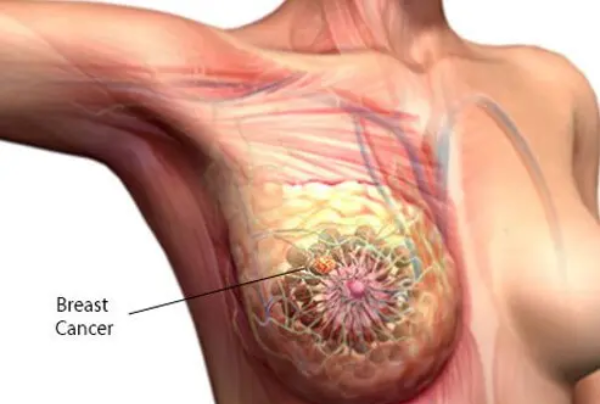
The connection between emotional stagnation and the development of breast cancer is both profoundly energetic and intensely physical. Energetically, the pathways of the body dictate exactly where pathology is most likely to manifest.
As previously detailed, while the Stomach, Kidney, and Conception Vessel meridians are all deeply involved in the anatomical breast tissue, the Liver meridian exerts a massive, dominating influence over the entire lateral and internal breast region. Because of this direct energetic pathway, the spongy, fatty tissue of the breast is highly vulnerable to the state of the Liver’s energy. If the Liver Qi stagnates due to chronic stress or frustration, the micro-circulation of energy and fluids within the breast tissue immediately suffers.
In Chinese medicine, the manifestation of a malignant tumor is never considered a sudden, isolated, or random accident of genetics. It is viewed as the tragic, predictable culmination of a prolonged, four-stage progression of systemic stagnation:
Emotional Strain and Qi Stagnation
Years of repressed feelings, unfulfilled desires, and high-tension stress cause the Liver Qi to stop its smooth flow. The chest often feels physically tight, and functional discomforts begin to arise. The individual may experience frequent, involuntary sighing (the body’s natural attempt to force stuck Qi to move), a sensation of a lump in the throat (plum pit qi), or premenstrual breast distension and tenderness.
Phlegm Accumulation
Because Qi is the energetic force responsible for moving all bodily fluids, when Qi stops flowing, fluid metabolism grinds to a halt. Over time, these stagnant bodily fluids thicken, condense, and congeal into a dense, energetic sludge called Phlegm. In the fatty tissues of the breasts, this often presents initially as benign, soft, movable fibrocystic lumps. The body is effectively creating a physical storage unit for unprocessed emotional and energetic waste.
Blood Stasis
Qi is not only the mover of fluids but also the commander of Blood. Where energy has been trapped for an extended period, the local microvascular blood supply eventually ceases to circulate effectively, creating a condition known as Blood Stasis. The previously soft, movable, phlegm-based lumps lose their elasticity. They become hard, fixed in place, and often highly painful to the touch, characterized by a sharp, stabbing sensation.
Toxic Heat and Malignancy
As this dense, compacted mass of congealed Phlegm and stagnant Blood sits within the breast tissue, it blocks the normal flow of energy entirely. This localized blockage creates intense internal friction. Think of a pile of damp rags left in a confined space, eventually, the lack of ventilation generates spontaneous heat. This friction generates profound inflammatory heat, termed Toxic Heat in TCM. It is this intense, localized, smoldering heat that ultimately damages the DNA, mutates the surrounding cellular tissue, and transforms a benign energetic blockage into an aggressive, malignant, structural tumor.
The Ayurvedic Translation
Agni Failure, Ama, and Arbuda
When examining this exact same pathogenesis through the Ayurvedic lens, the fundamental mechanics of the disease remain remarkably consistent, beginning with a primary failure of the body’s internal processing centers. In classical Ayurveda, cancer is broadly categorized under the concepts of Arbuda (a major, often malignant tumor or swelling) and Granthi (a smaller knot, localized blockage, or benign cyst).
The Ayurvedic pathological cascade leading toward a breast tumor begins deeply intertwined with the state of the mind and the body’s internal metabolic fire. Mental stress, suppressed emotional responses, and psychological trauma strike first at Agni, which is governed by the Pitta dosha. When an individual undergoes chronic stress, Pitta becomes vitiated (corrupted), and Agni becomes incredibly weak, dull, or erratic. The body essentially loses its vital, intelligent capacity to properly process and transform food, complex thoughts, or lingering emotional traumas.
This primary failure of Agni leads directly to the creation of Ama. Ama is a toxic, sticky, heavy, unprocessed metabolic residue, the bodily equivalent of environmental pollution. This Ama is the exact, conceptual Ayurvedic counterpart to the TCM concept of Phlegm. It is heavy, dense, cold, and inherently prone to causing severe blockages within the body’s delicate systems.
Once Agni has failed and Ama begins to accumulate in the system, the subsequent doshas are inevitably pulled into the chaos of the imbalance. Vata dosha (the subtle energy of movement and wind) becomes highly disturbed, erratic, and aggressive as it attempts to navigate physical channels (Srotas) that are now heavily clogged with the sticky, glue-like Ama.
Driven by the underlying mental stress and the physical obstruction, the vitiated Vata dosha forcefully pushes this toxic Ama, along with accumulated Kapha dosha (which governs structure and bodily fluids) and Meda Dhatu (fatty tissue, which is naturally abundant in the breasts), deep into the Stanyavaha Srotas. These are the specific, delicate micro-channels that feed and drain the breast tissue.
Here, the Ayurvedic connection to the physical liver becomes highly relevant to the oncological process. Ayurveda identifies a specific, potent sub-type of pitta dosha energy called Ranjaka Pitta, which resides primarily in the liver and spleen. Ranjaka Pitta is responsible for oxygenating, coloring, and giving blood its life-giving vitality. Suppressed anger, chronic resentment, and unrelenting stress severely injure the physical liver and damage this Ranjaka Pitta.
Consequently, the liver fails in its duty to purify the blood. Toxic, impure, and overheated blood is then circulated directly into the already blocked, Ama-filled channels of the breast tissue. Finally, the vitiated, fiery Pitta dosha becomes physically trapped inside this dense, toxic, unmoving mass. With nowhere to vent, the trapped, inflammatory heat of Pitta causes aggressive, chaotic cellular division, tissue suppuration, and genetic mutation. This transforms the localized blockage into a Tridoshaj Arbuda, a highly complex, malignant tumor involving the severe derangement of all three doshas (Vata pushing it, Kapha forming the dense mass, and Pitta causing the destructive inflammation and mutation), making it notoriously difficult to treat.
Synthesizing the Ancient Wisdom
When reading the diagnostic texts of Traditional Chinese Medicine alongside the ancient Vedic scripts of Ayurveda, all cultural boundaries, geographic distances, and linguistic barriers dissolve entirely. What remains is a profoundly unified, cohesive, and incredibly logical theory of human health and oncological disease.
Both of these venerable ancient sciences demonstrate unequivocally that structural, life-threatening diseases like breast tumors do not spontaneously materialize without a root cause. They are not random strikes of lightning. They are, instead, the dense, physical manifestations of a long-standing, chronic, systemic breakdown in the fundamental way the human body processes vital energy, bodily fluids, and emotional experiences.
The Chinese paradigm illustrates how unexpressed emotional stress freezes the Liver Qi, leading to a cascade of congealed Phlegm, Blood Stasis, and ultimately, mutating Toxic Heat. The Ayurvedic perspective perfectly mirrors this precise mechanism by illustrating how mental distress first extinguishes the internal metabolic fire (Agni/Pitta), generating toxic, sticky Ama. This then causes the Vata dosha to behave erratically, pushing dense toxicity and impure, overheated blood into the physical tissues. Both medical systems point directly and unflinchingly to the breast tissue as a highly sensitive, energetically vulnerable repository for the body’s unresolved metabolic waste and unexpressed, heavy emotional burdens.
Conclusion
Understanding the deep, conceptual correlations between the Chinese Meridian system, the Ayurvedic Nadis, and their respective foundational pillars offers a beautiful, expansive, and deeply empowering framework for conceptualizing human health. It teaches us a vital lesson that modern society often ignores: emotions are not merely fleeting, intangible thoughts confined to the ether of the mind. They are deeply physiological events. Every thought, stressor, and feeling carries a biochemical and bioelectrical signature that possesses the profound power to shape the physical landscape of the body. The specific connection between stagnant energetic flow, compromised metabolic fire, and the subsequent manifestation of breast cancer serves as a vital biological reminder that our emotional life must be processed, expressed, and digested just as diligently as our physical nourishment. Viewing illness through this ancient, holistic lens is by no means intended to replace, dismiss, or diminish modern medical science. When an individual is facing the terrifying reality of a cancer diagnosis, the advanced diagnostics, surgical interventions, and targeted treatments of modern oncology are absolutely vital, appropriate, and life-saving. However, ancient wisdom provides a critical, desperately needed component that modern medicine frequently overlooks: a comprehensive, logical roadmap for true prevention, early intervention, and long-term holistic recovery. By learning to recognize the subtle, energetic warning signs, the chronic tightness in the chest, the frequent sighs, the pervasive feeling of stuck frustration, the premenstrual tenderness, or the weakening of the digestive fire – interventions can be made years before pathology solidifies. By utilizing practices that move vital energy (like acupuncture, yoga, Qigong, or Tai Chi), herbs that clear physical and energetic channels, and therapeutic modalities that process heavy emotional weight, the free flow of vitality can be restored. This ensures that the physical tissues of the body are not irrevocably forced to bear the heavy, destructive burden of physiological and psychological stagnation.
