Treatment of Epidermolysis Bullosa in Ayurveda with Herbal Remedies
Abstract
The skin is the largest organ of the human body and serves as a vital protective barrier against physical injury, infections and fluid loss. It is composed mainly of the outer epidermis and the underlying dermis which are firmly held together by specialized protein structures that provide strength and flexibility. Epidermolysis Bullosa (EB) is a rare inherited disorder that affects this natural strength of the skin leading to a lifelong disorder recognized primarily for its impact on skin integrity. Due to its early onset and chronic nature it requires continuous care and medical attention and it significantly influences the quality of life of affected individuals and their families. Let’s learn about it in detail.
Introduction
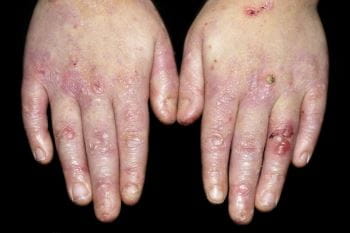
Epidermolysis Bullosa (EB) is a hereditary dermatological disorder caused by mutations in genes responsible for the structural integrity of the skin and is characterized by extreme skin fragility causing the skin to blister and tear easily with minor trauma or friction. The condition can affect not only the skin but also mucous membranes, nails and in severe cases internal organs.
Causes
EB is caused by mutations in genes encoding structural proteins responsible for binding skin layers together.
Risk Factors
- Family history of Epidermolysis Bullosa
- Consanguineous marriage increasing the risk of recessive forms
- Parents who are carriers of defective genes
- Previous child affected with EB
Pathophysiology
The human skin is made up of two main layers that are the outer epidermis and the underlying dermis. In healthy individuals, specialized protein anchoring structures at the dermo epidermal junction firmly bind these layers together, preventing them from sliding or separating from each other during normal movement or friction, however in epidermolysis bullosa these proteins are either defective or absent and the epidermis and dermis fail to bind firmly, making the skin extremely fragile. Even minor mechanical stress or friction leads to separation of skin layers, resulting in blister formation at different levels depending on the EB type. Recurrent blistering causes chronic wounds, inflammation, secondary infections, scarring and delayed healing, while severe forms may involve mucous membranes and internal organs, leading to significant morbidity.
Types
The main types are classified by the skin layer where blisters form:
- Epidermolysis Bullosa Simplex (EBS): It affects the epidermis, the outermost skin layer and is the most common (about 70% of cases) type. It is often milder with blisters mainly on hands and feet and improves with age.
- Junctional Epidermolysis Bullosa (JEB): It involves the junction between epidermis and dermis leading to severe and widespread blistering sometimes with internal issues like pyloric atresia.
- Dystrophic Epidermolysis Bullosa (DEB): It occurs in the dermis below the basement membrane causing scarring, nail loss or deformities.
- Kindler Syndrome: It is a rare mixed type with blistering at multiple skin levels along with skin thinning and photosensitivity.
Symptoms
- Skin blisters forming after minor friction or trauma
- Pain, burning and tenderness of the skin
- Recurrent wounds that heal slowly
- Difficulty eating or swallowing
- Discomfort while walking or using hands
- Fatigue
Signs
- Visible fluid filled blisters and erosions on the skin
- Scarring and milia formation
- Nail deformities or complete loss of nails
- Thickened, fragile or atrophic skin
- Fusion of fingers or toes (pseudosyndactyly)
- Oral ulcers, dental defects and mucosal involvement
- Evidence of secondary infection such as redness, discharge or crusting
Diagnosis
- Clinical evaluation
- Skin biopsy with immunofluorescence mapping
- Genetic testing
- Electron microscopy
Treatment
- There is no cure for this and treatment focuses on symptomatic relief like:
- Daily wound care uses non-adherent dressings, sterile techniques and emollients.
- Pain and itch are managed with topical or oral medications.
- Use of topical or systemic antibiotics when needed.
- Proper balanced diet to aid healing and growth.
- Daily physical activity to prevent weakness and maintain mobility.
Ayurvedic Overview
In Ayurveda, it can be seen as a condition involving tridosha which happens mainly due to beej dushti (defects in reproductive tissue) and affects the dhatu (tissues) especially rasa (vital energy), rakta (blood), mamsa (muscle) dhatu (tissue). The aggravation of vata dosha affects the skin and subcutaneous tissues causes skin fragility, dryness, reduced elasticity, predisposing to blistering even with minor trauma and delayed healing and the kapha and pitta aggravation results in blister formation, oozing and chronic inflammation. Its management involves deepana and pachana (Digestives and carminatives) to eliminate the ama (metabolic toxins) build up in the body, Shodhana (Purifying Therapies) like Virechana (purgation) or Raktamokshana (bloodletting), Shamana chikitsa (pacifying treatment) using various herbs and rasayana (rejuvenating) therapy to nourish the body.
Herbs that can be used are:
- Neem (Azadirachta indica): It purifies rakta (blood) and exhibits antibacterial effects to heal ulcers and reduce oozing from pitta aggravation.
- Haridra (Curcuma longa): It has anti-inflammatory and pitta shamaka (pitta pacifying) properties that promotes vrana ropana (wound healing) and prevents secondary infections in fragile skin.
- Manjishtha (Rubia cordifolia): It has rakta shodhaka (blood purifying) properties that clears deep seated doshas, supports srotas clearance and reduces scarring via lekhana (scraping) action.
- Guduchi (Tinospora cordifolia): It has rasayana (rejuvenating) properties for ojas (immunity) building, boosts immunity against genetic fragility and aids ama (metabolic toxin) elimination.
- Kumari (Aloe vera): It soothes twak srotas (channels nourishing skin), accelerates epithelial regeneration and provides cooling for pitta mediated burning.
Planet Ayurveda Remedies
Planet Ayurveda is a well known Ayurvedic healthcare company dedicated to providing authentic, herbal and classical Ayurvedic formulations. It follows the principles of pure Ayurveda using standardized extracts of medicinal herbs without the addition of chemicals, preservatives, yeast or artificial colors. All products are 100% vegetarian, GMP certified and prepared under strict quality control and it also provides Ayurvedic treatment options for Epidermolysis Bullosa (EB) like:
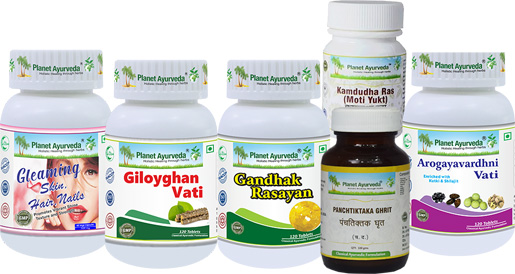

1. Gandhak Rasayan
It is a classical ayurvedic tablet formulation which is prepared by Planet Ayurveda and consists of Shudh Gandhak (purified sulphur). It has rakta shodhak (blood purifying), pitta shamak (pacifying pitta dosha), krimighna (antimicrobial) and vranaropak (wound healing) properties. It helps reduce recurrent skin infections, supports healing of blisters and erosions, improves skin strength and enhances immunity. Its Rasayana (rejuvenating) effect also aids tissue nourishment and recovery.
Dosage: 2 tablets twice daily with lukewarm water after meals.
2. Gleaming Skin Hair Nails Formula
It is a capsule formulation of Plant Ayurveda which consists of Manjistha (Rubia cordifolia), Pit Papada (Fumaria officinalis), Ghritkumari (Aloe barbadensis) and Sariva (Hemidesmus indicus). It also supports hair and nail health which are often affected in epidermolysis bullosa. It also provides hydration and strengthens the epidermal skin barrier thus preventing skin from further damage.
Dosage: 2 capsules twice daily with plain water after meals.
3. Panchtiktaka Ghrit
It is a classical formulation prepared by Planet Ayurveda which consists of Go Ghrit (Cow Ghee), Patol (Trichosanthes diocia), Saptaparna (Alstonia scholaris), nimba (Azadirachta indica) and many others. It targets non healing blisters and skin fragility and its antimicrobial and detoxifying properties help control secondary infections and promote tissue repair in the wounds.
Dosage: 1 tsp twice daily with warm water after meals.
4. Kamdudha Ras (Moti Yukta)
: It is a classical ayurvedic tablet formulation prepared by Planet Ayurveda. It consists of Mukta Bhasma (Pearl calx), Shankh Bhasma (Conch shell calx), Giloy (Tinospora cordifolia), and many more. It is used to strengthen dhatu (tissues), improve skin integrity and promote healing. It pacifies pitta and kapha dosha and helps in reducing inflammation and heat related erosions.
Dosage: 2 tablets twice daily with plain water after meals.
5. Arogyavardhini Vati
It is a classical ayurvedic tablet formulation prepared by Planet Ayurveda which contains Kutki (Picrorrhiza kurroa), Chitrak (Plumbago zeylanica), Shudh Shilajit (Purified Asphaltum), Haritaki (Terminalia chebula ), etc. It helps to eliminate ama (metabolic toxins) and pacifies pitta dosha and helps to purify the blood thus helps to prevent blister formation and further skin damage.
Dosage: 2 tablets twice daily with lukewarm water after meals.
6. Giloyghan Vati
It is a classical ayurvedic tablet formulation prepared by Planet Ayurveda which contains standardised extract of Giloy (Tinospora cordifolia). It helps to balance the pitta dosha and rakta dhatu (blood tissue) and has immunomodulatory actions thus removing the free radicals from the body, provides overall vitality and prevents the body from secondary infections.
Dosage: 2 tablets twice daily after meals
Conclusion
Epidermolysis bullosa is a rare genetic disorder causing fragile skin and blistering. Although there is no complete cure, proper care and management can improve quality of life. Ayurveda helps by balancing doshas, strengthening tissues and improving immunity, thereby supporting healing and overall well-being.
