Herbal Remedies of Stages of Diabetic Foot – Causes, Symptoms, Diagnosis & Treatment
Abstract
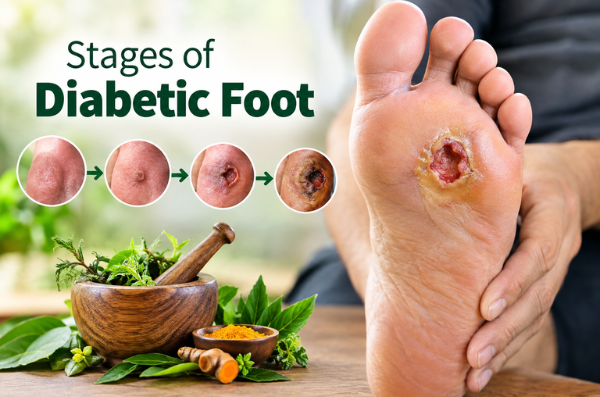
Diabetes can gradually affect the nerves, blood vessels, skin, muscles, and bones of the feet. Reduced protective sensation, impaired circulation, altered foot mechanics, and delayed wound healing can allow a minor blister, cut, pressure point, or callus to develop into a serious foot ulcer. Diabetic foot therefore represents a spectrum of changes rather than a single condition, beginning with a high-risk but intact foot and potentially progressing to superficial ulceration, deep tissue involvement, infection, gangrene, and limb-threatening disease. Several systems are used to classify diabetic-foot severity. The Wagner classification is one of the most familiar and grades ulcers according to their depth and the extent of tissue destruction. The stage of a diabetic foot has an important bearing on treatment, prognosis, limb preservation, and the possibility of healing without major intervention. In this article, we shall discuss diabetic foot and its stages in detail, explain how far reversal is realistically possible, and examine its management in contemporary medicine along with the Ayurvedic perspective and selected herbal formulations.
Introduction
Diabetic foot develops through a combination of complications associated with diabetes, particularly peripheral neuropathy, peripheral arterial disease, foot deformity, repetitive mechanical pressure, and impaired wound healing. Peripheral neuropathy can reduce protective sensation, causing a person to overlook a stone inside the shoe, a blister, a burn, or a small cut. Continued walking on an injured area then repeatedly traumatizes the tissue. Peripheral arterial disease creates another major obstacle to healing. Reduced arterial blood supply limits delivery of oxygen and nutrients to the affected tissues. Infection can further accelerate tissue destruction. These processes can occur simultaneously, explaining why a seemingly small foot lesion can progress rapidly in some people. Current diabetic-foot guidance emphasizes pressure relief, appropriate wound care, infection management, assessment of blood flow, debridement when indicated, and optimization of diabetes and cardiovascular risk factors. The American Diabetes Association’s Standards of Care also highlights the importance of offloading, wound care, vascular assessment, and treatment of infection in diabetes-related foot ulcers. This makes the stage of a diabetic foot particularly important. An intact high-risk foot is a very different clinical situation from a foot with an infected ulcer, osteomyelitis, or gangrene.
What Is a Diabetic Foot?
Diabetic foot refers to foot pathology associated with diabetes, especially when neuropathy, vascular disease, ulceration, infection, or structural abnormalities are present. It can include:
- Loss of protective sensation
- Callus formation
- Foot deformity
- Skin fissures
- Blisters
- Ulceration
- Infection
- Abscess
- Osteomyelitis
- Ischemia
- Gangrene
Diabetes-related foot ulcers are an important cause of hospitalization and lower-limb complications. The IWGDF emphasizes the interaction between loss of protective sensation and mechanical stress in the development of foot ulceration.
How Does a Diabetic Foot Develop?
The process often begins quietly.
A common sequence is:
Diabetic neuropathy → loss of protective sensation → repeated pressure or unnoticed trauma → callus/blister → skin breakdown → ulcer → infection and/or ischemia → deep tissue destruction
Vascular disease can add another way:
Peripheral arterial disease → reduced tissue perfusion → inadequate oxygen supply → delayed healing → necrosis
When infection and ischemia occur together, progression can become particularly rapid.
Stages of Diabetic Foot
Wagner Grade 0 – High-Risk Foot Without an Open Ulcer
At Grade 0, the skin is intact, but the foot contains one or more risk factors for ulceration. These can include:
- Peripheral neuropathy
- Calluses
- Foot deformity
- Previous ulcer
- Previous amputation
- Abnormal pressure distribution
There is no open ulcer at this stage.
Can Grade 0 Be Reversed?
Yes. This is the stage with the greatest opportunity for prevention and reversal of risk. The objective is to prevent ulcer formation through:
- Good blood-glucose control
- Daily foot inspection
- Appropriate footwear
- Pressure redistribution
- Callus management
- Neuropathy assessment
- Vascular assessment
- Foot-care education
At this stage, the foot is not being treated for an existing wound. The focus is to restore the safest possible condition and prevent progression.
Wagner Grade 1 – Superficial Ulcer
Grade 1 describes a superficial ulcer confined to the skin and subcutaneous tissues without exposed tendon, joint, or bone. It can develop from:
- Friction
- Pressure
- Callus
- Minor trauma
- Ill-fitting footwear
- Repetitive mechanical stress
Can Grade 1 Be Reversed?
Yes. Grade 1 has a high potential for complete healing when treated early and correctly.
The priorities include:
- Immediate offloading
- Appropriate wound cleansing
- Removal of nonviable tissue when indicated
- Infection assessment
- Suitable wound dressing
- Glycemic management
- Assessment of circulation
- Regular wound monitoring
Offloading is particularly important because continued pressure can keep reopening the ulcer. The IWGDF considers appropriate offloading one of the central interventions for healing plantar diabetic-foot ulcers.
This is the stage at which early Ayurvedic wound-care measures can be incorporated most effectively into a professionally supervised treatment program.
Wagner Grade 2 – Deep Ulcer
A Grade 2 ulcer extends beyond the superficial tissues and may involve:
- Deep subcutaneous tissue
- Fascia
- Tendons
- Ligaments
- Joint capsule
Bone involvement is not yet part of the Wagner Grade 2 definition.
Can Grade 2 Be Reversed?
Healing remains possible, but the situation is considerably more serious than Grade 1. Management requires:
- Specialist wound assessment
- Effective offloading
- Appropriate debridement
- Vascular assessment
- Infection evaluation
- Glycemic control
- Suitable wound care
- Monitoring for deeper infection and osteomyelitis
Ayurvedic management can be incorporated into an individualized multidisciplinary program, but a deep diabetic-foot ulcer should not be treated with herbal medicines alone.
Wagner Grade 3 – Deep Ulcer With Abscess, Osteomyelitis or Deep Infection
Grade 3 represents a major progression of disease. The ulcer is associated with a deep complication such as:
- Abscess
- Osteomyelitis
- Septic arthritis
- Deep-space infection
At this stage, infection can extend far beyond the visible ulcer.
Can Grade 3 Be Reversed Through Ayurveda Alone?
No. Grade 3 is not an Ayurveda-only treatment stage.
Urgent management can involve:
- Specialist evaluation
- Wound and surgical assessment
- Appropriate cultures when indicated
- Antibiotic therapy for confirmed infection
- Drainage of abscesses
- Surgical debridement
- Evaluation and treatment of osteomyelitis
- Vascular assessment
- Effective offloading
The IWGDF/IDSA guideline emphasizes severity-based treatment and multidisciplinary management of diabetic-foot infections.
Ayurvedic treatment can be considered within a coordinated program after the immediate infectious and surgical requirements have been addressed.
Wagner Grade 4 – Localized Gangrene
Grade 4 indicates localized gangrene, generally affecting part of the foot.
Gangrene signifies tissue death and can result from severe ischemia, infection, or both.
Possible features include:
- Black or necrotic tissue
- Tissue discoloration
- Reduced blood supply
- Cold foot
- Foul-smelling discharge if infection is present
- Severe ischemic pain in some patients
- Reduced sensation in neuropathic patients
Can Grade 4 Be Reversed Through Ayurveda?
Dead tissue cannot be restored to viable tissue through Ayurvedic medicines. Management can require:
- Urgent vascular evaluation
- Revascularization when feasible
- Removal of nonviable tissue
- Infection control
- Surgical management
- Amputation when required for limb or life preservation
Ayurveda can form part of longer-term metabolic and recovery-oriented care, but gangrene demands urgent contemporary vascular and surgical management.
Wagner Grade 5 – Extensive Gangrene
Grade 5 represents gangrene involving a large part of the foot and constitutes a limb-threatening and potentially life-threatening condition.
Can Grade 5 Be Reversed Through Ayurveda?
No. Grade 5 cannot be regarded as reversible through Ayurvedic treatment alone.
The treatment priority is:
- Emergency medical care
- Vascular assessment
- Revascularization when possible
- Surgical management
- Infection control
- Glycemic management
- Amputation when necessary to control extensive tissue destruction and protect life
At this stage, delaying definitive treatment in favor of herbal therapy can place the patient at serious risk.
Till Which Stage Can Ayurveda Help Reverse a Diabetic Foot?
The answer depends on the nature of the lesion and what is meant by “reverse.”
Grade 0
The highest potential exists for preventing progression and restoring the foot to a lower-risk state.
Grade 1
The ulcer has a strong potential for complete healing when pressure, infection, circulation, and blood glucose are appropriately managed.
Grade 2
Healing is still possible, but the ulcer is deep and requires intensive wound care and professional monitoring. Ayurvedic management can be integrated into a multidisciplinary plan.
Grade 3
The presence of deep infection, abscess, septic arthritis, or osteomyelitis changes the treatment priority. This is not a stage for Ayurveda-only management.
Grade 4
Gangrenous tissue is nonviable and requires urgent vascular and surgical assessment.
Grade 5
Extensive gangrene is a medical emergency and cannot be reversed with Ayurvedic medicine alone.
Therefore, Grade 0 and early Grade 1 represent the most favorable window for prevention and healing, while selected Grade 2 ulcers can also heal with intensive multidisciplinary care.
Why Early Diabetic-Foot Treatment Is So Important
A diabetic-foot lesion becomes increasingly difficult to treat as it moves deeper into the tissues. Consider the progression:
Skin involvement → subcutaneous tissue → fascia/tendon → joint/deep space → bone → necrosis/gangrene
At each step, the treatment becomes more complex.
An ulcer that could have healed with early offloading and wound care can become an infected deep ulcer if pressure continues. A deep infection can then progress into osteomyelitis. Severe vascular insufficiency can culminate in gangrene.
For this reason, early detection is one of the most powerful tools in diabetic-foot management.
Signs That Require Immediate Medical Attention
A person with diabetes should seek prompt medical evaluation for:
- Any new foot ulcer
- Blister that fails to heal
- Increasing redness
- Swelling
- Warmth
- Pus or discharge
- Foul odor
- Black tissue
- Blue or pale discoloration
- Sudden change in skin temperature
- Increasing pain
- New numbness
- Fever
- Chills
- Red streaks extending from a wound
A painless wound should never be considered harmless. Neuropathy can significantly reduce pain sensation.
Investigations for Diabetic Foot
A proper diabetic-foot assessment evaluates the wound, nerves, blood vessels, infection, and underlying metabolic control.
Neurological Assessment
Common tests include:
- 10-g monofilament testing
- Vibration perception testing
- Ankle reflexes
- Pinprick sensation
Vascular Assessment
Depending on the findings:
- Pedal pulse examination
- Ankle-brachial index
- Toe pressures
- Toe-brachial index
- Doppler ultrasound
- Arterial imaging when revascularization is being considered
Wound Assessment
The clinician evaluates:
- Length
- Width
- Depth
- Wound bed
- Callus
- Necrosis
- Exudate
- Odor
- Surrounding redness
- Tendon exposure
- Bone exposure
Infection Assessment
When infection is suspected, investigations may include:
- CBC
- CRP
- ESR
- Appropriate wound sampling
- Blood cultures in systemic illness
- Plain X-ray
- MRI when deep infection or osteomyelitis is suspected
Contemporary Management of Diabetic Foot
Diabetic-foot treatment is multidisciplinary.
Offloading
Pressure must be removed from the ulcer. Methods can include:
- Therapeutic footwear
- Total-contact casting
- Removable cast walkers
- Customized orthoses
- Other pressure-relieving devices
The appropriate option depends on ulcer location, severity, infection, ischemia, mobility, and patient factors.
Debridement
Nonviable tissue and excessive callus can interfere with wound healing. Appropriate debridement removes unhealthy tissue and allows better assessment of the wound.
Infection Management
Antibiotics are indicated for clinical infection, not merely because an ulcer is present. Moderate and severe infections require particularly careful assessment and treatment.
Vascular Management
An ischemic foot cannot be expected to heal normally without restoration of adequate blood flow. Vascular specialists can determine whether revascularization is appropriate.
Glycemic Management
Good diabetes management is fundamental to reducing neuropathy, infection risk, and impaired healing.
Surgical Management
Surgery can be required for:
- Abscess
- Deep infection
- Osteomyelitis
- Extensive necrosis
- Gangrene
- Nonviable tissue
- Structural complications
Ayurvedic View and Management of Diabetic Foot
Diabetic foot is a modern clinical entity and does not have a direct one-to-one disease name in classical Ayurveda. The most useful Ayurvedic correlation is Madhumeha progressing to Dushta Vrana. In Madhumeha, disturbance of metabolism is associated with excessive Kleda and impairment of tissue nourishment. Progressive disturbance involving Meda (adipose tissue), Mamsa (muscle tissue), Rakta (blood tissue), and related Srotas (microchannels) reduces tissue integrity and the body’s ability to maintain normal repair. Vata dosha subsequently becomes aggravated, especially when tissues are depleted and circulation and sensation are impaired. Repeated mechanical pressure or unnoticed trauma then produces a wound. Because the underlying metabolic and tissue abnormalities persist, normal healing becomes difficult. Continued Dosha disturbance and local contamination can convert the lesion into Dushta Vrana, with persistent discharge, abnormal tissue, delayed healing, pain or sensory loss, and progressive destruction.
Ayurvedic Management of Diabetic Foot
Ayurvedic management focuses on Prameha (diabetes) management, Vrana Shodhana (wound cleansing), Vrana Ropana (wound healing), Vata regulation, tissue nourishment, and prevention of further tissue injury. The internal treatment is chosen according to glucose status, digestion, body strength, vascular condition, wound stage, and associated complications. Local care focuses on maintaining cleanliness, controlling excessive discharge, supporting healthy tissue repair, and protecting the wound from repeated trauma. Warm, freshly prepared and appropriately portioned meals, adequate protein and fiber, regular physical activity according to wound status, weight management, and good sleep are incorporated into the broader plan. Pressure relief remains essential because no herbal preparation can compensate for constant mechanical trauma. Ayurvedic treatment is most appropriately integrated at the early stages of diabetic-foot disease, while infected, ischemic, deeply necrotic, or gangrenous wounds require immediate specialist treatment.
Herbal Remedies for Diabetic Foot by Planet Ayurveda
Planet Ayurveda offers Ayurvedic formulations prepared from selected herbs and classical ingredients for metabolic health, wound care, digestion, inflammation, tissue nourishment, and general well-being. The following combination is designed around several important aspects of Ayurvedic diabetic-foot management, including metabolic balance, wound cleansing, skin and tissue care, Vata regulation, and healthy digestion. Planet Ayurveda is pleased to present its list of products for an Ayurvedic approach to diabetic-foot management.
Product list
- Vara Churna
- Dashang Lepa
- Jatyadi Oil
- Chandraprabha Vati
- Diabeta Plus Capsules
- Shilajit Capsules
- Kaishore Guggul
Herbal Remedies for Stages of Diabetic Foot


Product description
1. Vara Churna
Planet Ayurveda’s Vara Churna contains Haritaki (Terminalia chebula), Bibhitaki (Terminalia bellirica), and Amalaki (Emblica officinalis) in equal proportions. These three fruits constitute Triphala, a combination valued for a number of health benefits. When used for washing wounds, it helps to clean the wound and paces up the recovery and healing of the wound. For diabetic-foot care, the product can be incorporated into an externally cleansing method only when specifically recommended by the treating practitioner and when the wound is suitable for such care.
Dosage/Application: For wound cleansing, use as directed by the treating practitioner. (store.planetayurveda.com)
2. Dashang Lepa
Dashang Lepa contains herbs including Shirisha (Albizia lebbeck), Madhuyashti (Glycyrrhiza glabra), Tagara (Valeriana wallichii), Raktachandana (Pterocarpus santalinus), Haridra (Curcuma longa), Daruharidra (Berberis aristata), Kushta (Saussurea lappa), and Hrivera (Pavonia odorata). These ingredients provide a herb-based external formulation for skin and local tissue care. Haridra (Curcuma longa) and Daruharidra (Berberis aristata) contribute antimicrobial and inflammation-modulating properties, while Madhuyashti supports skin comfort. The formulation is suited to carefully selected superficial skin and wound-care applications.
Application: Local application mixed with Jatyadi Oil.
3. Jatyadi Oil
Planet Ayurveda’s Jatyadi Oil contains a broad combination of herbs including Neem (Azadirachta indica), Haridra (Curcuma longa), Daruharidra (Berberis aristata), Manjishtha (Rubia cordifolia), Lodhra (Symplocos racemosa), Mulethi (Glycyrrhiza glabra), and Haritaki (Terminalia chebula), prepared in sesame oil. Neem (Azadirachta indica) and Daruharidra (berberis aristata) possess antimicrobial properties, Haridra provides curcuminoids with antioxidant and inflammation-modulating activity, while Manjishtha (Rubia cordifolia) and Lodhra (Symplocos racemosa) complement the formulation’s skin and tissue-care profile. Jatyadi Oil is primarily an external preparation and can be considered for appropriately assessed superficial wounds when compatible with the wound-care plan.
Application: Local application as directed.
4. Chandraprabha Vati
Chandraprabha Vati is a classical multi-ingredient formulation containing components such as Shilajit (asphaltum), Guggulu (Commiphora mukul), Vacha (Acorus calamus), Mustak (Cyperus rotundus), Haridra (Curcuma longa), Amalaki (Emblica officinalis), Vidanga (Embelia ribes), Guduchi (Tinospora cordifolia), Shunthi, (Zingiber officinalis) Maricha (Piper nigrum), and Pippali (Piper longum), along with additional classical ingredients. Its broad Ayurvedic composition supports metabolic, urinary, digestive, and systemic balance. Haridra (Curcuma longa) and Guduchi (Tinospora cordifolia) contribute antioxidant and metabolic support, while Guggulu (Commiphora mukul) and Shilajit (asphaltum) provide additional systemic and vitality-oriented components. In diabetic-foot management, its role belongs primarily to the internal metabolic component, rather than direct treatment of an open ulcer. It is a most useful medicine for the management of diabetes.
Dosage: 2 tablets twice daily.
5. Dia-Beta Plus Capsules
Planet Ayurveda’s Dia-Beta Plus contains Gurmar (Gymnema sylvestre), Karela (Momordica charantia), Saptrangi (Salacia chinensis), Vijaysar (Pterocarpus marsupium), Ashwagandha (Withania somnifera) and Tulsi (Ocimum sanctum/tenuiflorum) Gurmar contains gymnemic acids, Karela contains bioactive compounds including charantin, and Salacia contains salacinol-related constituents, all of which have been investigated for their relationship with glucose metabolism. Vijaysar provides polyphenolic constituents, while Tulsi contributes antioxidant properties and Ashwagandha adds metabolic and stress-resilience support. Maintaining appropriate glucose levels is fundamental to diabetic-foot care because persistent hyperglycemia contributes to neuropathy, vascular dysfunction, impaired immune defense, and delayed wound healing.
Dosage: 1 capsule twice daily.
6. Shilajit Capsules
Planet Ayurveda’s Shilajit Capsules contain standardized Shilajit extract. The product is positioned for vitality, strength, and overall tissue nourishment. Its major bioactive components include fulvic-acid-associated compounds and dibenzo-alpha-pyrones, together with mineral substances. Within an Ayurvedic approach to diabetic-foot care, Shilajit contributes primarily to the broader objective of maintaining strength, vitality, and tissue nourishment, particularly where metabolic illness is accompanied by weakness or reduced stamina. In Ayurveda, Shilajit is known to manage high blood sugar levels.
<Dosage: 1 capsule twice daily.
7. Kaishore Guggul
Kaishore Guggul is a classical ayurvedic formulation that contains Amalaki, Bibhitaki, Haritaki, Guggul, Guduchi, Ginger, Black Pepper, Long Pepper, and Vidanga, along with additional ingredients. Guggul provides guggulsterones and contributes to the formulation’s metabolic and inflammatory profile. Guduchi supports systemic balance, while Triphala components support digestion and elimination. Ginger, Black Pepper, and Long Pepper promote healthy digestive activity and metabolism. In diabetic-foot management, Kaishore Guggul fits into the internal Ayurvedic strategy of maintaining metabolic balance and supporting healthy tissue function. And it helps in the management of chronic wound management.
Dosage: 2 tablets twice daily.
Conclusion
Diabetic foot progresses along a spectrum that can begin with an intact but high-risk foot and develop into superficial ulceration, deep tissue involvement, infection, osteomyelitis, and gangrene. The Wagner classification provides a useful framework for understanding this progression, although modern diabetic-foot assessment also considers neuropathy, ischemia, infection severity, wound characteristics, and the patient’s overall health. The greatest opportunity for prevention and healing lies in Grade 0 and Grade 1. At these stages, early foot care, appropriate footwear, pressure relief, glucose management, vascular assessment, and prompt wound treatment can prevent progression and provide a strong opportunity for complete healing. Grade 2 remains potentially healable but requires intensive wound management and specialist monitoring. Once a foot reaches Grade 3, the presence of deep infection, abscess, or osteomyelitis requires urgent contemporary treatment. Grades 4 and 5, characterized by gangrene, require vascular and surgical intervention and cannot be reversed through Ayurvedic treatment alone. From an Ayurvedic perspective, diabetic foot can be understood through the progression of Madhumeha to Dushta Vrana, involving Kleda and Meda Dushti, impaired tissue metabolism, Vata aggravation, and impaired wound repair. Ayurvedic management therefore emphasizes metabolic balance, proper digestion, tissue nourishment, Vata regulation, wound cleansing, local care, and prevention of repeated trauma. Planet Ayurveda’s provided combination addresses different aspects of diabetic-foot management, from metabolic health and tissue nourishment to carefully wound-care measures. The most important lesson is that time is tissue in diabetic-foot disease. A small superficial ulcer treated promptly has a very different prognosis from the same wound after weeks of pressure, infection, or ischemia. Ayurveda has its greatest practical value when introduced early and integrated intelligently with wound care, glucose control, offloading, vascular assessment, and rehabilitation. Once deep infection, osteomyelitis, severe ischemia, or gangrene develops, timely contemporary intervention becomes essential for protecting both the limb and the patient’s life.
