Nuclear Cardiac Stress Test – Procedure, Benefits & Role of Arjun Tea in Heart Health
ABSTRACT
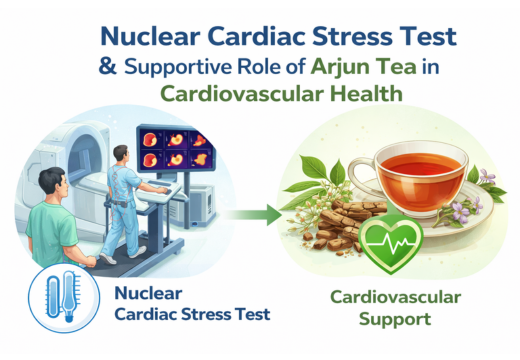
Cardiovascular diseases (CVDs) continue to be the leading cause of death globally, posing a significant burden on healthcare systems. Early detection and appropriate management are essential to reduce morbidity and mortality. Among modern diagnostic modalities, the Nuclear Cardiac Stress Test plays a pivotal role in evaluating myocardial perfusion and identifying coronary artery disease under stress conditions. This non-invasive imaging technique provides valuable insights into cardiac function, helping clinicians make informed decisions. In parallel, traditional systems like Ayurveda emphasize preventive and supportive approaches to heart health. One such revered herb is Terminalia arjuna (Arjun), widely known for its cardioprotective, antioxidant, and lipid-lowering properties. This article presents a comprehensive overview of the nuclear cardiac stress test, including its methodology, indications, and clinical relevance, along with the supportive role of Arjun in maintaining cardiovascular health.
INTRODUCTION
The human heart is a vital organ responsible for pumping oxygenated blood throughout the body. Proper cardiac function is essential for sustaining life, and any impairment in blood flow can lead to serious health consequences. Coronary artery disease (CAD), characterized by narrowing or blockage of coronary arteries, is one of the most common forms of cardiovascular disease. With the advancement of medical science, diagnostic techniques have evolved to allow early detection of cardiac abnormalities. The Nuclear Cardiac Stress Test is one such sophisticated tool that evaluates blood flow to the heart muscle both at rest and during stress. Simultaneously, Ayurveda offers holistic strategies for maintaining heart health. The herb Terminalia arjuna has been extensively used for centuries as a natural cardiotonic. Its integration with modern medical practices can provide a balanced approach to cardiovascular care.
UNDERSTANDING THE NUCLEAR CARDIAC STRESS TEST
A Nuclear Cardiac Stress Test is a specialized imaging procedure that uses radioactive tracers and advanced imaging technology to assess myocardial perfusion. It helps in identifying areas of the heart that receive insufficient blood supply, especially during physical exertion.
Principle of the Test: The test is based on the principle that healthy heart muscle absorbs more of the radioactive tracer compared to damaged or poorly perfused tissue. By comparing images taken during rest and stress, physicians can detect abnormalities in blood flow.
Procedure of the Test
Patient Preparation
- Avoid caffeine for at least 24 hours
- Refrain from smoking
- Temporary discontinuation of certain medications if advised
- Fasting for a few hours before the test
Resting Phase: A small amount of radioactive tracer is injected into the bloodstream. After allowing time for circulation, images of the heart are captured using a gamma camera.
Stress Phase
- Exercise Stress: The patient walks on a treadmill or pedals a stationary bike
- Pharmacological Stress: Medications are administered to simulate the effects of exercise in patients unable to perform physical activity. During this phase, heart rate, blood pressure, and ECG are continuously monitored.
- Post-Stress Imaging: A second dose of tracer is injected, and additional images are taken. These are compared with resting images to evaluate differences in blood flow.
Indications of Nuclear Cardiac Stress Test
- Suspected coronary artery disease
- Evaluation of chest pain (angina)
- Shortness of breath of unknown origin
- Assessment of previous heart attack damage
- Monitoring effectiveness of cardiac treatments
- Preoperative cardiac risk evaluation
Advantages of the Test
- Non-invasive and relatively safe
- Provides detailed imaging of myocardial perfusion
- Detects early-stage coronary artery disease
- Helps guide treatment decisions
- Offers prognostic information about cardiac risk
Limitations and Risks
- Exposure to a small amount of radiation
- Possible allergic reaction to tracer (rare)
- Not suitable for pregnant women
- May produce false-positive or false-negative results in some cases
Clinical Importance
- Identifying ischemic regions of the heart
- Differentiating between reversible and irreversible damage
- Guiding interventions such as angioplasty or bypass surgery
- Predicting future cardiac events
AYURVEDIC PERSPECTIVE ON CARDIOVASCULAR HEALTH
Ayurveda considers the heart (Hridaya) as the seat of consciousness and circulation. It is influenced by the balance of three Doshas – Vata, Pitta, and Kapha. Any imbalance, especially involving Vata (movement) and Kapha (structure), can lead to cardiovascular disorders.
- Strengthening cardiac tissue (Hridya)
- Improving circulation (Rakta Pravaha)
- Reducing toxins (Ama)
- Maintaining mental and emotional balance
AN AYURVEDIC REMEDY FOR CARDIOVASCULAR DISEASES
Ayurveda provides a holistic approach to preventing and managing cardiovascular diseases by emphasizing the balance of Doshas, enhancement of circulation, and strengthening of the heart (Hridaya). It focuses on correcting the root cause rather than just relieving symptoms, promoting overall well-being. Among various herbal remedies, Arjun tea by Planet Ayurveda, prepared from Terminalia arjuna and various other herbs, is widely recognized for its cardioprotective properties. It helps improve heart function, regulate blood pressure, and support healthy . Regular use of Arjun tea, along with proper diet and lifestyle, can play an important role in maintaining long-term cardiovascular health naturally.
HERBS IN ARJUN TEA AND THEIR BENEFITS
Arjuna (Terminalia arjuna)
- Acts as a powerful heart tonic (Hridya)
- Strengthens cardiac muscles
- Improves coronary circulation
- Helps regulate blood pressure
- Reduces cholesterol and oxidative stress
Punarnava (Boerhavia diffusa)
- Natural diuretic, reduces fluid retention
- Helps manage hypertension
- Supports kidney function
- Aids in detoxification (removal of Ama)
Pipal Tvak (Ficus religiosa)
- Improves blood circulation
- Helps purify blood
- Provides mild cardiotonic support
- Reduces inflammation and stress
Dalchini (Cinnamomum zeylanicum)
- Helps lower blood sugar levels
- Reduces cholesterol
- Improves blood circulation
- Acts as a strong antioxidant and anti-inflammatory agent
Chhoti Elaichi (Elettaria cardamomum)
- Helps regulate blood pressure
- Acts as a mild diuretic
- Improves digestion and metabolism
- Reduces stress and provides antioxidant support
PREPARATION METHOD OF ARJUN TEA
- Take 1 teaspoon of Arjun Tea Powder
- Add it to 3 cup of water
- Place the mixture on low flame
- Boil for 10–15 minutes to extract active constituents, for more benefits you can also add milk into it
- Stir occasionally for proper mixing
- Allow the water to reduce slightly
- Turn off the flame once done
- Strain the decoction to remove residue
- Pour into a cup
- Consume warm for better absorption
- Preferably take on an empty stomach
- Can be taken once or twice daily
CONCLUSION
Cardiovascular diseases require a comprehensive approach that focuses on early diagnosis, proper management, and long-term prevention. The Nuclear Cardiac Stress Test is an important diagnostic tool that helps evaluate myocardial perfusion, detect coronary artery disease, and assess heart function under stress. It plays a key role in identifying ischemic changes and guiding timely treatment, thereby reducing the risk of serious cardiac events. Alongside modern diagnostics, Ayurveda offers a preventive and supportive approach by balancing Doshas, improving circulation, and strengthening the heart (Hridaya). Arjun tea, prepared from Terminalia arjuna and other beneficial herbs, provides cardioprotective, antioxidant, and lipid-lowering effects. It helps regulate blood pressure, improve heart function, and maintain overall cardiovascular health. In addition, adopting a healthy lifestyle that includes a balanced diet and regular yoga practice further enhances heart health by reducing stress and improving circulation. Thus, integrating modern diagnostic techniques with Ayurvedic remedies and lifestyle modifications offers an effective strategy for preventing cardiovascular diseases and promoting long-term well-being.


