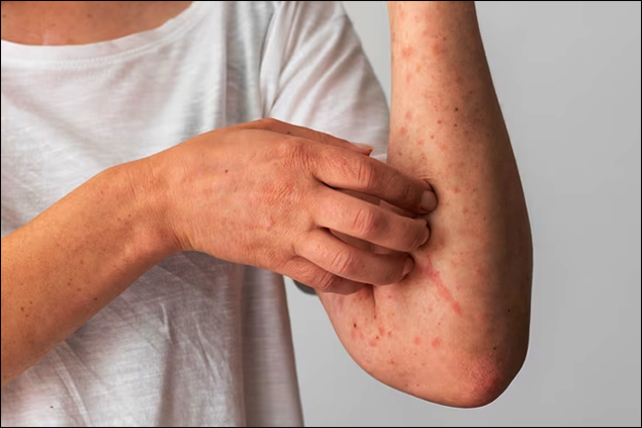
Herbal Remedies of Stevens-Johnson Syndrome – Causes, Symptoms, Diagnosis & Treatment
Abstract
This article provides a comprehensive overview of Stevens-Johnson Syndrome (SJS), a rare and serious condition affecting the skin and mucous membranes. It discusses the possible causes and triggers, common medicines associated with SJS, early and advanced symptoms, warning signs, risk factors, underlying mechanisms, diagnosis, and important facts and statistics. The article also explains the relationship between SJS and Toxic Epidermal Necrolysis (TEN), along with its potential complications and recovery concerns. Further sections cover medical management, eye and mucosal care, prevention of future episodes, dietary and lifestyle considerations, and the role of supportive Ayurvedic practices. The article emphasizes the importance of early recognition and urgent medical treatment while explaining how appropriate supportive care may contribute to recovery after the acute phase.
Introduction
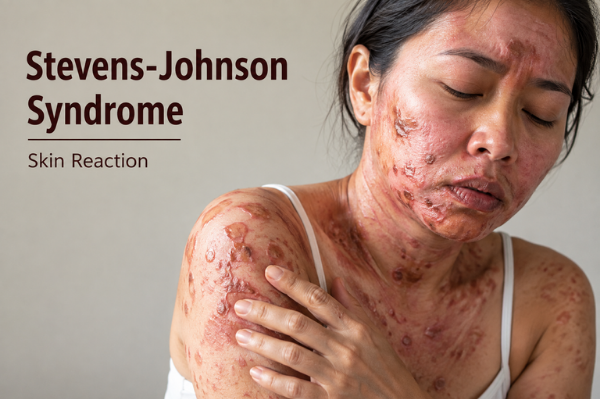
Stevens-Johnson Syndrome is a rare but potentially life-threatening disorder characterized by severe injury to the skin and mucous membranes. It usually develops as a reaction to certain medicines and, in some cases, may be associated with infections or other triggers. Unlike a mild drug rash, SJS can progress rapidly and cause painful skin lesions, blistering, skin detachment, and extensive involvement of the mouth, eyes, throat, and genital mucosa. The condition can interfere with eating, drinking, vision, urination, and normal daily activities. Severe cases may lead to dehydration, secondary infections, organ complications, and long-term problems, particularly involving the eyes and skin. Early recognition and urgent medical treatment are therefore essential.
Common Causes and Triggers of Stevens-Johnson Syndrome
Several factors can be associated with the development of SJS
- Certain prescription medicines
- Some antibiotics
- Certain anticonvulsant medicines
- Some non-steroidal anti-inflammatory drugs
- Certain medicines used for gout
- Viral infections
- Mycoplasma pneumoniae infection
- Other infections
- Genetic susceptibility
- Previous history of severe drug reactions
In many cases, a recently introduced medicine is considered the most important potential trigger. However, identifying the exact cause may require a detailed medical history because symptoms can develop after exposure to different medicines or infections.
Medicines Commonly Associated With SJS
Several medicines have been associated with Stevens-Johnson Syndrome, particularly:
- Sulfonamide antibiotics
- Some anticonvulsants such as carbamazepine, phenytoin, phenobarbital, and lamotrigine
- Allopurinol
- Certain non-steroidal anti-inflammatory drugs, particularly some oxicam-type medicines
- Some other antibiotics and prescription medicines
Important: A medicine being associated with SJS does not mean that most people taking it will develop the condition. SJS is rare, but because the reaction can be severe, new unexplained skin or mucosal symptoms after starting a medicine require prompt medical assessment.
Symptoms of Stevens-Johnson Syndrome
SJS often develops in stages. Early symptoms may resemble an infection or flu-like illness before characteristic skin and mucosal changes appear:
Early Symptoms
- Fever
- Fatigue
- General weakness
- Sore throat
- Cough
- Headache
- Muscle or joint aches
- Burning or irritated eyes
- General feeling of being unwell
Skin Symptoms
- Painful red or purplish patches
- Skin tenderness
- Blister formation
- Target-like skin lesions
- Rapid development of skin lesions
- Peeling or separation of the skin
- Increased sensitivity or burning of the skin
Mucosal Symptoms
The mucous membranes may be significantly affected, particularly the:
- Mouth
- Lips
- Eyes
- Nose
- Genital region
- Urinary tract
Painful ulcers and erosions inside the mouth may make eating and drinking difficult. Eye involvement can cause redness, burning, light sensitivity, discharge, and pain.
Red-Flag Symptoms Requiring Immediate Medical Attention
Urgent medical evaluation is essential if a person develops:
- Rapidly spreading painful rash
- Blisters or skin peeling
- Skin pain that seems disproportionate to the visible rash
- Painful mouth or lip sores
- Difficulty swallowing fluids
- Severe eye pain or light sensitivity
- Red or swollen eyes
- Genital or urinary mucosal lesions
- High fever associated with a new rash
- Difficulty breathing
- Severe weakness or dehydration
- Extensive skin tenderness
These symptoms should not be managed at home with herbal remedies or self-medication. SJS can progress rapidly and requires hospital-based assessment.
Diagnosis of Stevens-Johnson Syndrome
There is no single routine laboratory test that independently confirms SJS. Diagnosis is primarily based on the clinical appearance, progression of symptoms, and detailed medical history:
Assessment may include
- Complete medication history
- Recently started or stopped medicines
- Recent infections
- Skin examination
- Assessment of skin detachment
- Examination of the mouth and other mucous membranes
- Eye examination
- Blood investigations
- Electrolyte assessment
- Kidney and liver function assessment
- Evaluation for secondary infection
- Skin biopsy when required
A skin biopsy can help support the diagnosis and distinguish SJS from other blistering or inflammatory skin conditions.
Possible Complications in Stevens-Johnson Syndrome
SJS can produce both short-term and long-term complications:
These may include
- Dehydration
- Secondary infection
- Electrolyte abnormalities
- Scarring
- Skin pigmentation changes
- Chronic dry eyes
- Corneal damage
- Vision problems
- Oral sensitivity
- Difficulty swallowing
- Genital complications
- Urinary complications
- Respiratory complications
- Psychological distress
Eye Care in Stevens-Johnson Syndrome
Eye involvement is one of the most important complications of SJS because damage to the ocular surface may result in long-term visual problems. Patients may require:
- Early ophthalmological examination
- Lubricating eye preparations
- Treatment of ocular inflammation
- Protection of the ocular surface
- Prevention of secondary infection
- Specialist interventions in severe cases
Statistics About Stevens-Johnson Syndrome
- SJS is a rare condition, with reported incidence estimates generally around 1–6 cases per million people per year.
- SJS and TEN together are estimated to occur in approximately 2–7 cases per million people annually, although rates vary among populations.
- Medicines are responsible for a large proportion of SJS/TEN cases.
- SJS can occur in children as well as adults.
- Several mucosal surfaces may be affected simultaneously.
- Eye involvement can lead to long-term complications.
- Severe skin involvement can result in substantial fluid and electrolyte loss.
- Severe cases may require intensive-care or specialized burn-unit management.
- TEN has a higher mortality risk than SJS because of its greater extent of skin involvement.
Important Facts About Stevens-Johnson Syndrome
SJS is not an ordinary skin allergy
It is a severe systemic immune-mediated reaction.
It is not contagious
SJS cannot spread from one person to another.
Medicines are important triggers
A complete medication history is essential.
Symptoms can progress rapidly
Early recognition is extremely important.
Mucosal involvement is common
The mouth, eyes, and genital areas may be affected.
Skin pain is an important warning sign
Significant tenderness may accompany early skin changes.
Re-exposure can be dangerous
A confirmed culprit medicine should generally be avoided permanently.
Eye involvement requires special attention
Ophthalmological assessment can help prevent serious complications.
Self-treatment is inappropriate
Suspected SJS requires urgent professional medical evaluation.
Ayurvedic Overview on Stevens-Johnson Syndrome
From an Ayurvedic perspective, Stevens-Johnson Syndrome has no exact classical equivalent, but its clinical features may be broadly correlated with Pitta aggravation, Rakta Dushti, and involvement of Tvak Dhatu. Symptoms such as burning sensation, redness, inflammation, tenderness, blistering, and mucosal lesions may reflect disturbances involving Pitta and Rakta. The acute stage requires immediate hospitalization, withdrawal of the suspected causative medicine under medical supervision, fluid and nutritional support, wound care, and specialist monitoring. Ayurveda may have a supportive role during the recovery phase, focusing on maintaining Agni, proper hydration, balanced nutrition, rest, and restoration of Bala (strength). Easily digestible foods and avoidance of excessively spicy, sour, salty, or irritating foods may be considered according to individual tolerance. Ayurvedic medicines or therapies should be used only under qualified professional supervision and must not replace emergency medical treatment.
Herbal Remedies for Stevens-Johnson Syndrome by Planet Ayurveda
Planet Ayurveda is an Ayurveda-focused healthcare and wellness organization dedicated to promoting traditional Ayurvedic principles through herbal formulations, educational resources, and holistic wellness guidance. The organization emphasizes the traditional Ayurvedic approach of supporting overall wellbeing through balanced nutrition, healthy lifestyle practices, and appropriately selected herbal preparations. Planet Ayurveda aims to make Ayurvedic knowledge accessible while encouraging responsible and informed use of traditional wellness practices. Its approach combines classical Ayurvedic concepts with contemporary quality standards in the development and presentation of herbal products. For serious medical conditions such as Stevens-Johnson Syndrome, professional medical diagnosis and emergency treatment remain essential, while Ayurveda may be considered as supportive care under appropriate supervision. Following are the remedies by Planet Ayurveda to support Stevens-Johnson Syndrome.
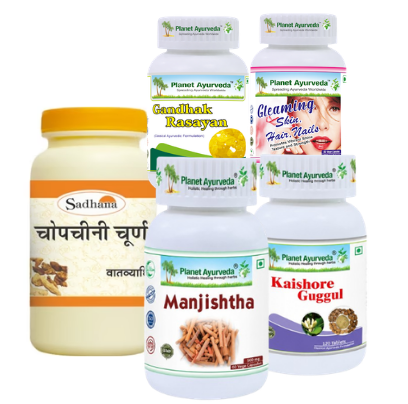
- Kaishore guggul
- Gandhak rasayan
- Manjishtha capsules
- Gleaming skin hair nails formula
- Chopchini churna
Herbal Remedies of Stevens-Johnson Syndrome

Product Description
1. Kaishore guggul
Kaishore Guggul is an Ayurvedic herbal formulation prepared by Planet Ayurveda, traditionally formulated with herbs such as Guggul (Commiphora mukul), Guduchi (Tinospora cordifolia), Ginger (Zingiber officinale), Black Pepper (Piper nigrum), Long Pepper (Piper longum), Vidanga (Embelia ribes), etc. The herbs in Kaishore Guggul are traditionally considered supportive of Agni and digestion, healthy metabolism, and balanced Vata-Pitta. From an Ayurvedic perspective, its collective action may be described as supporting Agni (Digestive Fire), Rakta Dhatu (Blood Tissue) balance, and the body’s natural inflammatory-response regulation, with traditional emphasis on maintaining metabolic and tissue balance. These ingredients are traditionally used to support Agni (digestive fire), Rakta Dhatu (blood tissue) balance, healthy metabolism, proper elimination, and balanced Vata-Pitta. In the context of Stevens-Johnson Syndrome (SJS), Kaishore Guggul may be considered as a supportive Ayurvedic formulation during the recovery phase, supporting digestion, metabolism, tissue nourishment, and the body’s natural inflammatory-response balance.
Dosage: 2 tablets twice daily with plain water after meals.
2. Gandhak rasayan
Gandhak Rasayan is a classical Ayurvedic formulation prepared by Planet Ayurveda, traditionally centered around purified Gandhak (Sulphur). Collectively, the formulation is traditionally considered supportive of Rakta Dhatu (blood tissue) balance, skin health, digestion, metabolism, and the body’s natural cleansing and rejuvenation processes. In the context of Stevens-Johnson Syndrome (SJS), Gandhak Rasayan may be included as a supportive Ayurvedic formulation during the recovery phase, with its traditional properties supporting healthy skin and tissue regeneration, maintaining internal balance, and supporting the body’s natural recovery processes.
Dosage: 2 tablets twice daily with plain water after meals.
3. Manjishtha capsules
Manjishtha Capsules are an Ayurvedic herbal formulation prepared by Planet Ayurveda, featuring Manjishtha (Rubia cordifolia) as the principal herb. Traditionally, Manjishtha is associated with supporting Rakta Dhatu (blood tissue), Twak (skin), and healthy circulation, while helping maintain the body’s natural internal balance. The formulation is traditionally valued for its supportive role in maintaining healthy skin and assisting normal metabolic and cleansing processes. Manjishtha Capsules may be used as a supportive Ayurvedic formulation to promote healthy skin and tissue nourishment and support the body’s natural recovery and restoration processes, alongside appropriate medical care.
Dosage: 1 capsule twice daily with plain water after meals.
4. Gleaming skin hair nails formula
Gleaming Skin Hair Nails Formula is a comprehensive Ayurvedic formulation prepared by Planet Ayurveda, designed to provide holistic nutritional and herbal support for skin, hair, and nail health. The formulation works collectively to nourish the tissues, support healthy hair growth, maintain skin quality and radiance, and promote stronger, healthier nails. Its balanced herbal profile is traditionally valued for supporting Rakta Dhatu (Blood Tissue) and, along with healthy metabolism and natural tissue nourishment. In the context of recovery from skin-related concerns, it may be used as a supportive wellness formulation to promote overall skin, hair, and nail nourishment and maintain healthy tissue regeneration.
Dosage: 1 capsule twice daily with plain water after meals.
5. Chopchini churna
Chopchini Churna is a classical Ayurvedic herbal formulation, traditionally centered around Chopchini (Smilax china). The formulation is traditionally valued for supporting Rakta Dhatu (blood tissue), Twak (skin), and healthy metabolism, while promoting the body’s natural cleansing and balancing processes. Its overall Ayurvedic profile makes it a supportive formulation for maintaining healthy skin, tissue nourishment, and internal balance. During recovery from skin-related conditions, Chopchini Churna may be used as part of a supportive Ayurvedic wellness approach.
Dosage: ½ tsp twice daily with plain water after meals.
Conclusion
Stevens-Johnson Syndrome is a rare but potentially life-threatening condition that requires prompt recognition, immediate medical evaluation, and appropriate hospital-based management. Medicines are among the most common triggers, and early withdrawal of the suspected causative drug under medical supervision is essential. Because SJS can affect the skin, eyes, mouth, and other mucosal surfaces, multidisciplinary care and long-term follow-up may be necessary. From an Ayurvedic perspective, its manifestations may be broadly understood in relation to Pitta aggravation, Rakta Dushti, and Tvak Dhatu involvement; however, Ayurveda should only have a supportive role during recovery and must not replace emergency medical treatment. Adequate hydration, nutrition, rest, gentle care, and individualized professional guidance can support recovery. Any herbal formulation should be used only under qualified medical supervision, particularly after stabilization.