What is SHINGLES (Herpes Zoster)? – Causes, Symptoms and Ayurvedic Treatment
ABSTRACT
In this article, you’ll get to know all about the Shingles or Herpes zoster in one place. The causative virus of this particular infection is Varicella-zoster, which results in red rashes on the skin accompanied by pain and burning on the affected area. Shingles is only caused to the people who have already suffered from chickenpox at some point of their life, putting clearly it is the reactivation of the same virus. Let’s learn in detail about the infection and role of Ayurveda in treating the infection naturally.
INTRODUCTION TO THE SHINGLES
Shingles is also termed as herpes zoster which causes painful rashes on the body. Vaccines are given to decrease the risk of getting this infection but nothing is hundred percent guaranteed. Herpes zoster or shingles is not a deadly disease but can cause long-lasting pain and burning. When a person gets chicken pox, the virus may remain in latent state even after recovering from the infection completely. This virus lives in the nervous system of a person for many years only to reactivate as shingles. Rashes may appear on any part of the body but the predominant locations are neck, torso or face.
AYURVEDIC ASPECT OF SHINGLES
As per the Ayurveda, shingles or herpes zoster is caused due to the aggravation of Pitta dosha in the body. Pitta dosha can be flared due to excessive oiliness or heat, building up of toxins in the body, excessive increase in vata, pitta and kapha dosha or improperly digested food. Owing to any of these factors skin gets affected as it is an organ of elimination.

SIGNS AND SYMPTOMS OF THE SHINGLES
Usually the small part of the body is affected by shingles, generally including one side of the body. Some of the major signs and symptoms of this infection are:
- Pain occurring in small patches usually on one side of the body
- Burning is also accompanied with pain on affected areas
- Rashes which are red in color are followed after a few days
- Itching in the rashes
- Appearance of blisters which breaks and crust is formed over them
- Some of the less common symptoms include fever, headache, fatigue, and photosensitivity.
Pain is the most common and can be the most severe symptom of the infection. In some cases there might be pain without any rashes. Right or left torso is the common location for the appearance of blisters.
RISK FACTORS OF SHINGLES
People who got affected by Chickenpox whose chances are more likely to get affected by shingles or herpes zoster are:
- Having low immunity or immunocompromised people
- Having life threatening conditions like HIV, cancer, or who have had organ transplant
- Age above 50 years
- Prolonged illness
- Experiencing stress for a long time
- People gone through trauma
CAUSES OF SHINGLES
Herpes zoster or shingles is caused by the virus called Varicella-zoster. It is the same virus which causes chickenpox. When a person suffers from chickenpox which means first infection, the symptoms are treated or resolved on its own without the virus leaving the body. This virus stays in the body passing to the nervous system and remains dormant for maybe years and due to unknown reasons get reactivated at any point of life causing shingles. When this reactivation occurs, the virus travels to the skin along the nerve pathways and develops the signs and symptoms of herpes zoster. However not everyone who got chickenpox will get affected from it. Probably the risk factors discussed above are the reasons for its reactivation.
DIAGNOSIS OF SHINGLES
The typical distribution of the rashes on the body is the most useful tool for the diagnosis of the shingles. Rashes and blisters of shingles are usually present on one side of the body which is a characteristic feature. However certain laboratory tests including the fluid swab from blisters or its scraping will confirm the presence of virus in it.
TREATMENT OF SHINGLES
As shingles is considered to be an incurable condition, in orthodox system of medicine (Allopathy) the medication is given to relieve the complaints. Main mode of treatment is antiviral medicines to decrease the duration of symptoms and relieve the discomfort caused by shingles. Painkillers are given to ease the pain. At times there can also occur bacterial infection along with shingles, hence antibacterial medications are given for it. However all of these medicines have certain side effects when taken in the long term and shingles generally takes 2-6 weeks in order to resolve. When an immunocompromised person gets shingles (herpes zoster), these drugs can worsen their immunity. Hence opting the natural science, i.e. Ayurveda would be a better option.
AYURVEDIC TREATMENT OF SHINGLES
As per the Ayurveda diseases are caused due to the imbalance of any of the three doshas, i.e. Vata, Pitta and Kapha and hence restoration of their balance is the main aim in order to restore health. As per the Ayurvedic concept, shingles can be correlated with Pittaj visarpa. As we already discussed, due to the increase in Pitta dosha disease is manifested on the skin in the form of red rashes, burning and pain. In Ayurveda not a single part or area is treated but the person as a whole is treated which results in restoration of complete health of a person as a whole. Holistic approach of treatment includes correction of physical exercise (Vihaar), diet (Ahar) along with the natural medicines (Aushadhi). Certain external processes to let out the toxins can be done like therapeutic purgation or bloodletting. External applications like mukhalepa and pralepa (herbal pastes) can be used on the affected areas. Further we will discuss the medicines which can be used to treat shingles naturally.
HERBAL REMEDIES BY PLANET AYURVEDA FOR SHINGLES
Planet Ayurveda is one of the leading herbal brands in India. It is very well known in India and abroad for the amazing herbal products which are used to treat various acute as well as chronic (obstinate) diseases. All the products manufactured here are produced following the strict Ayurvedic principles under the supervision of MD Ayurveda doctors who have expertise in this area. All the medicines and products manufactured in Planet Ayurveda are purely herbal, vegetarian, organic and devoid of chemicals, preservatives, fillers, dye, colors, additives and yeast. These medicines and products are further prescribed to the patients by experienced MD Ayurveda doctors as per the disease or complaints one is suffering from. For Shingles, Planet Ayurveda offers a combination of herbal medicines that works efficiently in treating and managing the infection naturally.


Product List
These herbal formulations are selected for treating the infection as they contain herbs and compounds which have healing effects on the shingles. These herbal medicines help in relieving the pain, burning, rashes, blisters and eradicate the infection naturally without causing any further harm to the body.
- Mahamanjisthadi Ghan vati
- Pitta balance
- Neurogenie capsule
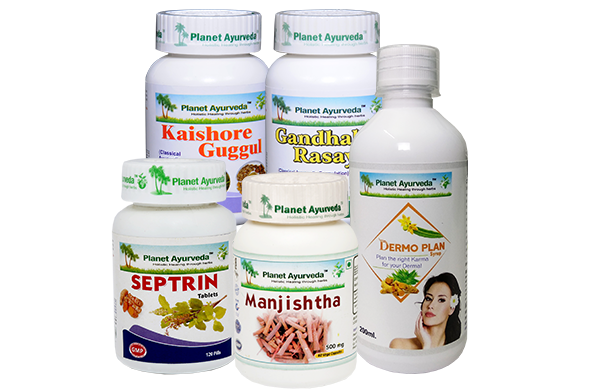
- Kaishore guggul
- Gleaming skin hair nails formula
Product Description
1. Mahamanjisthadi Ghan vati
These herbal tablets are prepared from the extract of Manjistha (Rubia cordifolia) which is known for its amazing therapeutic effect on skin. Owing to these factors, Mahamanjisthadi Ghan vati helps in treating the rashes and blisters which is one of the main complaints in shingles and clears the skin naturally.
Dosage- Take 2 tablets twice daily after meals with plain water
2. Pitta balance
Praval pishti (Coral calcium), Akik pishti (Agate calcium), Kamdudha ras (An Ayurvedic calcium compound), Jawar mohra pishti (An Ayurvedic calcium compound), Giloy satva (Tinospora cordifolia) and Mukta pishti (Pearl calcium) are used in the preparation of the Pitta balance. All of these components altogether acts in a synergistic manner to alleviate the Pitta dosha, hence eradicating the root cause and restoring the health.
Dosage- Take 1 capsule twice daily after meals with plain water
3. Neurogenie capsule
These herbal capsules are prepared from standardized extract of two therapeutic herbs, i.e. Brahmi (Bacopa monnieri) and Ashwagandha (Withania somnifera). Neurogenie capsules as the name suggests are used to treat neurological complaints. In shingles pain and burning is due to the affected nerve, hence these capsules help in relieving the mentioned ailments naturally.
Dosage-Take 1 capsule twice daily after meals with plain water
4. Kaishore Guggul
It is prepared from the combination of numerous herbs, i.e. Haritaki (Terminalia chebula), Bibhitaki (Terminalia bellirica), Amalaki (Emblica officinalis), Shunthi (Zingiber officinale), Vidanga (Embelia ribes), Black pepper (Piper nigrum), Long pepper (Piper longum), Guduchi (Tinospora cordifolia), Indian jalap (Ipomoea turpetheum), Guggul (Commiphora mukul), and Red physic nut (Baliospermum montanum). Kaishore guggul helps in eliminating the accumulated toxins from the body in the case of shingles or herpes zoster and relieves the condition by purifying the blood.
Dosage- Take 2 tablets twice daily after meals with plain water
5. Gleaming skin, hair, nails Formula
These are the multi herbal capsules which helps in clearing the rashes, itching and redness from the skin in the people suffering from shingles and helps in maintaining healthy skin. Herbs like Manjistha (Rubia cordifolia), sariva (Hemidesmus indicus), Pit papda (Fumaria officinalis) and Ghrit kumari (Aloe barbadensis) are used in the preparation of Gleaming skin, hair, nails capsules.
Dosage- Take 1 capsule twice daily after meals with plain water
CONCLUSION
Shingles or herpes zoster is not a fatal condition however it can cause severe and long lasting pain. Natural medicines discussed above can help in relieving and treating the condition naturally and gently without causing any further damage to the body.