Herbal Remedies of Epidermolysis Bullosa – Causes, Symptoms, Diagnosis & Treatment
Abstract
Epidermolysis bullosa is a group of rare skin disorders in which the skin becomes extremely fragile and develops blisters or wounds after minor friction or injury. The condition may be present from birth and can vary from mild to severe. Some forms mainly affect the skin, while others may involve the mouth, digestive tract, nails, or other body parts. Recurrent wounds can cause pain, scarring, infections, and difficulty in daily activities. Management focuses on protecting the skin, preventing trauma and infection, relieving pain, and supporting nutrition and wound healing. Early diagnosis, regular monitoring, appropriate wound care, and multidisciplinary support can help improve comfort and quality of life.
Statistics for Epidermolysis bullosa
- Epidermolysis bullosa (EB) is an uncommon inherited disorder characterized by increased skin fragility. In the United States, its estimated incidence is around 19.6 cases per million live births.
- Approximately 11.1 cases per million people are estimated to live with EB in the United States.
- Around 25,000–50,000 people in the United States may be affected by different forms of EB.
- Epidermolysis Bullosa Simplex is the most frequently reported subtype, representing approximately 70% of EB cases. Its estimated incidence is about 7.9 cases per million live births.
- Dystrophic Epidermolysis Bullosa represents approximately 20–30% of cases. When dominant and recessive forms are considered together, the estimated incidence is around 5.2 cases per million live births.
- Junctional Epidermolysis Bullosa is less common and can be clinically severe. It accounts for approximately 5% of EB cases, with an estimated incidence of 2.7 cases per million live births.
- The frequency and severity of EB can differ between populations because of genetic and demographic factors.
Facts about Epidermolysis bullosa
- “Butterfly children” is a commonly used term for people with EB because their skin can be as delicate as a butterfly’s wings.
- A simple touch can cause injury: In some severe forms, everyday activities such as rubbing, scratching, or wearing tight clothing may lead to blistering or skin damage.
- EB is not one single disease: It includes several inherited forms, mainly Epidermolysis Bullosa Simplex, Junctional EB, and Dystrophic EB, each affecting different layers or structures of the skin.
- Wounds can take considerable care: People with moderate or severe EB may require regular wound dressing and specialized skin protection to reduce further trauma.
- EB is genetic, not contagious: The condition results from changes in genes involved in maintaining the strength and attachment of skin layers. It cannot spread from one person to another.
- Nutrition can become a major concern: Extensive wounds and difficulty eating may increase nutritional requirements, particularly in children with severe EB.
Introduction
Epidermolysis bullosa (EB) is a rare inherited condition that makes the skin unusually fragile and prone to injury. Minor friction, pressure, or physical contact may lead to blisters, erosions, or open wounds. The condition can affect people of all ages, although many forms become noticeable during infancy or childhood. The severity varies widely, ranging from localized skin problems to extensive involvement of the skin and other tissues. EB develops because of changes in genes responsible for proteins that help maintain the strength and attachment of different skin layers. When these proteins do not function properly, the layers of the skin can separate more easily, resulting in blister formation. Different types of EB involve different levels of the skin and may therefore produce different patterns of symptoms. Frequent blistering and wound formation can interfere with everyday activities and may lead to pain, scarring, infections, nail abnormalities, and difficulty with movement. In some forms, the mouth, digestive tract, teeth, and other tissues may also be affected. Children with more severe disease may experience nutritional difficulties and require additional support for healthy growth. Regular medical assessment is important because complications can develop over time. Advances in genetic research have also increased interest in treatments that target the underlying causes of the condition.
Causes of Epidermolysis bullosa
Most forms are inherited, although new genetic changes can also occur without a family history. The specific gene or immune mechanism involved influences the type, severity, and complications of the disorder. The causes include:
Genetic changes
Epidermolysis bullosa (EB) mainly develops because of disease-causing changes, or mutations, in genes responsible for proteins that maintain the strength and stability of the skin. More than a dozen genes have been identified in different forms of EB.
Weak structural proteins
These genes provide instructions for proteins that help connect the different layers of the skin. Some of these proteins are involved in the formation and organization of collagen, keratins, laminins, and other components that provide mechanical strength to the skin.
Poor attachment between skin layers
When an important structural protein is absent, reduced, or abnormal, the connection between the epidermis and the underlying dermal tissue becomes weaker. Even minor friction or pressure can then cause the skin layers to separate and form a blister.
Inherited forms
Most cases are inherited. Depending on the specific type of EB, the altered gene may be passed through an autosomal dominant or autosomal recessive pattern. In some families, an affected parent can transmit the condition to a child, while in recessive forms, both parents may carry an altered gene without having significant symptoms themselves.
New genetic changes
EB can occasionally occur because of a new genetic mutation that develops in an individual without a previous family history of the disorder.
Acquired EB
A rare form known as epidermolysis bullosa acquisita (EBA) is not caused by an inherited gene defect. It is an autoimmune condition in which the immune system mistakenly produces antibodies against proteins that help attach the skin layers.
Not caused by lifestyle
EB is not caused by poor hygiene, diet, or ordinary environmental exposure. The inherited forms arise from genetic abnormalities, while acquired EB results from an abnormal immune response.
Effect on skin strength
The underlying problem is a weakened connection within the skin rather than simply excessive sensitivity. This structural weakness explains why routine activities such as rubbing, scratching, or pressure can produce blisters and wounds in affected individuals.
Signs and Symptoms of Epidermolysis bullosa
The clinical features of epidermolysis bullosa (EB) vary according to its specific type, the severity of the genetic abnormality, and the tissues involved. Symptoms often become noticeable during infancy or early childhood, although milder forms may appear later. Common features include:
Fragile skin and blistering
Minor friction, pressure, rubbing, or injury can produce fluid-filled blisters. The hands, feet, elbows, knees, and areas exposed to repeated friction are commonly affected.
Skin erosions and wounds
Blisters may break easily, leaving painful raw areas or open wounds that require careful wound management.
Thickened skin
Repeated injury, particularly on the palms and soles, may lead to thickened areas, calluses, or hardened skin.
Nail abnormalities
Fingernails and toenails may become thick, fragile, irregular, discolored, or deformed. In some severe cases, nails may be lost.
Milia
Small, firm, white bumps called milia can develop during the healing of damaged skin.
Scarring
Recurrent blistering and wound healing may result in scars. Severe forms may cause tight or contracted skin that restricts movement.
Fusion of fingers or toes
Extensive scarring can cause adjacent fingers or toes to gradually become joined together, particularly in some forms of dystrophic EB.
Mouth and throat involvement
Blisters or sores inside the mouth and throat may cause pain while eating, chewing, or swallowing. Some individuals may develop dysphagia, or difficulty swallowing.
Dental abnormalities
Certain forms of EB can affect tooth development, resulting in weak or underdeveloped tooth enamel and an increased risk of dental problems.
Poor growth and nutritional difficulties
Children with severe EB may have difficulty eating because of mouth or throat lesions. Recurrent wounds can also increase nutritional requirements, potentially contributing to poor weight gain and delayed growth.
Anemia
Chronic wounds, inflammation, blood loss, and nutritional deficiencies may contribute to anemia, particularly in individuals with more severe disease.
Reduced mobility
Pain, wounds, scarring, and tightening of the skin around joints can make walking, gripping objects, or performing routine activities difficult.
Diagnosis of Epidermolysis bullosa
Diagnosing epidermolysis bullosa (EB) involves assessing the skin findings, understanding the family history, and using specialized laboratory tests. Since several types of EB can produce similar symptoms, identifying the exact subtype is important for appropriate management and genetic counseling.
Clinical examination
A dermatologist or specialist examines the pattern of blistering, the areas affected, scarring, nail changes, and involvement of the mouth or other tissues. The age at which symptoms began and the severity of skin fragility also provide useful diagnostic clues.
Skin biopsy
A small sample of affected or appropriately selected skin may be taken for laboratory examination. Specialized techniques, such as immunofluorescence mapping, can identify abnormalities or absence of specific proteins involved in maintaining the connection between skin layers. Transmission electron microscopy may also be used in selected cases to examine the ultrastructural level at which the skin separates.
Genetic testing
Molecular genetic testing can identify disease-causing variants in genes associated with EB. This helps confirm the diagnosis, distinguish between EB subtypes, and provide information about the likely inheritance pattern.
Family history
Information about relatives with recurrent blistering, unexplained skin fragility, or similar problems can help doctors understand whether the condition may have been inherited.
Prenatal testing
Families known to carry a disease-causing EB variant may be offered genetic counseling. When the specific familial variant has been identified, prenatal genetic testing can determine whether a pregnancy is affected. Options may include testing through chorionic villus sampling or amniocentesis, depending on the clinical situation.
Genetic counseling
Counseling helps affected individuals and families understand inheritance patterns, recurrence risks, available testing options, and implications for future pregnancies.
Management of Epidermolysis bullosa
Management of epidermolysis bullosa (EB) is individualized according to the type of EB, extent of skin involvement, age, and associated complications. Since the underlying genetic abnormality cannot usually be corrected with routine treatment, care mainly aims to protect the skin, promote wound healing, reduce pain, prevent infection, and maintain adequate nutrition and mobility. The management approaches include:
Gentle wound cleaning
Open wounds should be cleaned carefully to remove debris and reduce the risk of infection. Dressings can be softened with lukewarm water before removal to avoid unnecessary damage to the surrounding skin.
Blister management
Large or painful blisters may require drainage under appropriate medical guidance. The overlying skin is generally preserved when possible because it can provide a natural protective covering for the underlying wound. Sterile techniques are important to reduce infection risk.
Non-adherent dressings
Dressings that do not stick firmly to the skin are preferred. Adhesive tapes and materials that can pull away the superficial skin should generally be avoided unless specifically recommended by a specialist.
Handle the skin gently
Lifting, transferring, bathing, and other routine activities should be performed carefully. Avoiding unnecessary friction can reduce the formation of new blisters.
Protect vulnerable areas
Padding and appropriate protective materials may be used around areas that experience repeated pressure or rubbing.
Pain and itch management
Appropriate pain-relieving medicines may be prescribed according to the individual’s age and clinical condition. Pain management may be planned before procedures such as wound care or dressing changes. Cool compresses, suitable moisturizers, loose clothing, and physician-recommended anti-itch treatments may provide relief.
Nutrition
Adequate nutrition is particularly important in individuals with extensive or recurrent wounds. The body may require additional calories, protein, vitamins, and minerals to support tissue repair. A dietitian may recommend an individualized nutritional plan.
Physical therapy and mobility
Repeated wounds and scarring can restrict movement, particularly around the hands, feet, and joints. Physiotherapy and occupational therapy can help maintain mobility, flexibility, muscle strength, and independence. Specialized exercises should be performed under professional guidance to avoid excessive friction or trauma.
Psychological and social support
Living with chronic wounds and repeated medical procedures can affect emotional well-being, education, work, and social activities. Psychological counseling, family support, patient education, and connection with EB support organizations can help individuals and caregivers cope with the long-term challenges of the condition.
Multidisciplinary Care
Severe EB is best managed through coordinated multidisciplinary care. Dermatologists, wound-care teams, nutritionists, dentists, physiotherapists, pain specialists, genetic counselors, and other specialists may contribute to the treatment plan. Regular assessment allows complications to be identified early and treatment to be adjusted according to changing needs.
Ayurveda Insights
Epidermolysis bullosa (EB) is a genetic disorder, so Ayurveda should be viewed as a supportive approach rather than a replacement for dermatological or genetic care. Classical Ayurvedic texts do not describe EB as a direct one-to-one disease entity. Its clinical features can, however, be considered from the perspective of disorders involving Twak (skin), Rakta (blood), Mamsa (muscle tissue), and Rasa dhatu, along with disturbances of Vata and Pitta doshas.
Pathogenesis of Epidermolysis bullosa
The hereditary nature of EB may be correlated conceptually with Beeja Dushti, reflecting an underlying genetic predisposition. Vata and Pitta may be considered the predominant Doshas, with Vata contributing to dryness, fragility, pain, and poor tissue stability, while Pitta may be associated with inflammation, burning, redness, and irritation. Twak and Rakta Dhatu are considered important sites of involvement, with possible participation of Rasa and Mamsa Dhatu due to their role in tissue nourishment and repair. Impaired Agni and inadequate Dhatu nourishment may further affect tissue regeneration, particularly when recurrent wounds increase nutritional requirements.
Home Remedies for Epidermolysis bullosa by Planet Ayurveda
Planet Ayurveda is a well-established Ayurvedic healthcare organization that works to promote the ancient knowledge of Ayurveda through natural remedies and holistic health solutions. The company develops a wide range of herbal formulations using pure, high-quality ingredients and standardized herbal extracts, with a focus on maintaining safety, authenticity, and effectiveness. Following the principles of classical Ayurveda, Planet Ayurveda aims to support overall health by addressing the underlying causes of health concerns and encouraging balance in the body, mind, and emotions. With an emphasis on quality, natural ingredients, and traditional approaches supported by modern research, the organization works toward making Ayurvedic wellness solutions available globally. We will explore various herbal approaches used for the management of Epidermolysis bullosa according to Ayurvedic principles. The herbal formulations are:
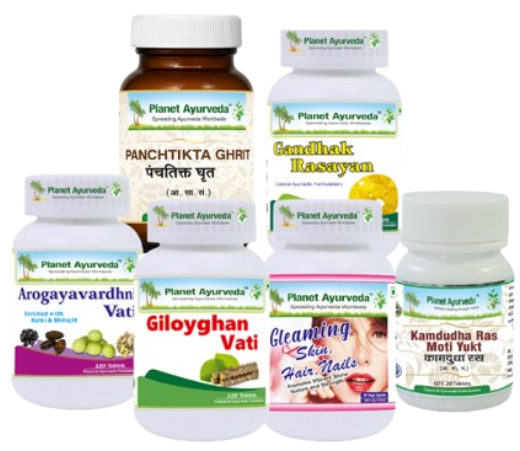
- Gandhak Rasayan
- Gleaming Skin Hair Nails Formula
- Panchtiktaka Ghrit
- Kamdudha Ras Moti
- Arogyavardhini Vati
- Giloyghan Vati
Herbal Remedies of Epidermolysis Bullosa

Product description
1. Gandhak Rasayan
Gandhak Rasayan, containing Shuddha Gandhak (purified sulphur), may be considered in Ayurveda as a supportive formulation for skin health and tissue nourishment. Its traditional properties are associated with Twak Prasadana, Rasayana, and Pitta-Kapha balancing effects, which may support skin integrity and recovery from recurrent lesions.
Dosage: 2 tablets twice a day with lukewarm water.
2. Gleaming Skin Hair Nails Formula
It contains Manjistha (Rubia cordifolia), Pit Papda (Fumaria officinalis), Ghritkumari (Aloe barbadensis), and Sariva (Hemidesmus indicus), traditionally used to support skin health. In an Ayurvedic supportive context, these herbs may help maintain healthy skin, soothe irritation, and support tissue nourishment.
Dosage: 2 capsules twice a day with plain water after meals.
3. Panchtiktaka Ghrit
Panchtiktaka Ghrita may be considered in Ayurvedic supportive management of epidermolysis bullosa because its Tikta (bitter) and cooling properties are traditionally used to support skin health, reduce Pitta-related inflammation, and promote tissue nourishment. Its ghrita base may provide Rasayana and Brimhana effects, supporting the repair and maintenance of weakened skin tissues. The formulation may help reduce dryness, irritation, and inflammatory discomfort while supporting wound healing and healthy skin regeneration.
Dosage: 1 teaspoon twice a day with lukewarm water.
4. Kamdudha Ras Moti
It contains Mukta Bhasma, Shankh Bhasma, Praval Bhasma, Vartikā Bhasma, Shuddha Gairik, Giloy Satva, and Mukta Shukti Bhasma. In an Ayurvedic supportive approach, its cooling and Pitta-pacifying properties may help address burning, irritation, and inflammatory features associated with fragile skin. The formulation is traditionally considered supportive of Rakta and Twak health and may promote tissue nourishment.
Dosage: 2 tablets twice a day.
5. Arogyavardhini Vati
Arogyavardhini Vati, containing Haritaki, Bibhitaki, Amalaki, Shuddha Shilajit, Shuddha Guggul, Chitraka Moola, and Kutki, may be considered as a supportive Ayurvedic formulation for skin and tissue health. Traditionally, its Deepana, Pachana, Rasayana, and Dosha-balancing properties are considered helpful for supporting metabolism and tissue nourishment. In EB, it may theoretically support the body’s response to recurrent skin injury and promote overall tissue health.
Dosage: 2 tablets twice a day with lukewarm water.
6. Giloyghan Vati
It is prepared from Giloy (Tinospora cordifolia), may be considered a supportive Ayurvedic formulation in epidermolysis bullosa (EB) because Guduchi is traditionally valued for its Rasayana, anti-inflammatory, antioxidant, and immunomodulatory properties. These actions may theoretically support tissue resilience, recovery from recurrent skin injury, and the body’s response to inflammation.
Dosage: 2 tablets twice a day with lukewarm water.
Conclusion
Epidermolysis bullosa requires comprehensive, individualised and long term management aimed at minimizing tissue injury and addressing associated complications. Regular monitoring is important to identify complications early and maintain comfort and daily functioning. Appropriate dietary support and lifestyle practices can contribute to tissue repair and general health. Ayurvedic interventions offer supportive measures for skin health, tissue nourishment and overall well being, provided they are supervised properly. A multidisciplinary approach can contribute to substantially improving patient outcomes and the quality of life.