Category: Liver Health

How to Treat Hyponatremia ( Low Blood Sodium) in Ayurveda

ABSTRACT

Hyponatremia is the medical condition when the level of serum sodium goes below 135 mEq/L. It is a medically important and common imbalance of electrolyte which can occur due to various situations or medical illnesses like renal failure, heart failure, pneumonia, liver failure etc. Hyponatremia can be mild to severe in form depending upon the level of sodium decreased in serum. In this write up we will learn all about Hyponatremia and its management through herbal remedies.

INTRODUCTION

There are various electrolytes present in the body and sodium is one of them. It is an essential one which helps to maintain the water balance around and inside the cells of the body. This water balance maintained by sodium is important for nerve functioning and proper muscle function along with maintaining normal blood pressure. The insufficiency of sodium in blood is termed as hyponatremia.

This imbalance is caused due to either too much water (diluting the sodium) or too less sodium creating an imbalance. The normal level of sodium in blood should be around 135-145 mEq/L. However when the sodium goes down to range below 135 mEq/L, the condition is hyponatremia.

When this level of sodium decreases in the cells, too much water starts to move inside the cells resulting in their swelling up. To be noted, this is not a minor change but a major one which can alter almost all the other functions of the body resulting in various signs and symptoms. Various diseases affecting the liver, kidneys, heart, or certain medicines can cause this condition. However the condition can usually be reversed with proper treatment and the patient gets back to being healthy.

Hyponatremia

SIGNS AND SYMPTOMS

Signs and symptoms in patients suffering from hyponatremia can differ depending upon the speed of depletion of sodium. If the sodium level in blood falls slowly and gradually then the patient is likely to not experience any of them, however if the depletion occurs at a faster rate then the complaints are severe. Some of the common signs and symptoms seen are

  • Fatigue
  • Lack of energy or lethargy
  • Weakness
  • Nausea and vomiting
  • Headache
  • Spasm or cramps in muscles
  • Changes in mental status
  • In severe cases the patient can have seizures, loss of consciousness and coma

CAUSES

Low sodium or hyponatremia, i.e. low sodium level in blood can occur due to various reasons. The basic cause behind it can be losing a lot much water and electrolytes. Some of the major causes for hyponatremia are:

  • Severe diarrhea or vomiting
  • Intake of diuretics
  • Intake of antidepressants or other certain medications
  • Kidney failure or other kidney disease
  • Liver disease
  • Dehydration
  • During exercise drinking water in large quantity
  • Congestive heart failure or other heart ailments
  • Adrenal gland disorder affecting its ability to maintain a balance of potassium, sodium and water in the body
  • Hypothyroidism
  • Diabetes insipidus in which the body does not make the antidiuretic hormone
  • Inappropriate antidiuretic hormone syndrome resulting in retention of water in the body
  • Polydipsia i.e. excessive thirst leading to drink too much water
  • Cushing syndrome

DIAGNOSIS

Hyponatremia can easily be detected by a simple blood test which will indicate the low levels of sodium in the blood. Medical history presenting the signs and symptoms will make your doctor doubt hyponatremia further on blood tests. Even if the patient does not have signs and symptoms regular metabolic panels will show it up. On discovering the low level of sodium in your blood further urine tests are advised to check its level in urine. The Results of the urine test will help to determine the exact cause behind hyponatremia.

If the level of sodium in urine is high, it means there is increased loss of sodium from your body and if the level is low in urine as well, this indicates the low intake or there is too much water in the body.

TREATMENT

Treatment for hyponatremia depends upon the cause of it. However the certain measures taken conventionally are:

  • Decreasing the intake of fluid
  • Treatment of underlying cause like liver, kidney, heart or brain disease
  • Cutting off the diuretics or adjusting the dosage
  • Intravenous infusion of sodium solution
  • Other symptomatic treatment is given for weakness, headache, nausea etc.

Ayurveda here can help in treating the underlying condition and maintaining the level of the sodium in the body naturally. There are certain herbs and compounds which help in making a balance between electrolytes in the body. Ayurveda is the holistic science which not only treats the presenting complaints but also deals to eradicate the root cause behind it.

HERBAL REMEDIES BY PLANET AYURVEDA

Planet Ayurveda is a very well known herbal pharmaceutical company that indulges in the production of herbal medicines and products. All the production is under the strict supervision of the MD Ayurveda doctors and classical Ayurvedic literature is the base of the production. No dye, chemicals, fillers, preservatives, colors, and yeasts are used in any herbal medicine which enhances their efficiency. For hyponatremia, Planet Ayurveda offers a combination of herbal remedies that helps in management of the ailment.

Product List

  1. Chitrakadi vati
  2. Lavan bhaskar churna
  3. Brahmi capsule
  4. Neuroplan syrup

Product Description

Herbal Remedies for Hyponatremia

Herbal Remedies for Hyponatremia

1. Chitrakadi vati

It is classical Ayurvedic formulation prepared from various herbs like Pippali (Piper longum), Chitraka (Plumbago zeylanica), Shunthi (Zingiber officinale), Maricha (Piper nigrum), Chavya (Piper chaba) etc. Chitrakadi vati helps in treating diarrhea and hence prevents dehydration. These tablets also improve the function of the liver.

Dosage– Take 2 tablets twice daily after meals with plain water

2. Lavan bhaskar churna

The chief ingredient of this churna is Rock salt, Black salt, Coriander (Coriandrum sativum), Peepal (Ficus religiosa), Black cumin (Nigella sativa), Anardana (Punica granatum), Black pepper (Piper nigrum), Piplamool (Piper longum) etc. Lavan bhaskar churna helps to fill the sodium deficiency in the blood that is too naturally. It also helps to relieve gastric issues like constipation, gas, bloating etc.

Dosage– Take 1 tsp twice daily with buttermilk or plain water

3. Brahmi capsule

Bacopa monnieri (Brahmi) in standardized form is used to prepare these herbal capsules. Brahmi is known as the brain tonic and hence these capsules help to treat the ailments of the nervous system like confusion, weak memory, seizures and irritability.

Dosage– Take 2 capsules twice daily after meals with plain water

4. Neuroplan Syrup

This multi herbal syrup as the name suggests helps to maintain a good nervous system balance and help to treat its ailments as well. In hyponatremia, Neuroplan syrup helps to treat seizures, loss of consciousness, confusion, and other brain related symptoms. It is prepared from Brahmi (Bacopa monnieri), Mandukaparni (Centella asiatica), Ashwagandha (Withania somnifera), Shankhpushpi (Convolvulus pluricaulis), Jyotishmati (Celastrus paniculatus) etc herbs.

Dosage– Take 2 teaspoon twice daily after meals with plain water

CONCLUSION

Hyponatremia is a common ailment that can affect people of any age or gender. However people suffering from kidney, liver, heart or brain disease are more prone to it also the severity of symptoms depends upon the level of the sodium. Some patients even might not have any complaints while others can have serious conditions. Herbal remedies by Planet Ayurveda help in refilling this deficiency of sodium and maintain the balance of electrolytes in the body naturally.

Alternative Treatment For Crigler Najjar Syndrome (Type 1)

Abstract

There are many congenital and inherited disorders which are becoming common in children as the world is growing. With technology our life was supposed to become easy but it is becoming more of a difficulty instead of the agenda “Difficulties being solved”. The children are even born with diseases now and diseases like whose solution is not written anywhere, is not described anywhere. In this article we are going to discuss one of such conditions whose name is Crigler Najjar Syndrome (Type 1). The condition is an inherited disorder and is related to bilirubin. The article mentions all about Crigler Najjar Syndrome (Type 1) and how its management is possible with Ayurvedic formulations.

crigler najjar syndrome

Introduction

Crigler Najjar Syndrome (Type 1), as mentioned earlier is an inherited disorder in which the bilirubin is not broken down. In this condition the patient basically lacks the enzyme that normally converts the bilirubin into a form that can be easily removed from the body through stools and urine. But without this enzyme the bilirubin build up is obvious and thus it results in damage to several organs, mostly the brain. The condition of severe jaundice appears. The Crigler Najjar Syndrome (Type 1) is caused by the mutation in a certain set of genes called UGT1A1 and it was inherited. The condition is understood as an autosomal recessive manner.

Causes of Crigler Najjar Syndrome (Type 1)

The cause of crigler- Najjar syndrome is a result of gene mutation. This gene is responsible for providing instructions for making Bilirubin uridine diphosphate glucuronosyltransferase (Bilirubin UGT) enzyme. This enzyme is primarily found in liver cells and is necessary for the removal of bilirubin from the body.

If understood from the view point of Ayurveda, then this condition is simply the result of bijadushti i the worm by the tridosha. The aggravation of doshas may be due to external factors like emotional stress from the side of the family or husband or may be due to internal factors like wrong eating habits etc.

Symptoms of Crigler Najjar Syndrome (Type 1)

The symptoms related to crigler najjar syndrome type 1 are as follows:

  • The symptoms usually vary from patient to patient and usually appear just after the birth.
  • Affected child present with severe and persisting yellowing of skin along with mucous membranes and sclera (white portion of eyes)
  • The infants are also at the risk of developing kernicterus which is commonly known as  bilirubin encephalopathy. All of this happens within the first month of life.
  • The kernicterus is a potentially life threatening condition, which is related to the neurological system. In this condition, toxic levels of bilirubin start accumulating in the brain and cause irreversible damage to the central nervous system.
  • There are some early signs of kernicterus which may include lack of energy or lethargy, vomiting along with fever or not taking satisfactory feed.
  • Absence of certain reflexes like more reflex
  • Mild to severe pain in the muscles along with spasms
  • Spasms causing head and heels to bend or they are arched backward.
  • The body bows forward which is called as opisthotonus
  • Uncontrolled and involuntary movement of muscles
  • Spasticity is also present
  • The affected infant may suck or nurse very weekly
  • Suddenly they develop a high pitched cry and also exhibit diminished muscle tone.
  • This also results in abnormal floppiness. 
  • Kernicterus can also result in milder variety of symptoms like clumsiness, difficulty with motor skills along with underdevelopment of enamel of teeth. In Addition severe things like hearing loss, and problems with sensory perception are also present. 
  • Moreover, convulsions, slow and continuous involuntary, writhing movements are also seen. These are generally observed in arms and legs. Sometimes, the entire body is involved. 
  • When the condition appears in childhood then symptoms like fatigue, abdominal pain related to biliary stones can also be there.
  • The acute stage of illness may include symptoms like diarrhoea, vomiting, fever, confusion, slurred speech, difficulty in swallowing and sometimes change in gait, staggering and falling frequently. Same things can also continue with on and off episodes of seizures. 

Diagnosis of Crigler Najjar Syndrome (Type 1)

  • The diagnosis is suspected within the first few days of the life which is with persistent jaundice. The diagnosis is done on the basis of clinical evaluation, characteristic findings, after detailed history of the patient.
  • Blood tests reveal abnormally high levels of unconjugated bilirubin. This situation is generally associated with degeneration of high levels of RBC but in this situation it is not linked to hemolysis.
  • Moreover, analysis of bile will reveal no detectable glucuronides and urine analysis will show lack of bilirubin.

Treatment of Crigler Najjar Syndrome (Type 1)

  • The mainstay treatment of Crigler najjar includes the following:
  • Aggressive phototherapy
  • Immunosuppressant medication
  • Liver transplantation
  • Certain multivitamins like vitamin E, Vitamin C, Coenzyme Q and creatinine.
  • If the condition is aggressive,  intravenous fluid hydration is done along with management of elevated glucose along with administration of  albumin and even plasma exchange is also done.

Ayurvedic View Point of Crigler Najjar Syndrome (Type 1)

As mentioned before the cause in this situation is the beejadushti from the Ayurvedic view point. The symptoms in the body are arising due to the high levels of pitta in the body and it can be well managed with the Ayurvedic herbs. Bile here is considered as pitta and when it is not converted into the form which can be easily excreted out of the body then it starts accumulating in the body and thus causes various types of problems. To balance this pitta it is really important to maintain the healthy functioning of the liver here. Liver is termed as yakrit in Ayurveda and To maintain the health of Yakrit there are many things which can be done in Ayurveda. Certain formulations can be given for the shaman of pitta and some others are given to enhance the working of the liver.

Herbal Formulations for Crigler Najjar Syndrome (Type 1)

Planet Ayurveda is a herbal manufacturing company, which prepares effective Ayurvedic products. The products are vegan and do not contain any kind of additives, adulterants, dyes, preservatives, flavour enhancers and other chemicals. The products are prepared using effective Ayurvedic herbs which are effective in managing many conditions efficiently. The products by Planet Ayurveda in this condition can be of great help and helps in giving fruitful results.

They enhance the body’s metabolism and also work as an immune modulator. The diseases related to the liver can also be very well managed using Ayurvedic formulation. This simply means that they have a great effect on the working of the liver. Formulation offered by Planet Ayurveda in Crigler Najjar Syndrome (Type 1) are as follows:

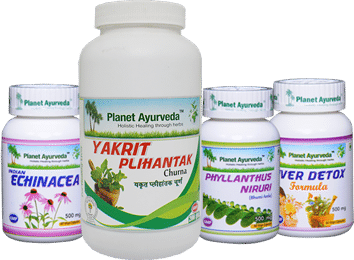
  1. Yakrit Plihantak Churna
  2. Phyllanthus Niruri
  3. Echinacea Capsules
  4. Liver Detox Capsules

Crigler Najjar Syndrome

Product’s Description

1. Yakrit Plihantak Churna

Yakrit plihantak churna is a classical Ayurvedic formulation which has many beneficial herbs like Bhumi Amla (Phyllanthus niruri), Katuki (Picrorhiza kurroa) Makoy (Solanum indicum) Punarnava (Boerhavia diffusa) Kalmegh (Andrographis paniculata) Kaasni (Cichorium intybus) Sharpunkha (Tephrosia purpurea) and Bhringraj (Eclipta alba). These herbs are potent in enhancing liver functioning, removing accumulated fat in the liver and also are effective in showing liver protecting effects. This churna is having very brilliant results not only in enhancement of liver functioning and also is effective in getting rid of the obstruction in the bile duct which is the main reason of biliary atresia.

Dosage: Half tsp daily with lukewarm water after meals.

2. Phyllanthus Niruri

Phyllanthus niruri capsules are the standardised extract of Bhumi amla (Phyllanthus Niruri). It is a very great formulation that is having its direct effect on the liver. It helps in enhancement of liver functioning and gives really wonderful results. In this condition it helps by its effect on the liver and also helps in balancing the levels of the bilirubin in the body. The formulation also helps in the body’s detoxification and has a soothing effect on the entire body. As it controls the level of bilirubin in the body it helps in protecting nerves and brain from harmful effects of high bilirubin.

Dosage: One capsule twice daily after meals.

3. Echinacea Capsules

Echinacea capsules also have standardised extract of kalmegh (Andrographis paniculata). Kalmegh is known as a kind of bitters and is a very great pitta dosha pacifier. Kalmegh is known for its great effects on the liver and supports healthy functioning of the liver.  Due to its bitter taste the herb is really well known for its effect on kapha dosha as well. Echinacea Capsules also help in liver detoxification and help in excreting out the bile from the body as well. The formulation is really great for managing this situation and tends to give nice results.

Dosage: One capsule twice daily after meals.

4. Liver Detox Capsules

Liver detox formula has herbs like Kutki (Picrorhiza kurroa), Punarnava (Boerhavia diffusa), Kalmegh (Andrographis paniculata), Haritaki (Terminalia chebula), Kasni (Cichorium intybus) and many others. The liver detox formula helps in clearing the toxins that are accumulated in the liver and also may help by enhancing the liver enzymes secretion. It also helps in balancing the pitta dosha thus leading to proper digestion. It is a very effective formulation which helps in treating various ailments. Liver detox formula has herbs like kalmegh that have liver protective effect too and also help in liver cell regeneration. In this condition liver detox works by protecting and detoxifying the liver.

Dosage: One capsule twice daily after meals.

Conclusion

The situations like these are very difficult for even parents to watch. Sometimes, such conditions lead to severe brain damage and thus can prove fatal. But with technology many things are possible. Though phototherapy is the only conservative treatment in this situation along with Ayurvedic formulations the phototherapy can prove to be more effective. The patient can recover at a faster rate. The formulations prepared by Planet Ayurveda do not have any type of additives, fillers, dyes, preservatives in it. The products are totally natural and do not have any side effects. They have a very good role in this condition In case of any query kindly visit www.planetayurveda.com