Category: GASTROPARESIS

Planet Ayurveda Agnitundi Vati – Ayurvedic Medicine for Strong Digestion & Metabolism

ABSTRACT

In the present era, digestive disorders such as Agnimandya (a weakened digestive fire) are prevalent across all age groups, resulting from impaired digestive fire (Agni) that leads to toxin accumulation (Ama) and complications like fever associated with indigestion (Amajvara). Ayurveda attributes these to Vata and Kapha dosha aggravation with channel obstruction and metabolic disturbances. Agnitundi Vati, a classical herbo-mineral formulation, features Ushna (hot potency), Tikshna (penetrating action), Lekhana (scraping), and Deepana (appetizer) properties to effectively balance both doshas, kindle digestive fire, and eliminate Ama (endotoxins). It comprises equal proportions of purified minerals, alkaline ashes, salts, and select herbs triturated with citrus fruit juice for enhanced efficacy. A detailed overview of this formulation follows.

INTRODUCTION

Agnitundi Vati is a potent herbo-mineral formulation renowned for igniting digestive fire and alleviating agnimandya (weak digestion) along with its complications. The name “Agnitundi” signifies its thunderbolt-like (tundi) action on Agni (fire), combining purified mercury, sulfur, aconite, alkaline ashes, salts, borax, and select herbs triturated in lemon juice for profound ama endotoxins clearance and vitality restoration. Primarily indicated for weak digestion, bloating, indigestion-related fevers, and toxin-mediated symptoms, it promotes robust gut health and metabolic harmony.

This preparation acts on annavaha srotas (digestive channels), addressing ama (endotoxins) buildup, jatharagni (digestive fire) impairment, and dosha vitiation. It effectively dispels anorexia, abdominal discomfort, fever due to indigestion (amajvara), and vata-kapha imbalances. By scraping channel obstructions, balancing Vata and Kapha doshas, and rejuvenating without aggravating Pitta, Agnitundi Vati serves as a key remedy for digestive debility and associated systemic issues.

Acidity and Bloating

CLASSICAL INDICATION

Agnimandya (weak digestion)

INGREDIENTS

शुद्धसूतं विषं गन्धमजमोदाम् फलत्रयम् ।
स्वज्जिक्षारं यवक्षारं वह्निं सैन्धवजीरकम् ॥१३॥
सौवर्चलं विडङ्गानि सामुद्रं टङ्कणं समम् ।
विषमुष्टिं सर्वतुल्यं जम्बीराम्लेन मर्दयेत। 
मरीचाभाम् वटीम्   खादेदग्निमांद्यप्रशांतये  ॥१४॥
(भैषज्यरत्नावली, अग्निमान्द्याधिकार; १३ –१४)
  • Shuddha Parad (Purified Mercury) – 1 part
  • Vatsanabha (Aconitum ferox) – 1 part
  • Gandhaka (Sulphur) – 1 part
  • Ajamoda (Apium graveolens) – 1 part
  • Haritaki (Terminalia chebula) – 1 part
  • Amalaki (Emblica officinalis)– 1 part
  • Sarji Kshara (Sodium carbonate) – 1 part
  • Yava Kshara (Barley)– 1 part
  • Vahni (Plumbago zeylanica)– 1 part
  • Saindhava Lavana (Rock salt) – 1 part
  • Jiraka (Cuminum cyminum) – fruit – 1 part
  • Sauvarcala Lavana (Black salt) – 1 part
  • Vidanga (Embelia ribes) – 1 part
  • Samudra Lavana (Sea salt) – 1 part
  • Tankana (Borax) – 1 part
  • Vishamushti (Strychnos nux-vomica) – 16 parts
  • Jambiramla (Citrus lemon) – Q.S. (for trituration)

INGREDIENT DESCRIPTION

  • Shuddha Parada (Purified Mercury) possesses madhura rasa (sweet taste), snigdha guna (unctuous property), and ushna virya (heating potency), balancing Vata and Kapha doshas. It acts as a supreme rasayana (rejuvenator) and yogavahi (catalyst), effectively improves weak digestive fire (agnimandya) through its synergistic blend of ushna-tikshna (hot-piercing property) ingredients that kindle digestive fire, dissolve ama, and clear srotas (microchannels) obstructions.
  • Shuddha Vatsanabha (Purified Aconitum ferox) possesses tikta-katu rasa (bitter-pungent taste), laghu-ruksha guna (light-dry properties), and ushna virya (heating potency), primarily pacifying Vata and Kapha doshas. It acts as a potent deepana (appetizer), shothahara (anti-inflammatory), and vishaghna (anti-toxic), stimulating jatharagni (digestive fire) to dispel ama (endotoxins), relieve abdominal colic, and enhance nerve conduction for better peristalsis.
  • Shuddha Gandhaka (Purified Sulphur) features katu rasa (pungent taste), snigdha guna (unctuous quality), and ushna virya (hot potency), balancing Vata-Kapha while mildly aggravating Pitta. As a yogavahi (bio-enhancer) and lekhana (scraping agent), it purifies dhatus (body tissues), boosts metabolism, eliminates endotoxins, supports skin health, and augments antimicrobial action against ama-related infections
  • Ajamoda (Apium graveolens) has tikta-katu rasa (bitter-pungent taste), laghu-snigdha guna (light-unctuous properties), and ushna virya (hot potency), targeting Vata-Kapha doshas with deepana-pachana (appetizer-digester), anulomana (carminative), and shulahara (pain reliever) effects. It alleviates adhamana (bloating), pavana (flatulence), and ama (toxin) accumulation by promoting srotas shodhana (channel clearance) and agni vriddhi (gastric motility).
  • Haritaki (Terminalia chebula) exhibits five tastes, ruksha-laghu guna (dry-light property), and ushna virya (hot potency), tridoshahara (balances all doshas) as a rasayana. It kindles digestive fire, acts as a laxative & detoxifier, removes srotorodha (channel blocks), and prevents endotoxins (ama) by enhancing nutrient absorption and tissue rejuvenation.
  • Bibhitaka (Terminalia bellirica) offers kashaya-madhura rasa (astringent-sweet taste), ruksha guna (dry property), and ushna virya (hot potency), pacifying Kapha-Vata with grahi (astringent), deepana (digestive), and keshya (hair promoting) properties. It strengthens annavaha srotas (digestive channels), controls atisara (diarrhea) from ama (toxins), clears respiratory mucus (Kapha), and supports ayu (longevity) by shodhana (detoxification) and dhatu poshana (tissue nourishment).
  • Amalaki (Emblica officinalis) is amal rasa (sour taste) dominant, snigdha guna (unctuous property), and sheeta virya (cooling potency), tridoshahara (balances three doshas) with supreme rasayana (rejuvenative) status. Rich in vitamin C, it rejuvenates jatharagni (digestive fire) without Pitta aggravation, neutralizes free radicals, combats oxidative ama (toxin) damage, enhances immunity (vyadhi kshamatva), and promotes hematopoiesis for vitality.
  • Sajji Kshara (Sodium carbonate) provides katu-ushna (pungent-hot) qualities, acting as tikshna (sharp) deepana-pachana (appetizer-digester) to shatter ama (endotoxins) complexes, relieve udara shula (abdominal pain), and alkalize acidic gastric environment (amla pitta) for optimal digestion (pachana).
  • Yava Kshara (Barley ash alkali) has katu rasa (pungent taste), laghu guna (light property), ushna virya (hot potency), targeting Kapha-Vata as anulomana (carminative)-shulahara (pain reliever). It scrapes meda/ama (fat/toxins), eases vibandha (constipation), adhamana (bloating), and arsha (hemorrhoids) by clearing mutravaha srotas (urinary channels) and enhancing peristalsis (anatomical movement).
  • Vahni also known as Chitraka (Plumbago zeylanica) features katu rasa (pungent taste), snigdha guna (unctuous property), ushna virya (hot potency), potently pacifying Kapha-Vata as digestive fire enhancer and krimighna (anti-helminthic). It dahati (burns) ama, dissolves gulma (abdominal tumors), stimulates glandular secretions (upasneha), and boosts anupana (bioavailability) of co-herbs.
  • Saindhava Lavana (Rock salt) offers lavana rasa (salty taste), snigdha guna (unctuous property), ushna virya (hot potency), balancing all doshas mildly (tridoshahara). As yogavahi (catalyst), it enhances herb absorption (grahana), lubricates srotas (channels), stimulates salivation, and counters Kapha-induced shushkata (dryness) without jala vriddhi (fluid retention).
  • Shveta Jiraka (Cuminum cyminum) has katu-kashaya rasa (pungent-astringent taste), laghu-ruksha guna (light-dry properties), ushna virya (hot potency), pacifying Vata-Kapha with deepana (appetizer)-anulomana (carminative)-shulaghna (analgesic) actions. It relieves gas, colic, atisara, diarrhea, enhances liver function, and dispels belching from weak digestive fire.
  • Sauvarchala Lavana (Black salt) provides lavana-amla rasa (salty-sour taste), guru guna (heavy property), ushna virya (hot potency), targeting Kapha as carminative & digester. It decongestes srotas (channels), improves rasa buddhi (taste perception)  and anorexia, alkalizes ama (endotoxin) acidity, and supports electrolyte balance for digestion.
  • Vidanga (Embelia ribes) exhibits katu rasa (pungent taste), snigdha-laghu guna (unctuous-light properties), ushna virya (hot potency), Kapha-Vata shamaka (pacifier) with krimighna (anti-parasitic) & rechaniya (purgative) effects. It eradikates krimi (worms), ama (endotoxins), purifies gut flora, and kindles digestive fire, and prevents malabsorption.
  • Samudra Lavana (Sea salt) has lavana rasa (salty taste), snigdha guna (unctuous property), ushna virya (hot potency), mild tridoshahara as anulomana (carminative). It softens channel blocks (srotorodha), stimulates digestive fire, aids mineral assimilation, and counters Kapha mandata (sluggishness) without Pitta increase.
  • Shuddha Tankana (Purified Borax) offers madhura-katu rasa (sweet-pungent taste), snigdha guna (unctuous property), ushna virya (hot potency), balancing Vata-Kapha-Pitta as deepana (appetizer)-shulahara (pain reliever)-keshya (hair tonic). It ledayati (dissolves) kapha/ama (phlegm/toxins), relieves kasaghna (cough)-kantha roga (throat issues) linked to mandagni (weak digestion), and enhances skin & hair vitality.
  • Shuddha Vishamushti (Purified Strychnos nux-vomica) possesses tikta-kashaya rasa (bitter-astringent taste), laghu guna (light property), ushna virya (hot potency; in large proportion: 16 parts), Vata-Kapha pacifier with uttejaka (stimulant), shulahara (analgesic), and visha-hara (anti-toxic) properties. It powerfully stimulates neuromuscular function, dispels pakshaghata-like (paralysis) ama stagnation, boosts peristalsis, and counters udara manda (visceral lethargy).
  • Jambira (Citrus lemon) juice (Q.S. for trituration) provides amla rasa (sour taste), laghu guna (light property), ushna virya (hot potency), tridoshahara especially Kapha-Pitta. As a potent digester, it dissolves endotoxins, enhances mineral and herbal absorption, vitamin C boosts immunity, and provides hridayada (refreshing) anupana (adjuvant) for optimal bioavailability.

METHOD OF PREPARATION

Agnitundi Vati is prepared using the classical Kharaliya Rasayana (trituration method) in a Khalva Yantra (mortar-pestle). First, equal parts (1 part each) of Shuddha Parada (Purified mercury), Shuddha Vatsanabha (Purified Aconitum ferox), Shuddha Gandhaka (Purified sulphur), Ajamoda (Apium graveolens fruit), Haritaki (Terminalia chebula pericarp), Bibhitaka (Terminalia bellirica pericarp), Amalaki (Emblica officinalis pericarp), Sajji Kshara (Sodium carbonate), Yava Kshara (Barley ash), Vahni/Chitraka (Plumbago zeylanica root), Saindhava Lavana (Rock salt), Shveta Jiraka (Cuminum cyminum fruit), Sauvarchala Lavana (Black salt), Vidanga (Embelia ribes fruit), Samudra Lavana (Sea salt), and Shuddha Tankana (Purified borax) are blended with 16 parts Shuddha Vishamushti (Purified Strychnos nux-vomica seeds). The mixture undergoes repeated bhavana (trituration) with Jambira (Citrus lemon) rasa (juice) – Quantity Sufficient (Q.S.) until the attainment of scraping test (laja bhavat), forming a smooth, blackish pill dough. Finally, 125-250 mg vati (tablets) are rolled, dried in shade, and stored airtight to preserve potent herbo-mineral synergy without involving agni samskara (incineration).

MEDICINAL PROPERTIES

  • Agnitundi Vati pairs best with lime juice (Nimbu swarasa) and warm water (Ushnodaka) as anupana (adjuvant) for optimal Vata-Kapha shamaka (pacifying) effects, igniting jatharagni (gastric fire), relieving Aruchi (anorexia), and restoring vitality through deepana (appetizer) and pachana (digestive) actions.
  • For Agnimandya (Impaired Digestion) Management, administer Agnitundi Vati (125-250 mg twice daily) with Hingvashtak Churna (1 g), reducing Adhmana (bloating) and Gaurava (heaviness) via enhanced ama pachana (toxin digestion) and vata anulomana (downward movement) synergy.
  • In cases of Amajvara (Ama-associated Fever), Agnitundi Vati is used alongside Guduchyadi Kashaya (40 ml), a potent jwaraghna (anti-pyretic) for Jvara and Daurbalya (weakness), boosting agni deepana (fire kindling) and ama shodhana (toxin clearance) properties.
  • In conditions associated with Ajirna (Indigestion) & Vibandha (Constipation), Agnitundi Vati works best with Abhayarishta (15-30 ml with warm water), aiding srotas shodhana (channel cleansing) and mala pravritti (bowel movement) by balancing Vata-Kapha and promoting dhatu poshana (tissue nourishment) for sustained digestive harmony.

IMPACT OF DOSHA

Agnitundi Vati primarily pacifies Vata (cold, dry qualities causing colic, bloating, impaired motility) and Kapha (heavy, sticky traits leading to sluggish digestion, ama accumulation, anorexia) through its ushna (heating), tikshna (sharp), and lekhana (scraping) actions that kindle jatharagni (digestive fire) and clear obstructed srotas (channels). It mildly balances Pitta via alkaline and rasayana components, preventing hyperacidity or inflammation aggravation while supporting metabolic harmony in toxin-mediated fevers. Ideal for Vata-Kapha dominant Agnimandya (weak digestive fire) and its complications.

INDICATIONS

  • Sluggish digestion (Agnimandya)
  • Indigestion-associated fever (Amajvara)
  • Anorexia (Aruchi)
  • Abdominal bloating (Adhmana)
  • Flatulence and belching (Pavana-Udgara)
  • Abdominal colic (Udara Shula)
  • Constipation/Diarrhea (Vibandha/Atisara)
  • Intestinal worms (Krimi)
  • Vata-Kapha disorders
  • Digestive debility
  • Toxin-mediated weakness (Ama Daurbalya)
  • Poor appetite with fatigue

DOSAGE

  • 125-250 mg – once or twice daily, after meals for agnimandya (impaired digestion) and amajvara (toxin fever).
  • Anupana (Adjuvant): Lemon juice (Nimbu swarasa) or warm water.

WHY CHOSE PLANET AYURVEDA’s AGNITUNDI VATI

Planet Ayurveda’s Agnitundi Vati excels due to its adherence to classical Bhaishajya Ratnavali proportions, GMP-certified production ensuring rigorous purification of potent rasa dravyas like mercury and aconite for complete safety and zero heavy metal toxicity, 100% natural vegetarian formulation free from fillers, binders, or preservatives to deliver pure herbo-mineral synergy, clinically validated standardization enhancing bioavailability and stability, and widespread trust among practitioners with proven rapid results in kindling digestive fire and toxin clearance, all at an affordable price with user-friendly packaging.

CONTRAINDICATION

  • Pregnancy and lactation
  • Children under 12 years
  • Pitta-dominant hyperacidity or peptic ulcers
  • High blood pressure

CONCLUSION

Agnitundi Vati stands as a time-tested herbo-mineral powerhouse in Ayurveda, masterfully blending potent mineral ingredients with digestive herbs to reignite gastric fire, dissolve toxins, and restore channel patency for profound metabolic revival. This sharp, appetizer formulation excels in conquering impaired digestion and toxin-associated fever, offering safe, synergistic relief when dosed judiciously under expert guidance, transforming digestive debility into vibrant vitality.

Piles Natural cures and Alternative Remedies

Abstract

Everyone in the world is busy making money through jobs or business and other things. But no one really cares about the body they have. It is really essential to understand that the body is the base of every emotion you have, every feeling you feel, every work you do and every thought you have. Not taking care of your body gives a chance to diseases, disorders and conditions to rise in your body and maximum of these diseases, disorders or conditions are due to fluctuating lifestyle and dietary habits. Lifestyle includes all the things we do like prolong sitting for hours, too much work on screen, no fixed time of eating along with dietary habits like eating too much fast food, binge eating, eating without thinking etc. give rise to many lifestyle disorders and one of such diseases is piles. Piles has become a really common problem especially in the youngsters and this article is all about piles, its ayurvedic aspect and its management using ancient herbs and formulations.

Introduction

Piles, one of the most common problems encountered in today’s world and the surprising thing is that people sometimes don’t even know that they have piles. In Ayurveda piles is known by the name Arsh and ancient texts also mentioned its types like vataj Arsh (having predominance of vata dosha), piitaj Arsh (having predominance of pitta dosha), kaphaj Arsha (having predominance of kapha dosha) and raktaj Arsh (bleeding piles). The modern concept of piles explains  that piles are of three types that are internal, external and prolapsed. The article will cover both of the aspects along with the approach of management for piles. Though the protocol is a bit similar but still has differences at some point. Medically piles are called hemorrhoids. Hemorrhoids simply means a swollen vein or group of veins in the anus region, either externally or internally.

Piles

Causes of piles

The cause of piles is just one that is increased pressure in the lower rectum and this increased pressure is the responsible factor for formation of piles. So what are the reasons for this increased pressure? Keep on reading if you want to know the reasons!!

The reasons for increased pressure in lower rectum are following

  1. The first and the most common is constipation. Constipation increases the pressure on the lower rectum which finally can result in both internal or external piles.
  2. The second most common cause for increased lower rectum pressure is pregnancy. In pregnancy, as the uterus expands it puts pressure on the rectum placed just behind it resulting in piles. Again these piles can be internal or external.
  3. The next reason is chronic diarrhea. Diarrhea can be the reason for piles in patients like ulcerative colitis and crohn’s disease.
  4. Other causes include habis like straining while passing stool, lifting weights, prolonged sitting,having chillies in excess, increased intake of alcohol, having too much refined grains etc.

In Ayurveda there are certain specific causes for onset of piles or any type of Arsha. These includes

  1. Intake of heavy, sweets, cold and abhishyandi aahar (food which is heavy and slimy) , vidahi aahar (causing burning in stomach), viruddh anna (improper food combinations).
  2. Indigestion, eating less in quantity
  3. Asaatmaya food (improper food)
  4. Intake of Cow meat, fish, pig meat, buffalo meat, goat meat, sheep meat in heavy quantities regularly.
  5. Excessive sneha paan (intake of ghee), curd, sesame and jaggery intake
  6. Doing no exercise
  7. Sleeping in day time
  8. Indigestion
  9. Prolonged constipation

These all causes can cause all types of arsha or piles. But these situations arise only when a person is not having a good lifestyle as well as dietary habits.

Prodromal symptoms

The prodromal symptoms refer to or donate the period between the appearance of initial symptoms. So for all type of arsha or piles, Ayurveda mentions following prodromal symptoms:

  1. Indigestion (Vishtambh)
  2. Flatulence (Aatop)
  3. Weakness (dorbalaya)
  4. Constipation (vibandha)
  5. Emaciation (kasharya)
  6. Excessive belching (Udgaar bahulya)
  7. Pain in thighs (Sakthi sadan)
  8. Sprue (Grahni dosha)
  9. Anaemia (Pandu)
  10. Abdominal disorder (Udar roga)
  11. Polydipsia (Pippasa)
  12. Small quantity of stool (alpa vitakta)

Symptoms of Arsha or piles According to Ayurveda and Modern

  1. Pain and burning in anal region (daha and shoola in gudda)
  2. Sometimes even bleeding per anus is also observed (rakta sarava)
  3. Constipation (Mal badhta)
  4. Diarrhoea (atisaar)
  5. Flatulence (aatop and aadhmaan)

On the other hand Modern explains the symptoms of piles in two types that are external symptoms and internal symptoms. Obviously the internal symptoms are for internal piles and external are for external piles.

Symptoms of  internal piles

  1. Painless bleeding during bowel movements. The blood is bright red in colour.
  2. A pile pushing through anal opening called as protruding or prolapsed pile.

Symptoms of external piles

  1. Itching and irritation in your anal region
  2. Discomfort and pain
  3. Bleeding
  4. Swelling around anus region

There is an additional type of pile called a thrombosed pile. The blood pools in an external hemorrhoid or external pile thus forms a clot which can result in severe pain, swelling, inflammation and a hard lump near your anus.

Diagnosis internal and external piles

The diagnosis of piles can be done using digital and visual examination.

1. Digital examination

Inserting a gloved lubricated finger into your rectum by your doctor for inspecting any unusual growth.

2. Visual examination

Proctoscopy is done by inserting a proctoscope inside your rectu as internal piles are really soft to feel. This examination visualizes the lower portion of rectum.

Criteria for treatable and untreatable piles according to Ayurveda

1. Sadhya arsha (treatable piles)

  1. There is predominance of only one dosha that is either kapha, pitta and vata dosha
  2. Below the dentate line
  3. The pileous mass that is not older than one year.

2. Krich Sadhya (treatable with difficulty)

  1. Having dominance of two doshas.
  2. Present above dentate line.
  3. Pilous mass older than one year.

3. Asadhya pile (non treatable piles)

  1. The patient has piles with swelling over feet, face, mouth, umbilicus, anus and heart along with pain in ribs.
  2. Patient suffering from vomiting, pain in body, fever, thirst and pus in anal region.
  3. Piles present from birth
  4. The pilous mass having predominance of all three doshas
  5. Present above the dentate line.

Treatment (According to Ayurveda and Modern)

The Ayurvedic for piles is described by Two Aacharyas. Aacharya charak explains the treatment with internal administration and panchakarma procedures of medication and acharya Sushruta explains four different ways to treat piles.

Let’s discuss the treatment according to Aacharya charak first

1. Sanshodhan chikitsa (includes panchakarma procedures)

  1. Vaman karma (vomiting induced by administration of emetic drugs)
  2. Virechan karma (Purgation induced by administration of laxative drugs)
  3. Basti (Asthappan and anuvasana basti): Medicated enema using unctuous decoction and non unctuous decoction.
  4. Picha basti (Enema prepared using milk and effective herbs)

2. San Shaman chikitsa (Internal medicine)

The Ayurvedic texts describe use of effective formulations which include

  1. Rasa aushadiya also like arsh kuthar ras, ashtanga ras,
  2. Some vatis like jatiphaladi vati, chandra prabha vati,
  3. Some powdered formulations like vijay churna, dhaturadi churna etc.
  4. Along with the  administration of some decoction formulations like takrarishta, abhayarishta, kankarishta, draksha aasav and
  5. Some ghrita formulations like chavya ghrita, pippalyadi ghrita etc.

On the other hand Acharya Sushruta explained four sidhanta for the chikitsa of arsh. The four sidhanta are as follows:

  1. Bheshaj (that is internal medicine): In arsha having less aggravation of dosha and are with less complications
  2. Kshar karma (In soft, bleeding or in Arsha having dominance of pitta dosha)
  3. Agni karma (In hard and in arsha having predominance of vata and kapha dosha)
  4. Shstra karma (In Arsha having soft root and presence of all three dosha)

Modern treatment for Arsha or piles

There are several types of hemorrhoid surgery available. Let’s get to know about all of them. The following are the procedures done to remove piles:

1. Rubber ligation

The procedure is done for the bleeding piles or prolapsed internal hemorrhoid. The procedure involves placing a rubber band on the base of a hemorrhoid. This will help in restricting the blood flow and eventually causing hemorrhoids to fall off.

2. Coagulation

Coagulation is helpful in treating internal bleeding hemorrhoids which are not protruded. Basically a trained doctor will use an electric current or infrared light to create scar tissue on the hemorrhoid, thus restricting the blood supply to the hemorrhoid and causing it to fall.

3. Sclerotherapy

In sclerotherapy this procedure involves a doctor injecting a chemical solution into internal hemorrhoids. The solution helps in relieving pain as it makes nerve endings numb and causes a scar tissue formation. Thus hemorrhoids fall.

4. Hemorrhoidectomy

This procedure aims to remove the hemorrhoid and the procedure is performed by the expert surgeon under local anesthesia or will receive a spinal block.

5. Hemorrhoid stapling

The procedure is especially for internal hemorrhoids and has no significance for external hemorrhoids. A special device is used to staple the hemorrhoids to normal position within the anal canal. This restricts the blood supply and causes reduction in size slowly.

If your doctor does not guide you for any of the above mentioned procedures then you are probably in a good condition. So generally some laxatives and ointments are prescribed. Now after knowing all about piles in both Ayurveda and Modern science let’s proceed towards some natural cures of piles as mentioned in Ayurvedic texts. These ways can be of great help for an immediate relief.

These are as following

1. Sudation or swedan

The sudation or swedan is really helpful especially in stiff and swollen pilous mass. Generally the swedan is done using potli swedan. In potli swedan a cloth packet in round shape and is filled with various herbs like yav (Hordeum vulgare),  masha (Vigna mungo), kulathi (Macrotyloma uniflorum) and Pulaka (tucchadhnnya). The potli is generally applied after smearing it in oil prepared using chitraka (Plumbago zeylanica) and Bilva (Aegle marmelos).

2. Ava Ghana (Sitz bath)

Sitz bath after mixing alum in the water is a very effective hemostat and also relaxes the swollen piles, reduces stiffness and thus is really effective in reducing discomfort too. Before a sitz bath one can apply jatyadi tail.

3. Jatayadi tail pichu

This involves application as well as insertion of jataydi oil in or into the anal opening.

4. Pralepa (ointments)

The ointment is prepared using powder of haridra (Curcuma longa) mixed with latex of Snuhi (Euphorbia neriifolia). The paste is really helpful to reduce swelling over the pilous mass present.

Herbal formulations by Planet Ayurveda

Planet Ayurveda is a leading Ayurvedic firm which deals with the manufacturing of herbal formulations. These formulations are prepared using potent herbs which are really effective in managing many conditions related to immune system disturbances and its working. The formulations prepared by Planet Ayurveda do not contain any kind of adulterants, dyes, additives, fillers etc. These medications are really potent to manage various conditions related to all the anorectal conditions especially and are very fruitful hence giving positive noticeable results. The medication or formulations offered by Planet Ayurveda for the management of piles as follows

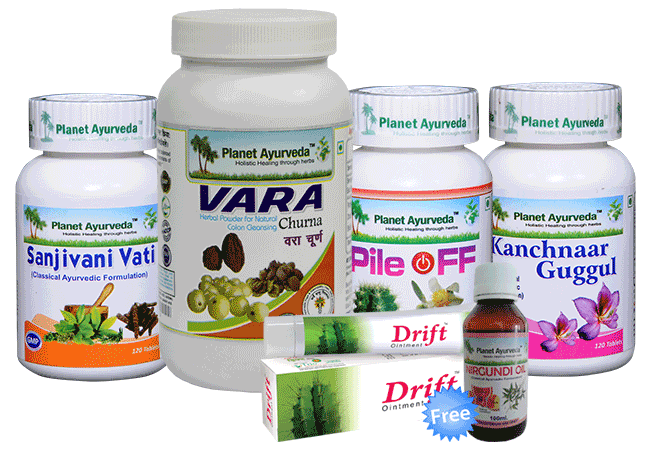
Piles Care Pack

  1. Sanjivani vati
  2. Vara churna
  3. Kanchnaar Guggul
  4. Pile off capsules
  5. Nirgundi oil
  6. Drift ointment

Natural Treatment of Piles

Alternative Treatment for Piles

PRODUCTS DESCRIPTION

1. Sanjivani Vati

Sanjivani vati is popularly known to infuse life. It is best for ama digestion and also helps in burning the accumulated toxins. This is also a classical formulation and contains many herbs like sonth (Zingiber officinale), vidanga (Piper retrofractum), giloy (Tinospora cordifolia), triphala etc. These all combinedly strengthens the immune system and hampers the recurrence of any disease. These herbs when ingested and passed through the intestine creates an environment that is suitable for healthy digestion. It all over works by enhancing the digestion power and provides a very good and positive effect on digestion processes as well as on the digestive system.

Dose: Two tablets twice a day after meals along with lukewarm water.

2. Vara Churna

Vara churna is based on a classical preparation called as triphala churna. It consists of amalaki (Emblica officinalis), bibhitaki (Terminalia berberica) and haritaki (Terminalia chebula). This combination is the best combination which acts as a stool softener and laxative also. It also has an antioxidant effect. It works by the bhedan of stool in the colon and reduces chances for constipation which is the main reason for onset of piles. Vara churna is the best stool laxative and has a very great impact on digestion as well as on piles.

Dose: Half teaspoon twice a day after meal with lukewarm water.

3. Kanchnaar Guggul

Kanchnaar guggul is a classical formulation that has constituents like bark of kachnar (Bauhinia variegata), amalaki (Emblica officinalis), haritaki (Terminalia Chebula), bibhitaki (Terminalia bellerica), black pepper (piper nigrum) and others. These all ingredients help in reducing  the size of swollen piles. It is also very beneficial in reducing the size of piles or prevents its further growth. The formulation is also very effective in reducing the chances of recurrence as well as chances of any complications further.

Dose: Two tablets twice daily after meals with lukewarm water.

4. Pile off capsules

Pile off is a poly herbal formulation and  is specifically used in management of piles. This herbal formulation is prepared from the standardized extracts of Haridra (Curcuma longa), Pippali (Piper longum), Maricha (Piper nigrum), Shunthi (Zingiber officinale), Sajjikshar (Soda bi carb powder), etc. It relieves pain, stinging feeling and inflammation over the pile mass. The capsules also help in smooth evacuation of stools. These capsules normally relax the nerves and hence reduce tenderness or stiffness present over pile mass.

Dose: One capsule twice a day with lukewarm water after meals

5. Nirgundi oil

The nirgundi oil  is a medicated oil preparation useful in piles and also in some kinds of wounds. The oil is formulated with herbs like Nirgundi (vitex negundo), Manjishtha (Rubia cordifolia), Haridra (Curcuma longa), Kalahari (Gloriosa superba), etc. All of these herbs have anti-inflammatory, analgesic and antiseptic properties. Thus they are  helpful in pain, swelling and any kind of infection. The oil protects the piles from getting infected.

How to apply: Just apply this oil over the pile mass two times a day with the help of cotton.

6. Drift ointment

The ointment is used for the management of all kinds of anorectal disorders. It relieves itching and pain over pile mass. It also reduces bleeding and swelling in the affected area. This ointment contains herbs like nirgundi beej (seeds of Vitex negundo), Lajjavanti (Mimosa pudica), Bhringraj (Eclipta alba), etc. These all ingredients are helpful in shrinking the pile mass and also help in reducing the pain and other associated symptoms.

How to apply: Directly apply over the pile mass two times a day

Conclusion

Piles is basically a lifestyle disorder and sometimes such conditions are at peace if you try to bring some positive change in your diet and lifestyle. No doubt, we all have a busy schedule but as I mentioned before, taking care of our bodies is also our duty and we should do it at any cost. It does not require anything more than just a try and obviously an honest try. Try to control the craving and try to push for not being lazy. The above mentioned products are totally natural and do not cause any kind of side effects. In case of any query kindly visit www.planetayurveda.com