Category: Child Health

Concept of Sapta Dhatu in Ayurveda

Sapta Dhatu in Ayurveda

Abstract

According to the Ancient Ayurvedic texts- to maintain Swasthya i.e. health our Sharira (body) needs to have maintained compatibility between Dosha, Dhatu, and Mala. Basically, harmony among these components is essential to maintain health. ‘Sapta Dhatu’(The seven bodily tissues) as the name itself says – ‘Sapta’ means seven and ‘Dhatu’ is that which supports or better to say holds the body. Let’s discuss it in detail!

Sapta Dhatu in Ayurveda

Introduction

According to Texts and Samhitas of Ayurveda, these Dhatus provide

Nourishment & growth to the entire body. Here the 7 dhatus consist of

  • Rasa (Plasma, WBC, lymph)
  • Rakta (RBCs & platelets)
  • Mamsa (Muscle tissues)
  • Meda (Adipose/fat tissue)
  • Asthi (Bones/Skeletal tissues)
  • Majja (Bone marrow)
  • Shukra (Reproductive tissue)

These are responsible for prime functions of the body. Rasa which is first

among all the dhatus provides nourishment to the other 6 dhatus. Rasa indicates Ahara rasa (Chyle) which is absorbed from Ahara is the diet we consume. Dhatu refers to the 7 structural components of the body, Acharya Sushruta in (S.Su.14/10) says that Rasa dhatu provides nourishment to rakta dhatu, rakta dhatu to mamsa dhatu, mamsa dhatu to meda dhatu, meda dhatu to asthi dhatu and so on.

समदोषः समाग्निश्च समधातु मलःक्रियाः।

प्रसन्नात्मेन्द्रियमनः स्वस्थइतिअभिधीयते॥  (S.Su 14/41)

  • Acharya Sushruta says that the sense of well being of Atma (soul), Mana (mind) and Indriyas (sense organs) is attained by a state of equilibrium between dosha, dhatu and mala. And alteration in them causes diseases.
  • So, Ayurveda believes that all the dhatus are nourished by the food we eat. If vitiation of dosha takes place in any dhatu then it will affect all the next dhatus.
  • When dhatus are at the state of equilibrium, it prevents diseases,elements of tissues develop properly hence it slows down ageing. Each of these seven dhatus have their own updhatus (Produced by dhatus during metabolism), particular pramanas (normal values) in Anjali pramana (its a unit of measurement of liquid in Ayurveda) & predominance of different
  • Mahabhutas (According to Ayurveda all living and nonliving things are made of 5 mahabhuta – Prithvi, Agni, Vayu, Jala & Akash are called Panchmahabhutas).
  • According to Acharya, Sushruta dosha gets severity (mahatwa) and stability (sthiratwa) when it invades the Dhatus of the body. It becomes even more difficult to manage, when they have invaded the deeper dhatu and say this should be treated as soon as possible to avoid severity.

Rasa Dhatu

Rasa dhatu has a predominance of Jala Mahabhuta. So this predominance keeps rasa dhatu in liquid form. Rasa basically means something that is mobile, hence this dhatu provides mobility. Dhatu which is circulated continuously in the body is the Rasa dhatu. This dhatu is formed from previously digested food.The important karma/function of Rasa dhatu is Prerana that means satisfaction or feeling of freshness. Acharya Sushruta in S.Su15/51 says that Rasa dhatu by supplying fluid & minerals to every cell of the body keeps the body and mind fresh.

  • Predominant Mahabhuta – Jala
  • Updhatu of Rasa Dhatu- Stanya (breast milk), rajas (menstrual fluid)
  • Pramana – 9 Anjali

Physiological Functions of Rasa Dhatu Includes

When the rasa dhatu is in sam awastha that is neither increased or decreased the person feels cheerful, happy and as it nourishes the skin so the skin too looks nourished moisturised and also it nourishes the next dhatu that is rakta dhatu.

When the rasa dhatu depletes it makes one’s skin dry and hard, the person is pale, lean, fatigued, the person can’t tolerate loud noises or voices, the person experiences exhaustion, thirst, feeling of fear, pain in chest.

When the rasa dhatu elevates the person loses appetite , saliva secretion increases, nausea, vomiting, feels heavy, feels cold and sleeps a lot more than usual and bad taste in mouth is felt.

Rakta Dhatu

The physiological function of rakta dhatu that can be correlated to blood (RBC,WBC & Platelets) in modern Science.

  • Updhatu of Rakta Dhatu – Kandara (tendons) & sira (blood vessels)
  • Predominant mahabhuta – Agni & Jala
  • Pramana – 8 anjali

The main function of rakta dhatu is to nourish mamsa dhatu. The rakta dhatu is inseparable from the Pitta dosha. So when rakta dhatu decreases from its usual pramana it diminishes the pitta dhatu and that makes the person feel cold.Even the lustre of skin loses and becomes dull and dusty.

Elevation of Rakta dhatu increases the guna (properties) of Pitta dosha and that makes the person feel warmer than usual. The built up heat in the body, tries to release it along with the malas of the body.this ultimately increases bowel movements of the body even the stools can be loose too. This also increases the frequency of urine.

Mamsa Dhatu

The physiological function of Mamsa dhatu is to strengthen the body, to build tissues of muscle in various regions of the body like in the neck, shoulders and thighs. Also the Mamsa dhatu provides nourishment to Meda dhatu.

  • Updhatu of Mamsa Dhatu includes Vasa (fatty material), Shat twacha (seven layers of skin).
  • Predominant Mahabhuta – Prithvi
  • Pramana – Male – 500 & Female – 520 in nos.
  • Depletion of mamsa dhatu causes debility to the sense organs,it emaciates the cheeks and buttocks,or collapse of blood vessels may also take place, and a person can also experience joint pain.
  • Elevation of the Rakta dhatu can cause obesity, breathing disorders, increase of the abdomen and flanks, fatigue, bad smell from one’s body etc.

Meda Dhatu

Meda dhatu which can be correlated to Adipose Tissue in modern, The General function of meda dhatu is Snehan (that which provides lubrication). Its function consists of nourishment of asthi dhatu.

  • The Updhatus – sweda(sweat) Snayu (ligament), sandhi (joints).
  • Predominant mahabhutas are Prithvi & Jala.
  • Pramana – 2 anjali

If  Meda dhatu depletes it can cause enlargement of spleen and also difficulty in movement of joints. Its depletion also increases the urge to eat fatty food.

When Meda dhatu increases than its usual amount the person feels tired and fatigued, fat in regions like abdomen, neck, thighs etc. the person has a foul smell in his/her sweat and experiences breathlessness.

Asthi Dhatu

Asthi dhatu can be correlated with the skeletal tissues or the bones. Dharana can be considered as the general function of Asthi dhatu.

  • Its updhatu includes Danta (teeth).
  • Predominant mahabhuta are Prithvi & Vayu.
  • Pramana – 360 in nos.

So as per qualities of vayu mahabhuta, Asthi is dry & rough and as like prithvi mahabhuta it is strong & heavy. Physiological functions of Asthi dhatu are that it gives good stability and structure to the body along with a hard working capacity. It nourishes the majja dhatu.

When the amount of Asthi dhatu decreases that its required amount there will be pain in bones (pricking type of pain) & the bones become porous which makes the bone prone to fractures even with a mild trauma. Depletion of this dhatu also leads to hair fall, fragile nails or even falling of teeth.

Similarly, increase in the dhatu leads to unusual growth of bones, teeth can be developed one over the other.

Majja Dhatu

This dhatu is located deep inside the asthi dhatu and are formed when during the formation of asthi dhatu a cavity is left in them, it is formed by nourishing tissues of fat. The Majja dhatu strengthens the bone and also makes the bone flexible. It also balances the dryness of asthi dhatu.

  • Its updhatu is Kesha (hair).
  • Predominant mahabhuta – Jala
  • Pramana – 1 anjali

So, depletion in the levels of Majja dhatu weakens the bones which eventually causes pain in the joints, giddiness and also the depletion of this dhatu causes depletion of Shukra dhatu too.

Elevations in the level of this dhatu leads to heaviness of the whole body especially eyes.

Shukra Dhatu

Shukra is the seventh and the final dhatu in the dhatu formation cycle. Ayurveda considers shukra as the male semen and the female egg. Hence a person with healthy shukra has a brightness of confidence in his/her eyes, and also has a brighter skin.

  • Predominant mahabhuta is Jala (water)
  • Its updhatu is Ojas (immunity)
  • Pramana – ½ anjali

In case of depletion of Shukra dhatu ejaculation is delayed or even semen mixed with blood can ejaculate, which ultimately causes pain in the testicles. The person will also be weak and an increase in thirst can also be seen. Exhaustion, dryness in mouth, general body aches, impotency can also be seen.

Elevation in Shukra dhatu may lead to a person’s increased desire towards

coitus, development of stone in the seminal tract can take place.

Conclusion

The above article concludes that the elevation or depletion of any particular dhatu leads to disease. That’s why all the dhatu should be nourished well for their proper functioning and to attain good immunity in order to stabilise the body. A proper harmony between the doshas and dhatus should also be maintained in order to attain a healthy life.
Plantar Warts Causes, Symptoms, and Ayurvedic Treatment

Abstract

The feet are the ones which take us to many places and feet health is the one which is mostly ignored by a human being. That’s the most wrong thing to do, our feet demand equal care as our face and we reject this fact from time to time. Due to our ignorance, our feet develop conditions like Plantar warts, various fungal infections, and bacterial growths. But all can be avoided by just taking care of your precious feet. In this article we will discuss one condition which is affecting the feet of many humans and is quite irritating. This is known as Plantar warts. The plantar warts are mostly due to HPV infection that is human papillomavirus but its other causes are also stated in the following article. So, let’s get to know more and more about Plantar warts.

Plantar Warts

Introduction

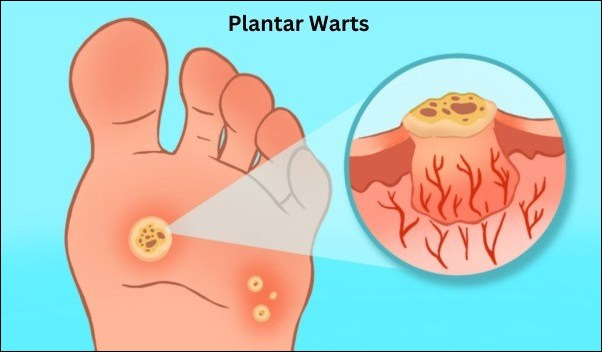
Plantar warts are a type of skin infection which is present on the sole of the feet. It can be single sided or can be present on both of the feet. The term “plantar” refers to the sole of the foot. These are small and rough overgrowths which are present on the sole of the foot or feet. They are mostly present in the areas which tend to bear most of the pressure. The pressure causes inward growth of the wart which is below a hard and thick layer of skin which thus results in various symptoms present in this condition. This thick layer of skin is called a callus. Plantar warts are mostly caused by human papillomavirus which enters inside through tiny breaks or cuts on the bottom of the feet. Most of the plantar warts are not serious and go away themselves especially in the children below the age of 12. Mostly self care works in this condition really well. In Ayurveda Plantar warts are correlated with Kadar.

Causes of Plantar warts

As we have discussed above, they are due to the HPV infection or human papillomavirus infection. Human papillomavirus is the name of a very common group of viruses. These viruses cause problems in most people or some types are potent to cause genital warts or even cancer.

Symptoms and Signs of Plantar Warts

The Sign and Symptoms of Plantar Warts may vary from person to person but following are one of the most important

  1. A small but fleshy slight rough and grainy growths or lesions are observed on the sole of the foot. The most major sites are the base of toes and heels of one or both feet
  2. Hard or thickened skin which is called as callus is observed
  3. Black pinpoints are also seen which are called Wart seeds. These are clotted blood vessels
  4. A lesion which interfere the normal ridges/ lines in the skin of foot (both sides)
  5. Pain and tenderness can be present while walking as well

In Ayurveda it has been explained that pain in case of Plantar warts is of pricking nature and can have secretions as well.

Diagnosis of Plantar Warts

The diagnosis of Plantar Warts can be done through following methods

Physical Examination involves the examination of lesions and tearing them with scalpel. Also check for the signs of dark or pinpoint dots (Tiny clotted blood vessels).
Sometimes the small section of lesion is removed and is sent for biopsy.

Treatment for Plantar Warts

The Plantar warts are harmless mostly and also go away without treatment but in case if it persists and starts spreading the medical attention is needed. For such warts strong peeling medicine like salicylic acid, freezing medicine like the one used in cryotherapy are preferred.

In some cases electrodesiccation is also preferred which is a minor surgical procedure.

Ayurvedic Aspect of Plantar Warts

Plantar Warts, as mentioned before, are called or understood as kadar in Ayurveda. Kadar is one of the kshudra rogas which are mentioned in Ayurveda and kshudra rogas simply means small or minor or negligible. Roga means disease. Various Aacharyas have mentioned kshudra rogas and they are 44 in number according to Acharya Sushruta. On the other hand, Acharya Vagbhatta has mentioned 36 kshudra rogas.

The Kadar is being mentioned by both of them and is defined as painful swelling at the sole of the foot.

In addition, if understood according to Acharya Sushruta deeply then he is mentioned in Nidana Sthana chapter 13 Shlok 29-30.

Reference Sushruta samhita Nidana Sthana 13/29-30

The above shloka explains that injury due to small stones, thorns  etc can result in vitiation of meda along with rakta dosha. This results in hard nails like swelling in the middle of the sole of the foot.

This Nail like swelling is a bit raised from the flat surface of the skin and is a bit oval in shape.

Aforementioned in symptoms the kadar results in pain and a granthi (type of hard swelling) which may ooze some discharge. That’s how Plantar warts are being explained in Ayurveda. But it doesn’t end here. Acharyas have also mentioned treatment of Kadar or Plantar warts in Ayurveda.

Treatment of KADAR/ Plantar Warts in Ayurveda

Reference Sushruta samhita Chikitsa sthana 20/33

Explaining treatment of Kadar in his samhita, Acharya Sushruta has explained that its best to do chedan karma in case of kadar. Chedan karma is called excision in modern language. After Chedan the Cautri is done with Vata Nasak oil.

But initially the situation can be managed with Ayurveda and siddha medication without requirement of any minor or major surgical procedure. Plantar warts are well managed with herbs which are responsible for cleansing the circulatory system like manjistha and neem. Along with that, gandhak or purified sulphur also has good results in kadar. A popular herb from siddha medication system called as Thuja occidentalis also gives good impact in this condition.

Herbal Remedies For Plantar Warts by Planet Ayurveda

Planet Ayurveda, A herbal supplements  manufacturing company which has been in the market for more than two decades. The Planet Ayurveda manufactures both patent and classical products. All of the products are GMP certified and do not have anything which is against the ethics. The company has its resellers around the world and in many parts of India as well. The products are registered with the FDA as well. The manufacturing of products is strictly done under the MD Ayurveda experts so as to maintain the unique quality of them. Ayurveda has solutions to many problems, problems especially like plantar warts. Planet Ayurveda has following products to manage Plantar Warts

Produts List

  1. Gandhak Rasayan
  2. Mahamanjisthaghan Vati
  3. Neem Capsules
  4. Kustha Rakshas Tel + Thuja Occidentalis Mother Tincture

Product Description

1. Gandhak Rasayan

Gandhak rasayan is a Ayurveda classical formulation which has only purified sulphur (Shuddha Gandhak) as its ingredient. Sulphur is an element which is known for its various properties in Ayurveda and also an ingredient in many formulations. Gandhak has the power to rejuvenate and hence help in removing the warts. As the warts are benign growths, they are easily managed with gandhak rasayan. Gandhak rasayan has the tendency to move into microchannels after ingestion and remove impurities etc from them. It’s a great preparation and can be given in both genders and at any age.

Dosage: Two tablets twice a day after meals with lukewarm water

2. Mahamanjisthaghan Vati

Mahamanjisthaghan vati is an impressive formulation which has only one ingredient and that is manjistha (Rubia cordifolia). The role of this formulation is in blood purification and it also acts as a brilliant immunomodulator. The formulation works on the plantar warts or warts which are there anywhere in the body. Due to its immunomodulatory effect it has its impact on the body’s metabolism and also results in pacification of doshas. The herb is very well known for its blood purification effect and has its positive impact on the entire body. The tablets are having impressive results in this condition and prepared under the strict guidance of MD Ayurveda Experts

Dosage: Two tablets twice a day after meals with lukewarm water

3. Neem Capsules

Neem Capsules are the patent product of Planet Ayurveda and have neem (Azadirachta indica) extract. The extract which is used for the manufacturing of these capsules is totally herbal and is very potent for the elimination of Plantar Warts. In addition, these capsules are prepared under the strict guidance of MD Ayurveda experts and have an impressive effect in easing the rough surface of warts. The warts are often due to fungal infections or bacterial infections but potent extract of neem helps in making the things better in such cases. The reason is it has antifungal and antibacterial effects as well.

Dosage: One capsule twice a day after meals with lukewarm water

Kustha Rakshas Tel + Thuja Occidentalis Mother Tincture

4. Kustha Rakshas Tel

Kustha rakshas tel is a classical preparation manufactured by Planet Ayurveda. It is prepared in the same way which is mentioned in the classics and gives good results in Plantar warts or any type of warts. The oil is having ingredients like Bakuchi (Psoralea corylifolia), Kushta (Saussurea lappa), Chitraka (Plumbago zeylanica), Aragwadha (Cassia fistula), Saptaparna (Alstonia scholaris), Rasona (Allium sativum) and many others. These all ingredients have an impressive effect in decreasing the plantar warts and also have anti fungal and anti bacterial effects. The oil also has purified mercury and purified sulphur which are also having a good impact in many conditions related to skin due to their rasayanic effects.

5. Thuja Occidentalis Mother Tincture

The Mother tinctures of herbs originated in homoeopathic sciences. Mother tinctures are the liquid preparation resulting from the extraction of a suitable herb or animal substance and then mixed with alcohol and water. These are mixed in a particular ratio to make mother tincture. In the same way thuja occidentalis mother tincture is prepared. Thuja is known for its great effects in warts and thus helps in elimination of the same.

How to Use Kustha Rakshas Tel + Thuja Occidentalis Mother Tincture

Take the amount of kushta rakshas tel to be used. Now add 3-4 drops of thuja occidentalis mother tincture. Mix well and apply over wart/warts.

Contact Planet Ayurveda Support Team to provide you the costing/ordering and delivery information at – costing.planetayurveda@gmail.com or Call at 0172-521-4040 (India), +91-172-521-4040 (Outside India) or Whatsapp at (+91) 842-749-4030

Conclusion

The plantar warts are difficult to treat and if ignored for a long time it can give you troubles in walking and running too. The warts are small, rough growths on the feet and they usually show up on the balls or heels of the feet. Modern treatment of plantar warts generally involves freezing medicine called cryotherapy. In Ayurveda, the same is done with the help of herbal and mineral medication. Ayurveda also explains agni karma for warts, which is a cauterization technique. In modern times the treatment involves surgery as well but it will not give much impressive results. In case of any query kindly visit www.planetayurveda.com