Ayurvedic Treatment Of Vasculitic Neuropathy With Herbal Remedies
ABSTRACT
Vasculitic neuropathy is a systemic illness which develops eventually after vasculitis. Vasculitis is the inflammation of the blood vessels that can lead to blood vessel occlusion which eventually results in ischemia in the tissues and organs. Ischemia is a condition in which a certain part of the body gets affected due to reduced or restricted blood and oxygen supply to it. When this inflammation reaches the blood vessels that supply peripheral nerves, it causes vasculitis neuropathy. In this article you can get all the information about Vasculitic neuropathy and its Ayurvedic management and treatment.
INTRODUCTION TO VASCULITIC NEUROPATHY
Vasculitic neuropathy is a peripheral neuropathic condition which results in damage to the blood vessels that supply the nerves. This disease can be either a single organ issue or it can be due to the systemic problem which affects the peripheral nervous system. Vasculitic neuropathy is a serious ailment that can cause prolonged disability and morbidity and hence require medical attention and treatment. It is diagnosed with the help of various tests like electrophysiological test testing, nerve biopsy and blood tests along with clinical examination.
AYURVEDIC ASPECT OF VASCULITIC NEUROPATHY
As per Ayurveda, Vasculitic neuropathy is caused due to vitiation of tridosha. According to Ayurveda, tridosha, i.e. Vata, Pitta and Kapha are responsible for the maintenance of the health and imbalance of any of these dosha-caused diseases. In case of Vasculitic neuropathy, all of the three doshas are vitiated which cause the signs and symptoms of the ailment.
SIGNS AND SYMPTOMS OF VASCULITIC NEUROPATHY
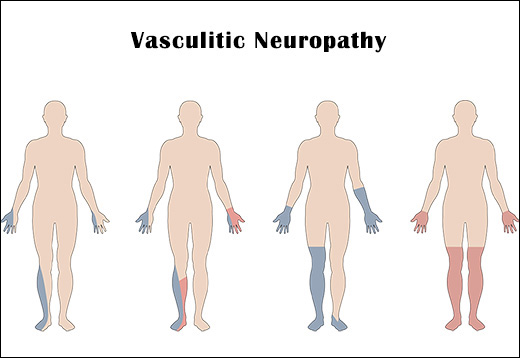
The signs and symptoms of Vasculitic neuropathy depend upon the location of the affected nerve and its type. Usually this ailment results in dysfunction of both the sensory and motor system of the body resulting in various unusual sensations experienced by the patient like pain, numbness, weakness of limbs and its muscles. Most peripheral neuropathies are symmetrical and affect the both sides of the body equally, however this is not the case with Vasculitic neuropathy. In this neuropathy, the affected part can be very asymmetric and one limb is more affected than the other.
CAUSES OF VASCULITIC NEUROPATHY
Vasculitic neuropathy is generally caused due to systemic vasculitis which can affect different organs in the body like lungs, kidneys, skin etc. Some of the conditions which affect the whole body and can lead to Vasculitic neuropathy are Chrug-Strauss syndrome, polyarteritis, microscopic polyangiitis and Wegener granulomatosis. Vasculitic neuropathy can also occur secondary to other inflammatory diseases like systemic lupus erythematosus and rheumatoid arthritis. Here the reasons for vascular wall damage are lymphocytes and macrophages.
TYPES OF VASCULITIC NEUROPATHY
Vasculitic neuropathy is of mainly three types, i.e. Primary, secondary and non-systemic.
- Primary Systemic Vasculitic Neuropathy – In this case the systemic vasculitis diseases, for example Polyarteritis nodosa, IgA vasculitis etc that have affected different organs in the body move towards the peripheral nervous system.
- Vasculitic Neuropathy Secondary to other Disease – Here the patient already suffering from a non systemic vasculitis disease like infection or malignancy, develops vasculitic neuropathy due to the direct effect of the former disease. Such conditions can be like rheumatoid arthritis, dermatomyositis, systemic lupus erythematosus etc.
- Non-systemic Vasculitic Neuropathy – This is a single organ ailment. It is eliminatory diagnosis which means when no other condition is diagnosed behind the vasculitic neuropathy than a diagnosis of non-systemic vasculitic neuropathy is suggested and made.
DIAGNOSIS OF VASCULITIC NEUROPATHY
Diagnosis of Vasculitic neuropathy is majorly made with the help of medical history, physical examination, and certain laboratory examinations. Tests like skin biopsies, electromyography, muscle and nerve biopsies are done for evaluating the condition.
TREATMENT OF VASCULITIC NEUROPATHY
Conventional treatment of Vasculitic neuropathy depends upon the underlying condition which is causing the vasculitis and eventually leading to Vasculitic neuropathy. As usually the underlying condition is an autoimmune disorder, hence immunomodulatory therapies are given. Mainly the corticosteroids are used to treat Vasculitic neuropathy, which in the long term can cause various complications.
AYURVEDIC TREATMENT FOR VASCULITIC NEUROPATHY
As the cause mentioned in Ayurveda is aggravation or vitiation of the tridosha, i.e. Vata, Pitta and Kapha and it is the causative factor. So the Ayurvedic treatment aims at balancing these doshas with the help of herbal remedies naturally.
HERBAL REMEDIES OF PLANET AYURVEDA FOR VASCULITIC NEUROPATHY
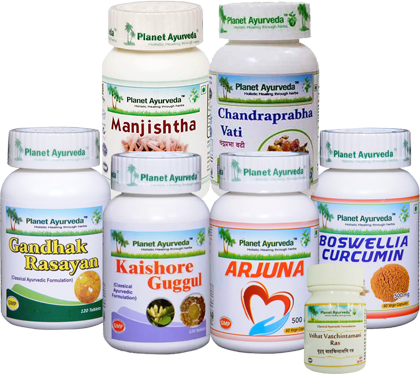
Planet Ayurveda is a very famous name in the industry of herbal pharmaceuticals. It deals in the production of herbal remedies and products which are used to treat various ailments. All these herbal products and medicines are produced from the best quality of herbs and natural compounds that possess natural therapeutic powers. For Vasculitic neuropathy, Planet Ayurveda offers a combination of herbal remedies.
Products List
- Boswellia Curcumin
- Arjuna Capsule
- Kaishore Guggul
- Gandhak Rasayan
- Manjishtha Capsule
- Chandraprabha Vati
- Vrihat Vatchintamani Ras

Products Description
1. Boswellia Curcumin
These therapeutic capsules are formulated using standardized extract of Shallaki (Boswellia serrata) and Haridra (Curcuma longa). Boswellia curcumin capsules help in easing the pain in the muscles of the limbs naturally and also helps in treating inflamed blood vessels.
Dosage: 2 capsules twice daily after meals with plain water.
2. Arjuna Capsule
Standardized extract of Arjuna (Terminalia arjuna) is used in the preparation of these medicinal herbal capsules. Arjuna capsules helps in balancing the tridoshas and helps in maintaining healthy blood circulation in the body.
Dosage: 2 capsules twice daily after meals with plain water.
3. Kaishore Guggul
Therapeutic herbs like Haritaki (Terminalia chebula), Bibhitaki (Terminalia bellirica), Shunthi (Zingiber officinale) and Amalaki (Emblica officinalis), Vidanga (Embelia ribes), Black pepper (Piper nigrum), Long pepper (Piper longum), Guduchi (Tinospora cordifolia), I ndian jalap (Ipomoea turpetheum), Guggul (Commiphora mukul), Red physic nut (Baliospermum montanum),are used in its formulation. Kaishore guggul helps in eliminating the toxins from the body that are the cause of infection in the body.
Dosage: 2 tablets twice daily after meals with plain water.
4. Gandhak Rasayan
Gandhak rasayan is known for its therapeutic effects that have been used since ages to treat various types of ailments. It is composed of purified sulfur (Shuddha gandhak). This herbal remedy helps in cleansing the body inside out and eradicates all types of toxins from the body.
Dosage: 2 tablets twice daily after meals with plain water.
5. Manjishtha Capsule
The standardized extract of therapeutic herb, i.e. Manjistha (Rubia cordifolia) is used to manufacture these herbal capsules that contain medicinal properties like anti inflammatory, antimicrobial, and antioxidant which helps in relieving inflammation of the blood vessels which are the cause of Vasculitic neuropathy.
Dosage: Take 1 capsule twice daily after meals with plain water.
6. Chandraprabha Vati
These are the multi herbal tablets which are prepared using therapeutic herbs like Shilajit (Asphaltum), Hairdra (Curcuma longa), Giloy (Tinospora cordifolia), Mustak (Cyperus rotundus), Chavya (Piper chaba), Guggul (Commiphora mukul), Kapur (Cinnamomum camphora) etc. Chandraprabha vati helps in relieving the weakness of the muscles of the limbs in Vasculitic neuropathy.
Dosage: Take 2 tablets twice daily after meals with plain water.
7. Vrihat Vatchintamani Ras
This Ayurvedic tablet is prepared from using various therapeutic bhasmas like Loh bhasma (Calx of iron), Swarna bhasma (Calx of gold), Rajata bhasma (Calx of silver), etc. As Vasculitic neuropathy is caused due to vitiation of the tridosha, Vrihat Vatchintamani Ras helps in restoring the balance of doshas.
Dosage: Chew 1 tablet twice daily after meals.
CONCLUSION
Vasculitis neuropathy can be tricky to diagnose. However, early diagnosis and correct sort of medical care and medicines can help in preventing the progression of the disease and complications. Ayurveda can help in treating Vasculitis neuropathy naturally. Our experts at Planet Ayurveda are dealing with the number of ailments daily and they are ready to serve the suffering humanity always. Do contact us at herbalremedies123@yahoo.com or you can read more about us at www.PlanetAyurveda.com
November 9, 2022
Nightfall and Its Ayurvedic Management
Abstract
When puberty hits a boy, some changes related to reproductive organs and system occurs. At this time or later in life at night involuntary ejaculation occurs that is known as night fall. Nightfall is also called nocturnal emission. A lot of men are suffering from nightfall. For some it is just a phase whereas there are others who suffer from the condition life long. In India people do not fully tell about the condition as they find it embarrassing. The over-explicit visuals and some other conditions lead to the involuntary ejaculation at night. Improper and lack of sex education and negligence on the part of parents leads to the increased cases of nightfall. In the following text, we shall have a look at the condition of nightfall in a little detail and its management. Let’s discuss!!

Introduction
Nightfall, an unfortunate condition, a lot of men suffer from. Informally it is known as sleep orgasm, se dream and wet dream. Though it is harmless. Nightfall is a condition when an involuntary ejaculation (discharge of semen) occurs at night. Nightfall is an inconvenient condition. Usually it affects men eho are less sexual active as the body relieves it of sexual arousal. In Ayurveda, the condition is known as ‘swapandosh’. In Ayurveda, the correlation can be established with shukra vaha srotas dushti. There are a number of reasons that lead to the dushti of the shukar vaha srotas.
Causes Of Nightfall
Sukarvaha srotas dushti reasons
- Indulgence in sex at restricted time ie early sexual relationships
- Having sex with women with contaminated and diseased vagina and anal and performing bestiality
- Practising holding the ejaculatory urge or lack/absence of sexual activity
- Excessive sextual intercourse and masturbation
- Injuries
- Alkali application
- Burning with fire
Other Reasons
- Sexual perversions
- Stress
- Increased libido
- Tension
- Diet, visual pleasure, sexual desires
- Lifestyle
- Obesity
- Physical inactivity
- Excessive stimulation of genitals
- Hormonal changes
Symptoms Of Nightfall
- Lack of concentration
- Pain in testicles
- Fatigue
- Gastric issues
- Feeling of embarrassment
- Joint pains
- Anaemia
- General weakness
Prevention & Reduction Of Nightfall
- Frequent masturbation or sexual intercoure to release excess semen.
- Practising meditation and pranayama for reducing stress and anxiety.
- Avoid watchung sexually explicit content
- Regular exercising
- Balanced diet
Ayurvedic Remedies For Nightfall
- Ripened leaves of bottle gourd helps in preventing night erections
- Consuming yoghourt helps in wet dreams
- Sage tea is beneficial in reducing nightfall
- Consumption of amla is of much help
Herbal Remedies for Nightfall by Planet Ayurveda
Planet Ayurveda is an esteemed GMP certified, ISO 9001:2015 certified and US-FDA registered Ayurvedic Company, which sticks to the objective of producing quality Ayurvedic products as described in a number of ancient texts of Ayurveda. Products are manufactured without additives and preservatives and other kinds of chemicals or artificial flavour enhancers which can cause a number of side effects on the human body. Products manufactured at Planet Ayurveda are pure and devoid of any kind of adulteration. The products are purely organic and vegetarian and gluten free. Planet Ayurveda presents its NIghtfall Care Pack which is efficient in preventing and curing nightfalls and helps in overall wellness of reproductive health.
Following is the list of formulation that make the Nightfall Care Pack exemplary and unique
- Chandraprabha Vati
- Kamdudha Ras Moti Yukt
- Vikramprash
- Musli Strength Capsules

Product Description
1. Chandraprabha Vati
It is a classical Ayurvedic formulation which is also called Sarvaroga Pranashini which means it ends all the aliments. It pacifies all the three doshas. It contains a variety of herbs and minerals. It is constituted with darvi (Berberis aristata), sarjikakshara (Sodium carbonate), saindhava lavana (Rock salt), maricha (Piper nigrum), trivrit (Operculina turpethum), gaja pippali (Piper chaba), chitraka bark (Plumbago zeylanica), vanshlochan (Bambusa arundinacea), ela (Elettaria cardamomum) etc. Chandraprabha vati is used adversely in various health conditions related to the reproductive health of both men and women.
Dosage: Two tablets twice a day after meals with lukewarm water.
2. Kamdudha Ras Moti Yukt
Kamdudha Ras Moti Yukt is a classical Ayurvedic formulation which is constituted with mukta bhasma (pearl calx), shankh bhasma (calx of conch shells), praval bhasma (calx of coral), varatika bhasma (calx of cowries), shuddha gairik (purified hematite), mukta shukti bhasma (pearl oysters calx) and giloy satva (extract of Tinospora cordifolia). It is a useful medicine in male reproductive system. As it heals the damage caused by various agents in shukra vaha srotas. It possesses the stambhan property thus prevents involuntary ejaculation.
Dosage: One tablet twice a day 10 minutes before meal with lukewarm water.
3. Vikramprash
Available in jam form. Ingredients are Bilva (Aegle marmelos), Agnimantha (Premna mucronata), Syonak (Oroxylum indicum), Patla (Stereospermum suaveolens), Pippali (Piper longum), Gokshura (Tribulus terrestris), Jivanti (Leptadenia reticulata), Utpal (Nymphaea alba), Musta (Cyperus rotundus) and other herbs. Drugs that are present in the formulation aids the well being of the heart because it maintains cholesterol levels within normal limits. Antioxidants present in the medicine slow down the ageing process because it is rich in nutrients that rejuvenates body cells. Every day consumption enhances sexual behaviour. It maintains digestive fire that leads to better absorption of nutrients/vitamins. It has anti-inflammatory action and acts as a tonic because it contains various herbs which are rich in multivitamins and other minerals. It acts as an immunity booster. Moreover it is helpful in various disorders.
Dosage: 1 teaspoonful once daily after a meal.
4. Musli Strength Capsules
Musli Strength Capsules are filled with goodness of gokshura (Tribulus terrestris) and safed musli (Chlorophytum borivilianum). Both the herbs pacify vata and pitta dosha. It strengthens the muscles and improves nerve conduction. Therefore, Musli Strength Capsules are helpful in Psychomotor retardation.
Dosage: One capsule twice a day after meals with lukewarm water.
Conclusion
As we have seen lack of sex education is one of the main reason that can lead to the condition of reproduction disorders. Nightfall is quite normal in those who practise holding ejaculatory urge. The conditions sometimes become so frequent and it shows bad effects on other aspects of the body. Therefore, its timely management is necessary. In preventing frequent nightfalls there is no better treatment than what Ayurveda offers. Beside medications, a healthy lifestyle and diet is essential for containing the condition. Moreover, the products mentioned above are efficiently curing wet dreams. Furthermore, nightfalls are harmless, sex education should be necessary so that children do not feel embarrassed when talking about their sexual conditions. For more information, you can check our website www.PlanetAyurveda.com and for any queries, you can send your queries to our email id herbalremedies123@yahoo.com
Click the CROSS button to close
