Category: Brain / Memory Health

Effective Ayurvedic Solutions for Premenstrual Syndrome Treatment

Nature had gifted women with the power of reproduction. New life is kindled by her womb. This makes her body functional in a very peculiar manner which has its roots in hormonal cycles. Hormones secreted by the female body have a marked impact on her physical as well as mental wellbeing. Excessive work  pressure ,unhealthy  lifestyle adoption , faulty food habits like excessive use of packed foods, disturbed time of meals proves to be one of  the major factors responsible for  hormonal imbalance . These all count on her  menstrual  health . Today the majority of women  experience symptoms prior to menstruation  and are collectively termed  as PMS -premenstrual syndrome . If not addressed rightly these syndrome may disturb her daily life  and can also be responsible for any other mental condition.

PMS (Premenstrual Syndrome)

Premenstrual syndrome is a group of physical and emotional  symptoms that starts from one to two weeks  before your period. PMS symptoms are different for everyone . You may get physical symptoms , emotional symptoms or both. It is more common in women aged 30-45.
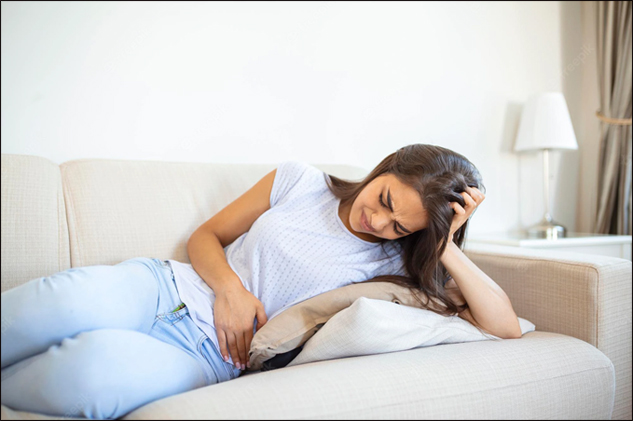
premenstrual syndrome

Physical Symptoms may include

  1. Breast tenderness
  2. Severe  abdominal pain or cramps
  3. Acne
  4. Weight gain
  5. Backache
  6. Food cravings

Emotional symptoms may include

  1. Anxiety
  2. Crying spells
  3. Mood swings
  4. Irritability
  5. Sleeping too much or too little
  6. Less interest in sex

PMS (Causes)

  • The exact cause of PMS is not clear but as we know  that  levels of estrogen and progesterone usually drop  one week before your periods . This decline in hormone levels triggers the symptoms of PMS .
  •  There is no single test that can diagnose  PMS. The symptoms  occur only during the 5 to7 days  before the menstrual period and there can be physical as well as behavioral symptoms.

Ayurvedic aspect

  • Ayurvedic believes  that PMS is caused by the imbalance in doshas . More specifically  Apana Vata . Apana vata  is located in the lower pelvic  and is responsible for elimination of menstrual blood ,urine & reproductive fluids.
  • On the onset of menstruation,  apana vata in the body increases & produces symptoms like disturbed digestion, headache & more. It also causes the aggravation of  prana vata  which is located in the head and brain and is linked to anxiety and mood disorders.
  • While there is no physical examination  that can diagnose PMS, Ayurveda can help in balancing out the doshas that cause  its symptoms.

1. Vata imbalance

Symptoms include

  • Anxiety
  • Backache
  • Headache
  • Insomnia

Herbs

  • Brahmi, Ashwagandha, Guduchi  Dashamoola , Tulsi , Shankapushpi are a few such herbs that can be used for balancing vata dosha.
  • Consuming aloe vera gel (1 tablespoon) with  a pinch of black pepper is also effective.

2. Pitta imbalance

Symptoms include

  • Irritability
  • Anger
  • Increased Appetite

Herbs

  • Herbs like Shatavari , Kumari , Amalaki ,Triphala are the  best to deal with a pitta imbalance.
  • Consume alovera gel (1 tablespoon) with  a pinch of Cumin powder is also effective.

3. Kapha imbalance

Symptoms include

  • Weight gain
  • Breast tenderness
  • Anxiety

Herbs

  • Herbs like Shatavari , Ashwagandha , Trikatu are the  best to deal with a kapha imbalance.
  • Consume alovera gel (1 tablespoon) with  a pinch of trikatu is also effective.

Some Drugs and Medicinal Formulations Which can be used on Day  to Day Basis

  1. Ashwangandha-Regular use helps to maintain optimum energy level and also confers sound sleep .
  2. Rason– Garlic is mainly indicated in  vata disorders and so has Rasayana  effects in organs.
  3. Shatavari-Single herb can be used as Rasayana and also acts on Rasa Dhatu.
  4. Chandraprabha vati- Acts as Rasayana  for female body. It takes care of any imbalance  in dosha and corrects hormonal imbalance also.
  5. Chawanprash Rasayana –Whole body rejuvenator.
  6. Having buttermilk with a pinch of fenugreek(Methi) & asafoetida(Hing) helps to relieve muscle cramps.
  7. Hibiscus flower paste is mixed with lukewarm milk & consumed  to relax the  mind .

Diet and lifestyle Tips

  1. Proper maintenance of personal hygiene.
  2. Maintaining sound and balanced state of mind throughout the day.
  3. Taking rest at regular intervals.
  4. Having a happy and positive attitude in all situations.
  5. Drink plenty of fluids including water, fresh fruit juices.
  6. Taking food only after digestion of previously taken food.
  7. Minimize the use of  soft drinks and other drinks like tea and coffee

A few yoga asanas that can help are

  • Surya Namaskar
  • Ushtrasana(camel pose)
  • Gomukhasana(cow- face pose)
  • Bhujangasana(cobra- pose)
  • Anuloma Viloma(Alternate nostril breathing)
  • Practicing breathing  exercises and meditation for Controlling thought process & associated emotions.

Herbal Remedies for PMS by Planet Ayurveda

Planet Ayurveda is a GMP certified company which offers products across the world. The products are totally organic and prepared using standardized extract of herbs under the guidance of expert ayurveda practitioners. So in PMS planet ayurveda offers PMS care pack, Let’s have a Look!

Herbs for Premenstrual syndrome

Herbal Remedies for Premenstrual syndrome

1. Pradrantak churna

Blend of four unique herbs like Ashok(Saraca asoca), Lodhra(Symplocos racemosa), Arjuna(Terminalia arjuna), Udumbar (Ficus racemosa) make a special formulation named pradrantak churna. This helps in strengthening of muscles and proper flower during menstruation.

Dosage– 1 tsp twice daily after meal with plain water

2. Aloe vitals capsules

Aloe vitals capsules contain pure extract of Aloe-vera . Aloe -vera detoxifies the whole body as it has Antioxidant properties. This product helps in healthy flow of blood & supports healthy menstruation.

Dosage– 1 cap twice daily after meal with plain water

3. Female Health support

Female Health support capsules are specially made for the overall well being of the females. These capsules are prepared using the pure extracts of -Shatavari(Asparagus racemosus), Ashoka(Saraca asoca), Lodhra (Symplocos racemosa). It helps to maintain hormonal balance.

Dosage– 1 capsule twice daily after meal with plain water

4. Mahashank Vati

It is made using herbs such as – Shunthi (Zingiber officinale), Pippali (Piper longum), Tamarind bark(Tamarind indica).This three herbs combination helps to balance all the three doshas of the body. It also helps to maintain a healthy menstrual cycle.

Dosage– 1 tab thrice daily to be chewed 20 min before meal.

5. Brahmi Vati

It contains extract of Brahmi is one of the four Medhya rasayan mentioned by Acharya Charak that means it is an Amazing brain tonic. It calms the mind & reduces the symptoms occurring in PMS like Anxiety, Mood swings & Headache.

Dosage– 2 tab twice daily after meal with plain water

Conclusion

In a nutshell it is concluded that PMS can be very well managed with ayurveda along with safe herbal formulations and diet or lifestyle. So use these formulations and keep yourself safe and healthy!  For more queries, please mail us on herbalremedies123@yahoo.com
Demyelinating Diseases – Causes, Symptoms, Types and Ayurvedic Treatment

ABSTRACT

The nervous system is the main commanding center for the body. It is responsible for the various processes of the body. One of which is the transmission of signals to and fro between the organs and brain. The proper functioning of the nervous system is very essential for the maintenance of the bodily systems. There can be numerous abnormal conditions related to the nervous system, one of which is the demyelinating disease. Demyelinating diseases is a category of diseases which affects the nervous system adversely. This condition along with its ayurvedic aspect will be discussed in detail in the following article.

INTRODUCTION

Demyelinating diseases are a group of diseases that destroy the myelin sheath of the nerves. The myelin sheath is a protective covering around the nerve fibers. When this protective covering of the nerve fibers namely the myelin sheath gets destroyed, the nerve impulses are slowed down. When there is destruction of myelin sheath, the particular region gets scared. The nerve impulses or signals are unable to transfer through the scarred region and hence, the impulses are slowed down. In severe cases, it might even stop. This will result in a variety of neurological conditions. There are various types of demyelinating diseases such as multiple sclerosis, acute disseminated encephalomyelitis, etc. We will look into these conditions one by one, but let us first discuss the common causes and symptoms of the demyelinating diseases.

CAUSES & SYMPTOMS OF DEMYELINATING DISEASES

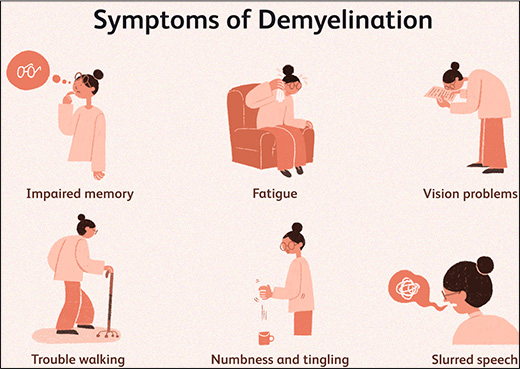
There can be numerous reasons lying beneath the condition of demyelinating diseases. Although there is no specific known cause yet, some of the causes believed to be responsible for these conditions can be a viral infection, autoimmunity, genetic conditions, ischemia of the brain i.e. lack of oxygen supply to the brain. The symptoms of demyelinating conditions will include various types of difficulties depending upon the region affected. Some of them could be vision loss, muscular weakness, stiffness in the muscles, etc. The person may also lose control or reduced control on the bladder. He/she may also experience sensory changes. Let us now discuss the types of demyelinating conditions as follows.

Demyelinating Diseases

TYPES OF DEMYELINATING DISEASES

As earlier said, demyelinating diseases are a group of conditions that are known to destroy the myelin sheath. The general causes and symptoms have already been discussed. There can be numerous types of demyelinating diseases, let us discuss a few of these as follows.

  1. Multiple Sclerosis – Multiple sclerosis is the one of the most common types of demyelinating disorders. It is a result of autoimmunity and targets the brain, optic nerve and spinal cord. The condition of multiple sclerosis usually presents with feelings of extreme fatigue, problems related to vision, etc. He/she may also face trouble in moving along with tingling or burning sensation sensations.
  2. Acute Disseminated Encephalomyelitis (ADEM) – ADEM is usually observed in children. It is an inflammatory condition that leads to destruction of myelin sheath in the brain and spinal cord. It targets the optic nerve and is considered to be a result of autoimmunity. It presents with various features such as nausea, vomiting, confusion, reduced eyesight, headache, fever, etc. 
  3. Neuromyelitis Optica (Devic’s Disease) – The devic’s disease is a rare type of demyelinating disease, it is a result of autoimmunity. Devic’s disease usually targets the eyes, arms and legs. The person may face various difficulties related to the vision such as blurred vision, total loss of vision, pain in eyes, which may be accompanied with complaints of weakness or numbness in legs and arms, problems related to bladder and bowel movements, etc.
  4. MOGAD – The term MOGAD refers to Myelin oligodendrocyte glycoprotein antibody disease. It is an inflammatory condition. MOGAD is observed in patients suffering from recurrent inflammatory attacks of the nervous system. The patient suffering from Myelin oligodendrocyte glycoprotein antibody disease complains of blurred vision, loss of color vision, sensation loss, lost control on bladder functions, seizures, etc.
  5. Balo’s Disease (Concentric Sclerosis) – Balo’s disease is a rare type of demyelinating disease. There can be various symptoms such as high fever, headache, seizures, paralysis, memory loss, etc. The symptoms may appear suddenly and get worse in a short span of time.

DIAGNOSIS And TREATMENT OF DEMYELINATING DISEASES

The diagnosis of demyelinating diseases will require detailed history of the symptoms along with appropriate diagnostic tests such as EMG (Electromyography), Nerve conduction studies, Evoked potential, Lumbar puncture, etc. The line of management will vary from patient to patient and severity of the condition. The treatment modalities will help to deal with the symptoms and focus on stopping the demyelination process. The myelin is a covering that regenerates on its own. So, if the nerve damage is on a lower extent, it can resolve and recovery of the neurological condition is possible. So, the treatment of demyelinating disease will include immunosuppression, rehabilitation, and avoiding different types of toxins. After discussing the modern concept of these demyelinating conditions, let us now learn about the ayurvedic perspective of the same through the following article.

AYURVEDIC ASPECT OF DEMYELINATING DISEASES

The demyelinating conditions present similarities with various conditions described in ayurveda categorized under vata vyadhi. Therefore, it should not be correlated with one particular disease but can be associated with the dushti of the vata dosha. There are five types of vata dosha mentioned in the ayurvedic texts namely, prana vayu, udana vayu, samana vayu, vyana vayu and apana vayu. In the condition of demyelinating diseases, there is vitiation or dushti of the vata vaha srotas also. The vata is said to be responsible for numerous activities in the body such as utsaha (enthusiasm), uchwas & nichwas (breathing), cheshta (sensory & motor movements), vega pravarthana (releasing the natural urges from the body). These activities are carried out by the vata dosha when present in the natural form. The diseases of the nervous system are majorly a result of vitiation of the vata dosha which will hinder the normal activities of vata and ultimately resulting in diseased state. The treatment methodology will target the equilibrium of the vata dosha levels to restore the health of the body. The treatment can include sanshodhan chikitsa and sanshaman chikitsa. The shodhan chikitsa will aim at expelling the aggravated dosha out of the body while the shaman chikitsa targets the vitiated dosha by lowering their levels back to normal range. The most suitable sam shodhan chikitsa for aggravated vata dosha is the basti karma (Medicated enema). The samshodhan chikitsa will aim at decreasing the aggravated vata dosha through the administration of various vata pacifying ayurvedic components.This can be achieved by using various ayurvedic formulations such as vrihat vat chintamani ras, ashwagandha capsules, brahmi capsules, etc. These ayurvedic formulations beneficial for the patients of demyelinating diseases will be described as follows.

HERBAL REMEDIES BY PLANET AYURVEDA FOR DEMYELINATING DISEASES

Planet Ayurveda prepares medicinal formulations that contain natural herbs beneficial for the health of the body. Planet Ayurveda is providing various preparations of natural herbs such as ashwagandha capsules, vrihat vat chintamani ras, musli strength, atirasadi churna, etc. which is prepared using authentic ways and provide great results in improving the condition of demyelinating disorders. All the herbal products manufactured here are free from chemicals, preservatives, starch, additives, colors and fillers. These products are hundred percent natural and are formulated by MD Ayurvedic doctors with deep knowledge of Ayurveda and many years of experience. The formulations are prepared strictly according to the procedures described in the samhitas (classical texts) and therefore are very effective in promoting the health of the patient and managing the diseased state effectively. The products beneficial for improving the condition of demyelinating disorders is described as follows.

A LIST OF MEDICATIONS THAT CAN BE USED ARE

  1. Brahmi Capsule
  2. Ashwagandha Capsule
  3. Vrihat Vatchintamani Ras
  4. Musli Strength
  5. Atirasadi Churna

Ayurvedic Treatment For Demyelinating DiseasesHerbal Supplements for Demyelinating Diseases

Product Description

1. Brahmi Capsules

The Brahmi capsules prepared by Planet ayurveda contain natural extracts of the ayurvedic herb namely brahmi (Bacopa monnieri). Brahmi is known to be a very effective ayurvedic component for improving the health of the nervous system. Brahmi is a potent neurotonic as it is an excellent vata pacifier. Thus, brahmi capsules help to manage the various types of demyelinating diseases.

Dose – One to two capsules two times a day, after meals.

2. Ashwagandha Capsules

Ashwagandha capsules are being prepared by planet Ayurveda. It contains natural extracts of a very beneficial ayurvedic herb known as ashwagandha (Withania somnifera). Ashwagandha is very helpful in balancing the vata dosha and hence, also useful in improving the neurological condition of the body. Balancing the vata dosha will help to improve the condition of demyelinating diseases.

Dose -Two Capsules to be taken two times a day, after meals.

3. Vrihat Vatchintamani Ras

Vrihat vat chintamani ras is a classical ayurvedic formulation which is very effective in managing the imbalanced levels of the vata dosha. It contains various beneficial ayurvedic components such as Swarna bhasma (Ash of gold), Abhrak Bhasma ( calcined mica ash), Pravala Bhasma (Coral calyx), etc. Hence, it is useful in managing various vata disorders such as demyelinating disease, paralysis, hemiplegia, etc.

Dosage – One tablet two times a day, to be chewed, after meals.

4. Musli Strength capsules

Musli Strength Capsules are prepared by planet ayurveda containing natural extracts of safed musli (Asparagus adscendens) and gokshura (Tribulus terrestris). These capsules help to pacify the vitiated vata dosha from the body. It is also known to increase the strength of the body. Thus, improving the condition of demyelinating disease.

Dose – One capsule to be taken two times a day, after meals.

5. Atirasadi Churna

Atirasadi churna is being prepared by planet Ayurveda. It contains a combination of a variety of beneficial ayurvedic components such as musli (Chlorophytum borivillianum), ashwagandha (Withania somnifera), akarkara (Anacyclus pyrethrum), etc. Atirasadi churna is very beneficial for improving the overall strength of the body. It contains a combination of excellent vata pacifiers, thus manages the condition of demyelinating disorders effectively.

Dosage – Take one teaspoon of atirasadi churna two times a day, after meals.

CONCLUSION

Putting the above provided information regarding the demyelinating diseases in a nutshell briefly, it can be concluded that although, it might not be a fatal or life threatening condition but if not medically managed timely and properly, may hinder the quality of life of the patient adversely, upto a great extent. The main aim of treatment of the demyelinating diseases will be to pacify the vitiated vata dosha. This will be achieved with the use of ayurvedic formulations such as ashwagandha capsules, vrihat vat chintamani ras, musli strength, atirasadi churna, etc. along with strictly following a healthy diet and lifestyle. So, it can be said that ayurveda can effectively manage the cases of demyelinating diseases and improve the health status of the patient through the above said ayurvedic formulations.