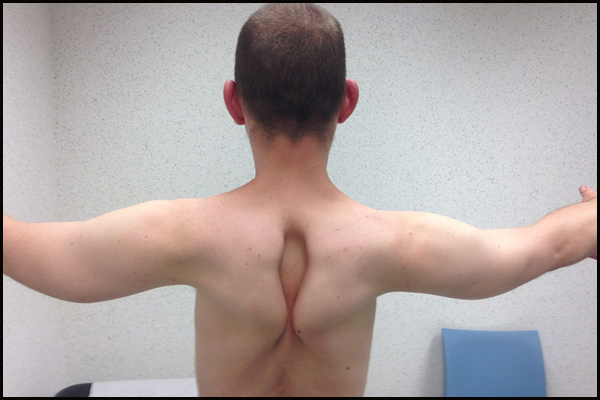
Radiofrequency Ablation & Ayurvedic Treatment for Frozen Shoulder
Abstract
Frozen shoulder is an excruciating, frequently prolonged, condition that requires cautious clinical conclusion and therapy. Patients typically recuperate, however they might very well never recapture their full scope/range of movement. So this condition is quite troublesome and needs emergency care thus we must focus on its management at earliest as the patient loses the range of motion and is extremely in pain. In the text below, we shall discuss its detail and management protocol in the contemporary system of medicine and the traditional system of Indian Ayurvedic medicine. Further we shall also discuss radiofrequency ablation for frozen shoulders. Let’s discuss!!
Introduction
In 1934, Codman introduced the term ‘Frozen shoulder’. He portrayed an excruciating shoulder state of insidious beginning that was related with stiffness and troublesome sleeping on the affected side. Codman additionally recognized the undeniable decrease in forward rise and outside rotation that are the signs of the illness. Frozen shoulder is also known as adhesive capsulitis. In Ayurveda, this condition can be well correlated with vata dosha as the vata dosha causes pain, immobility and stiffness. Thfurther the correlation of the condition can be well established with the vata disorder ‘avbahuka’. We shall further see its ayurvedic aspect in this text. Now let’s discuss the causes, features and management of the condition of frozen shoulders.

Causes of Frozen shoulder
Though the exact cause of the frozen shoulder is not known, some of the causes have been postulated. Usually seen in the sixth decade of life. Some of the medical conditions such as Diabetes, Thyroid dysfunction, Parkinson’s disease, Cardiac disorders have been linked with the development of frozen shoulders. Immobilisation : the condition of frozen shoulder can exist after a long period of immobilisation post injury or post surgery, a fracture.
Signs and Symptoms
- Pain
- Pain increases with the movement of the arm
- Stiffness in the affected shoulder
- Reduced range of motion
Investigations
- Physical examination
- Pain while moving the arm.
- arthroscopy
Management
- Nonsteroidal anti-inflammatory drugs
- Stretching and strengthening exercises
- Corticosteroid injection
- Joint distension
- hydrodilation
- Physical therapy – external rotation -passive stretch, forward flexion- supine position, crossover arm stretch
- Surgery (arthroscopic surgery)
- Radiofrequency ablation.
Radiofrequency Ablation
Radiofrequency ablation is a procedure to reduce pain that is indicated when the patient feels an excruciating pain in his shoulder. According to a study, radiofrequency ablation of shoulder pain. It has been found that it adds to the increased range of motion as well as reduced intensity of pain. A frozen shoulder is a condition that can affect anybody at any age, in spite of the fact that it is undeniably more seen in the age group of 40-60 and it is likewise substantially more common in females than in gents.
Conventional medicines for a frozen shoulder will generally focus on physiotherapy coupled with the patient exercises practices at home, to really objective the shoulder joint to become flexible once again and lessening the pain and irritation/inflammation of the joint. Though, there are a few examples where the pain is hard-headed as in it doesn’t respond to physiotherapy. In these cases, the strategy used to control the pain and overcome the inflammation would in general focus on steroid infusions, which additionally contained nearby sedatives. Now, presently there is one more exceptionally viable weapon that can be utilised in the battle against frozen shoulder and that is pulsed radiofrequency, which is applied in the locale of the suprascapular nerve.
The suprascapular nerve is the most commonly affected nerve that is affected in the condition of frozen shoulder. Therefore, it is targeted by the pulsed radiofrequency ablation management. Pulsed Radiofrequency treatment is a method of re-molding the nerves so they return to being in their ‘pre-torment’ state. Dissimilar to other radiofrequency management there is no drawn out harm to the nerves, so a method is leaned toward by both patients and pain experts. This absence of harm originates from the way that the nerves are not warmed similarly likewise with other radiofrequency managements.
The methodology includes a terminal (an electrode) applied through the skin straightforwardly focusing on a nerve or nerves and warming them up just to around 42 º C which causes no long-lasting harm. The procedure of this technique is very short, usually less than 10 minutes in an outpatient department. The technique is minimally invasive and it has a few risks associated with the technique and patients usually recover within an hour and can go home later.
General physics; examination and routine check ups are performed in order to check the fitness for the procedure.The success rate of the procedure is very good around seventy to eighty percent. Furthermore, the procedure has very few side effects which makes it an effective technique in patients who are not responsive to the exercises and physiotherapy. With the radiofrequency ablation the usage of ayurvedic herbal herbs are beneficial in controlling the pain and ease the mobility of the fixed arm (frozen shoulder).
Herbs such as ashwagandha (Withania somnifera), gokshura (Tribulus terrestris), ela (Elettaria cardamomum), vidanga (Embelia ribes), haridra (Curcuna longa), shallaki (Boswellia serrata), nirgundi (Vitex negundo), sonth (Zingiber officinale), guggulu (Commiphora mukul) etc benefits the conditions and symptoms associated with Frozen shoulder.
Medicines such as maharasnadi kwath, yograj guggul, kaishore guggul, rasraj ras, nirgundi swaras, dashmoolarishta, ashwagandharishta, mall sindoor, arjunarishta etc are various herbal formulations available that effectively manifest the condition of frozen shoulder and controls its associated symptoms.
Herbal medicines can be taken with the procedure which benefits the patient effectively and properly diminishes the symptoms of frozen shoulder with the providing enhancement in the range of motion and relief from the excruciating pain as well.
Ayurvedic Aspect and Management of Frozen Shoulder
Ayurveda, the traditional medicinal system of India has been serving mankind till date. Ayurveda focuses on general well being of the person with certain basic discipline that has been mentioned in the various ancient texts of Ayurveda which focuses on the daily regimen and diet plan according to the seasons. Further, Ayurveda has two main objectives upon which Ayurveda has been working, are maintaining the health status of healthy people and treating the diseased ones. Ayurveda is excelling in providing relief to the people from minor to major and acute to chronic diseases.
Frozen shoulder we are discussing in this text can be well correlated with the vataja disorder namely avbahuka. Avbhauka is one among the vataja disorders that is characterised by pain in the shoulder joint, restricted movement of the arm, inflammation and stiffness.
The condition of avabahuka is caused by vata dosha vitiation by dhatu kshaya (dhatu depletion). This dhatu kshya causes vata vitiation which leads to vata vyadhi. Vata vyadhi can happen due to dry food consumption (ruksh ahara), ati-alpa ahaara (less food consumption), sheeta ahaara (cold food), asatamaya ahaara (faulty diet), katu ahaara, tikta ahaara, kshaya ahaara, vishma ahaara, excessive fasting, excessive intercourse, food intake on indigestion, natural urge suppression, depression, stress, fear, excessive swimming, excessive travelling, depleted sleep, day sleeping, anger, day sleeping. All these dietary and lifestyle regimen cause vata vyadhi.
According to acharya Vagbhata the above mentioned causes leads to the aggravation of the vata dosha which leads to shrinking of the arteries and veins located in the shoulder region leading to the occurrence of avabahuka roga. This leads to the stiffness, inflammation, restricted range of motion of the ram and pain during the arm movement.
Management includes the shamana and shodhana chikitsa. Shodhana chikitsa includes the various panchakarma procedures such as snehana, swedana, virechana karma, basti, rasayan chikitsa, nasya and dhoompana. Shamana chikitsa includes the management of the condition with herbal medicines.
Shaman chikitsa includes the following medicines that helps in overcoming the condition of avabahuka (Frozen shoulder)
- Agnitundi vati
- Mall sindoor
- Rasraj ras
- Shunthi Powder
- Ashwagandha churna
- Ashwagandharishta
- Swedana by Dashmool Kwath
- Massage by prasarini taila, maha narayan taila
- Nasya by vyaghri taila
Pathya and Apathya
Pathya (Things to consume)
- Whole wheat
- Brown rice
- Cherries
- Dates
- Grapes
- Mango
- Papaya
- Apricots
- Banana
- Plums
- Apples
- Peaches
- Cooked onion
- Carrots
- Mustard
- Peas
- Moong dal
- Red lentil
- Buttermilk
- Butter
- Tofu
- Garlic
- Cloves
- Mint
- Sea salt
- Ajwain
- Herbal tea
- Fruit juices
Apathya (Not to be taken)
- Rye
- White rice
- White refined flour
- Melon
- Dried fruits
- Cauliflower
- Sprouts
- Cabbage
- Potato
- Ice cream
- Powdered milk
- Coriander seeds
- Beer
- Wine
- Coffee
- Hard alcohol
- Mutton
- Beef
- Dry and roasted nuts
- White sugar
- Brown sugar
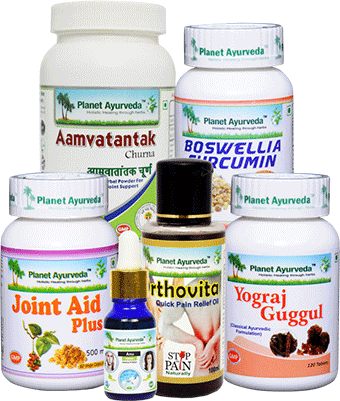
Herbal remedies for Frozen Shoulder by Planet Ayurveda
Planet Ayurveda is an emerging GMP certified, ISO 9001:2015 certified and US-FDA registered Ayurvedic Company, which adhered to the objective of manufacturing quality Ayurvedic products as mentioned in the various ancient texts of Ayurveda. Products are formulated without additives and preservatives and other kinds of chemicals or artificial flavouring agents which causes a number of ill effects on the human body. Products formulated at Planet Ayurveda are pure and do not contain any kind of adulteration. The products are purely organic, vegetarian and gluten free. Planet Ayurveda presents its Frozen Shoulder care pack that can be used in the condition of stiff shoulder and immobility of the arm and painful arm movements along with radiofrequency ablation.
Given below are some of the medicines that effectively manages the condition of Frozen Shoulder
- BOSWELLIA CURCUMIN
- JOINT AID PLUS
- AAMVATANTAK CHURNA
- ORTHOVITA OIL
- YOGRAJ GUGGUL
- ANU TAILAM

Product Description
1. BOSWELLIA CURCUMIN
Boswellia Curcumin capsules are enriched with the herbs shallaki (Boswellia serrata) and haridra (Curcuma longa). Both the herbs possess antiinflammatory, analgesic and antipyretic properties. Boswellia Curcumin reduces the pain associated with neuromyotonia and also helps in the healing process of the injury related to nerves and muscles. Therefore, Boswellia Curcumin is beneficial in the condition of frozen shoulders. This product of Planet Ayurveda is a gem in the condition of joints and effectively manages frozen shoulders.
Dosage : 2 capsules should be taken with warm water, two times a day, after meals.
2. JOINT AID PLUS
Joint Aid Plus capsules is a product of Planet Ayurveda that contains herbs that are helpful in joint conditions and disorders. The herbs of the joint aid plus are nirgundi (Vitex negundo), shallaki (Boswellia serrata), ashwagandha (Withania somnifera), sonth (Zingiber officinale) and guggul (Commiphora mukul). The herbs are known to provide relief from the pain. It possesses antiinflammatory activity thus alleviating pain due to inflamed bursae. Joint Aid Plus heals the joint and reduces inflammation of the bursae of the shoulder joint. By its healing property and anti-inflammatory activity Joint Aid Plus is of much help in frozen shoulder.
Dosage : 2 capsules should be taken with warm water, two times a day, after meals.
3. AAMVATANTAK CHURNA
Aamvatantak Churna is a product of Planet Ayurveda and is known to pacify kapha and vata doshas. The product contains ashwagandha (Withania somnifera), suranjaan (Colchicum autumnale), haridra (Curcuma longa), methi (Trigonella foenumgraecum), gorakhmundi (Sphaeranthus indicus) and sonth (Zingiber officinale). Aamvatantak Churna clears aam and relieves the patient from stiffness and eases motion of the limb. As the name of the formulation suggests it is a formulation that ends the condition of amavata. It removes the ama which eventually clears the blockage and helps in proper digestion. And by pacifying the vata dosha it helps in managing frozen shoulders.
Dosage : 1 tsp twice in a day with warm water should be taken 10 minutes before meals.
4. ORTHOVITA OIL
Orthovita oil is a wonderful oil product of Planet Ayurveda for strengthening bones, joints and muscles. This preparation includes various miraculous classical ayurvedic oils such as shul gajendra oil, gandhapura oil, saindhavadi oil, prasarini oil etc. These oils are very effective in pacifying vata dosha and kapha dosha and alleviates the pain along with reducing inflammation. This can be used in strengthening muscles, bones, joints and nerves. It can be used in getting rid of pain and inflammation in various health concerns such as sandhigata vata (osteoarthritis), amavata (rheumatoid arthritis), vatarakta (gout) and all other health concerns related to pain and swelling. In frozen shoulders, orthovita oil helps in reducing inflammation, relieving pain and providing a wider range of motion.
Dosage : Massage should be done locally with the oil for 10 to 15 minutes twice a day.
5. YOGRAJ GUGGUL
Yograj Guggul is a classical ayurvedic medicine. It is a beneficial formulation in disorders of the musculoskeletal system and neurological system. It contains the herbs amalaki (Emblica officinalis), guggul (Commiphora mukul), haritaki (Terminalia chebula), ela (Elettaria cardamomum), vidang (Embelia ribes), gokshur (Tribulus terrestris), shunthi (Zingiber officinale), bibhitaki (Terminalia bellirica) etc. The herbs of the formulation possess properties that enhance muscle and bone health. By its anti-inflammatory property Yograj Guggul is best to manage frozen shoulder and its associated symptoms.
Dosage : 2 tablets to be taken twice daily with warm water.
6. ANU TAILAM
Anu tailam is one of the classical oils prepared by Planet Ayurveda which is used as a remedy administered in nostrils in the form of drops (nasya). It is formulated as per classical references. This herbal remedy pacifies all the three dosha (tridosha shamaka) and provides strength to the nerves. It nourishes all the five sense organs thus enhances their functioning. Having key benefits such as relieving headache (shiroroga), sinusitis (dushta pratishyaya), facial paralysis (ardita), allergic rhinitis (vata-kaphaja pratishyaya), migraine
(Ardhavabhedaka), greying of hairs (palitya roga) and improving the perception of all sense organs. The anu taila is composed til taila, goat milk, jivanti, usjir, devadar, mustak, daruhaldi, shatavari, yashtimadhu, kantkari, shallaki, shalparni, ela, vidang, bala and other various herbs. The oil also benefits in managing the hormone levels produced by the glands of the neck and head area. Further as it helps in vata balancing, thus helps in frozen shoulder.
Dosage : Two drops in each nostril at the time of sunrise every morning.
Conclusion
Frozen shoulder is a very troublesome condition that leads to the immobility of the affected shoulder and arm, painful movements and decreased range of motion. Sometimes the conditionresolves quietly and in some cases physiotherapy and exercises are of no use. Even corticosteroid injections do not work and medicines prove futile. In the condition, the condition can be well managed with the radiofrequency ablation along with herbal medicines
This adds to the overall improvement of the condition of the frozen shoulder. And both the management protocol leads to a wide range of motion, reduced inflammation, eases stiffness and pain relief. With some time the condition improves permanently. So products explained above work wonderfully in managing the condition of frozen shoulder with and without radiofrequency ablation. Ayurveda does wonders, we must use herbal medicines that exhibit no side effects. Ayurvedic medicines benefit the patient with frozen shoulders permanently.