Ayurvedic Treatment For Myofascial Pain Syndrome
ABSTRACT
Myofascial syndrome is called pain in the muscle.It is made up of two words Myo means Muscle and fascia means Fibrous .Hence Myofascial Pain is considered as a chronic pain and it affects muscle pain at specific points on the body known as (Trigger Points).MyoFascial .Let’s understand about muscle pain with the help of orange peel. Let’s consider the body an orange and the skin will be the outside orange peel. Muscles will be the fleshy part of orange fruit and the thin layer of white membrane which surrounds each orange segment will be the fascia. So Fascia covers every stage of muscle tissue that is muscle fibers,muscle groups,and single muscles.
Muscle pain can occur to anyone at any time in their life journey. It can occur when the mother carrying her child in arms can experience muscle pain. Unfortunately, this pain can not be tolerable for some people and they suffer from it for a long time after it should have vanished. If you are suffering from muscle pain that will not go away for a long duration of time, then it is a sign of myofascial pain.Planet ayurveda provides the best herbal remedies for the treatment of this painful condition.

INTRODUCTION
Human body is made up of the largest organ system. Musculoskeletal system is the prominent system which comprises 639 muscles. According to ayurvedic clinician more patients are suffering from Fibromyalgia pain syndrome and Myofascial pain syndrome is a subtype of fibromyalgia pain syndrome.It includes tension headache, irritable bowel syndrome, chronic fatigue syndrome , disturbed sleep are the common problems which are generally faced by the people during this painful condition.
WHAT ARE THE CAUSES OF MYOFASCIAL SYNDROME
Myofascial syndrome is developed from a muscle injury or from excessive strain on a particular muscle ,tendon and ligament.There are many other causes which are responsible for Myofascial pain syndrome.
- General Tiredness is also responsible for Myofascial Syndrome.
- Injury to spinal discs can also lead to Myofascial syndrome.
- Medical conditions such as Stomach irritation and Heart attack.
- Lack of activity can also lead to Myofascial syndrome.
WHAT ARE THE SYMPTOMS OF MYOFASCIAL SYNDROME
- It can be due to Genetic or hereditary conditions.
- It can be due to Infection.
- It can be due to emotional or physical trauma.
WHAT CAN BE THE RISK FACTOR OF MYOFASCIAL SYNDROME
- It can be due to sex.
- It can be due to family history.
- It can be due to Rheumatic disease.
- It can be due to Poor posture.
- If you are working in a living or working environment.
- Emotional stress also causes it.
WHAT ARE THE PHYSICAL EXAMINATIONS OF MYOFASCIAL SYNDROME
Physicians generally perform mild finger pressure to the painful area so as to identify a delicate or trigger point. There are limited ways of pressing on the point that can reduce specific responses. A Patient may experience a muscle jerk while performing the above Physical examination.
WHAT ARE THE INVESTIGATIONS OF MYOFASCIAL SYNDROME
Radiographs and laboratory investigations (Full blood count cell,Erythrocyte sedimentation rate etc)are only helpful in excluding other serious pathology. EMG and nerve conduction are normal but most patients have a disturbance of stage IV non -rapid eye movement sleep on EEG (Electroencephalogram).
WHAT ARE THE MANAGEMENT OF MYOFASCIAL SYNDROME
According to modern science Strong medical reassurance with advice from a physiotherapist about posture and physical fitness can also lead to Myofascial syndrome. Let’s discuss the management of Myofascial syndrome in detail.
Many people are not aware about the treatment for MPS (Myofascial syndrome).
- Stretching-Patients should understand that a well trained and an experienced practitioner may help you through gentle stretching exercises which helps to reduce the pain in your affected muscle. If you feel or experience trigger point pain ,then the provider may use heat fomentation on the affected area.
- Posture training- A patient should improve their posture and can help relieve Myofascial pain. Certain exercises that strengthen the muscles which surround your trigger point may lead to Myofascial pain syndrome.
- Massage- An ayurveda therapist may massage your affected or triggered muscle with luke medicated oil and certain herbal medicines will be helpful to relieve your pain. The therapist uses long hand strokes along the affected muscle and places a pressure on the specific areas of Muscle to release pressure.
- Exercise-A patient should perform mild or light exercise that can help you better deal with pain.
AYURVEDIC PERSPECTIVE OF MYOFASCIAL SYNDROME
We can’t ignore the ayurvedic point of view .Let’s discuss what ayurveda justifies about Myofascial syndrome.This syndrome is due to localised Vatavyadhi.Vata Vyadhis occur due to Vitiation of vata dosha in the body.
Acharya charak mentioned about Vata vyadhi in charak chikitsa 28 . These are the following causative factors for Vata dosha vitiation.
- According to Ayurveda if a patient takes dry food as well as cold food may lead to aggravation of vata dosha in the body.
- If a man consumes Less amount of food it may lead to aggravation of Vata dosha.
- If a patient consumes Katu (Bitter), Tikta (Pungent), Kashaya rasa (Astringent) Rasa will increase the vitiation of Vata dosha.
- Certain Lifestyles may lead to Aggravation of vata dosha .Excessive Sex indulgence, Late night wakeup, Fear, anxiety, excessive running may lead to aggravation of vata dosha in the body.
WHAT ARE THE TREATMENT PLAN OF VATA VYADHI ACCORDING TO AYURVEDA
Ayurveda is an ancient science which predominantly believes to cure any disease with natural herbs and lifestyle daily routine.
- A patient should do Oleation with mild purgative medicine.
- A patient should do intake of Vata anuloman chikitsa (Evacuation of vata dosha)
- A patient should consume Madhura (Sweet),amla (Sour) and lavana (Salty) food to reduce vata dosha in the body.
- Various panchakarma such as Niruha basti (the basti with kwatha)and anuvasana basti (the basti with oleation) may cure the vata related disease.
WHAT ARE THE LIFE STYLE (YOGAS) TO PERFORM DURING MYOFASCIAL PAIN SYNDROME?
When ayurveda combines with yoga it boosts up the patient’s longevity along with the total elimination of Pain in the body. Anulom Vilom, Nadi Shodhana Pranayama,Balasana,Tadasana to pacify pain due to vata in the body.
HERBAL REMEDIES BY PLANET AYURVEDA
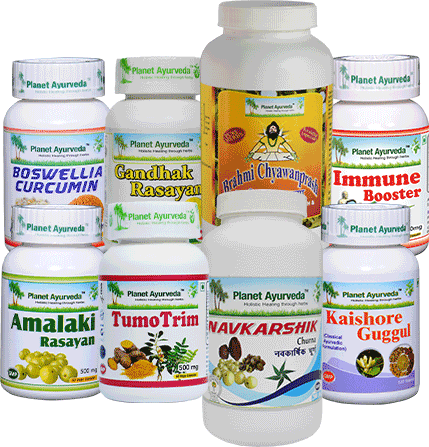
Planet ayurveda provides the best herbal remedies for cure of Myofascial Pain syndrome.
- Boswellia Curcumin
- Yograj Guggul
- Moringa Capsules
- Nirgundi Swaras
- Vrihat Vatchintamani Ras
- Bala Ashwagandha Oil
Product’s Description
1. Boswellia Curcumin
It is the best herbal remedy to cure anti-inflammatory herbs such as Shallaki (Boswellia serrata) ,and curcumin (Curcuma longa).It has high potency of anti- inflammatory herbal combination. It increases mobility in the patient of myofascial pain syndrome.
Dosage: One tablet twice a day with lukewarm water.
2. Yograj Guggul
Yograj Guggul is the best herbal remedy to cure Vata dosha related complications .It contains various herbs such as Guggul (Commiphora mukul),resin,Chitrak (Plumbago zeylanica),Pippali (Piper longum),etc which helps to pacify vata related dosha as well as acts an antioxidant to promote healthy immune system.
Dosage: Two tablets twice a day with lukewarm water.
3. Moringa Capsule
Moringa, also called Shigru, is the main herb for Moringa. It has plenty of minerals, vitamins and antioxidants.It is a god gifted product.It is a natural powerful source of Vitamin A, B complex and minerals like Calcium,magnesium , iron and many others.
Dosage: One capsule Twice a day with lukewarm water.
4. Nirgundi Swaras
(Vitex nirgundi) is helpful for anti-inflammatory action as well as to cure Pain caused by Myofascial syndrome.
Dosage: Two tablespoons twice a day.
5. Vrihat Vatchintamani Ras
It contains the following herbs such as Swarna bhasma (Gold powder), Rajat bhasma (Silver powder) ,Abhrak Bhasma (Mica powder)etc to cure vata dosha related pain in the body.
Dosage: One tablet daily to be chewed with warm ghee .
6. Bala Ashwagandha Oil
This oil contains Bala (Sida cordifolia),Ashwagandha (Withania somniferum),etc herbs to strengthen muscle pain and vata dosha in the body.
Dosage: Oils to be warmed before applying.
Contact my assistant to provide you the costing / ordering and delivery information at – costing.planetayurveda@gmail.com or call at +91-172-5214040 Or Check Website – www.PlanetAyurveda.com
CONCLUSION
Myofascial pain syndrome is a vata related disease causing unbearable pain for several periods of time. Ayurvedic herbal remedies by planet Ayurveda provide the best herbal remedy for the management of Myofascial pain syndrome.People should understand the importance of Ayurveda’s role to cure Myofascial pain syndrome.If people suffering from myofascial pain syndrome will understand the importance of Ayurvedic management and herbal remedies by Planet Ayurveda ,then they will get 100% result in the elimination of Myofascial pain syndrome from the root cause. In case of any query kindly visit www.PlanetAyurveda.com. For more queries, you can send your queries to our email id herbalremedies123@yahoo.com.