Natural Cure For Intervertebral Disc Prolapse
Abstract
The spine is made up of many bones called vertebrae. Each vertebra is like flat cylinders and between each vertebra there is a disc that is called Intervertebral disc. Intervertebral disc is a hydrostatic, burden bearing structure, forming a fibrocartilaginous joint located between adjacent vertebrae in the vertebral column permitting slight movement of the vertebrae. It acts as a ligament to hold the vertebrae together, gives extra support and strength to the spine, provides cushioning between vertebrates and functions as a pressure absorbent. Intervertebral disc prolapse (IVDP) is a common disease that affects the spine in which there is a tear in the annulus fibrosus (outer fibrous ring) of an intervertebral disc which leads to bulging out the nucleus pulposus (soft central portion) by damaging the outer ring causing pain in back and frequently in legs and arms. More oftenly, the lower region of the spine is apparently affected in intervertebral disc disease. It can cause periodic or chronic pain that worsens when sitting, bending, twisting or lifting weight; these symptoms depend on the location of the affected discs.

Introduction
Intervertebral disc prolapse is a condition in which the inner soft part nucleus pulposus herniates out through the weakness in the outer part of the disc annulus fibrosus. Prolapsed disc is sometimes called a herniated disc that may bulge out and compress the nearby structures such as nerves passing from the spinal cord or also cause swellings, which may also put pressure on the nerve. Degenerated discs are prone to herniation and result in pain, weakness, and numbness in legs and back. As the disc degenerates, small bony growths also named as bone spurs start to grow at the edges of affected vertebrae and lead to compression of the spinal nerves that ultimately results in developing problems with walking and other gastro-intestinal issues. Compression/ irritation of either one of five nerve roots(lumbar spine nerve root L4 to S3) which are the branches of Sciatica is more likely to be affected and causes pain in the leg. Elder people are more likely to develop this condition. Symptoms of herniated disc can vary depending on the location and type of tissue involved.
Incidence
Ages between 30-50 are most likely to develop IVDP. This disease affects men twice as often as women. Herniation of discs is the leading cause of neck, back and leg pain. Herniation can happen anywhere along the spine but most commonly develops in the lower back, rarely in the mid- back. It occurs due to sciatic nerve compression.
Causes
Most commonly this condition is caused by following factors
- Repetitive mechanical or exertional activities – Bending, twisting, lifting etc. due to this pain rise during the evening time.
- Traumatic injury to lumbar disc
- Chronic inflammation shows an increase in pain especially in the morning.
- Metabolic changes like decreased calcium in the body.
- Neoplastic changes
- Ageing
- Smoking
- Obesity
- Poor posture
- Sedentary lifestyle
Symptoms
Depends upon the site of the affected spine
- While the discs in the lower region of spine are more frequently affected in IVDP which causes most commonly it causes Sciatic nerve pain that is a very sharp pain which usually shoots from one side of the buttock, to leg and sometimes may involve foot also.
- It may also show symptoms like back pain, tingling and numbness in legs and feet, weakness in leg muscles etc.
- When the neck gets involved in IVDP then the symptoms include neck pain that increases on bending and moving the neck, pain near or between shoulder blades, or may travel to arms, hands and fingers, numbness and tingling sensation in arms.
Diagnosis
Diagnosis can be made by
- Inspection
- Palpation
- Movement of spine
- Lasègue test/ SLR test used in the clinical examination of patients presenting with low back pain, is an important test for determining nerve root tension.
- Magnetic resonance imaging
- X-rays
- Computed tomography
- Myelogram
- Electromyogram
Treatment Options As Per Ayurveda
Because of the various causes that can compress or irritate the nerve roots and lead to sciatica, treatment options also differ from patient to patient. Lower back is a Vata specific site and joints (Sandhi) are the site of sleshaka kapha, due to the intake of dosha aggravating factors vata vitiation occur in kapha sthana and because of the raising of ruksha guna leads to reduction in the water content between vertebrates that results in prolapse and nerve irritation or compression. When the cause behind the compression is prolapse or herniation of lumbar disc, traditional method of supportive and conservative treatment is used to help in relieving the clinical signs and symptoms which eliminates the chances of surgeries. The main aim of the treatment is to reduce rukshata and bring back the sneha guna, elasticity and rehydrate the disc, eliminating the osteophytes that are the mala of kapha dosha. The Ayurvedic approach of treating IVDP is Vataghana and kaphaghna that is by reducing the compressive forces that pressurise the sciatic nerve, this treatment is done on initial stages.
Treatment methods include internal medicines by using various types of herbal formulations that support and strengthen our body system wisely and fasten the healing processes. External treatment includes panchakarma procedures that also show positive results in treating IVDP effectively to reduce stiffness and inflammation of the affected area, by using bandages, paste applications, traction and marma chikitsa.
Herbal Remedies by Planet Ayurveda
Planet Ayurveda is a herbal manufacturing company that provides great formulation for effective results in many diseases. These medications are accomplished under the supervision of Ayurveda experts and are free from dyes, adulterants, and chemicals so that they are 100% natural. In the above condition Planet Ayurveda gives various medications to manage these symptoms, some of them are
- Yograj Guggul
- Boswellia Curcumin
- Ashwagandha Capsules
- Vrihat Vatchintamani Ras
- Hakam Churna
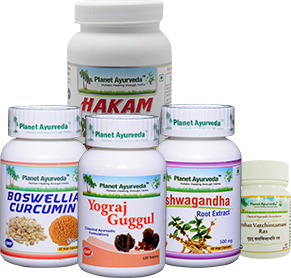

PRODUCT DESCRIPTION
1. Yograj Guggul
This is a classical polyherbal medication traditionally used by ayurveda experts in sandhigata vyadhis, consisting of Guggul resin (Commiphora mukul), Chitraka (Plumbago zeylanica), pippali (Piper longum). This formulation helps to maintain the neuromuscular system and reduces the pain and inflammation, strengthens the metabolic rate and stops the degenerative processes in the body.
Dosage – 2 tablets two times a day with warm water, after meals.
2. Boswellia Curcumin
This is a polyherbal formulation given by Planet Ayurveda consisting of Shallaki (Boswellia serrata) and Curcumin (curcuma longa). Boswellia and curcumin both are very effective in neural pain and degeneration process, moreover gives the anti-inflammatory effect as well as relieves stiffness or efficiently works on IVDP patients.
Dosage – 1 capsule twice daily after a meal with plain water.
3. Ashwagandha Capsules
This is a single herbal formulation consisting of standardised extract of Ashwagandha (Withania Somnifera). It is very effective in neuro-muscular disorders, also gives relief from the severe pain caused by compression of nerves, helps in managing inflammation and slows down the degeneration process and gives relief from the symptoms of IVDP.
Dosage – 2 capsules twice with warm water after meals
4. Vrihat Vatchintamani Ras
It is an Ayurvedic classical herbal formulation described by Acharyas in traditional texts consisting of Swarna Bhasma (Calx of Gold), Abhrak Bhasma (Calx of Mica), etc. This formulation is used in Vata and Kapha related disorders such as neuropathies, excessive pain due to compression of nerves or irritation of nerves, degeneration or osteophyte formations that cause neuromuscular diseases and shows symptoms like irritation, stiffness in muscles etc.
Dosage – 1 tablet twice a day to be chewed with plain water after meals.
5. Hakam Churna
This is a polyherbal churna consisting of Chandershoor Lepidium sativum, kalonji Nigella sativaa, methi Trigonella foenum graecum etc. It has the ability to retrieve the normal healthy digestion as well as eliminates the ama dosha from the body and also gives efficient results in painful joints, stiff joints and many other diseases caused by Vata and kapha imbalance.
Dosage – 1 tsp of powder with hot water twice daily.
Conclusion
As we are observing the surge in the number of IVDP patients, it is highly recommended to go with Ayurveda therapy as we can say Ayurveda is very effective and gives miraculous results in every disease. Ayurvedic herbal remedies as well as dietary advice surely gives a disease free and a good quality of life. Ayurveda provides efficacious management for IVDP patients by analysing the root cause and balances the tridosha which helps the patient to get relief. For more details of our products check out our website www.planetayurveda.com and for queries you can send your queries to our email id herbalremedies123@yahoo.com .

