Atibala in Ayurveda: Benefits, Uses, Dosage & Healing Properties
Abstract
Atibala, scientifically known as Abutilon indicum, is a treasured herb in Ayurveda celebrated for its broad spectrum of healing qualities. This shrub, belonging to the Malvaceae family, is traditionally used for its ability to strengthen the body, boost immunity, and act as a natural aphrodisiac. Atibala’s distinctive combination of anti-inflammatory, pain-relieving, liver-protective, and wound-healing properties makes it an essential herb for healing. Its capacity to balance bodily energies, support detoxification, and vitality in the body are amazing. Let’s discuss it briefly.
Description
Atibala (Abutilon indicum) is a highly esteemed Ayurvedic herb known for its potent strengthening, rejuvenating, and versatile healing qualities. It holds an important place in classical Ayurveda for enhancing muscle strengthening, boosting immunity, and providing relief for joint problems. This makes Atibala a vital natural herb for managing both chronic and acute health conditions effectively. It is also a part of Balatrayam and Balapanchak in ayurveda.
Scientific classification
- Kingdom: Plantae
- Subkingdom: Tracheobionta (vascular plants)
- Superdivision: Spermatophyta (seed plants)
- Division: Magnoliophyta (flowering plants)
- Class: Magnoliopsida (dicotyledons)
- Subclass: Dilleniidae
- Order: Malvales
- Family: Malvaceae (mallow family)
- Genus: Abutilon
- Species: Abutilon indicum (L.) Sweet
- Botanical name : Abutilon indicum
Synonyms
- Rishyaprokta
- Balika
- Rishagadha
- Bhuribala
Other vernacular names
- In Sanskrit : Rishyaprokta, Kankatika, Balika, Rishagadha, Bhuribala, and Vatyapushpy.
- In Hindi : Kanghi and Kakahi.
- In English :Country Mallow or Indian Mallow.
- In Bengali : Petari and Jhapi.
- In Gujarati : Khapat and Kansaki.
- In Kannada : Shrimudrigida and Mudragida.
- In Tamil : Tutti and Thuthi.
- In Telugu : Tutturu Benda.
- In Malayalam :Vellula.
- In Punjabi : Kangi and Kangibooti.
Habitat
Atibala (Abutilon indicum), is commonly found across tropical and subtropical regions, especially in India and Sri Lanka. This plant usually grows wild along roadsides, in waste areas, scrublands, and farms where the soil is often dry and disturbed. It can thrive from sea level up to heights of about 1,200 to 1,400 meters, including in the foothills of the Himalayas and warmer parts of India. Known for its resilience, Atibala tolerates different soil types such as dry, rocky, and even salty soils. Its widespread presence in diverse habitats has made it readily available and a valued herb in traditional Ayurvedic and folk medicine.
Morphology
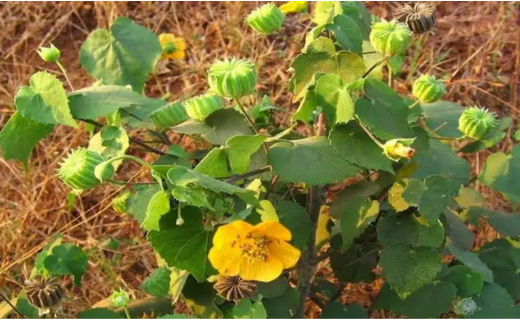
Atibala (Abutilon indicum) is a perennial shrub that typically reaches heights between 1 and 3 meters. Its stems and branches are adorned with soft, star-shaped hairs, giving the plant a smooth, velvety texture. The leaves are simple and alternately spaced, usually ovate with a cordate (heart-shaped) base and slightly toothed edges, ranging from 4 to 12 centimeters long. The herb produces bisexual flowers, which may appear alone or in small clusters; each flower has five yellow, obovate petals with fine hairs along the margins. The calyx is shaped like a small bell with five lobes, and the flowers are attractive to pollinators. The fruit is a capsule known as a schizocarp, generally rounded or oval, segmented into hairy parts called mericarps that open up when mature. Its seeds are kidney-shaped, dark brown or black, and covered with tiny rough hairs. These distinct features—including the velvety stems, heart-shaped serrated leaves, and bright yellow, hairy-edged flowers—define Atibala as a robust and medicinally valuable plant widely used in traditional healing practices.
Classical categorisation
- Acharya Charaka classified Atibala under Madhura Skanda, indicating it possesses a sweet taste (madhura rasa).
- It is included in the Balya Mahakashaya group, used primarily to enhance patient strength.
- Atibala is often mentioned alongside Bala, and together they are known as Baladwaya.
- Bala, Atibala, and Nagbala collectively form the group called Balatraya.
- When Mahabala is added to these three, the combined group is called Bala Chatushka.
- The Kaiyadeva Nighantu places Atibala in the Aushadhi Varga category.
- The Raj Nighantu categorizes it in the Satahvadi Varga.
- Both Dhanwantri Nighantu and Bhavprakash Nighantu include detailed descriptions of Atibala, recognizing its significant therapeutic value in classical Ayurveda.
Shloka’s
वातपित्तापहं ग्राही बल्यं वृष्यं बलात्रयम् ।
(Dhanwantri Nighantu / Guduchyadi Varga)
Interpretation of shloka:This means that Atibala is an herb that pacifies the aggravated Vata and Pitta doshas, possesses styptic (wound-healing) properties, strengthens the body, and acts as a natural aphrodisiac. It is considered one among the famous “Balatraya”—a trio of herbs known for their power to enhance strength and vitality.
तिक्ता कटुश्चातिबला वातघ्नी कृमिनाशनी ।
दाहतॄष्णाविषच्छर्दि क्लेदोपशमनी परा ।।
(Raj Nighantu / Satahvadi Varga)
Interpretation of shloka: Atibala (Abutilon indicum) is known for its multifaceted healing properties. It possesses a combination of Tikta (bitter) and (katu) pungent tastes and is highly regarded for its ability to pacify aggravated Vata dosha. Atibala also has strong anthelmintic (kriminashini) effects, making it effective in eliminating intestinal worms. Its cooling potency helps relieve burning sensations, excessive thirst, poisoning , vomiting, and excessive moisture-related conditions in the body.These qualities make Atibala a superior medicinal herb in Ayurveda, widely used for balancing doshas, detoxification, and alleviation of digestive and metabolic disorders.
बलचतुष्टयम् शीतं मधुरं बलकांतिकृत ।
स्निगधम् ग्राही समीरास्रपित्तास्रक्षतनाशनम् ।।
(Reference – Bhavprakash Nighantu / Guduchyadi Varga)
Interpretation of shloka: Atibala is known for its therapeutic properties. It is primarily categorized as a Balya (strength-giving) herb that helps in enhancing physical strength and vitality. Atibala has a madhura (sweet) taste, snigdha (unctuous) quality, sheeta (cooling) potency, and madhura vipaka, which contribute to its ability to balance Vata and Pitta doshas effectively. The herb acts as a grahi (astringent), vatahara (pacifies Vata), balya (strengthener), varishya (aphrodisiac), kantivardhaka (improves skin complexion), and ojjovardhaka (enhances immunity and vigor).
Ayurvedic properties
- Rasa (taste): Madhura (sweet)
- Guna (qualities): Laghu (light), Snigdha (unctuous)
- Virya (potency): Sheeta (cooling)
- Vipaka (post-digestive effect): Madhura (sweet)
- Karma : Balances the vata and pitta doshas.
Therapeutic indication
- Pacifies aggravated vata and pitta doshas, treating disorders related to their imbalance.
- Acts as a potent balay (strengthens), enhancing physical strength, endurance, and vitality.
- Reduces inflammation and alleviates pain, especially effective in conditions like arthritis, joint pain, and muscle spasms.
- Supports respiratory health by easing cough, bronchitis, and removing excess phlegm.
- It functions as a strong kriminashini (anthelmintic), expelling intestinal worms and parasites.
- Relieves burning sensations, excessive thirst, poisoning, vomiting, and excess moisture in the body.
- Promotes wound healing and is beneficial in skin conditions such as ulcers, eczema, and boils.
- Aids in urinary tract and liver disorders, facilitating detoxification and managing jaundice.
- Enhances male reproductive health by improving sexual vigor, sperm quality, and addressing fertility issues.
- Helps regulate digestive disorders such as diarrhea, ulcers, and abnormal intestinal motility.
- Boosts immunity and detoxifies the body, supporting overall health and longevity.
Systemic actions
- Nervous system : Strengthens and nourishes the nervous system, helping to balance aggravated Vata and alleviating disorders such as paralysis, tremors, and nerve pain by supporting the Majja dhatu (nervous tissue).
- Musculoskeletal system : Acts as a potent anti-inflammatory and analgesic for the musculoskeletal system, easing joint inflammation, muscle cramps, and stiffness, thus improving mobility and relieving Vata-induced discomfort.
- Respiratory system: Supports respiratory health by functioning as an expectorant and bronchodilator, facilitating the removal of mucus, and reducing cough, asthma, and bronchial congestion.
- Digestive system: Enhances digestive fire (Agni), promotes efficient digestion and assimilation, and treats conditions like diarrhea, gastric ulcers, and toxin (Ama) accumulation.
- Reproductive system : Functions as a Vrishya (aphrodisiac), improving reproductive health by increasing sperm production, sexual vigor, and treating infertility.
- Excretory system : Supports the excretory system through diuretic and detoxifying properties, aiding in kidney function and urinary tract health.
- Immune system: Boosts the immune system by acting as an immunomodulator, enhancing resistance and overall vitality.
Chemical composition & their Properties
- Contains mucilaginous substances rich in pentoses, methyl pentoses, hexoses, and uronic acids, which contribute to its soothing and demulcent properties.
- Comprises proteins, carbohydrates, and free amino acids essential for tissue nourishment.
- Enriched with saponins and various glycosides, providing medicinal potency.
- Possesses phytosterols like β-sitosterol, α-sitosterol, and cholest-5-en-3-ol, contributing to anti-inflammatory effects.
- Contains several fatty acids including linoleic, stearic, palmitic, lauric, myristic, caprylic, and capric acids, beneficial for skin and metabolic health.
- Rich in bioactive alkaloids, tannins, flavonoids (notably quercetin and rutin), phenolic compounds, and steroids which exhibit antioxidant and healing activity.
- Includes lupeol, a compound known for wound healing and anti-inflammatory properties.
- Has a variety of essential oils such as α-pinene, caryophyllene, and caryophyllene oxide, supporting respiratory and antimicrobial functions.
- Contains several amino acids including aspartic acid, histidine, threonine, serine, leucine, alanine, cysteine, tyrosine, phenylalanine, valine, and arginine, supporting metabolic processes.
- Contains organic acids like fumaric, p-coumaric, vanillic, and caffeic acid which contribute to its antioxidant properties.
Practical use and benefits
- Acts as a powerful tonic to boost physical strength, endurance, and overall vitality.
- Helps balance aggravated Vata and Pitta doshas, beneficial for neurological ailments like paralysis, tremors, and nerve pain.
- Provides relief from inflammation and pain, especially useful in arthritis, joint stiffness, and muscle cramps.
- Supports lung health by reducing cough, clearing excessive mucus, and alleviating bronchitis and asthma symptoms.
- Possesses vermifuge properties that help expel intestinal parasites and support digestive health.
- Promotes healing of wounds, skin ulcers, boils, and various dermatological conditions thanks to its anti-inflammatory and antimicrobial effects.
- Enhances urinary and liver function; supports detoxification and treatment of jaundice and urinary tract infections.
- Improves reproductive health in men by enhancing semen quality, sexual vigour, and fertility.
- Helps manage digestive issues such as diarrhea, acidic ulcers, and gut inflammation.
- Acts as an immune booster, enhancing resistance against infections and improving overall health.
- Treats a range of conditions including fever, blood disorders, leprosy, piles, gonorrhea, and urinary system complaints.
- Used externally and internally for oral health issues like toothache and gum inflammation; also beneficial for bladder inflammations.
- Leaf juice combined with herbs used for liver protection and jaundice management.
- Flower pastes and root infusions applied for healing skin lesions and reducing fevers.
Part used
- Roots
- Leaves
- Seeds
- Flowers
- Bark
- Whole plant
Dosage
- Decoction & juice of leaves – 10-20 ml.
- Powder – 3-6 gm.
Ayurvedic Medicines
- Mahanarayan Tail
- Bala Taila
- Ksheerbala Tail
- Gandha Tailam
- Punarnavadyarishta
- Balarishta
- Chyawanprash
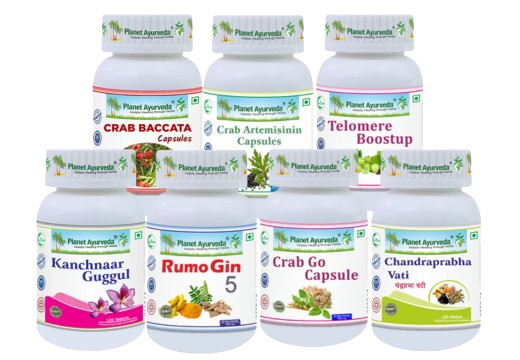
Planet ayurveda products
Conclusion
Atibala (Abutilon indicum) is a potent and genuine Ayurvedic herb that harmoniously combines ancient medicinal wisdom with modern therapeutic applications. Its remarkable ability to support the nervous system, musculoskeletal health, immune function, and reproductive vitality makes it an excellent choice for comprehensive wellness. This herb honors its timeless tradition as a natural source of strength, healing, and balance for the body and mind.