Natural treatment for Rheumatoid Arthritis
Abstract
Bones are the body’s structural elements, giving it a sound framework and helping us to maintain good posture. Bones are composed of water, inorganic materials, and biological materials. Proteins and collagen are examples of organic materials. Inorganic elements include sodium, potassium, calcium, phosphorus, and magnesium. When compared to organic components, which have a flexible texture and make up around 34–37% of bone, inorganic components, which give bone its rigid and hard texture and make up about 40–42% of bone (mostly calcium 85%), have a rigid and hard texture themselves. Water makes about 23-25% of the bone’s content. Changes in the ratio or a deficiency in some components can cause fractures and other problems with the bones.
Introduction
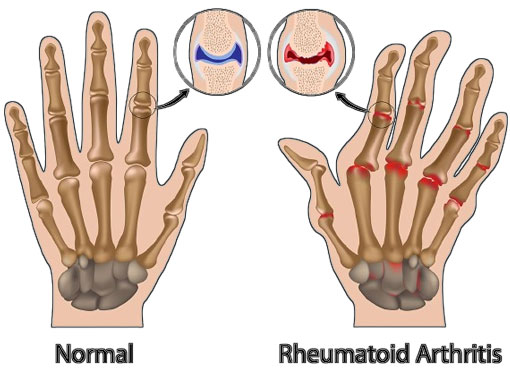
Rheumatoid arthritis (RA) is a symmetrical, chronic inflammatory autoimmune disease that first affects the skin, eyes, heart, kidneys, and lungs before progressing to larger joints. Tendons and ligaments deteriorate, and joint bone and cartilage are frequently injured. Deformities and bone erosion are caused by all of this joint deterioration, and the patient often experiences agonising pain as a result. A systemic autoimmune condition known as rheumatoid arthritis (RA) is characterised by extra-articular involvement and inflammatory arthritis. It is a chronic inflammatory illness that mostly affects synovial joints and is frequently brought on by the combination of genes with environmental factors, particularly cigarettes. If left untreated, it normally begins in tiny peripheral joints, proceeds to involve proximal joints, and is frequently symmetric. Joint inflammation eventually results in joint degeneration due to cartilage loss and bone erosion. Early RA is characterised by symptoms that have been present for less than six months, while established RA is characterised by symptoms that have been present for more than six months. If left untreated, RA progresses, increasing mortality and morbidity.
Causes
- Rheumatoid arthritis has an elusive aetiology. Genetics, hormones, and environmental variables may all have a role in its development, according to researchers. Our immune system often defends our body against illness. Something causes our immune system to assault our joints when a patient has rheumatoid arthritis. A trigger could be an infection, smoking, or physical or emotional stress.
- The aetiology of RA is heavily influenced by genetics. It is thought that patients’ genotypes and environments interact to cause it. Rheumatoid arthritis is an autoimmune illness because it results from the immune system attacking healthy human tissue. But the reason why this is happening is not yet known. The immune system frequently creates antibodies that target viruses and bacteria to fight infections. If someone develops rheumatoid arthritis, the immune system unintentionally transports antibodies to the lining of joints, where they attack the tissue around the joint. Because of this, the synovium, a thin layer of cells that covers the joints, swells and hurts, producing chemicals that damage the region around it.
General Symptoms
Rheumatoid arthritis affects people differently. Some people deal with joint issues for a very long time. Some people’s rheumatoid arthritis symptoms advance rapidly. Many patients go through flare-ups, remissions, or symptom-free periods.
- Various joints may experience discomfort, swelling, stiffness, and soreness as a result of rheumatoid arthritis.
- Stiffness, especially first thing in the morning or after a long period of sitting.
- The same joints in your body are painful and stiff on both sides.
- extreme tiredness or exhaustion.
- Weakness.
- Fever.
Risk Factors Of Rheumatoid Arthritis
Rheumatoid arthritis can occur for a number of reasons. These consist of
- Family history: If you have a close relative who also has RA, you are more likely to develop it.
- Sexes: Women and those who are born as females have a two- to three-times higher risk of developing rheumatoid arthritis.
- Smoking: Smoking raises the likelihood of developing rheumatoid arthritis and exacerbates the condition.
- Obesity: If you are obese, you are more likely to get RA.
Management
- Reducing joint discomfort and swelling is the main objective of rheumatoid arthritis treatment. So this ought to support maintaining or enhancing joint performance. Slowing or halting joint deterioration is the long-term therapy goal. The quality of life will increase and pain will be reduced by managing joint inflammation.
- Rheumatoid arthritis can be treated with lifestyle modifications, treatments, medications, and surgery.
Ayurvedic View
The most prevalent endogenous disease, amavata, is brought on by the body’s repeated creation of ama. It is the most prevalent kind of chronic inflammatory arthritis, which causes swollen, painful, and stiff joints. It has risen to the top of the list of joint diseases as a result of its complications and protracted nature.
Definition
Agnimandya of the Jatharagni and Dhatwagnis produces ama. Even though there are many diseases for which ama is a cause, ama is the primary cause of amavata. The condition is primarily manifested in the joints of hasta, pada, sira, trika, gulpha, janu, and uru due to the simultaneous vitiation of ama and vata. Angamardana, Aruchi, Trishna, Alasya, Gouravam, Apaka, and Shotha are the primary symptoms manifested. Aamvata was brought on by the vitiation of Vata Dosha and the production of Aam. According to Ayurveda, Mandagni is to blame for the majority of diseases, or ‘Roga sravepi mandagni’. The primary factor in the formation of the Aam is this Mandagni. Along with vatahara treatment, the goal of treatment in Aamvata is to improve Jathra-agani and remove Ama. According to Yogaratnakara, Langhana is the greatest treatment for Aam. Amavata is a Rasaja Vikara and an Amasayotha Vyadhi. In these circumstances, langhana is the primary line of treatment.
Causes/ Nidan
- Viruddhahara (unhealthy eating)
- Viruddhacheshta (illogical customs)
- Mandagni (agni that is weaker)
- Nishchalata (a life of inactivity)
- Exercise soon after taking Snigdha Ahara is what causes the sickness Amavata.
Poorvaroopa Of Amavata
- Weakness
- Chest heaviness
- Apaka (indigestion)
- Anga marda (bodyache)
- Aruchi (least interest in eating)
- Alasya (lethargy)
- Jwara (fever)
- Sandhi Vedana (joint pain)
Samanya Lakshan/symptoms Of Amavata
- Aalasya
- Angamardana
- Aruchi
- Trushna
- Gaurava
- Jwara
- Apaki
- Angashunata
Management
- Snehan (oleation therapy)
- Sweden (induced sweating)
- Langhan (fasting)
Herbal Remedies For Rheumatoid Arthritis By Planet Ayurveda
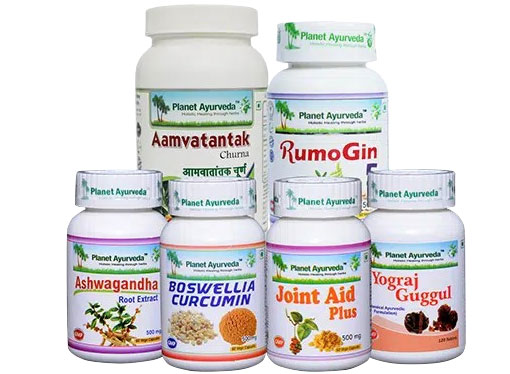
A reputable and well-known producer of pure herbal medications, Planet Ayurveda is a herbal pharmaceutical firm. The business creates herbal medications made entirely of plants. The business is well recognized for its remedies made with plant extracts. There are no adulterants or contaminants in the formulations. There are some herbal treatments for rheumatoid arthritis available on Planet Ayurveda.
- Boswellia+curcumin
- Aamvatantak Churna
- Ashwagandha Capsules
- Joint Aid Plus
- Rumogin 5 Capsules
- Yograj Guggul

Product Description
1. Boswellia+curcumin
This is the formation of Planet Ayurveda, which consists of shallaki (Boswellia serrata) and curcumin (Curcuma longa) as the main ingredients. An herbal extract from the Boswellia serrata tree is called boswellia, often known as Indian frankincense. People with specific medical issues may benefit from it and it may also help reduce inflammation. Boswellia seems to be efficient at lowering inflammation, which means that it may also lessen the signs and symptoms of RA. Boswellia is a potent anti-inflammatory and potent analgesic, and it might stop cartilage loss. Curcumin is useful in the treatment of rheumatoid arthritis. Curcumin supplements help reduce rheumatoid arthritis patients’ clinical symptoms and levels of inflammation.
Dosage : After meals, take 1 capsule twice a day with a glass of water.
2. Aamvatantak Churna
This is an amazing preparation of Planet Ayurveda, which consists of Ashwagandha (Withania somnifera), Methi (Fenugreek), Suranjan (Autumn crocus), and many others. This plant is the source of the medication “Colchicine,” which is used in contemporary medicine to reduce the synthesis of uric acid. It naturally lessens joint pain and inflammation. This herbal powder is a very effective natural remedy for rheumatoid arthritis and other types of joint pain since it is used in aamvatantak churna. It also acts like a great immune booster.
Dosage : Half to one teaspoon Per day, after meals, with plain water, aloe vera juice, or kumari saar.
3. Ashwagandha Capsules
This is a single herbal formulation that is formulated by Planet Ayurveda and consists of only Ashwagandha (Withania somnifera) as the main ingredient. Ashwagandha works as a painkiller by obstructing the central nervous system’s transmission of pain signals. Additionally, it might have some anti-inflammatory qualities. These are used as rasayanas in neurological disorders.
Dosage : After each meal, take 1-2 capsules with a glass of water.
4. Joint Aid Plus
This is a Planet Ayurveda’s patent medicine that contain Ashwagandha (Withania somnifera), Nirgundi (Vitex negundo), Guggul (Commiphora mukul), and Shallaki (Boswellia serrata), among others. These capsules assist in preserving strong bones and joints. Additionally, the anti-inflammatory components in these capsules aid in reducing joint swelling and irritation. Both acute and long-term arthritis can benefit from it.
Dosage : Twice daily, take 1-2 capsules with a glass of water after meals.
5. Yograj Guggul
Guggul (Cammiphora mukul), Chitrak (Plumbago zeylanica), Jeerak (cumin seeds), and many other traditional Ayurvedic ingredients are found in this product from Planet Ayurveda. It is very beneficial for the treatment of rheumatoid arthritis. The disc tissue can be regenerated by it. Yograj guggul also possesses anti-inflammatory properties that can aid in pain alleviation. Yogaraj Guggul, in particular, manages diseases brought on by an imbalance of the Vata and Kapha doshas. It should be taken for neurological conditions, ankylosing spondylitis, non-healing wounds, liver problems, and conditions involving the spleen. It effectively eases joint pain.
Dosage : Use two pills twice daily as directed.
6. Rumogin 5 Capsules
This is an amazing preparation by Planet Ayurveda, which consists of Haridra (Curcuma longa), Sonth (Zingiber officinale), Shallaki (Boswellia serrata), Maricha (Piper nigrum), and Pippali (Piper longum). In addition to providing pain relief for the joints, rumogen-5 also helps to lessen joint-related edema. When treating rheumatoid arthritis morning stiffness, rumogon-5 capsules are highly helpful.
Dosage : Once or twice a day, take 1-2 capsules.
Contact Planet Ayurveda Support Team to provide you the costing/ordering and delivery information at – costing.planetayurveda@gmail.com or Call at 0172-521-4040 (India), +91-172-521-4040 (Outside India) or Whatsapp at (+91) 842-749-4030.
Conclusion
When identifying Amavata, the two primary pathogenic factors, Ama and Vata, were taken into account. Material that is unripe, uncooked, and undigested due to Agni’s dysfunction is referred to as ama. Amavata is described in several ancient Ayurvedic textbooks, but after the mediaeval age, it started to dominate and is now a very common and dreadful illness. Rheumatoid arthritis (RA) is a symmetrical, chronic inflammatory autoimmune disease that first affects the skin, eyes, heart, kidneys, and lungs before progressing to larger joints. Planet Ayurveda is the platform where anyone can find their solutions regarding any disease. For more information, visit the official website of Planet Ayurveda.