Author: Dr. Vikram Chauhan

Ayurvedic Treatment for Thyroglossal duct cyst

Abstract

Thyroglossal duct cyst is a congenital abnormality that is mostly associated with the hyoid bone. According to the medical surveys and reviews, the cysts in around 21% of patients globally felt only pain as a symptom and 41.6% are found with painless cystic swelling. This usually turns into malignant form if left untreated. In some cases, it becomes necessary to remove the cyst surgically in order to prevent the reoccurrence of thyroglossal duct cyst. Presently, no doubt modern pharmacy is preferred in emergency situations but leads to adverse side effects. In order to avoid the side effects and managing the symptoms naturally people need to change the mode of treatment and naturally improves the quality of life.

What is the Thyroglossal duct cyst?

Thyroglossal duct cyst (TDC) is a common type of cyst that occurs in the neck region and the thyroglossal duct is embryological anatomy located in between the anterior and posterior part of the tongue. This part forms a connection between the thyroid and the base of the tongue. According to the literature reviews, the prevalence of this developmental disorder is about 7% population globally and 1% among them found out to be malignant. This can have equal chances of affecting males and females both. These kinds of cysts

Thyroglossal duct cyst

What are the signs and symptoms of Thyroglossal duct cyst?

Thyroglossal cysts are mostly palpable fibrous mass and non-tender which grows up to 2-4 cm in diameter and can eventually increase in size.

Some of the noticeable signs are as follows

  • Swelling along with pain
  • Redness in an area where swelling occurs
  • Tenderness
  • Recurrent discharge from cyst and swelling after sometime
  • Deglutination (painful)
  • Movement while swallowing (3)
  • Breathing problem
  • Small seizures or opening with mucous drainage
  • Recurring infections in the respiratory tract
  • Dysphagia
  • Dyspnoea (1)

What are the causes of Thyroglossal duct cyst?

After the fertilization when organogenesis starts in an embryo, the development of the thyroid gland starts at the base of the tongue and moves down through the Thyroglossal duct. But abnormality occurs when this results in the formation of a pocket-like structure called a cyst. These cysts are fibrous structures lined by respiratory and squamous epithelium. In some cases, ectopic thyroid tissue can be seen usually within the cyst wall. These cysts are mostly asymptomatic and can occur as an abscess.

Diagnosis

The physical and clinical aspects which confirm the cyst formation are as follows

  • Ultrasonography neck (USG)
  • Computerized tomography (CT)of the neck
  • Thyroidprofiling
  • Radioisotope scan
  • Blood tests
  • Magnetic resonance imaging (MRI)
  • Fine needle aspiration

What are the complications that may occur?

Sometimes there are few chances that even after treatment this may cause certain adverse complications like a reoccurrence of serious infections, excision, problem in breathing and swallowing, harshening of voice, etc. it may also lead to some serious disorders like thyroglossal fistula and thyroglossal cyst carcinoma.

Ayurvedic perspective of Thyroglossal duct cyst

According to the Ayurvedic concept, vitiated Tridosha results in the onset of the ailment. Cysts formation occurs due to aggravated Kapha dosha because this imbalance makes it difficult for the body in detoxification. This ultimately causes toxins or irritants surrounded by fluid that leads to cysts formation in the body. Some of the Indian Ayurvedic herbs which can manage the disorder naturally and dissolve the cysts are Kachnaar, Fenugreek, Curcumin, Manjistha, etc.

Best alternative natural treatment for Thyroglossal duct cyst by Planet Ayurveda
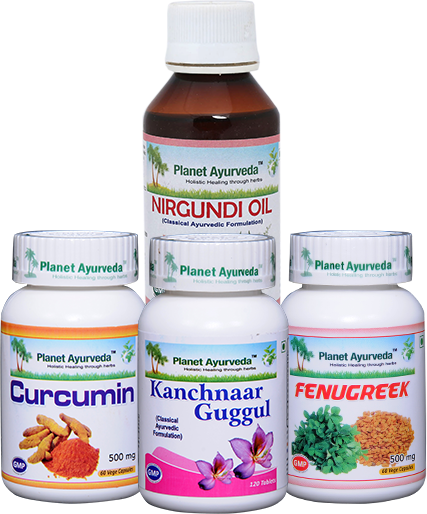
Ayurvedic Treatment for Thyroglossal Duct Cyst

Planet Ayurveda provides the best herbal management for Thyroglossal duct cyst with the following products

Kachnaar Guggul tablets

Kachnaar guggul is a Planet Ayurveda’s classical Ayurvedic formulation that contains enormous medicinally important herbs like

  • Kachnar bark (Bauhinia variegate)
  • Amalaki (Emblica Officinalis)
  • Ginger (Zingiber officinale)
  • Haritaki (Terminalia Chebula)
  • Bibhitaki (Terminalia bellerica)
  • Black pepper (Piper nigrum)
  • Pippali(Piper longum)
  • Varuna (Crataeva religiosa)

Benefits

These herbs in combination work synergistically in managing fibroids, ovarian cysts, goiter, fistula, etc. This product gives excellent results in treating benign and malignant cancers by maintaining healthy cells and tissues.

Dosage-2 tablets two times a day with plain water.

Fenugreek capsules

Fenugreek capsules have been manufactured with the standardized extract of high-quality Fenugreek/ Methika (Trigonella foenum-graecum)

Benefits

Methi works exceptionally in terminating cysts formation because of its tremendous phytochemical and chemical constituents like Gitogenin, tigogenin, Vitamin A, C and K, zinc, magnesium, potassium, copper, etc. fenugreek shows excellent results in treating various disorders like diabetes, wounds, boils, abdominal pain, leucorrhea, anorexia, asthma, etc.

Dosage-1 capsule two times a day with plain water.

Curcumin capsules

Benefits

Curcumin (the active compound of turmeric) is being used in Ayurvedic medicines for years which is beneficial in treating various skin disorders, digestive disorders, etc. It possesses anti-cancer, anti-inflammatory,anti-bacterial and anti-microbial properties that make it efficient in managing symptoms of a tumor, inflammation, cysts, etc. Curcumin contains curcuminoids which help in neutralizing free radicals and induces apoptosis.

Dosage-1 capsule two times a day with plain water is recommended.

Nirgundi oil and Dashang lepa

Nirgundi oil has been processed with many herbs like.

  • Tila oil (Sesamum indicum)
  • Manjistha (Rubia cordifolia)
  • Nirgundi (Vitex negundo)
  • Kalihari (Gloriosa superba)
  • Haridra (Curcuma longa)

Benefits

This herbal oil has anti-inflammatory, anti-biotic, anti-pyretic, anti-arthritic etc. increasing its efficiency in balancing vitiated Vata and Kapha Dosha, leucorrhea, ulcers, etc. Vitex negundo(Nirgundi) in this formulation helps ease pain, skin disorders, and increasing appetizer. It is recommended to use it with Dashang Lepa that is composed of Shiris, Yashtimadhu, Tagar, Rakta Chandan, Elaichi, Jatamansi, Haridra, Daruharidra, etc.

How to use it

Mix Nirgundi oil with Dashang lepa and apply externally.

What are the benefits of preferring Planet Ayurveda for the best herbal treatment?

  • Treatment and products will have any kind of side effects.
  • 100% pure, vegetarian and natural products
  • Maintains a healthy body naturally
  • All the products formulated and manufactured are free from chemicals, preservatives, additives, starch, fillers, colors, etc.
  • Production is done under the strict supervision of MD Ayurveda doctor and with high-quality herbs.

References

  1. https://www.ncbi.nlm.nih.gov/pmc/articles/PMC3077189/
  2. https://www.ncbi.nlm.nih.gov/books/NBK519057/
  3. https://www.ncbi.nlm.nih.gov/pmc/articles/PMC5305636/

What is Honeycombing of Lungs and its Best Alternative Treatment?

What is Honeycombing of Lungs?

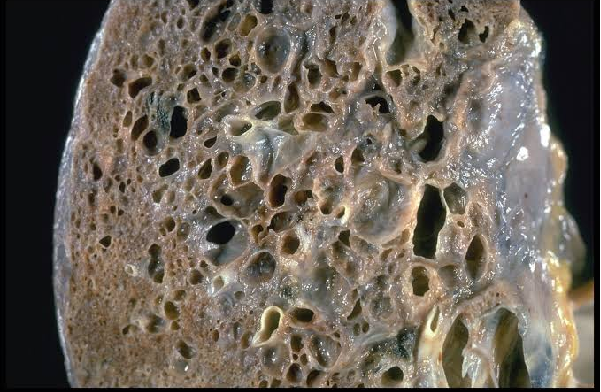
Honeycombing of lungs is also called honeycomb lungs. It is a radiological feature, seen with extensive fibrosis. Cystic air spaces with wide walls appear in this disorder. These air spaces are formed of fibrous tissue and are variable-sized, and irregular. Honeycomb cysts usually happen in the pleural or sub-pleural and peripheral regions of the lung areas.

Honeycombing of Lungs

The enlarged and expanded respiratory bronchioles and terminals produce cystic airspace that provides the appearance of honeycomb in the lungs as a result of chest x-ray or High-Resolution Computed Tomography (HRCT). These modifications are non-significant and are generally seen in the end-stage of many Interstitial Lung Diseases (ILDs).

Honeycombing of Lung is Divided into Two Types:

  1. Microcystic Honeycombing
  2. Macrocystic Honeycombing

1. Microcystic Honeycombing

It is a visual descriptor on HRCT (High-Resolution Computed Tomography) or CT which represents very small cysts that occur in the sub-pleural region in the patient of interstitial lung disease. It is commonly associated with Non-Specific Interstitial Pneumonitis (NSIP). If the size of the cyst is below 4 mm it is considered as Microcystic honeycombing.

2. Macrocystic Honeycombing

When the size of cysts is bigger than 4 mm it is considered as Macrocystic honeycombing. It is the morphological type of honeycombing. It is commonly associated with Usual Interstitial Pneumonia (UIP).

Interstitial Lung Disease (ILD) is a huge group of disorders that cause lung scarring known as fibrosis which leads to lung stiffness making it troublesome to breathe.

Examples of ILD:

  1. Idiopathic Pulmonary Fibrosis
  2. Non-Specific Interstitial Pneumonitis (NSIP)
  3. Interstitial pneumonia
  4. Hypersensitivity Pneumonitis
  5. Usual Interstitial Pneumonia
  6. Sarcoidosis and Asbestosis

The specific cause of interstitial lung disease (ILD) is not known. This may be due to some factors like chemical exposure, several medicines, family history, and some other diseases such as collagen disease, etc. The lung diseases get worse over time and at the end stage of the disease, they show the honeycombing appearance which is the cystic airspace in the lungs.

If a person with chronic lung disease does not get proper treatment on time, it becomes more severe and is recommended for lung transplantation. So, if you want to prevent your lungs from diseases and becoming a honeycomb lung then you should go for an alternative treatment which can treat it in an effective manner without affecting your health further.

What is the Alternative Treatment to Prevent the Honeycombing of Lungs?

If any treatment cures the disease at its roots and produces many side effects, it cannot be a good treatment. Therefore, it is better to go for an alternative treatment i.e. natural treatment which includes herbs that not only control the symptoms of the disease but also treat the root of the disease. These herbs do not cause any side effects rather they are beneficial for the health in many other ways.

Herbs to Prevent Honeycombing of Lungs

  1. Vasaka: It is a very effective herb for respiratory and lung disorders (3).
  2. Curcumin: This herb possesses numerous properties such as antioxidant, anti-inflammatory, chemotherapeutic properties, etc. (2)
  3. Tulsi: The herb helps to clear the lungs by purifying the air and is useful in lung diseases, like Sinusitis, bronchitis, and nasal congestion, etc. (1)
  4. Ginger: It helps to relieve respiratory diseases.
  5. Mulethi: It acts as an expectorant and holds bronchodilator activities that help to clean the respiratory tract.

These herbs are very effective individually, and also give a synergistic effect when used in combinations. Therefore, they are used in herbal formulations that are not only, more effective but also 100% pure and natural, without any added chemicals or preservatives as served by Planet Ayurveda.

Alternative Treatment for Honeycombing of Lungs by Planet Ayurveda

All the products of Planet Ayurveda are formulated under the direct supervision of highly qualified Ayurvedic practitioners. The herbal products provided for the treatment of Honeycombing of lungs are:

  1. Vasaka Capsules
  2. Tulsi Capsules
  3. Praanrakshak Churna
  4. Shwas Kuthar Ras

Product Descriptions

1. Vasaka Capsules

These capsules consist of pure extract of Vasaka (Adhatoda vasica) herb. Vasaka capsules are very beneficial in the treatment of lung diseases. This herb has expectorant and bronchodilator activities that help to clean the respiratory channels and promotes the healthy functioning of the respiratory system. So, these capsules also help to prevent the lungs from Honeycombing associated with interstitial lung disease (ILD).

Dosage: 2 capsules twice daily with water after meals.

2. Tulsi Capsules

Tulsi capsules are prepared by the standardized extract of Tulsi (Ocimum tenuiflorum), also known as Holy Basil. It is a wonderful herb that has medicinal properties to manage respiratory and lung complications preventing the formation of cystic airspace (honeycomb) in the patient’s lungs. It also possesses soothing and calming properties that help in easy and smooth breathing. It is a great antioxidant that promotes the healthy functioning of the lungs.

Dosage: 1 capsule twice daily with plain water after meals.

3. Praanrakshak Churna

This formulation from Planet Ayurveda is a blend of amazing herbs useful in lung diseases. The herbs included are Vasaka (Adhatoda vasica), Shirish (Albizia lebbeck), Bharangi (Clerodandrum serratum), Anantmool (Tylphora asthmatica),  Mulethi (Glycyrrhiza glabra), Kantkari (Solanum xanthocarpum), and Twak (Cinnamomum zeylanica).  This holds antioxidant properties which help to repair the lungs’ tissues and also encourages the transfer of oxygen throughout the blood. Praanrakshak Churna improves the functioning of the lungs and prevents Honeycombing. It is also effective in managing various conditions like cough, sneezing, Sinusitis, Rhinitis and others.

Dosage: 1-2 teaspoons thrice a day with plain water after meals.

4. Shwas Kuthar Ras

Shwas Kuthar Ras is a wonderful Ayurvedic formulation. It is a mixture of many ingredients including Shuddha Gandhaka (Purified Sulphur), Shuddha Parada (A Purified Mercury), Tankana Bhasma (Borax), Shuddha Vatsanabha (Purified Aconitum ferox), Manashila (Purified Realgar),  Pippali (Piper longum), Shunti (Zingiber officinalis), and Maricha (Piper nigrum). This formulation is very effective in various lung diseases like asthma, chronic bronchitis, dyspnea, etc.

Dosage: 2 tablets twice a day, before or after food.

Conclusion

From the above information, it is concluded that Ayurvedic treatment is the best alternative treatment to prevent and treat the lung diseases and formation of honeycombing in the lungs. Planet Ayurveda offers the best herbal products that naturally manage the condition of the lungs and do not even cause any side effect.

Reference

  1. https://www.nhp.gov.in/Raihan-Tulsi_mtl
  2. https://www.ncbi.nlm.nih.gov/pubmed/17569221
  3. http://www.jocpr.com/articles/indian-traditional-herbs-adhatoda-vasica-and-its-medicinal-application.pdf