Author: Dr. Vikram Chauhan

What is Honeycombing of Lungs and its Best Alternative Treatment?

What is Honeycombing of Lungs?

Honeycombing of lungs is also called honeycomb lungs. It is a radiological feature, seen with extensive fibrosis. Cystic air spaces with wide walls appear in this disorder. These air spaces are formed of fibrous tissue and are variable-sized, and irregular. Honeycomb cysts usually happen in the pleural or sub-pleural and peripheral regions of the lung areas.
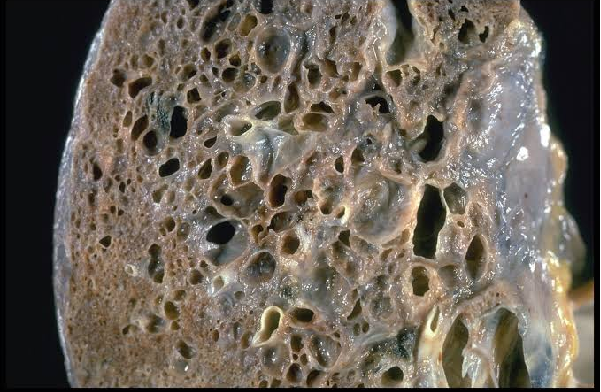
Honeycombing of Lungs

The enlarged and expanded respiratory bronchioles and terminals produce cystic airspace that provides the appearance of honeycomb in the lungs as a result of chest x-ray or High-Resolution Computed Tomography (HRCT). These modifications are non-significant and are generally seen in the end-stage of many Interstitial Lung Diseases (ILDs).

Honeycombing of Lung is Divided into Two Types:

  1. Microcystic Honeycombing
  2. Macrocystic Honeycombing

1. Microcystic Honeycombing

It is a visual descriptor on HRCT (High-Resolution Computed Tomography) or CT which represents very small cysts that occur in the sub-pleural region in the patient of interstitial lung disease. It is commonly associated with Non-Specific Interstitial Pneumonitis (NSIP). If the size of the cyst is below 4 mm it is considered as Microcystic honeycombing.

2. Macrocystic Honeycombing

When the size of cysts is bigger than 4 mm it is considered as Macrocystic honeycombing. It is the morphological type of honeycombing. It is commonly associated with Usual Interstitial Pneumonia (UIP).

Interstitial Lung Disease (ILD) is a huge group of disorders that cause lung scarring known as fibrosis which leads to lung stiffness making it troublesome to breathe.

Examples of ILD:

  1. Idiopathic Pulmonary Fibrosis
  2. Non-Specific Interstitial Pneumonitis (NSIP)
  3. Interstitial pneumonia
  4. Hypersensitivity Pneumonitis
  5. Usual Interstitial Pneumonia
  6. Sarcoidosis and Asbestosis

The specific cause of interstitial lung disease (ILD) is not known. This may be due to some factors like chemical exposure, several medicines, family history, and some other diseases such as collagen disease, etc. The lung diseases get worse over time and at the end stage of the disease, they show the honeycombing appearance which is the cystic airspace in the lungs.

If a person with chronic lung disease does not get proper treatment on time, it becomes more severe and is recommended for lung transplantation. So, if you want to prevent your lungs from diseases and becoming a honeycomb lung then you should go for an alternative treatment which can treat it in an effective manner without affecting your health further.

What is the Alternative Treatment to Prevent the Honeycombing of Lungs?

If any treatment cures the disease at its roots and produces many side effects, it cannot be a good treatment. Therefore, it is better to go for an alternative treatment i.e. natural treatment which includes herbs that not only control the symptoms of the disease but also treat the root of the disease. These herbs do not cause any side effects rather they are beneficial for the health in many other ways.

Herbs to Prevent Honeycombing of Lungs

  1. Vasaka: It is a very effective herb for respiratory and lung disorders (3).
  2. Curcumin: This herb possesses numerous properties such as antioxidant, anti-inflammatory, chemotherapeutic properties, etc. (2)
  3. Tulsi: The herb helps to clear the lungs by purifying the air and is useful in lung diseases, like Sinusitis, bronchitis, and nasal congestion, etc. (1)
  4. Ginger: It helps to relieve respiratory diseases.
  5. Mulethi: It acts as an expectorant and holds bronchodilator activities that help to clean the respiratory tract.

These herbs are very effective individually, and also give a synergistic effect when used in combinations. Therefore, they are used in herbal formulations that are not only, more effective but also 100% pure and natural, without any added chemicals or preservatives as served by Planet Ayurveda.

Alternative Treatment for Honeycombing of Lungs by Planet Ayurveda

All the products of Planet Ayurveda are formulated under the direct supervision of highly qualified Ayurvedic practitioners. The herbal products provided for the treatment of Honeycombing of lungs are:

  1. Vasaka Capsules
  2. Tulsi Capsules
  3. Praanrakshak Churna
  4. Shwas Kuthar Ras

Product Descriptions

1. Vasaka Capsules

These capsules consist of pure extract of Vasaka (Adhatoda vasica) herb. Vasaka capsules are very beneficial in the treatment of lung diseases. This herb has expectorant and bronchodilator activities that help to clean the respiratory channels and promotes the healthy functioning of the respiratory system. So, these capsules also help to prevent the lungs from Honeycombing associated with interstitial lung disease (ILD).

Dosage: 2 capsules twice daily with water after meals.

2. Tulsi Capsules

Tulsi capsules are prepared by the standardized extract of Tulsi (Ocimum tenuiflorum), also known as Holy Basil. It is a wonderful herb that has medicinal properties to manage respiratory and lung complications preventing the formation of cystic airspace (honeycomb) in the patient’s lungs. It also possesses soothing and calming properties that help in easy and smooth breathing. It is a great antioxidant that promotes the healthy functioning of the lungs.

Dosage: 1 capsule twice daily with plain water after meals.

3. Praanrakshak Churna

This formulation from Planet Ayurveda is a blend of amazing herbs useful in lung diseases. The herbs included are Vasaka (Adhatoda vasica), Shirish (Albizia lebbeck), Bharangi (Clerodandrum serratum), Anantmool (Tylphora asthmatica),  Mulethi (Glycyrrhiza glabra), Kantkari (Solanum xanthocarpum), and Twak (Cinnamomum zeylanica).  This holds antioxidant properties which help to repair the lungs’ tissues and also encourages the transfer of oxygen throughout the blood. Praanrakshak Churna improves the functioning of the lungs and prevents Honeycombing. It is also effective in managing various conditions like cough, sneezing, Sinusitis, Rhinitis and others.

Dosage: 1-2 teaspoons thrice a day with plain water after meals.

4. Shwas Kuthar Ras

Shwas Kuthar Ras is a wonderful Ayurvedic formulation. It is a mixture of many ingredients including Shuddha Gandhaka (Purified Sulphur), Shuddha Parada (A Purified Mercury), Tankana Bhasma (Borax), Shuddha Vatsanabha (Purified Aconitum ferox), Manashila (Purified Realgar),  Pippali (Piper longum), Shunti (Zingiber officinalis), and Maricha (Piper nigrum). This formulation is very effective in various lung diseases like asthma, chronic bronchitis, dyspnea, etc.

Dosage: 2 tablets twice a day, before or after food.

Conclusion

From the above information, it is concluded that Ayurvedic treatment is the best alternative treatment to prevent and treat the lung diseases and formation of honeycombing in the lungs. Planet Ayurveda offers the best herbal products that naturally manage the condition of the lungs and do not even cause any side effect.

Reference

  1. https://www.nhp.gov.in/Raihan-Tulsi_mtl
  2. https://www.ncbi.nlm.nih.gov/pubmed/17569221
  3. http://www.jocpr.com/articles/indian-traditional-herbs-adhatoda-vasica-and-its-medicinal-application.pdf

Ayurvedic Treatment For Multiple System Atrophy (MSA)

The term Atrophy refers to wasting away of cell components or tissues ultimately deteriorating the affected part of the body decreasing its functions. Multiple System Atrophy, therefore as it may clearly imply is the condition that involves atrophy of multiple systems of the body. Basically, it is a progressive neurological condition that involves atrophy of the cerebellum, brainstem, and basal ganglia which play an essential role in the regulation of internal autonomic functions of the body; thereby affecting body’s involuntary (autonomic) functions, including blood pressure, breathing, bladder function and muscle control.

Multiple System Atrophy (MSA) 600

Impaired balance, movement difficulty, muscle rigidity, poor coordination, bladder dysfunction, sleep disturbances, and poor blood pressure control are the characteristic symptoms of the disorder which are more or less like other neurological conditions like parkinsonism’s . However, patients with MSA typically show symptom onset at a younger age, with the average onset in the early 50s in contrast to patients with Parkinsonism’s. It is imperative to understand that patients with this condition can never be cured completely, only symptoms be improved as this rare disorder slowly eats away the neurological control. Therefore, medications and lifestyle changes are helpful in the management but cannot revert the condition back to normal.

Causes of Multiple System Atrophy (MSA)

The disorder which was first known as Shy-Drager Syndrome is believed to be a “sporadic,” implying that there are no genetic or environmental factors identified that cause the disease, the exact cause is still unknown. The probability of genetic inheritance is also very rare.
However, identification of a protein called alpha-synuclein in the cells that support neural cells and more specifically in ‘oligodendroglia’, a cell which forms a coating on nerve cells to enable them to speedily conduct electrical signals is a distinguishing feature of MSA. Studies show the possibility of α-syn causing disruption in the support and maintenance of the neurons &altered neurotrophic factor levels

Symptoms of Multiple System Atrophy (MSA)

The initial clinical symptoms are lightheadedness, dizziness, and episodes of passing out when the patient sit up or stand up – a condition c termed as a postural neurogenic orthostatic hypotension (NOH), a kind of low blood condition.

The other general characteristics symptoms are

  • Difficulty Initiating Movement.
  • Body Stiffness.
  • Urinary Incontinence
  • Increased Falls.
  • Slowness of Movement
  • Lack of Coordination
  • Tremors
  • Impaired Speech
  • A Hoarse, Quivering Voice
  • Constipation And Loss of Bladder Control
  • Reduced Production of Sweat, Saliva And Tears
  • Sexual Dysfunction Like Loss of Libido
  • Irregular Heartbeat
  • Difficulty in Controlling Emotions.

MSA in Contrast to Parkinsonism

  1. MSA affects several areas of the brain, including the cerebellum, the brain’s balance and coordination centers, and the autonomic nervous system whereas Parkinsonism is the imbalance of neurotransmitter Dopamine in the brain.
  2. Parkinson’s disease only affects the dopamine-producing neurons of a motor-controlling portion of the brain known as the nigro-striatal area whereas MSA on the other hand affects both neurons and glial cells.
  3. Onset of symptoms of MSA is in early 50s whereas Parkinson’s have no definite age.
  4. Changes to a person’s speech such as low pitch or quivering voice is also evident and absent in a patient with Parkinson’s

Types of Multiple System Atrophy (MSA)

MSA is characterized into two main subtypes based on the predominant symptom

1. MSA-Predominant Parkinsonism (MSA-P)

  • The most common symptoms in MSA-P are more similar to Parkinson’s disease, hence the designation.
  • This condition may respond to medications used for Parkinson’s disease; however, MSA-P tends to progress more rapidly than Parkinsonism.

2. MSA-Predominant Cerebellar Ataxia (MSA-C)

  • Patients are present with symptoms that affect the cerebellum, which plays a role in synchronizing motor movement.
  • Those who have this condition may look like intoxicated with alcohol, as they have difficulty in coordinating walking, hand movements, speech, and eye movements.

Diagnosis of Multiple System Atrophy (MSA)

There is no specific test to diagnose Multiple System Atrophy (MSA), however, doctors rely on a combination of symptom history, physical examination, and laboratory tests to evaluate the motor system, coordination, and autonomic function to arrive at a probable diagnosis.

  • Magnetic Resonance Imaging (MRI) measures activity levels in the brain and can demonstrate areas of impaired brain function.
  • Positron Emission Tomography (PET scan)
  • DaTscan.
  • Evaluation of a particular type of protein molecule, known as ABCA8, could provide a causative explanation and a screening tool for MSA.

Managing Multiple System Atrophy (MSA) With Ayurveda

Managing symptoms of Multiple System Atrophy (MSA) is the only way out to improve the condition of patients so as to allow them to carry out day-to-day activities. According to Ayurveda, this condition involves an imbalance of the ‘Vata’ energy of the body. The deranged ‘Vata’ energy cause slow and progressive damage to most parts of the sufferer’s body. Therefore, herbal formulations prepared from pure and natural herbs can effectively help to balance the body and improve the condition in many positive ways.

Following herbal formulations benefit the patients with Multiple System Atrophy (MSA) in managing the severity of illness:

Herbal Supplement for Multiple System Atrophy (MSA)(1)
buy now

1. Brahmi Capsules

Ingredient: Prepared from standardized extract of ‘Brahmi’ (Bacopa Monnieri) herb.

Benefits:

  1. Improves brain function and boosts memory
  2. Manages blood pressure, stress and anxiety
  3. Antioxidant properties keep the body healthy

Recommended Dosage: Two capsules with plain water two times a day, after meals.

2. Arjuna Capsules

Ingredient: Formulated using the bark extract of the ‘Arjuna’ herb (Terminalia Arjuna)

Benefits:

  1. Manage heart problems and other potential metabolic diseases
  2. Treat high cholesterol, blocked coronary arteries, blood pressure, high triglycerides, and effectively manages congestive heart failure.

Recommended Dosage: 1-2 Capsules twice daily, with plain water, after meals.

3. Gotukola Capsules

Ingredient: Herbal extract prepared from (Centella Asiatica) is an excellent herb for balancing the body’s three energies — Vata, Pitta, and Kapha.

Benefits:

  1. Balance the psychic energies of the body Satva, Rajas and Tamas
  2. Improve brain health, promote healthy blood circulation and maintain healthy metabolism
  3. Proven efficacy in management of depression, anxiety, and stress.

Recommended Dosage: 1-2 capsules two times a day with plain water, 30 minutes after meals.

4. Ashwagandha Capsules

Ingredient: Contains standardized extract of ‘Ashwagandha’ herb (Withania Somnifera), provide relaxation to the muscles and enhance mental capabilities.

Benefits:

Helpful in manging nervous breakdown, ageing, anxiety, stress, palpitations, and debilitating disorders.

Recommended Dosage: 1 capsule with plain water two times a day.

5. Curcumin Capsules

Ingredient: Prepared from pure and natural extracts of the ‘Haridra’ herb (Curcuma Longa), a herb commonly known as turmeric or haldi.

Benefits:

  1. Contains a bioactive compound called as Curcumin which tends to balance the three psychic energies of the body.
  2. Improves Postural instability

Recommended Dosage: 2 capsules with plain water, twice a day.

6. Boswellia Curcumin Capsules

Ingredients: This contains pure and standardized extracts of traditionally important herbs like Shallaki (Boswellia Serrata) and Curcumin (Curcuma Longa).

Benefits:

These capsules are very beneficial in managing various disorders like strains, inflammation, arthritis, sports injuries, etc.

Recommended Dosage- 1 capsule two times a day with plain water after meals.

7. Hakam Churna

Ingredients: Kalonji (Nigella sativa), Methi (Trigonella Foenum-Graceum), Ajwain (Trachyspermum Ammi)and (Lepidium Sativum).

Benefits:

This herbal supplement works efficiently in reducing symptoms of liver diseases, diseases caused due to inflammation, digestive ailments, etc.

Recommended Dosage: It is recommended to take 3-5gm with hot water two times a day.

8. Shilajit Capsules

Ingredients: Shilajit (Asphaltum)

Benefits:

Planet Ayurveda has formulated with pure purified and natural extracts of Shilajit which makes it beneficial in rejuvenating brain cells, increasing metabolism and cell regeneration.

Recommended Dosage: 2 capsules two times a day with plain water or milk after meals.

9. Giloy Capsules

Ingredients: Giloy (Tinospora Cordifolia)

Benefits:

This product is beneficial in treating urinary infections, Idiopathic thrombocytopenic purpura (ITP), weakness and manages blood platelets count naturally.

Recommended Dosage: 1-2 capsules two times a day with plain water after meals.

Conclusion

Ayurvedic formulations can be extremely beneficial for Multiple System Atrophy (MSA) patients in coping with their degenerative condition, and also in the prevention of some possible complications like breathing abnormalities while sleeping, breakdown of skin due to progressive immobility, injuries from falls resulting from poor balance, difficulty in swallowing, and vocal cord paralysis.

Contact Planet Ayurveda Support Team to provide you the costing / ordering and delivery information at – costing.planetayurveda@gmail.com or Call at 0172-521-4030 (India), +91-172-521-4030 (Outside India) or Whatsapp at (+91) 9915-593-604.